@0xLuciferCore 95? Move the bottom vertical from the six to the top of the 4. That maintains traditional style. For an unconditional look, 96 taking the top of the six and moving it to the top of the four, but they would be different “fonts”.
The BONUS Texas Quote of the Day is so great but needs a little historical background. In 1822, nine year-old Robert Hancock Hunter moved to Texas with his family. His account of what they encountered is utterly classic. Here it is, exactly as he wrote it, misspellings and all:
"I, R. H. Hunter, was born May first 1813 in Ohio in a little town Circleville in Pickaway Planes. I was a bout 4 years old when Father moved to Missouri, & in April 1822 come to Texas & on the 7th day of April we landed in San Jacinto Bay. We came a round by water in a small boat or a scow.
As we were sailing a long the coast, we spide a small boat on the beach, & went in shore at the Mouth of the Mamantough. There we stade 5 or 6 days, & fixt up the little schooner & we corked her up tite, put in the old mast that was broke down, & pute in something to eat that day, & tied our little Scow be hinde & set sale for Galveston with all of our goods & chattels in the Scow. While out a peace, a south east gale blowed up, & we come on untill a bout 8 or 9 oclock, when our scow broke loos & went a shore, & we come on to the mouth of what is now cald Taylors Bayou. There we campt. I Father & Jack our Saylor, went back to git the Scow.
When tha got there, Old Yokham & a bout 30 men was there, & no scow, & the men all drunk on Pa's rum. He had a barrel of Rum on the scow, & he had to come a way the best he could, & got nothing. He lost every thing we had. Pa got back the next evening. He was gon two days, & we had nothing to eat. Jack kild an aligator, & rosted the tale, & we eat it, & not a drop of water to drink. Pa saved 4 trunks out of the scow, & in one of them was a bolt of domestic. Pa took it, & spread it out on the grass, and got it wet with due, & rung it in a bucket & that saved us untill we got to Galveston that evening.
When we got to Galveston we found 5 large emagrant ships laying at ancor in the harber. Capt John Roch & his big black ship was laying at ancor. He fiard a cannon to bring us too. When Pa came to Texas in 1821, he got acquainted with old man Anson Taylor on the Trinity & old man Taylor was on Capt Rochs ship, & knew Pa, & with his speaking trumpet cald us a long side & Capt Roch let down a chir & took us a board. Us little ones, was hungry. We had not eat anything for 3 days but the aligator tall. The Cook was at the Caboos a cooking. He had a pot of rice seting by. The old irishman ast us if we were not hungery, & we the children told him yesser. He gave us some spoons, & we piched in to the rice. Pa came around & seen us, children children what are you doing there. The old irishman hollered out, let them a lone, I put them thare. Tha are hungery let them eat. That rice et good. We stade with Capt Roch that night."
------- Robert Hancock Hunter, "The Narrative of Robert Hancock Hunter," 1860.
Shown here: Robert Hancock Hunter, bottom right, with his three brothers circa 1885. They are wearing campaign ribbons.
The Arcane Texas Fact of the Day:
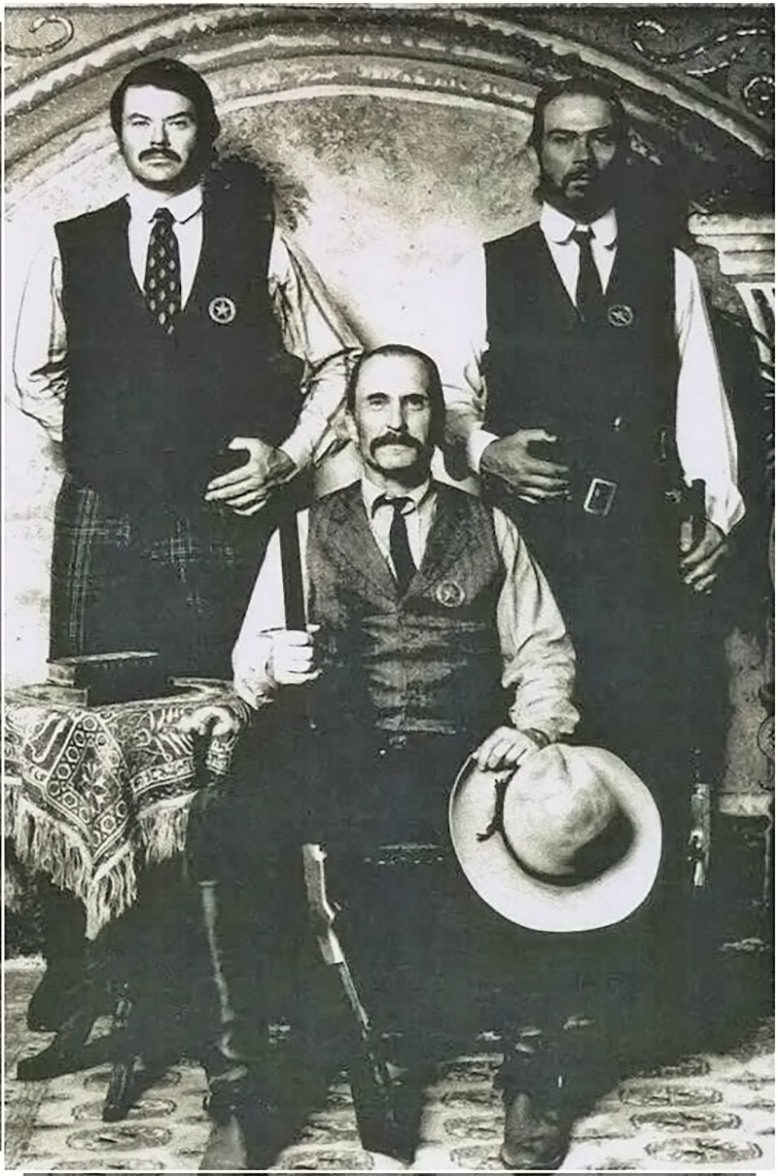
Robert Duvall patterned his mannerisms, voice, and gestures for the part of Gus McCrae in "Lonesome Dove" from Sammy Baugh, the hall-of-fame quarterback from Temple, Texas.
Said Duvall, "About a month before we started filming, I looked up a classmate, a rancher near Rotan, and he took me to see Sammy Baugh. I thought, 'Wow.' My dad had taken me to see him play with the Washington Redskins when I was ten years old. But he must have been seventy when I met him, and he didn’t even know who I was. We talked for hours about football and his life, and he just seemed to me like an old, tall Texas Ranger. So that’s where I got my gestures and voice and everything (for Gus McCrae), watching and listening to Sammy Baugh."