Do you work on surface MRI such as HCP data? Our paper is finally out in Imaging Neuroscience, showing biases in surface fMRI. The revised ms has many new insights!
TLDR: Vertices are much closer to each other in sulci, resulting in (fake) high spatial autocorrelation. (1/5)
New paper in Imaging Neuroscience by Jayson Jeganathan, Michael Breakspear, et al:
Spurious correlations in surface-based functional brain imaging
https://t.co/EyNE1RBrCg
@GianDuma This specific issue of mapping onto an irregular surface mesh is likely not relevant to MEEG. But you can have a different gyral bias in MEEG as you outlined
Do you work on surface MRI such as HCP data? Our paper is finally out in Imaging Neuroscience, showing biases in surface fMRI. The revised ms has many new insights!
TLDR: Vertices are much closer to each other in sulci, resulting in (fake) high spatial autocorrelation. (1/5)
I'm proud of this work, and I hope this paper helps you to avoid spurious conclusions in your work. Check out the full paper (https://t.co/dQtJjKVEcK) for a detailed breakdown and for other downstream analyses that can be impacted (FC fingerprinting, hyperalignment, etc). (5/5)
1/12 How do animals build an internal map of the world? In our new paper, we tracked thousands of neurons in mouse CA1 over days/weeks as they learned a VR navigation task. @nspruston@HHMIJanelia, w/ co-1st author @JohanWinn
Video summary: https://t.co/mMvsT8TVc9
Paper: https://t.co/35k5tWdvOe
In markets, there are price bubbles. In science, are there popularity bubbles? When promising research gets hyped up, it can lead to a burst of activity followed by a dramatic collapse, shows huge bibliometric study @Nature Magazine https://t.co/lHxeFJqriM
Wow. Most recent openAI model o3 smashes the prev leaderboard for ARC-AGI reasoning challenge. It is also now the 175th best coder in the world (CodeForces challenge), and can solve 25% of hard-for-humans FrontierMath Qs (up from 2%). What does this all mean?
I've combined some of these together into a new #neuro#visualization "In the eye of a fly":
Using the @FlyWireNews visual system wiring diagram, #Brian2 spiking #neuron simulator, and #blender. Information flow through the chiasms, across a topographic map.
@PessoaBrain My priors had brains quite close to artificial neural networks. Guess that's why I'm surprised. Also it's astounding that neurons can learn and rewire on such short time frames
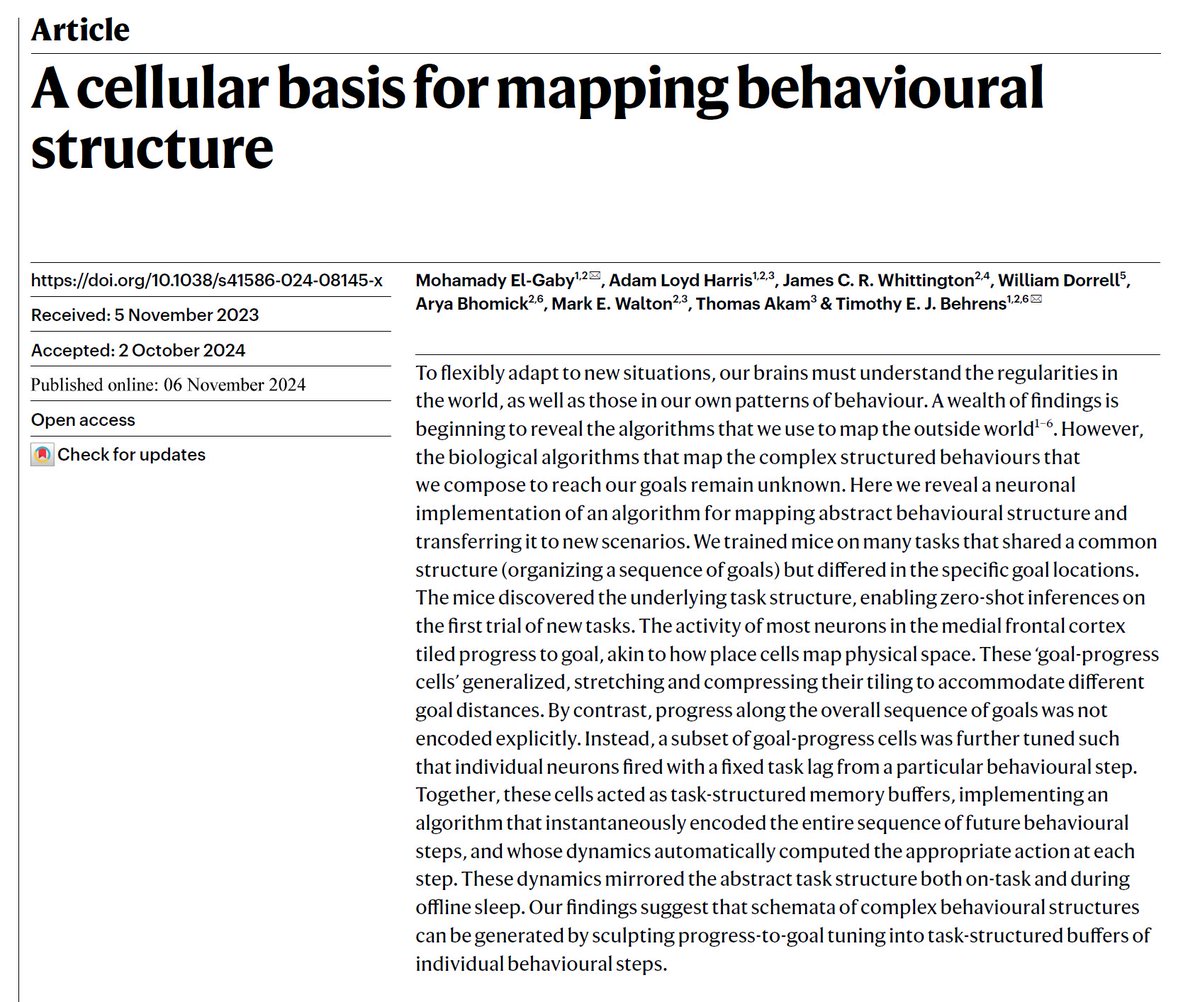
𝗛𝗼𝘄 𝘀𝗵𝗼𝘂𝗹𝗱 𝗼𝗻𝗲 𝗱𝗼 𝘀𝘆𝘀𝘁𝗲𝗺𝘀 𝗻𝗲𝘂𝗿𝗼𝘀𝗰𝗶𝗲𝗻𝗰𝗲??
This way! Every neuro program should just make this required reading and teach students how to do outstanding science like this.
https://t.co/cIjGhFzWDN
@DrYohanJohn In original transformer paper, it was for translation. The Wq could be applied to an English token, and the Wk to a Spanish token. In the cross attention layers of multimodal foundation models, Wq and Wk could be applied to text and visual input respectively