This past week, on a test bed in Britain, a Rolls-Royce jet engine ran at full take-off power on pure hydrogen, putting out water vapour instead of carbon.
Nobody on Earth had managed it before. It is the sort of thing that ought to stop the country in its tracks, and it will be forgotten by the weekend.
Leave aside the recent paroxysms of renewed net-zero insanity from Derelict Ed and the pervasive atmosphere of offended envy that greets much homegrown achievement nowadays in Britain. This engineering is a wonder, and it's British to the bone.
We gave the world the jet engine in the first place - Frank Whittle, a Coventry man and an RAF officer, patented it in 1930 while the Air Ministry assured him it was a curiosity. Rolls-Royce is today one of perhaps three firms anywhere that can build a large aero engine at the outer edge of the possible, and it has just done what most of the industry swore was twenty years away.
As usual, you marvel at how little the people who govern us had to do with it. The engineers in Derby are world-class; the stewardship above them is third-rate. They pulled off a global first while paying the most expensive industrial electricity in the developed world to keep the power on over the bench - a weight no German, American or Gulf rival has to carry. We produce frontier brilliance on the shop floor and fritter it away at the despatch box, and we have done for two generations.
That is the maddening shape of modern Britain: brilliance from below, sub- (or, indeed, ultra-) mediocrity from above. The people here who actually make things are still among the best in the world; the state that is meant to back them treats a firm like Rolls-Royce as a photocall today and a takeover target tomorrow, and prices its energy as though it would prefer the next plant were built in Texas.
Progress starts from the other end. Give these people what every rival government gives its champions and we beg ours to do without: the cheap, abundant power their competitors already enjoy, a supply chain built around them, and a state that guards a national asset rather than auctioning it. The hard part of a British revival - the talent, the nerve, the engineering - is already done, and was done again this week, by people who deserve a far better country than the one currently sitting above them.
We just taught an engine to breathe fire and exhale water. The least we owe the men and women who managed it is a government and a state as brilliant as they are.
Carl Sagan in 1995: "If we are not able to ask skeptical questions, to interrogate those who tell us that something is true, to be skeptical of those in authority, then we're up for grabs for the next charlatan, political or religious, who comes ambling along." He died in 1996.
Another one by him:
“One of the saddest lessons of history is this: If we’ve been bamboozled long enough, we tend to reject any evidence of the bamboozle. We’re no longer interested in finding out the truth. The bamboozle has captured us. It’s simply too painful to acknowledge, even to ourselves, that we’ve been taken. Once you give a charlatan power over you, you almost never get it back.”
"It's easier to fool people than to convince them they've been fooled." - Mark Twain
@GaelYeomans ¡La escuela de Gonzalo Winter!
Él no sabía el presupuesto de la Nación, ahora G. Yeomans, estando en la Comisión de Hacienda, inventa un recorte de 413 mil millones de dólares. No saben usar una calculadora, legislan al peo. No hay caso con estos flojos marxistas!
30 anos.
Por 30 anos o PC foi a mesma coisa: Intel ou AMD dentro, GPU do lado, e torce pra não travar.
A NVIDIA acabou com isso numa keynote.
RTX Spark. Primeiro chip deles para computador pessoal. CPU, GPU e memória num único silício. ARM, 3nm, 1 petaflop de IA local.
Num laptop de 14mm.
Rodou Forza Horizon 6 e 007 First Light no palco a 100 FPS em 1440p. Fora da tomada. Sem throttling. No Windows.
O número que muda tudo: roda modelos de IA de 120 bilhões de parâmetros sem cloud. Sem API. Sem assinatura. Seu agente de IA mora na sua máquina. Ligado 24 horas. Só seu.
O PC não é mais uma tela com teclado. É uma estação de IA pessoal.
Voltaire passed away today in 1778.
There are two quotes of his I always come back to:
"I disapprove of what you say, but I will defend to the death your right to say it."
and
“Those who can make you believe absurdities can make you commit atrocities.”
"Hurt" is not an original by Johnny Cash. The song was written by Trent Reznor (Nine Inch Nails) in 1994 for the album The Downward Spiral. Rick Rubin had to insist several times on Cash recording his version, at first Johnny found the idea completely insane because the original version is industrial and noisy. At 71, already very ill, almost blind and with trembling hands, Cash completely transformed the band.
The iconic video, directed by Mark Romanek, was filmed at the House of Cash (his own museum). June Carter Cash appears looking at him fondly, the video was shot in February 2003, a few months before she died (May) and Johnny himself (September).
Trent Reznor was so moved that he declared, "This song is not mine anymore." It is considered one of the best covers of all time.
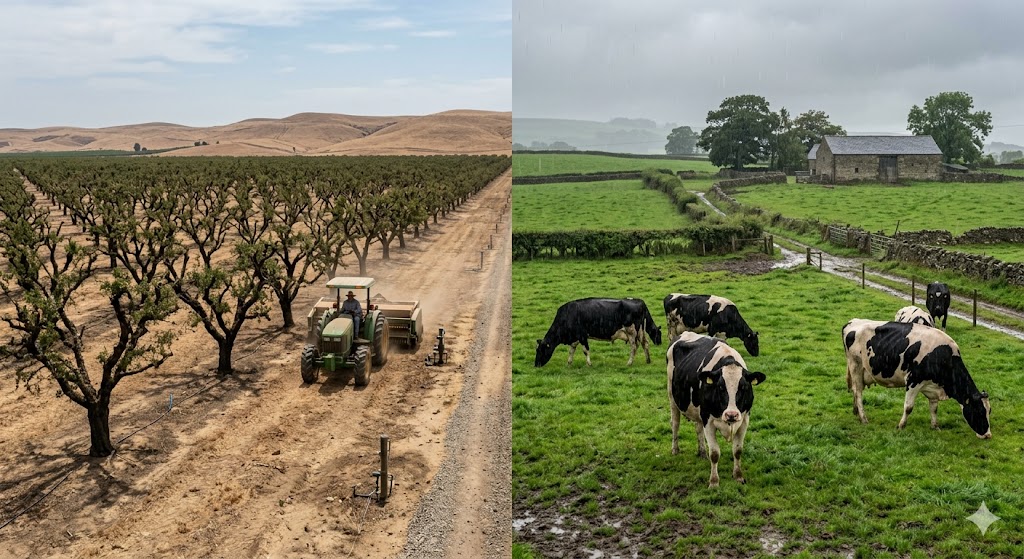
The funniest maths in modern environmentalism.
One almond requires 12 litres of irrigated water to produce. Peer-reviewed, ScienceDirect, 2017. A glass of almond milk contains roughly 50 of them. 600 litres of water before the carton is filled.
The water comes from the San Joaquin Valley in California, which sits over one of the most over-extracted aquifers on earth. The valley floor has subsided by up to nine metres in places due to groundwater depletion. The carton is then refrigerated, sailed across the Atlantic, refrigerated again, lorried to a Manchester Tesco, and bought by someone who is concerned about the environmental impact of dairy.
Meanwhile, in Cheshire.
A British dairy cow drinks roughly 70 to 100 litres of water a day and produces around 28 litres of milk. That's about 3.5 litres of water per litre of milk. The water is rainwater that fell on her field or came from a local stream fed by the same rainwater. The rain was going to fall on the field whether the cow stood in it or not. 80% of her moisture intake comes from the grass itself, which is also rain.
She converts the grass, free of charge, into a litre of milk containing seven times the protein and four times the calcium of almond milk, and shipped roughly 18 miles to the same Tesco.
To recap.
600 litres of stolen aquifer, flown halfway round the world for nutritionally worthless beige water.
Or 3.5 litres of rain that was already falling, converted by an animal you can pet, into actual food.
The shopper picks the almond.
She has been told this is the ethical position.
The aquifer would like a word.
That water clarity is an engineering decision, and the math behind it is wilder than the video.
Roman aqueducts ran on gravity alone. No pumps, no pressure systems. Engineers carved channels with a gradient so shallow it borders on absurd. The Pont du Gard in southern France drops 2.5 centimeters over 275 meters. That's roughly the thickness of a coin over the length of three football fields. They surveyed that accuracy with plumb lines and wooden leveling instruments.
The clarity you're seeing is a direct product of flow velocity. Too steep and the water erodes the channel walls, picks up sediment, turns brown. Too flat and it stagnates. Roman engineers targeted a slope of about 20 centimeters per kilometer, which kept the water moving fast enough to stay fresh but slow enough to stay clear. Before the water reached the city, it passed through multi-chamber settling tanks where velocity dropped near zero. Suspended particles sank. Clean water flowed out the top into the next chamber. Repeat three or four times.
Pliny specified the minimum slope in writing. Vitruvius published the exact mortar ratio for hydraulic cement: one part lime to two parts volcanic ash for underwater work. The pozzolana from Pozzuoli reacted with water to form a calcium-aluminum-silicate compound that actually gets stronger the longer it sits submerged. Modern concrete degrades in water. Roman concrete bonds with it.
Scale the whole system and it gets harder to process. Eleven aqueducts fed Rome at its peak. Combined output: roughly 1 million cubic meters of water per day. That works out to about 250 gallons per person for a city of one million. Modern New York delivers about 125 gallons per person per day. Ancient Rome had access to double the per capita water supply of the largest city in the United States, running entirely on slope and stone.
The Trevi Fountain in Rome is still fed by one of them. Two thousand years, same source, same gravity, same water.
Tiene razón. Bachelet introdujo nuevamente al PC a la política. Pero omite la razón por la cual llegamos a ser el 1er país de Latam. Chile no comenzó el día que ganó Aylwin.
A. Pinochet, entregó el mando de Chile con un crecimiento económico de un 10.4%.🇨🇱
🚨 Conservative MP Harriet Cross TORE into Labour’s energy policy in the House of Commons. 🔥
While Norway’s own Labour government is busy issuing new North Sea oil & gas licences and expanding drilling to secure its energy future, Britain’s Labour government has banned new licensing here at home.
The result? British workers fly to Norway for oil jobs, and we pay billions every year to import Norwegian gas from the very same North Sea basin we refuse to touch.
Harriet nailed it in the Commons:
We’re shutting down our own industry, exporting jobs and cash, and making ourselves more dependent on foreign energy, all in the name of “net zero” virtue signalling.
This isn’t environmental leadership. It’s national stupidity.
Quiero agradecer a mi equipo de campaña por haber realizado una rendición de gasto electoral impecable y sin observaciones. Esto da cuenta del profesionalismo y rectitud de todos quienes asumieron esta responsabilidad. Es un honor el tenerlos en nuestras filas. https://t.co/WWdzhV00dy