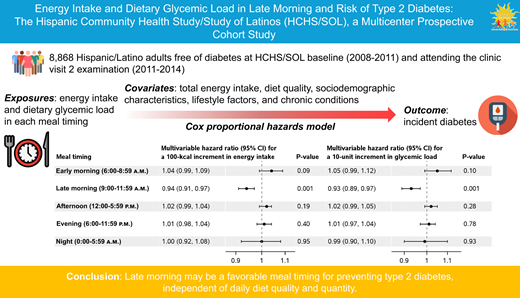
I'm thrilled to announce that my first dissertation paper has been published 😜! Our study suggests that late morning might be a beneficial eating time for reducing the risk of developing type 2 diabetes.
This cohort study of 8,868 U.S. Hispanic/Latino adults indicated that late morning might be a favorable meal timing for preventing type 2 diabetes independent of daily diet quality and quantity. @ADA_Pubs
Read Here➡️ https://t.co/gKYLPvCV8w
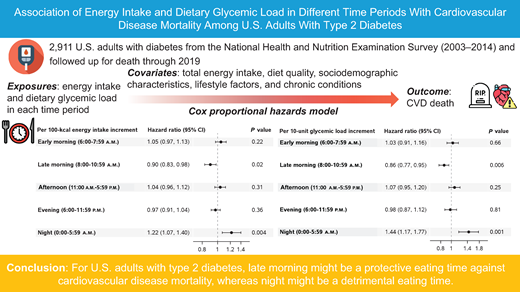
📢Check out our latest research investigating whether there is an optimal eating timing for managing cardiovascular disease risk in patients with type 2 diabetes‼️
For U.S. adults with type 2 diabetes, late morning might be a protective eating timing against cardiovascular disease mortality, whereas night might be a detrimental eating timing. @ADA_Pubs
Read Here➡️ https://t.co/dhgMofGlNE
My second dissertation paper has been published 😜! Our study suggests that for adults with type 2 diabetes, late morning may be a protective eating time against CVD mortality, whereas night may be a detrimental eating time.
https://t.co/RfwoDJw80O
Hair cortisol concentrations are associated with greater adiposity in late adolescence amongst non‐Hispanic White individuals - Sidote - Pediatric Obesity - Wiley Online Library https://t.co/65rmYKC0jM
This work would not have been possible without the unwavering support from #HCHS/#SOL sponsoring PI @danielasotres 🫡, as well as the other investigators and my committee members!
I'm thrilled to announce that my first dissertation paper has been published 😜! Our study suggests that late morning might be a beneficial eating time for reducing the risk of developing type 2 diabetes.
This cohort study of 8,868 U.S. Hispanic/Latino adults indicated that late morning might be a favorable meal timing for preventing type 2 diabetes independent of daily diet quality and quantity. @ADA_Pubs
Read Here➡️ https://t.co/gKYLPvCV8w
Dr. Ming-Li Chen from Stanford University found that three proteins (PRELP, CHGB, and CST6) were associated with CIMT. However, they noted that the addition of plasma proteomics to traditional CV risk factors only modestly improved the predictability of CIMT @JAHA_AHA
Dr. Liou from Icahn School of Med at Mount Sinai found that pathway-based PRS might improve the predictability of the CAD subtypes, but cautions are needed for interpreting the results @oolLathanLiou @JAHA_AHA#AHAJournals#JAHAMeetingReport
Dr. Beidelmen from Indianan University found that 1) physician pro-White bias associated with adverse treatment selection for Black patients and 2) physician pro-White bias not associated with the performance of clinical practices for Black or White patients @JAHA_AHA
Dr. Wendy Wang from the University of Minnesota found that among patients with T2D on metformin and free of CKD, SGLT2i was associated with ~50% lower risk of incident CKD compared to other 2nd line therapies. @JAHA_AHA#AHAJournals#JAHAMeetingReport
🔔Engagement in #transport-related physical activity stayed persistently low, and sedentary time stalled from 2007 to 2020.
🔔Adults with diabetes who were #middle-aged or #older, or with #severeobesity or #CKD or #CVD were less active and sat more.
Better hit the treadmill?! A decline in 2 METS of cardiorespiratory fitness spells 69-74% increased risk of mortality. https://t.co/Fnn0cZQwEb
#JACC#CVD#CardioTwitter
Metabolome-Wide Associations of Gestational Weight Gain in Pregnant Women with Overweight and Obesity https://t.co/l4oVmvcoIb #mdpimetabolites via @MDPIOpenAccess
While the results are negative, it is a nice attempt to study blood pressure diurnal rhythms. A better understanding of the circadian rhythm of blood pressure is needed.
Cardiovascular outcomes in adults with hypertension with evening versus morning dosing of usual antihypertensives in the UK (TIME study): a prospective, randomised, open-label, blinded-endpoint clinical trial https://t.co/p2gXeYFbdD