In my view, Kuminga does fit the Lakers. He is young, has size, has athleticism, and he can also give the Lakers the wing energy they are currently missing. But fit is one thing. Whether you can afford him is another. If Kuminga wants $25 million a year, that is a very difficult number for the Lakers to give him.
After all, the assets the Lakers currently have are not on the same level as teams like the Thunder, Nets, or Hornets. So if you want to go the sign-and-trade route, you have to give the Hawks enough incentive to make them willing to take on the salaries of other Lakers players, such as Vanderbilt, Knecht, Hardy, and so on.
And if the Lakers want to clear those salaries first and then sign Kuminga outright, that is also very difficult, because they only have three second-round picks and one 2032 first-round pick swap. So if I were the Lakers’ GM, assuming Kuminga’s camp is unwilling to lower the price, I would go after other wing players instead, and I would not want to stay stuck in place. There are still players like Ziaire Williams, Matisse Thybulle, and Ochai Agbaji on the free-agent market. Personally, I would rather secure someone first and then look for something better, instead of going all-in and ending up with nothing on both sides. Not to mention, it is really not easy for the Lakers to satisfy Kuminga’s $25 million salary demand.
-
Per Jake Fischer (Bleacher Report livestream from Las Vegas), Jonathan Kuminga is looking for more than $25M per year:
"I do believe that Kuminga is looking for something more than that $25 million ballpark that he landed last year from Golden State. Quite frankly, I find it difficult to imagine he's going to find that number on this marketplace."
On the Lakers' offer:
"They have made offers to Jonathan Kuminga repeatedly. Last I heard, two years, $20 million was what the Lakers were hoping for."
https://t.co/paJkmckbmc
He did.
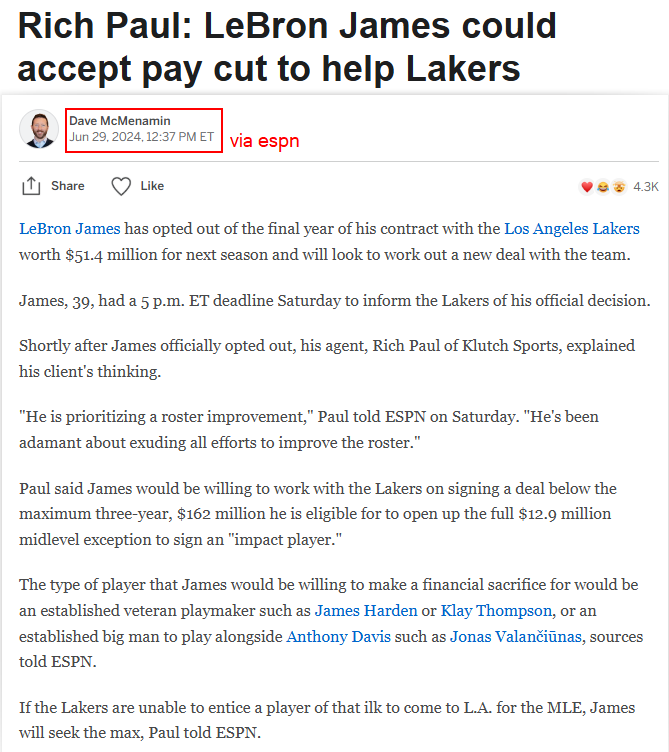
In 2024, ESPN reported that LeBron was willing to take a pay cut to help the Lakers add Harden, Klay Thompson, or Jonas Valančiūnas.
The problem is not that he never offered. The problem is the Lakers didn’t get those players.
-
Obviously it’s Windhorst talking but if Bron legit takes a paycut (a vet minimum at that) to help a team win a championship why didn’t he ever do that w/ the Lakers? I don’t want to hear the Rob Pelinka excuse either.
This is exactly why I want Johnson to start once the regular season begins.
When the Mavericks took him with the No. 9 pick, it was pretty clear they were not only looking at next season’s win total. I don’t see Dallas as a championship favorite next season, but long term, Johnson and Cooper Flagg can be the two foundational pieces for this team over the next decade, as long as they stay healthy.
If I were the head coach, Johnson and Cooper would be my two untouchable starters. I would give them as much time as possible to build chemistry together on the floor. Once those two find the right balance on both ends, that forward duo is going to put a lot of pressure on the rest of the league.
-
Nearly a year has already passed. By now, the things that needed to be investigated, the people who needed to be questioned, and the evidence that should have been gathered should probably already be in place. I understand that this is being handled by an independent outside firm, but this has dragged on for too long, especially now that we are already in the offseason.
At this point, it has clearly started to affect the normal operations of other teams. So moving forward, I personally hope this gets resolved as soon as possible. Simply put, if there is no issue, then give the players and teams a clear answer, or even clear their names. But if there really is a problem, then punish it. Personally, I support a heavy punishment. More importantly, to prevent something like this from happening again, the league should clean up the rules, the punishment standards, and any possible loopholes in the salary-cap rules. Otherwise, when something like this drags into the offseason and starts affecting trades, it is unfair to the players and the teams involved.
-
Developing: The Los Angeles Clippers-Toronto Raptors trade centered on Kawhi Leonard will not be complete until the NBA investigation into the Clippers is over. Statement from the Clippers to ESPN:
For the past 10 months, our organization has fully cooperated with an NBA investigation, participating in dozens of interviews, providing tens of thousands of documents, and facilitating access to our staff. While the process has been challenging, we have remained committed to transparency.
On June 30, we reached an agreement in principle to trade Kawhi Leonard to the Toronto Raptors. We have since been informed that the trade can only be finalized if the Raptors' ownership group assumes the risk of penalties related to Kawhi’s contract that could theoretically result from the ongoing investigation. The investigation is ongoing, and we expect the trade to be finalized following its conclusion.
At the heart of this investigation are Joe Sanberg and Aspiration. We did not funnel money to Kawhi Leonard through Aspiration. Like many sophisticated investors, financial institutions, and business partners, we were victims of a fraud initiated by Sanberg, who has been convicted and sentenced to 14 years in prison.
We recognize the uncertainty this has created and the impact it has had on our team, our fans, the Raptors organization, their fans, and the players whose futures remain affected while this process continues.
We remain confident that, when the facts are evaluated fairly and thoroughly, the NBA will confirm exactly what we have said from the beginning: We have not done what we are accused of doing.
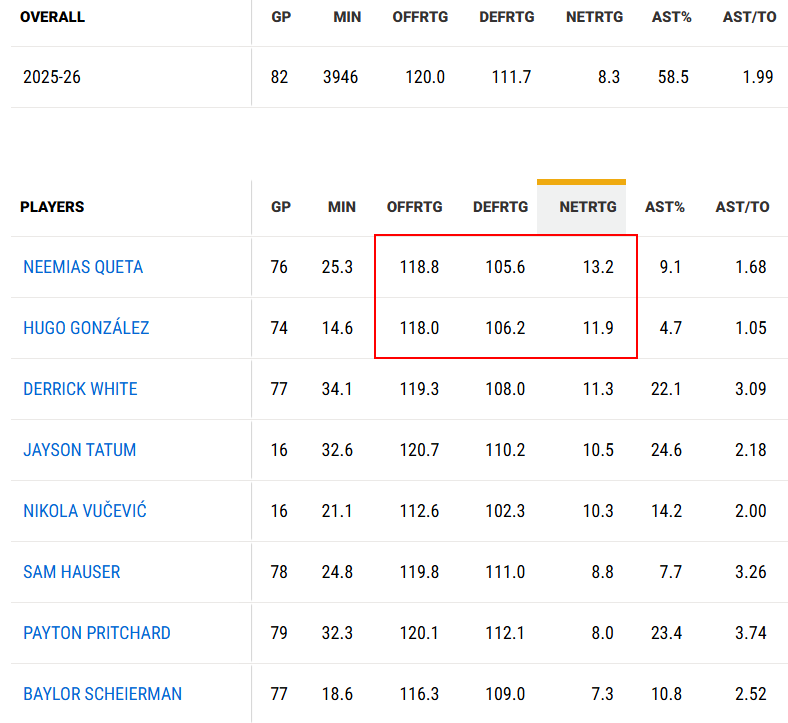
If I were Joe Mazzulla, I would seriously consider starting Hugo González. That means someone has to come off the bench, and for me, that player would be Derrick White. This is not about denying White’s ability. It’s actually the opposite. Because I trust his experience and his skill set, I would give him the tougher job: leading the second unit as a sixth man and helping stabilize the game from the bench.
The reason I would start Hugo is because his advanced numbers last season were actually very strong. When you already have Jayson Tatum, Payton Pritchard, and Paul George in the starting lineup — three players who can score and understand the game — I would be comfortable putting a younger player like Hugo next to them and letting those veterans help bring him along. He may not be part of the closing lineup, because Derrick White is still on the bench, but Hugo is absolutely a long-term piece worth developing for the Celtics. As for Mitchell Robinson, if I were Mazzulla, I would still start Neemias Queta. Not because Robinson is bad, but because Queta’s growth and effort last season deserve to be recognized.
-
If I were Joe Mazzulla, I would seriously consider starting Hugo González and bringing Derrick White off the bench. That’s not a knock on White at all. It’s actually because I trust his experience and ability enough to give him the harder job: leading the second unit, controlling the tempo, and stabilizing the game as a sixth man.
The reason I’d start Hugo is simple: his advanced numbers were really strong last season. With Tatum, Payton Pritchard, and Paul George already in the starting lineup, I’d be comfortable letting a young piece like Hugo grow next to those veterans. Same idea with Neemias Queta. I would still start Queta over Mitchell Robinson, not because Robinson is bad, but because Queta’s growth and impact last season deserve to be recognized.
Payton Pritchard
Hugo González
Jayson Tatum
Paul George
Neemias Queta
For the rotation, I would have Derrick White as the sixth man, with Sam Hauser, Jordan Walsh, Baylor Scheierman, and Mitchell Robinson coming off the bench. I would also try to find minutes for Chris Cenac Jr., the No. 27 draft pick this year, because if you already drafted him in the first round, you should at least give him some real opportunities to grow.
There are 11 Players involved in this six-team trade:
🏀To DAL: Santi Aldama (from MEM), Marcus Sasser (from DET), Tarik Biberovic (draft rights from MEM)
🏀To DET: John Collins (from LAC via S&T), Gary Harris (from MIL), Taurean Prince (from MIL)
🏀To LAC: No players incoming (create $16M TPE for John Collins)
🏀To MEM: A.J. Johnson (from DAL), Isaiah Stewart (from DET), D'Angelo Russell (from WAS)
🏀To MIL: Caris LeVert (from DET)
🏀To WAS: Khris Middleton (from DAL via S&T)
There are also one first-round pick, 10 second-round picks, a second-round pick swap and cash considerations changing hands to satisfy touch rules in a multi-team trade.
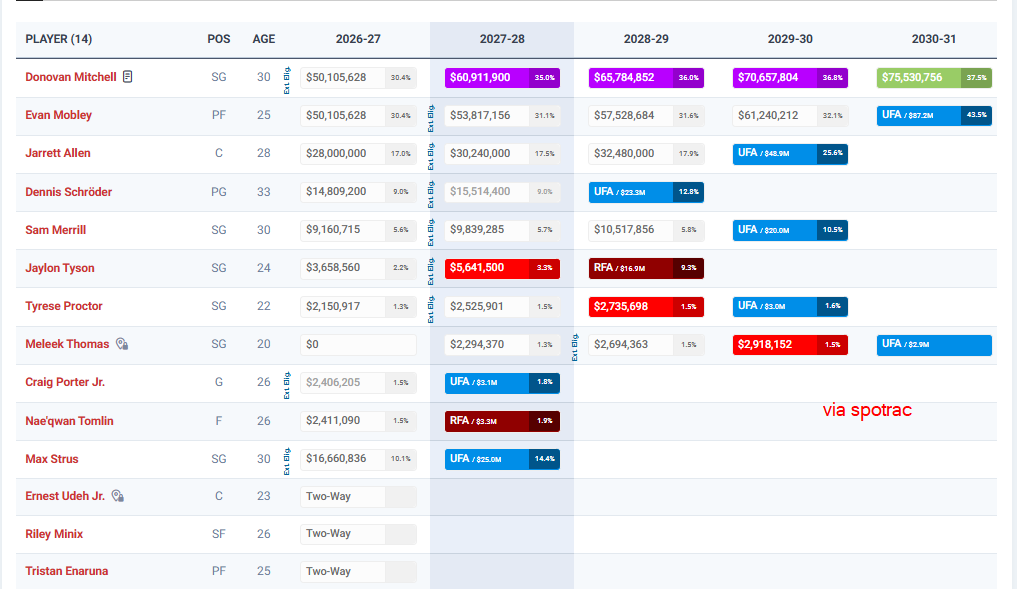
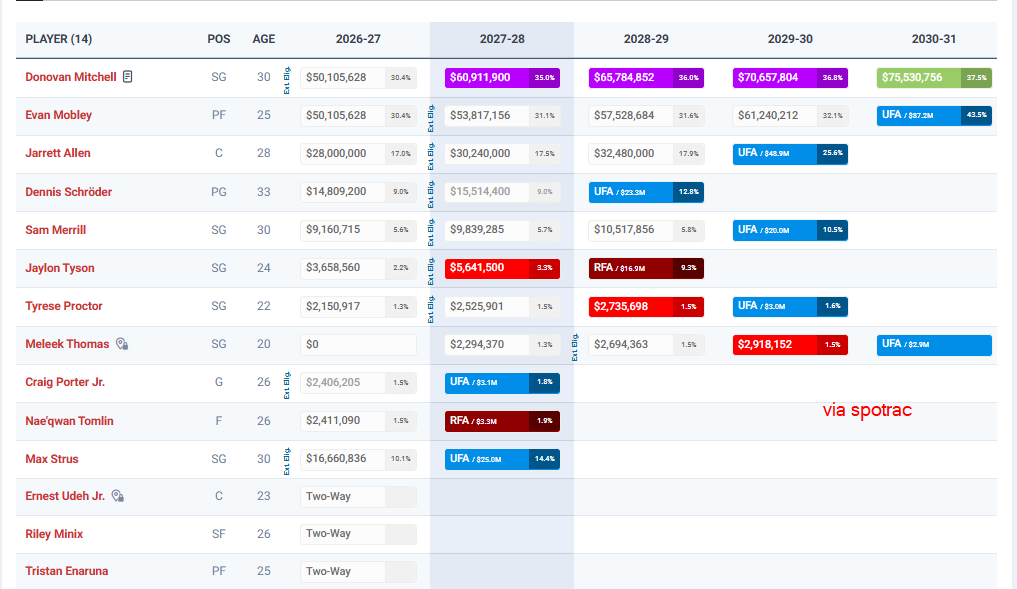
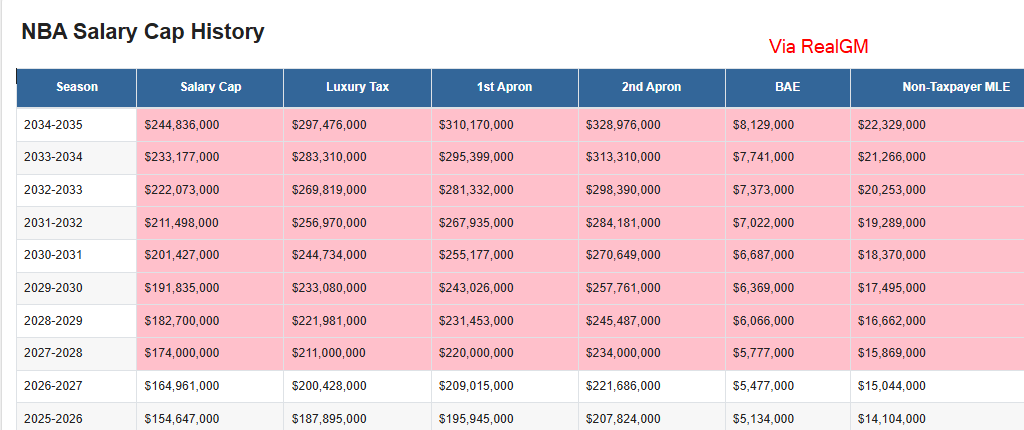
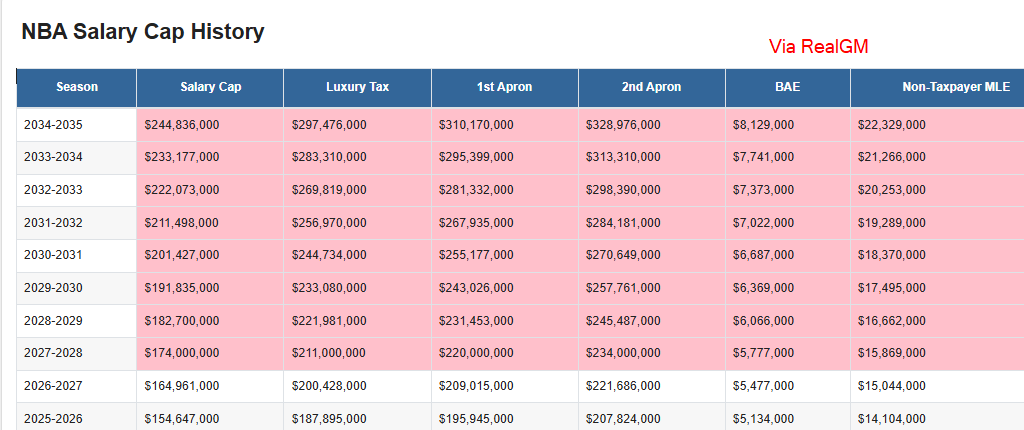
This is not really about whether Donovan Mitchell is “worth” the money or not. A player of his level and service time is eligible for a 35% max, and if Cleveland wants to keep him as its franchise core, this is the price they have to pay.The bigger story is the NBA’s new salary structure. We are entering an era where a 35% max can easily approach 70 million per year, and eventually even 80 million. By 2027-28, Mitchell, Evan Mobley and Jarrett Allen alone will combine for more than 144 million in salary, while the projected salary cap is around 174 million.That is the real pressure for Cleveland. Once a few massive contracts lock up the payroll, roster building becomes much harder under the new CBA. You have to draft well, develop well, and manage the margins perfectly. In the past, expensive tax teams still had the taxpayer mid-level exception. Now, if you go above the second apron, that tool is gone.
My view on this extension is actually very simple:
If you have to pay him, you pay him.
I am not going to frame this as expensive or cheap. A player of Donovan Mitchell’s level and service time is eligible for a 35% max contract. To put it more directly, if you want to keep this kind of core player, this is the price you have to pay. Some people may think the number looks ridiculous, but this is the NBA now.
As the salary cap keeps rising every year, once a player is eligible for a 35% max, the actual dollar amount is only going to look more and more absurd. We used to think 30 million per year was a lot. Now the league is moving toward the 70 million, and eventually even 80 million, era.
This extension also means Cleveland has officially locked in Mitchell as its core. There is no doubt about that. But in my view, the pressure on the Cavaliers to win is going to be very, very real.
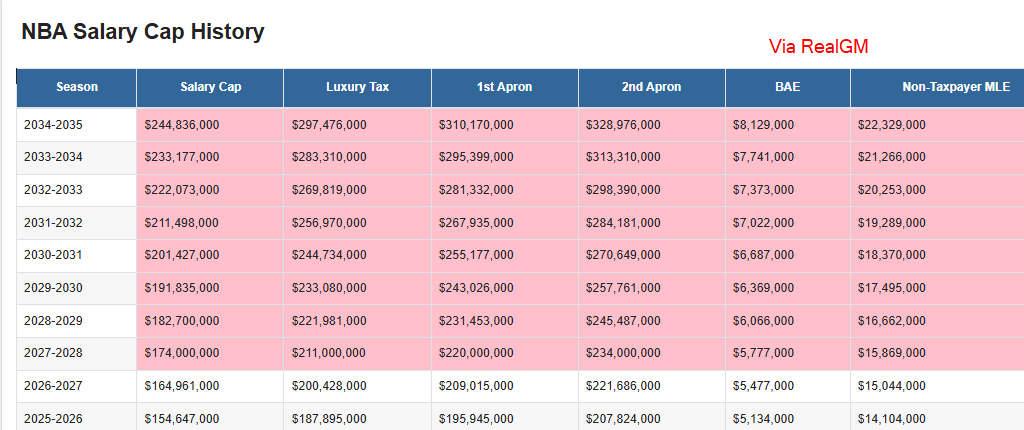
According to the salary table, by the 2027-28 season, when Mitchell’s 35% max officially kicks in, the combined salaries of Mitchell, Evan Mobley and Jarrett Allen alone will already exceed 144 million. And keep in mind, the projected salary cap for the 2027-28 season is around 174 million.
That is the scariest part of the modern NBA. When you have one 35% max, another 30% max, and the rest of your starters are not on cheap contracts, the salary cap itself may not even be enough to cover your starting lineup. Very quickly, you start moving toward the tax line, the first apron and the second apron.
So this is not about whether Mitchell is worth it or not. This is the salary structure under the new CBA.
That is why I think Cleveland had no real problem giving Mitchell this extension. They had to keep him. But the real pressure starts now.
Once a team’s payroll is locked up by a few massive contracts, it becomes extremely difficult to improve the roster. Simply put, you either have to draft very well and develop players very well, or your yearly tools may be limited to the mid-level exception, the bi-annual exception and minimum contracts.
So my point is not that Mitchell is expensive. My point is that the NBA has officially entered a new era. Front offices are going to have a much harder job than before. Remember, in the past, even expensive tax teams still had the taxpayer mid-level exception to add talent. But now, once your team salary goes above the second apron?
The taxpayer MLE is gone.
BREAKING: Cleveland Cavaliers All-NBA star Donovan Mitchell has agreed on a four-year, $273 million maximum contract extension that includes a player option for the 2030-31 season and a full trade kicker, CAA's Co-Head of Basketball, Austin Brown, tells ESPN.
I actually respect Brad Stevens’ answer here. Trading Jaylen Brown is painful emotionally, especially for Celtics fans, and no one should pretend it is easy to move on from a 2024 Finals MVP. But under the new CBA, carrying two 35% supermax-level players long term is extremely difficult. Once a team gets near or over the first and second apron, trades, roster upgrades, and flexibility all become much harder.
That is why I think Stevens was being honest, not just giving fans empty words. He basically admitted the real problem: it is not only about ownership spending money, but about how hard it is to build a complete roster when so much salary and usage are concentrated in two players.
I also do not think Celtics fans need to be overly pessimistic. They were still second in the East last season while missing Jayson Tatum for most of the year. If Tatum comes back healthy, and Boston adds Paul George, Mitchell Robinson, Mike Conley, plus continued development from young players like Hugo González, Baylor Scheierman, and Jordan Walsh, this team should still be very competitive.
The key now is how Boston uses that roughly $27M TPE. If they maximize that tool correctly, I still think the Celtics can remain one of the strongest teams in the East and a real title contender.
I actually respect Brad Stevens’ answer here. Trading Jaylen Brown is painful emotionally, especially for Celtics fans, and no one should pretend it is easy to move on from a 2024 Finals MVP. But under the new CBA, carrying two 35% supermax-level players long term is extremely difficult. Once a team gets near or over the first and second apron, trades, roster upgrades, and flexibility all become much harder.
That is why I think Stevens was being honest, not just giving fans empty words. He basically admitted the real problem: it is not only about ownership spending money, but about how hard it is to build a complete roster when so much salary and usage are concentrated in two players.
I also do not think Celtics fans need to be overly pessimistic. They were still second in the East last season while missing Jayson Tatum for most of the year. If Tatum comes back healthy, and Boston adds Paul George, Mitchell Robinson, Mike Conley, plus continued development from young players like Hugo González, Baylor Scheierman, and Jordan Walsh, this team should still be very competitive.
The key now is how Boston uses that roughly $27M TPE. If they maximize that tool correctly, I still think the Celtics can remain one of the strongest teams in the East and a real title contender.
This is the power of the new CBA. Many times, the issue is no longer simply whether the owner is willing to spend money, or whether the owner is trying to save a little bit. Just look at the tax penalties now, and you can understand that the NBA is no longer the same league where you can simply throw money at problems. Teams can still spend, of course, but the money has to be spent in the right place. Otherwise, if you spend a huge amount of money but the actual roster upgrade is not meaningful enough, then honestly, the value of that spending is not very high.
Under the new CBA, what really gets tested is the front office’s big-picture vision. Once a team goes over the second apron, the restrictions become very real. You can no longer operate like five years ago, when teams could still rely on the taxpayer mid-level exception every year to add another useful player. Trades, roster fixes, and lineup adjustments are all more limited now. The NBA has officially entered the new CBA era. It is not that teams cannot spend money. It is that every dollar has to be spent correctly.
-
According to @BobbyMarks42,
if the @nuggets simply waived Valanciunis and then signed Peyton Watson to a $25 million/year contract, they would get hit with a tax penalty of $177 million dollars.
That’s the cost of the repeater tax.
ONE HUNDRED SEVENTY SEVEN MILLION.
I actually respect Brad Stevens’ answer here. Trading Jaylen Brown is painful emotionally, especially for Celtics fans, and no one should pretend it is easy to move on from a 2024 Finals MVP. But under the new CBA, carrying two 35% supermax-level players long term is extremely difficult. Once a team gets near or over the first and second apron, trades, roster upgrades, and flexibility all become much harder.
That is why I think Stevens was being honest, not just giving fans empty words. He basically admitted the real problem: it is not only about ownership spending money, but about how hard it is to build a complete roster when so much salary and usage are concentrated in two players.
I also do not think Celtics fans need to be overly pessimistic. They were still second in the East last season while missing Jayson Tatum for most of the year. If Tatum comes back healthy, and Boston adds Paul George, Mitchell Robinson, Mike Conley, plus continued development from young players like Hugo González, Baylor Scheierman, and Jordan Walsh, this team should still be very competitive.
The key now is how Boston uses that roughly $27M TPE. If they maximize that tool correctly, I still think the Celtics can remain one of the strongest teams in the East and a real title contender.
-
I think Brad Stevens’ response this time was very honest and very practical. Under the new CBA, it is really not easy to carry two players on 35% supermax-level salaries for the long term. This is not something that can simply be explained as “the owner does not want to spend money.” This is a roster-building problem that many NBA teams are now facing.
Once a team goes over the first apron, or even the second apron, trades and roster upgrades become much more restricted. That is why this situation is difficult. But even with that said, if you are a Celtics fan, seeing 2024 Finals MVP Jaylen Brown get traded away will obviously hurt. Some fans may even be unhappy with the move. But the NBA is still a realistic and cruel business, so at this point, my view is simple: the team has to move forward.
When I saw Brad Stevens give this kind of response, I actually respected it. At least he did not lie to the fans. He did not give Celtics fans a bunch of empty words, and he did not run away from responsibility. He directly told you where the real difficulty is. So on this part, I think Celtics fans should give Brad Stevens some credit.
Also, I do not think Celtics fans have too many reasons to be pessimistic. Last season, the Celtics played most of the year without Jayson Tatum, but they still finished second in the East. Yes, you can say they blew a 3-1 lead in the playoffs and got eliminated by the 76ers. That was painful and hard to accept. But being able to take a 3-1 lead also proved that this team still had real strength.
Next season, the Celtics will not have Jaylen Brown, because he has already been traded to the 76ers. I wish him all the best. In return, Boston got Paul George, who is older and also has an injury history. That will naturally make some Celtics fans worried, and I completely understand that. But as I said, the Celtics were still second in the East last season while missing Jayson Tatum for most of the year.
If Tatum comes back healthy this year, and you add Paul George, Mitchell Robinson, and Mike Conley, I do not think this team will be worse. More importantly, some young players who did not have many minutes or chances before finally got a real stage last season and gained a lot of experience. After one year of development, whether it is Hugo González, Baylor Scheierman, Jordan Walsh, or other young players, I believe they should only be better next season.
So personally, I do not think Celtics fans have too many reasons to be pessimistic. The real question now is how Boston can maximize that roughly $27M trade exception. If the Celtics use this TPE well, they should still be one of the strongest teams in the East. I also believe they can still be one of the title contenders. As for the old three-point shooting problem, that will be a test for Joe Mazzulla.
-
Brad Stevens on trading Jaylen Brown:
“When I looked at our team and where the league was heading…the path looked a little bit more challenging to me with 70% of our cap and such a high usage into two players.”
(h/t @Johng_c)
I really like Baba Miller.
Before the draft, I already said on my own X post that I hoped the Celtics would take Baba Miller with the 27th pick. Yes, I mean the 27th pick. My reason was simple: after No. 27, if the Celtics waited until No. 40, I did not think Baba Miller would still be available. Now it looks like that was true, because Baba Miller was taken by the Clippers with the 36th pick.
Why do I like him so much? Because he is a player who can play the 3, the 4, and maybe even some small-ball 5. Some people may worry that this type of player can do a little bit of everything, but does not have one clear elite skill. That concern is fair, but that is also exactly why I like him. If a player is already locked into one position in college, his role and minutes in the NBA may become limited unless he develops another clear skill.
The Celtics took Chris Cenac Jr. with the 27th pick, and he is more of a 4/5 big. Because Boston went with Cenac, I said after the draft that I hoped Baba Miller could go to a team that understands him and is willing to develop him. Now he is with the Clippers, and I think this could be a very interesting situation. They have Darius Garland and this year’s high pick Keaton Wagler in the backcourt, and they also have wings like Jordan Miller and Brandon Ingram.
In this kind of environment, I hope Baba Miller can learn more skills and get chances to try different positions on the floor. If he really wants to improve, has enough competitive fire, and is willing to work through the hard parts, I believe he has a chance to become one of the underrated players from this draft class. The main point is simple: his talent is really, really exciting.
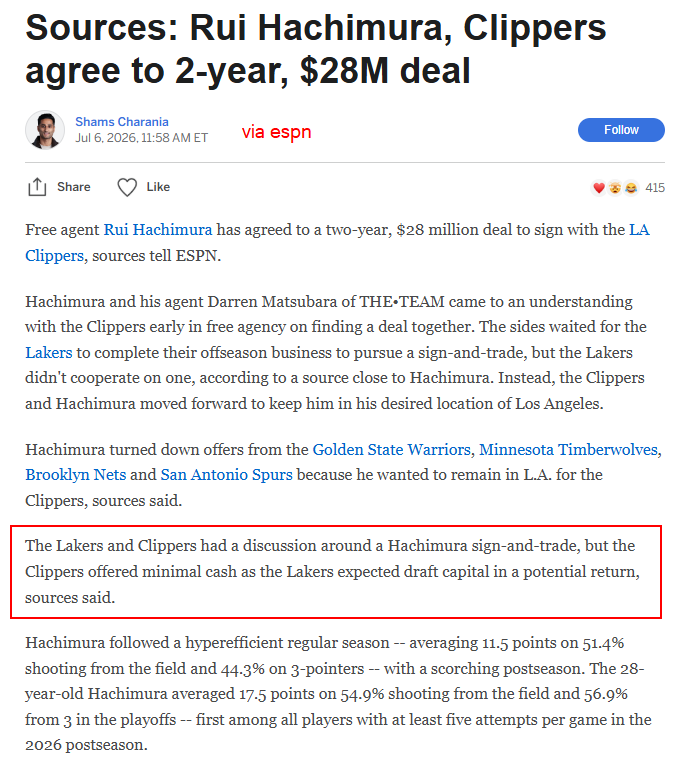
The Lakers should have completed the sign-and-trade unless Rui himself was unwilling.
The real value was never the draft pick. The Clippers could sign Rui outright, so why would they give up draft capital? For the Lakers, the important part was creating a $14M TPE.
In the Luka era, one full MLE per year is not enough. The Lakers don’t have OKC-level draft assets, so they need every roster-building tool they can create. A TPE is valid for one year, and it could have helped them add another $ 9M-$14M player without salary matching.
If ESPN’s report is accurate, I think the Lakers focused on the wrong thing. They chased draft capital, but the TPE itself should have been the win.