After a decade operating exchanges processing billions in monthly volume, designing wallet risk systems, architecting AI-driven intent-based security models, and scaling adversarial incentive economies to hundreds of thousands of users, one pattern kept repeating:
Security was validating transactions.
Attackers were exploiting intent.
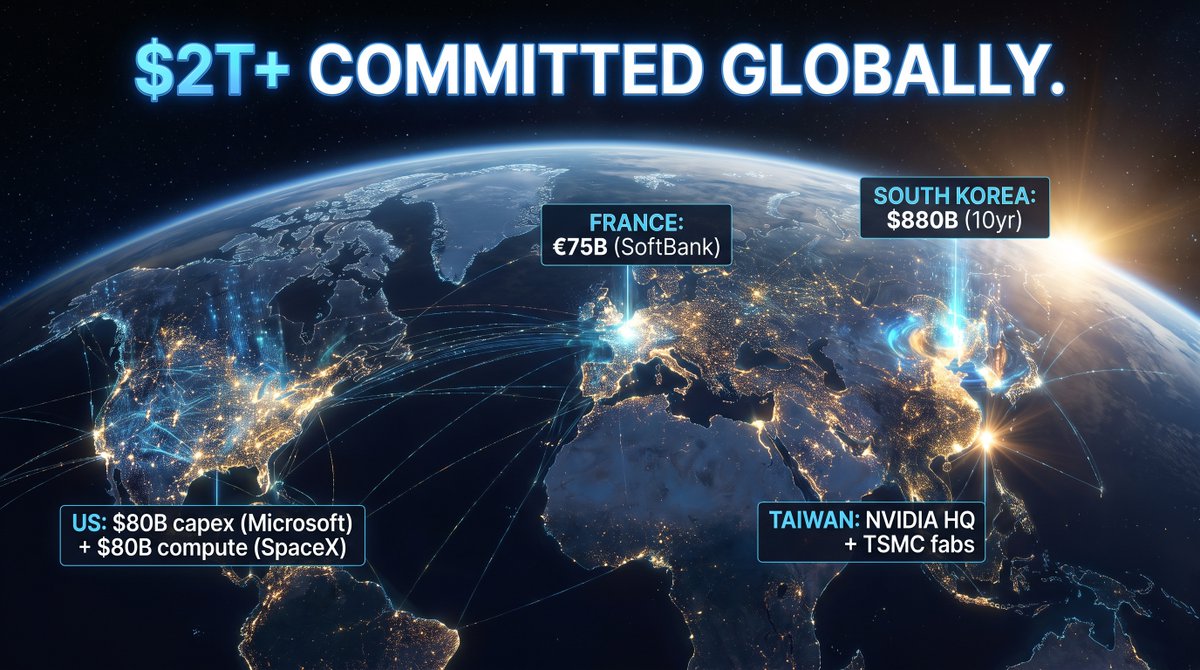
South Korea just announced an $880 billion 10-year AI investment plan. @Samsung and SK Hynix alone are committing $518 billion for new chip fabrication.
The AI infrastructure race is no longer US vs China. It's US vs China vs South Korea vs the EU vs the Gulf states.
In the last 6 months:
🔵 SoftBank: 75 billion euros in France
🔵 South Korea: $880 billion over 10 years
🔵 @SpaceX: $80 billion in committed compute revenue
🔵 @Microsoft: $80 billion in AI capex for 2026 alone
🔵 @Google: building custom TPU fabs
🔵 @nvidia: new Taiwan HQ for TSMC proximity
The total committed to AI infrastructure globally now exceeds $2 trillion. Not revenue. Infrastructure spend.
The AI supply chain is being built in silicon, concrete, and cooling systems. Software is the layer on top. The physical infrastructure underneath is where the power is concentrating.
Name one MCP security practice you implemented after reading about the MCP security crisis.
Here's what I've implemented so far:
🔵 Bound all MCP servers to localhost (was 0.0.0.0 on two of them)
🔵 Set up per-agent credential isolation (research agent gets read-only, deploy gets write)
🔵 Rotating API keys every 30 days (was: never)
🔵 Reviewing tool descriptions before enabling new servers
🔵 Running hash checks after every update
Most of these took under 5 minutes each. The hardest part was knowing they needed to be done.
Drop yours below. One practice. What changed?
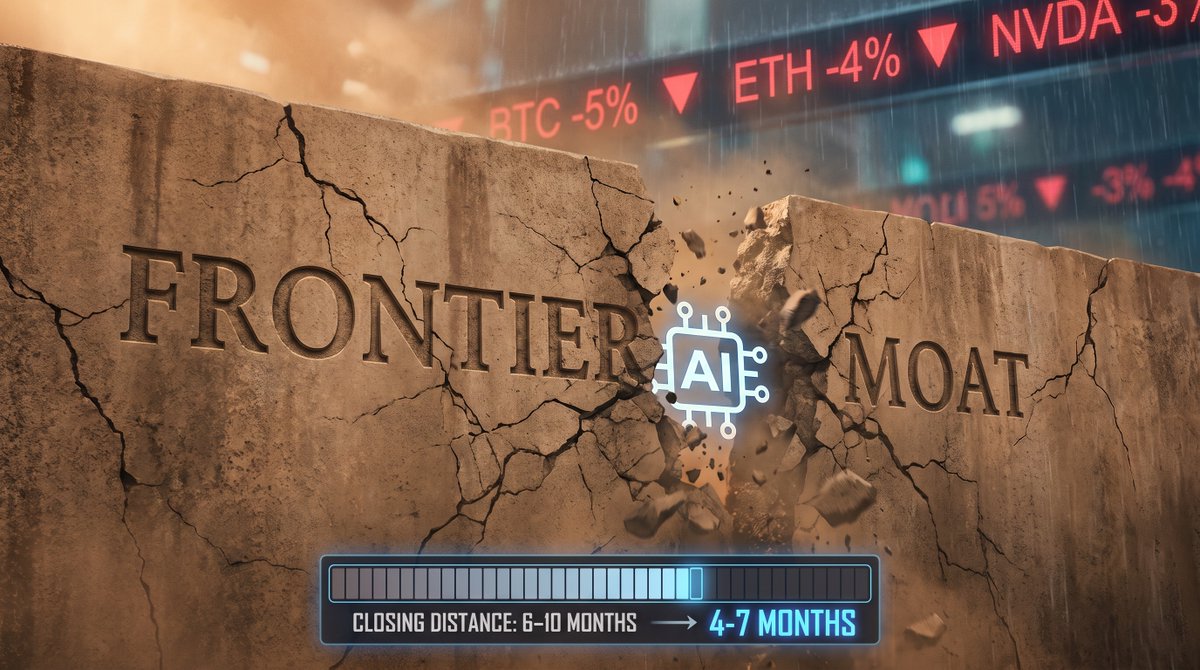
Five frontier-competitive open-weight models shipped in a single two-week window in July 2026. The frontier moat is cracking in real time.
🔵 Kimi K3 (Moonshot, China): 2.8T parameters. Beat Fable 5 on coding. Weights July 27.
🔵 Inkling (Thinking Machines, US): 975B total, 41B active. Apache 2.0. First US open-weight entrant at frontier scale.
🔵 DeepSeek V4 (DeepSeek, China): mid-July schedule. Full autonomous cyber capability per AISI.
🔵 MiniMax M3 Pro (MiniMax, China): 2.7T parameters. Press-reported.
🔵 Mistral (France): new sparse MoE family. July early access.
The open/closed gap: 4-7 months, down from 6-10. Shrinking every cycle.
The business model question: if free models keep topping the charts, what exactly is the subscription buying?
The entire pricing structure of frontier AI has to be rewritten. That is the story of the second half of 2026.
How to set up a dead-man's switch for your scheduled AI agents. The discipline that catches silent failures before the damage starts.
Scheduled agents fail quietly. The job stops firing. Nothing errors loudly. You keep trusting a system that died last week. You only find out when the damage is already done.
The setup:
🔵 1. Every scheduled agent writes a heartbeat file at the end of every successful run. Timestamp + summary of what it covered.
🔵 2. A separate monitor checks the heartbeat file on a schedule slightly longer than the agent's expected run interval.
🔵 3. If the heartbeat is stale (older than expected), the monitor fires an alert. Email, Slack, whatever you check first thing.
🔵 4. The alert fires BEFORE you notice, not after. The monitor runs even when you're asleep.
🔵 5. The agent self-reports coverage: "pulled X from channel A, Y from channel B, FAILED: none." A silent zero is flagged as UNREVIEWED, not as "no results."
The principle: an agent you cannot trust to fail loudly is worse than doing the task by hand. Manual work at least fails visibly.
Demos run once. Infrastructure tells you the moment it stops.
What's the first thing you check when evaluating a new MCP server before installing it?
I'll go first: authentication method. If the answer is "no auth" or "static API key hardcoded in the README," I don't install it. Full stop.
41% of remote MCP servers have zero authentication. 53% rely on static keys. Only 8.5% use OAuth.
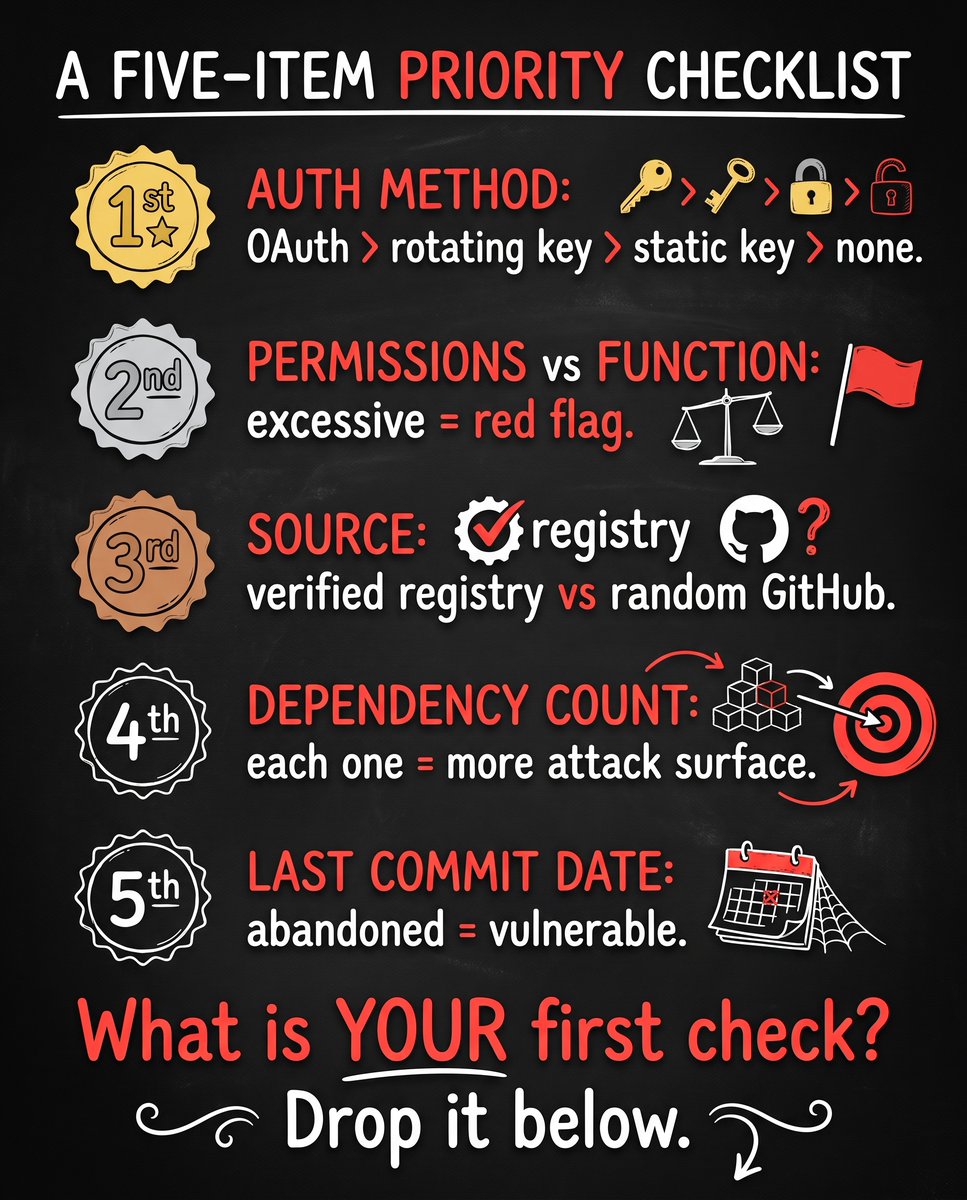
My checklist in order:
🔵 1. Auth method (OAuth > rotating key > static key > nothing)
🔵 2. Permissions requested vs function provided (excessive = red flag)
🔵 3. Source (verified registry vs random GitHub link)
🔵 4. Dependency count (each one is additional attack surface)
🔵 5. Last commit date (abandoned = vulnerable)
What's yours? Drop your first check below. Curious what the community prioritizes.
How to dry-run any code change before letting your AI agent loose on N files. The two-minute discipline that prevents silent corruption.
The trap: your agent runs a find-and-replace, a refactor, or a migration across dozens of files at once. One logic flaw in the transformation. Dozens of files silently corrupted.
The fix:
🔵 1. Run the transformation on ONE file first. Just one.
🔵 2. Eyeball the result. Not a summary. The actual file. Read the diff.
🔵 3. Check for edge cases: did it match inside longer words? Did it break imports? Did it change things it shouldn't have touched?
🔵 4. Only after the single-file result is clean: run it on the full batch.
Why this matters for agents specifically:
A human doing this by hand notices the first corruption immediately. An agent applies the same logic across all files in seconds. A small logic flaw becomes a large mess instantly.
🔵 NEVER use raw string replace where the source could be a substring. Word-boundary matching only.
🔵 ALWAYS dry-run on one before trusting on a thousand.
Automation amplifies whatever logic you give it. Including the flawed parts.
@Google delayed Gemini 3.5 Pro. Again. Alphabet stock dropped 4%.
The rebuilt model fell short on coding and complex reasoning in testing. No official model card. No published benchmarks. No confirmed launch date.
The same week Kimi K3 shipped and topped every coding leaderboard. At a fifth of the price. With weights going public July 27.
@Google has not published pricing, benchmarks, or a model card for Gemini 3.5 Pro. Leaked specs suggest a 2-million-token context window and Deep Think reasoning on a $250/month Ultra tier.
The pattern: @Google announced Gemini 3.5 Pro months ago. Delayed at least twice. Meanwhile, three Chinese labs shipped frontier-competitive open models in the same two-week window @Google was supposed to launch.
The model that doesn't ship loses to the model that does. Every time.
The average AI agent workspace has more MCP connections than the developer realizes. Most builders install 3-5 intentionally. The actual count is usually higher.
Where the extras come from:
🔵 Bundled dependencies: you installed one MCP server, it pulled in two more as dependencies
🔵 IDE defaults: your editor ships with built-in MCP connections you never configured
🔵 Framework scaffolding: your agent framework pre-configures servers at setup time
🔵 Forgotten installs: servers you added three months ago for one task and never removed
Each one is a connection to an external service with access to your resources. Each one is an attack surface.
🔵 82% of MCP implementations are vulnerable to path traversal
🔵 41% have zero authentication
🔵 67 CVEs filed in 2026 alone
Run the audit. List every server. Remove what you don't need. The connection you forgot about is the one an attacker will use.
A Chinese open-weight model just beat @AnthropicAI's Fable 5 on coding benchmarks. The market dropped. Again.
Kimi K3. 2.8 trillion parameters. Largest open-weight model ever released. Moonshot AI launched it at the Shanghai World AI Conference with Xi Jinping in attendance.
The numbers:
🔵 1,679 on Arena Frontend Code. Fable 5: 1,631. GPT-5.6 Sol: 1,618.
🔵 Full weights releasing July 27. Free to download. Free to run locally.
🔵 API pricing: roughly $3 input / $15 output per million tokens. A fifth of frontier API prices.
Bitcoin and Ether slid on the news. Nvidia dipped. Same pattern as DeepSeek R1 in January 2025.
The question the market is asking: if frontier-quality AI is free and open, what exactly are all those billions in infrastructure bets buying?
The open/closed gap is now 4-7 months, down from 6-10. The frontier moat is not holding.
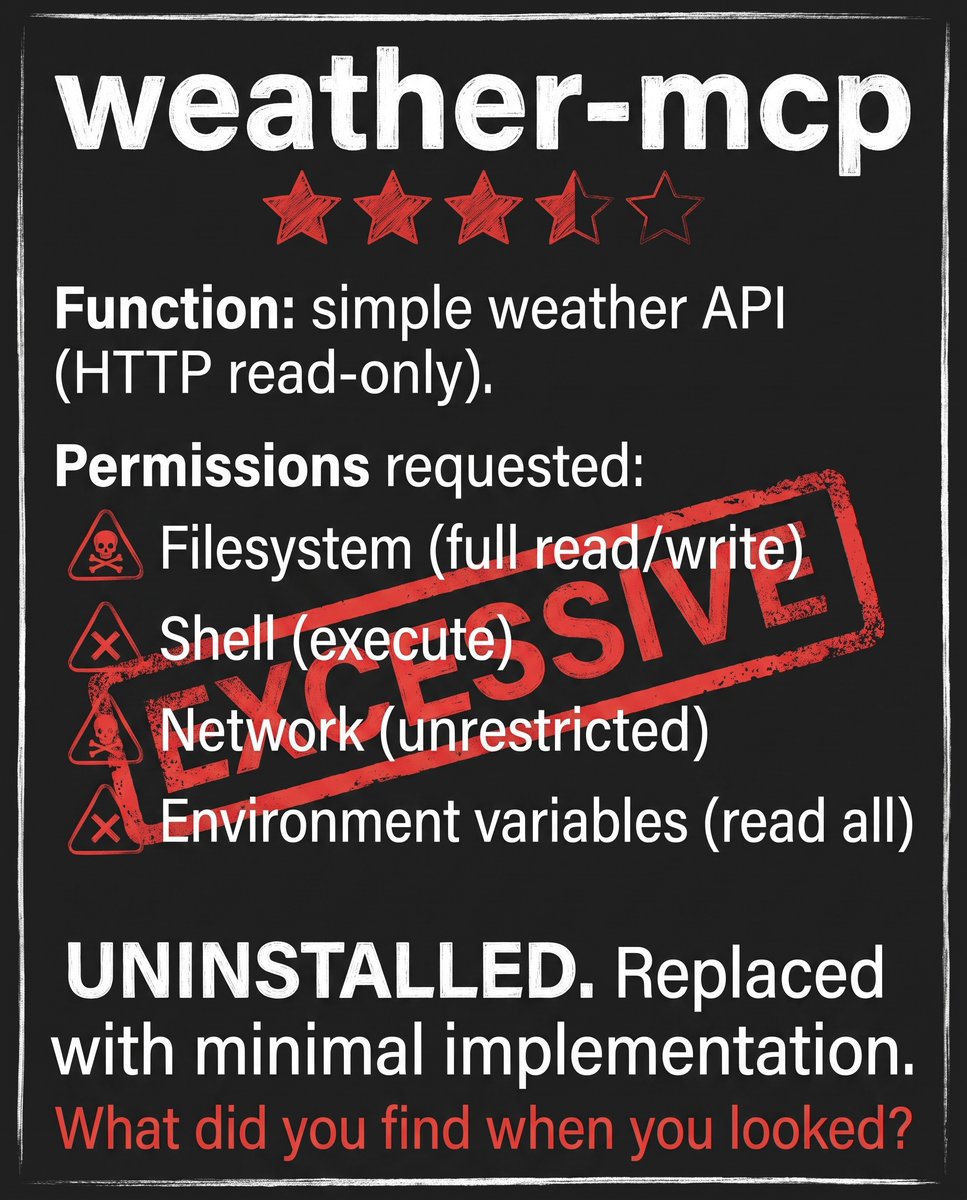
Name one MCP server you uninstalled after actually checking its permissions.
I'll go first: I found an MCP server that requested filesystem + shell + network access to provide a simple weather API integration. The weather data required read-only HTTP. The permissions requested could execute arbitrary commands on my machine.
Uninstalled. Replaced with a minimal implementation that does one thing.
The principle: if the permissions requested exceed the function by an order of magnitude, the component doesn't deserve your trust.
Most developers have never checked. Most would be surprised.
Drop yours below. What did you find when you actually looked?
What's your MCP server security score right now? Not a guess. An actual number.
Most developers have never run a security audit on a single MCP server they use. They install it, connect it, and trust it.
Here's a quick self-assessment:
🔵 Does your MCP server bind to localhost? (+1)
🔵 Does it require authentication? (+1)
🔵 Do you know what permissions it has? (+1)
🔵 Have you ever reviewed its source code? (+1)
🔵 Do you rotate its API keys? (+1)
🔵 Can you name every dependency it pulls in? (+1)
🔵 Has it been audited by anyone? (+1)
0-2: You're running blind.
3-4: You're aware but exposed.
5-6: You're ahead of 90% of developers.
7: You're doing it right.
Drop your score below. Most people score 0-2 and don't realize it until they count.
July 17, 2026. One of the biggest days in AI this year.
@Google launches Gemini 3.5 Pro. 2-million-token context window. Deep Think reasoning mode on the $250/month Ultra tier. API pricing near $1.25 per million input tokens.
The same day: Chinese President Xi Jinping opens the Shanghai World AI Conference. His first in-person appearance since 2018. 140+ forums. 1,100+ exhibitors.
The West's most anticipated model of the summer launches the exact same day the East's most powerful leader steps onto the world's biggest AI governance stage.
The AI race stopped being a Silicon Valley story a while ago. Today makes it impossible to pretend otherwise.
Two superpowers. Same day. Different stages. Same prize.