🇺🇸 AMAZING! Japan just did a whole FIREWORKS SHOW celebrating America’s birthday today, as it’s now July 4 in Tokyo
This is what a REAL ally looks like.
Unlike most of our European “allies”
God bless America, and God bless Japan! 🇺🇸🤝🇯🇵
@Rasmussen_Poll@pbump Rasmussen polling is (and always has been) the only poll results I trust. It always seems to mirror what I see around me, in my own state.
VOTE TRUMP. No matter what state you live in, do NOT vote for me. Let's get President Trump back in the White House and me to Washington so we can Make America Healthy Again, end the forever wars, and protect our civil liberties. 🇺🇸
🚨 GEORGIA ELECTION DATA HUB. UPDATING VOTE TOTALS FOR ENTIRE STATE 🚨
This new website is awesome, click all 3 tabs and the ‘Go Interactive’ button in the app.
https://t.co/y3ln5jY4Wj
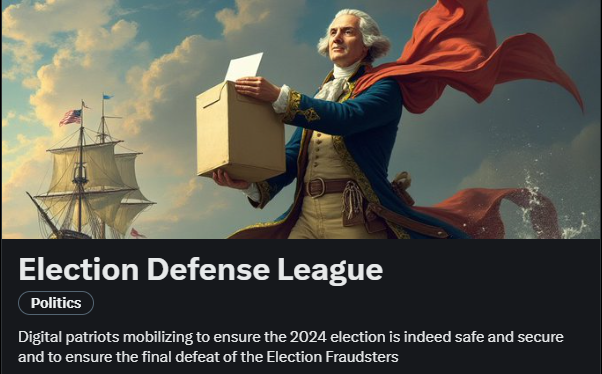
I have created an 𝕏 community, open to all, called the Election Defense League (EDL)
𝕏 is currently the most powerful platform in the world, and the sanctity of the 2024 election is the most important thing ever. Anyone can post about election integrity in this community. Any questions you post on there will be answered by fellow community members. I myself will be active in there A LOT. The mod team is full of the best "in the know" election integrity warriors.
Trump's job is to get the votes. Our job is to make sure they count as cast. It won't be an echo chamber, I invite all left minded people to join. Let's win yugely.
https://t.co/5ONbc5QQvM
People need to stop overreacting about Kamala’s plan to reduce food inflation, as if it would lead to communism, mass starvation, and the end of America.
I worked in M&A in the food industry. Here’s a step-by-step summary of what would actually happen:
1. The government announces that grocery retailers aren’t allowed to raise prices.
2. Grocery stores, which operate on 1-2% net margins, can’t survive if their suppliers raise prices. So the government announces that food producers (Kraft Heinz, ConAgra, Tyson, Hormel, et. al.) also aren’t allowed to raise prices.
3. Not all grocery stores are created equal. Stores in lower-income areas make less money than those in higher-income areas, as the former disproportionately sell lower-margin prepackaged foods (“center of the store”) instead of higher-margin fresh products like meat (“perimeter of the store”). Because stores in lower-income areas aren’t able to cover overhead (remember, even if their wholesale costs are fixed, their labor, utilities, insurance, and other operating expenses aren’t fixed… yet), grocery chains start to shut them down. Food deserts in rural areas and in low-income urban areas alike become worse.
4. Meanwhile, margins for food producers are also quickly eroding. Their primary costs (ingredients, energy, and labor) aren’t fixed, and their shrinking gross profits leave less cash flow available to cover overhead, maintain facilities, and reinvest in additional production capacity.
5. Grocery chains, which have finite shelf space, start to repurpose their stores (those they didn’t have to shut down, I should say) to sell more non-price-controlled items—everything from nutrition supplements to kitchenware to apparel—and less price-controlled food products. Your local Kroger or Safeway starts to look and feel more like a Walmart.
6. Food producers stop making products with lower margins. Grocery chain start competing with each other to secure inventory. Since they can’t compete by offering stronger prices (remember, producers aren’t allowed to raise prices here, and, even if they could, grocery chains no longer have the gross profit to bear price increases), they compete on things like payment terms.
7. Small grocery chains start to shut down entirely, or get sold to larger chains like Kroger. In addition to not being able to cover fixed costs, a major reason for this is because they can no longer reliably secure delivery of products, due to producers prioritizing sales to larger customers, which are able to leverage their stronger balance sheets to offer superior payment terms.
8. Smaller food producers—which typically sell via distributors, rather than directly to grocery chains—start to go out of business. Because these producers have an additional step their value chains, and because they have lower volumes over which to spread their fixed costs, their cost structure is inherently disadvantaged compared to major food producers. When grocery stores aren’t able to raise prices, cutting product costs becomes all the more important, and deprioritizing purchases from smaller producers is an easy way to do so.
9. As supply chains break down, lines start to form outside grocery stores every morning. Cities assign police officers to patrol store parking lots, and food producers draft contingency plans to assign armed escorts to delivery trucks.
10. The federal government announces a program to issue block grants for states to purchase and operate shuttered grocery stores. The USDA also seizes closed-down production facilities.
11. The government announces that prices for all key food costs—corn, wheat, cattle, energy, etc.—are also now fixed, to stop “profiteers” from gouging the now-government-operated food industry.
12. Shockingly, the government struggles to operate one of the most complex industries on the planet. The entire food supply chain starts imploding.
13. Communism, mass starvation, and the end of America quickly ensue.
Hey wait a second
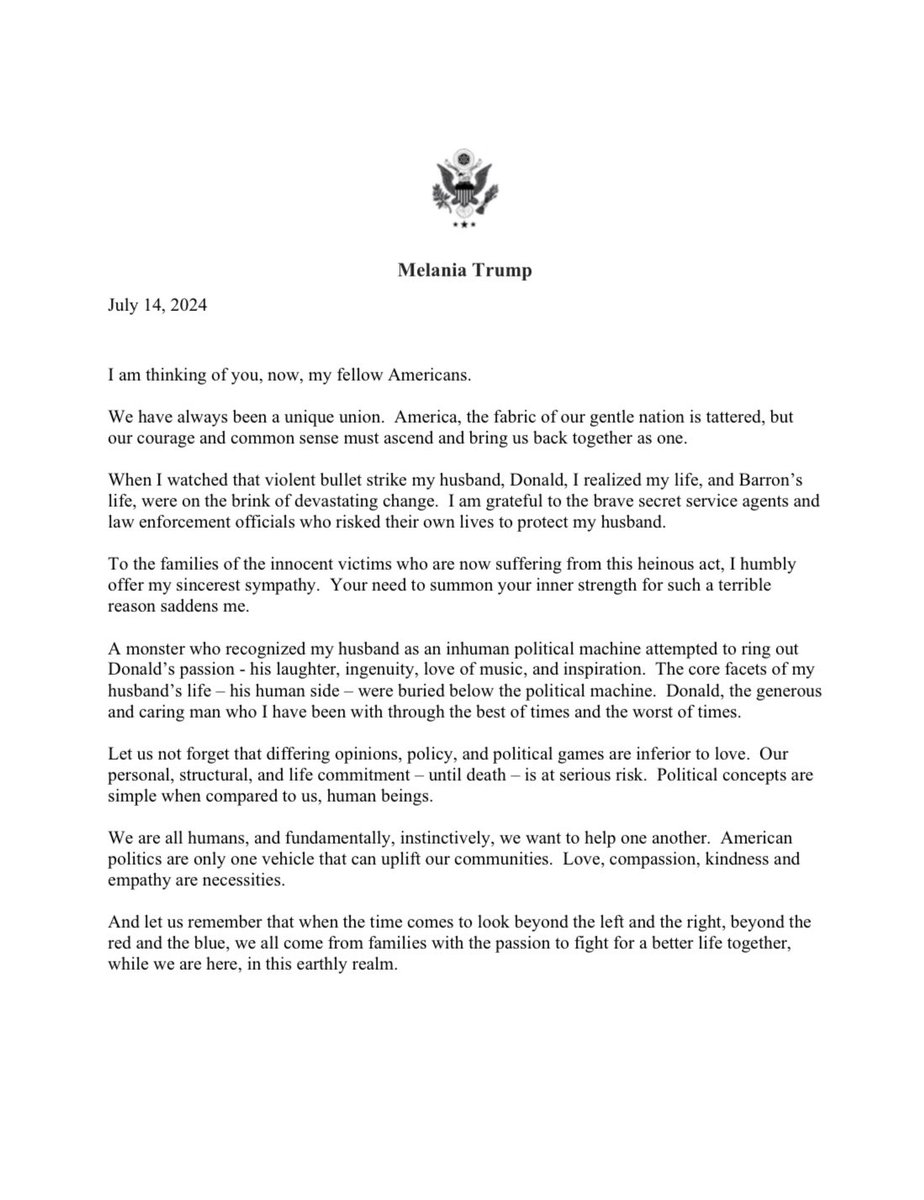
JUST IN: Former First Lady Melania Trump releases statement, calls for America to reunite after her husband was inches away from being assass*nated.
"When I watched that violent bullet strike my husband, Donald, I realized my life, and Barron's life, were on the brink of devastating change."
"I am grateful to the brave Secret Service agents and law enforcement officials who risked their own lives to protect my husband."
"A monster who recognized my husband as an inhuman political machine attempted to ring out Donald's passion - his laughter, ingenuity, love of music, and inspiration."
"The core facets of my husband's life - his human side - were buried below the political machine. Donald, the generous and caring man who I have been with through the best of times and the worst of times."
"Dawn is here again. Let us reunite. Now."
🚨NEW: Garland Favorito of VoterGA testifies on six affidavits alleging counterfeit ballots in Fulton County, Georgia's 2020 election, which remain unresolved three years later.
"These mail-in ballots weren't folded from being mailed. They were not on the correct paper stock. They were not marked with a writing instrument. They were marked with toner, according to senior poll managers who signed court affidavits."
"After three years, we have still not seen the ballots for which there were six sworn affidavits claiming they were counterfeit. That is not the appropriate way to investigate. The Secretary of State's office filed an amicus brief against us to try to prevent us from looking at the ballots. What kind of Secretary of State would do that?"
Additionally, over 70 counties in Georgia reportedly destroyed their original ballot images, violating federal and state laws requiring their retention for two years.
Favorito's testimony is part of the disbarment hearing for Former United States Assistant Attorney General Jeffrey Clark, who is among 19 defendants charged by Fani Willis for investigating the 2020 election in Fulton County.
Mark Wingate, a Fulton County Elections Board member, also testified that he voted against certifying the 2020 election because the county failed to verify signatures on 147,000 mail-in ballots.
Fulton County also couldn't provide any chain of custody documentation or surveillance footage for mail-in ballots or ballot drop boxes.
@JeffClarkUS@VoterGa
GEORGIA!🚨 The Georgia House recently voted to remove Secretary of State Brad Raffensperger from the State Election Board (SEB). The bill also gives the SEB power to investigate the Secretary of State.