Everyone talks about who’s building the fastest blockchain.
Not enough people talk about who’s building a sustainable one.
After reading CoinGecko’s latest report on @Injective, I came away with one conclusion: the network is focused on creating a financial ecosystem where growth is driven by real u not speculation.
One thing that stood out is how Injective measures success.
Instead of chasing inflated metrics, the network is generating revenue from actual on-chain activity.
Billions of dollars have flowed through its spot, derivatives, and RWA markets, making revenue a reflection of people actively using the chain.
The backbone of that activity is Injective’s native on-chain order book.
Developers don’t need to build trading infrastructure from scratch, they can tap into an existing protocol-level order book with shared liquidity.
That’s a huge advantage for anyone building financial applications.
Injective is also expanding beyond crypto-native assets.
The report highlights:
• Native USDC integration
• Support for both EVM and WASM developers
• Growing traction for tokenized real-world assets
It feels less like a DeFi chain and more like infrastructure for modern finance.
Probably my favorite part of the report is how the protocol handles its revenue.
Instead of keeping everything, Injective uses part of it through its Community BuyBack to purchase and burn INJ.
Over 7.1 million INJ has already been removed from circulation.
That’s a model where network activity can directly influence token economics.
Another trend that’s hard to ignore is the institutional momentum.
Between regulated futures, ETF filings, and infrastructure designed for compliant finance, Injective seems to be preparing for a world where traditional finance and DeFi aren’t separate ecosystems anymore.
They’re beginning to overlap.
It’s that all the pieces seem connected.
Trading generates revenue. Revenue supports the buyback. Better infrastructure attracts more builders and users. More activity strengthens the network.
That’s the kind of flywheel I’d rather see than short-term hype.
Worth reading the full CoinGecko report if you’re following where on-chain finance is heading.
Most people think blockchain is only about crypto.
But it’s starting to solve real business problems too.
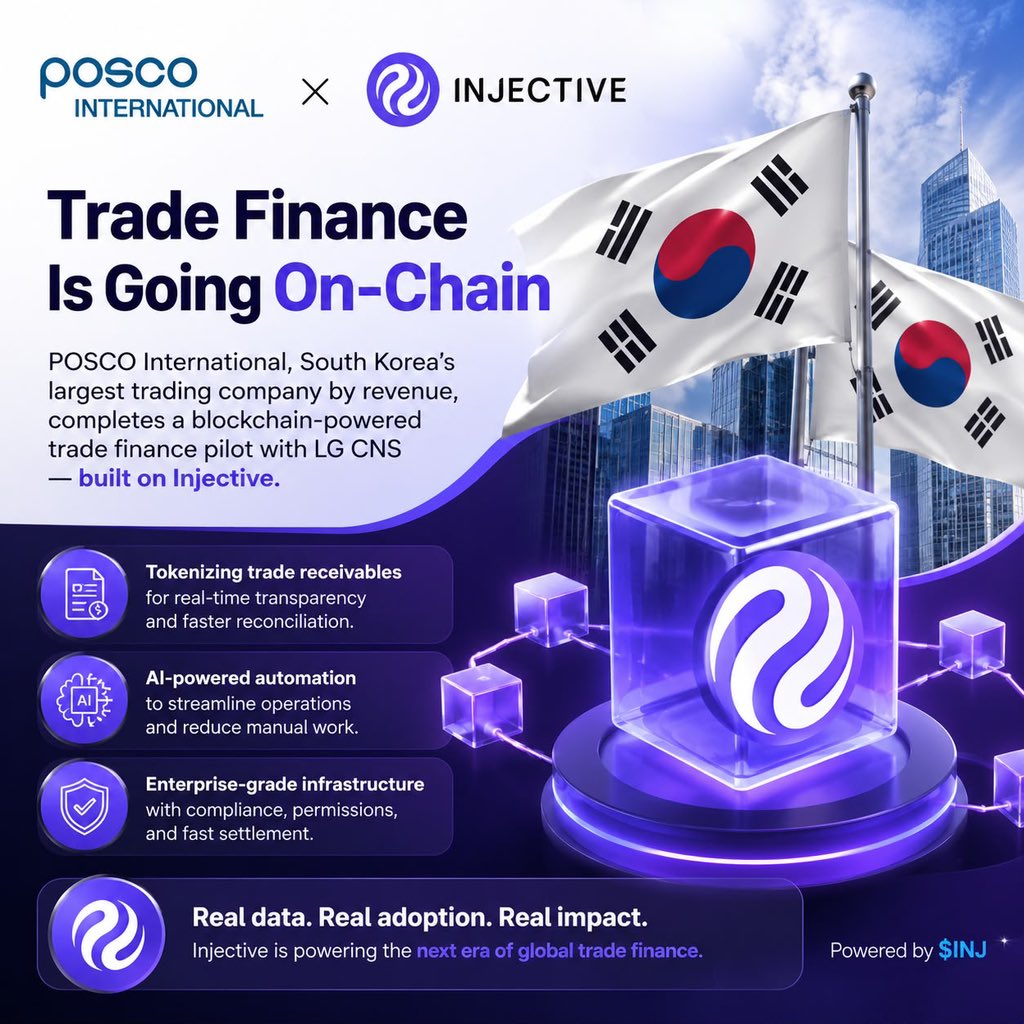
South Korea’s largest trading company, POSCO International, just tested on-chain trade receivables with LG CNS and it’s all built on @injective.
Powered by $INJ.
So, what are trade receivables?
They’re simply payments a company is waiting to receive after delivering goods or services.
Managing these records across different systems can be slow and inefficient, especially when banks and multiple businesses are involved.
With Injective, those receivables can be tokenized and recorded on-chain.
That means everyone involved works from the same source of truth, making reconciliation faster, reducing errors, and improving transparency.
Another interesting part is the use of AI.
The pilot combines blockchain with AI to help automate tasks like document verification and trade processing, reducing manual work and making operations more efficient.
This is where Injective stands out.
It’s not just fast and low-cost, it also has the infrastructure needed for enterprise finance, including compliance features, permissioned assets, and support for tokenized real-world assets (RWAs).
What caught my attention is that this wasn’t just a demo.
The pilot used real commercial trade data, showing that blockchain is moving beyond theory and into actual business operations.
That’s the kind of adoption the industry has been waiting for.
To me, this is another sign that blockchain is becoming real financial infrastructure.
When companies like POSCO International start testing on-chain trade finance, it shows where the industry is heading.
And Injective is positioning itself right at the center of that shift.
OG's assemble 🫡
Everyone who joins before July 31 will receive the exclusive OG role.
How to claim your OG role:
1. Join the Discord server
2. Go to the #og-check channel
3. Write "Silvana OG" in the thread
You have just 7 days to claim👇
https://t.co/WgWjV2eIYm
Wake up. Gamble. Life is good.
Win or lose, your balance resets.
$1000 Chain USD every day.
Grow the stack on Devnet, and get your airdrop.
It all happens on https://t.co/v3hnre8JyG
HECTO is now live on Silvana.
You can now access @hectoinc on Silvana as part of our growing range of supported assets.
More assets. More opportunities. One platform.
Everyone talks about the future of finance. Few events bring together the people actually building it.
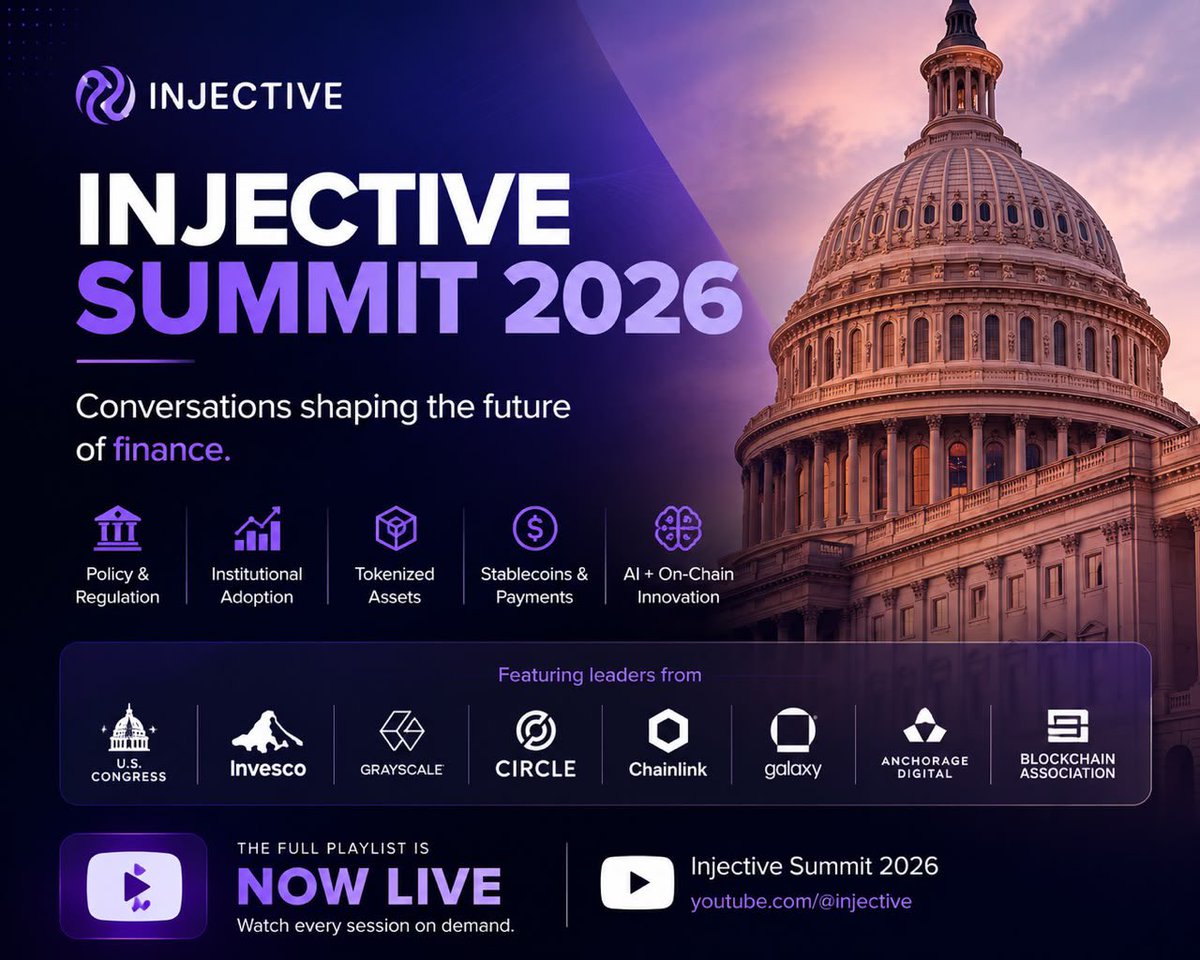
The full @injective Summit 2026 playlist is now live, featuring conversations with policymakers, asset managers, crypto pioneers, and infrastructure providers shaping what’s next for digital finance.
One thing stands out immediately: the quality of the speakers.
Leaders from Invesco, Grayscale, Circle, Chainlink, Galaxy, Anchorage Digital, the Blockchain Association, alongside members of the U.S. Congress, all shared one stage.
This isn’t just about crypto, it’s about where global finance is heading.
A recurring message throughout the summit is that tokenization is moving from theory to implementation.
RWAs are no longer a niche concept.
Institutions are actively exploring how blockchain can modernize capital markets through faster settlement, improved liquidity, greater transparency, and always-on financial infrastructure.
Another major discussion focused on stablecoins.
They’re evolving beyond trading tools into essential payment infrastructure, enabling faster settlements, seamless cross-border transfers, and more efficient movement of capital.
It’s a shift that could redefine how value moves across the internet.
Regulation was another key topic.
Instead of asking if digital assets will be adopted, many conversations centered on how to build compliant frameworks that encourage innovation while giving institutions the confidence to participate.
That change in narrative says a lot about where the industry is today.
For Injective, the summit reflects a broader vision.
Building infrastructure that supports:
• Tokenized real-world assets
• Institutional-grade finance
• AI-powered applications
• High-performance DeFi
• Open and interoperable financial markets
The goal isn’t simply to improve finance, it’s to rebuild its foundation on-chain.
The future of blockchain won’t be shaped by speculation alone, it will be shaped by collaboration between builders, regulators, institutions, and innovators.
If you want to understand where the industry is heading over the next few years, the Injective Summit 2026 sessions are well worth your time.
Sometimes the most valuable alpha isn’t a chart, it’s a conversation.
JUST RELEASED🔥 : The full Injective Summit playlist is officially live.
Hear directly from members of Congress and leaders from Invesco, Grayscale, Circle, Chainlink, Galaxy, Anchorage Digital, Blockchain Association and more.
Every session is now available on demand.
Huge shoutout to the latest creators stepping up from our ambassador search:
🥷 @Tebasv2
🥷 @XPharmax
🥷 @RahmonHammed7
🥷 @ihojae212644
🥷 @Iamsolenzy
Missed out on the first Injective wave?
We're opening up Round 2 right now.
If you want in on monthly $INJ rewards, Ninja Pass perks, and early beta access, now’s your chance.
🔗 Drop into the Discord and introduce yourself: https://t.co/Cgo18UYkgK
Connecting to Silvana just got easier.
@Walley_App is now supported⚡️
Connect with your preferred wallet provider and get straight into the platform – whether you're trading, exploring EarnHub or checking out the latest updates.
Welcome, Walley users👋
⚙️AI agents are moving beyond screens. Robots are moving beyond commands.
This demo shows the full flow: a user initiates a task, AEON AI Payment handles the settlment, and Fabric's RoboPay enables the robot to actuate in the real world.
As AI agents become economic actors and robots become economic participants, AEON and @FabricFND are building the payment rails that connect them.
Together, we're connecting agent-to-merchant and agent-to-robot payments to enable a new machine economy where autonomous agents and robots can transact and work together.
One of Web3's leading wallets @wallet is now powering AI agents on AEON.
The AEON AI Gateway now integrates OKX Agentic Wallet, bringing secure wallet infrastructure to autonomous AI payments.
Together, AI agents can seamlessly discover, pay for, and access AI services, APIs, x402-enabled resources, and digital tools, all from one unified workflow.
https://t.co/11npmBNeJ3
A real agentic workflow:
Prompt → Service Discovery → Autonomous Payment → Task Execution.
With the AEON AI Gateway and OKX Agentic Wallet @wallet, AI agents can securely pay for the services they need using onchain wallets, unlocking seamless access to AI tools, APIs, and x402-enabled resources.
Watch it in action. 👇
Everyone keeps talking about AI, but I think tokenization deserves just as much attention.
Some of the world’s biggest financial institutions believe tokenized assets could become a multi-trillion-dollar market over the next decade.
And @injective is quietly building for that future.
Think about the assets we use every day stocks, bonds, real estate, funds.
Now imagine being able to move and trade them on-chain with the same ease as sending crypto.
That’s what tokenization is all about: making traditional finance faster, more transparent, and accessible 24/7.
What caught my attention is that these projections aren’t coming from crypto companies.
McKinsey, Citi, BCG, ARK Invest, and Standard Chartered all see massive growth ahead for tokenized assets.
They don’t all agree on the exact number, but they agree on one thing: this market is getting a lot bigger.
This is why Injective has been doubling down on infrastructure.
Fast transactions, tiny fees, a native on-chain order book, and cross-chain support aren’t just nice features, they’re exactly the kind of tools institutions will need if tokenization goes mainstream.
The other piece people often overlook is regulation.
Financial institutions won’t bring trillions of dollars on-chain without clear compliance.
That’s why Injective’s work around MiCA in Europe and its SEC transfer agent registration efforts in the U.S. feels like an important step, not just another headline.
If tokenization really becomes the next chapter of finance, the winners won’t just be the assets.
The real value could be in the networks that make issuance, trading, and settlement seamless behind the scenes.
That’s the lane Injective is aiming for.
We’re still early, but it’s becoming easier to see where things are heading.
The conversation has shifted from “Will tokenization happen?” to “Which blockchain will power it?”
Injective is making a strong case that it wants to be one of those networks.
$INJ is definitely one to keep an eye on.
While most people focus on token prices, Injective is investing in something far more valuable: developers.
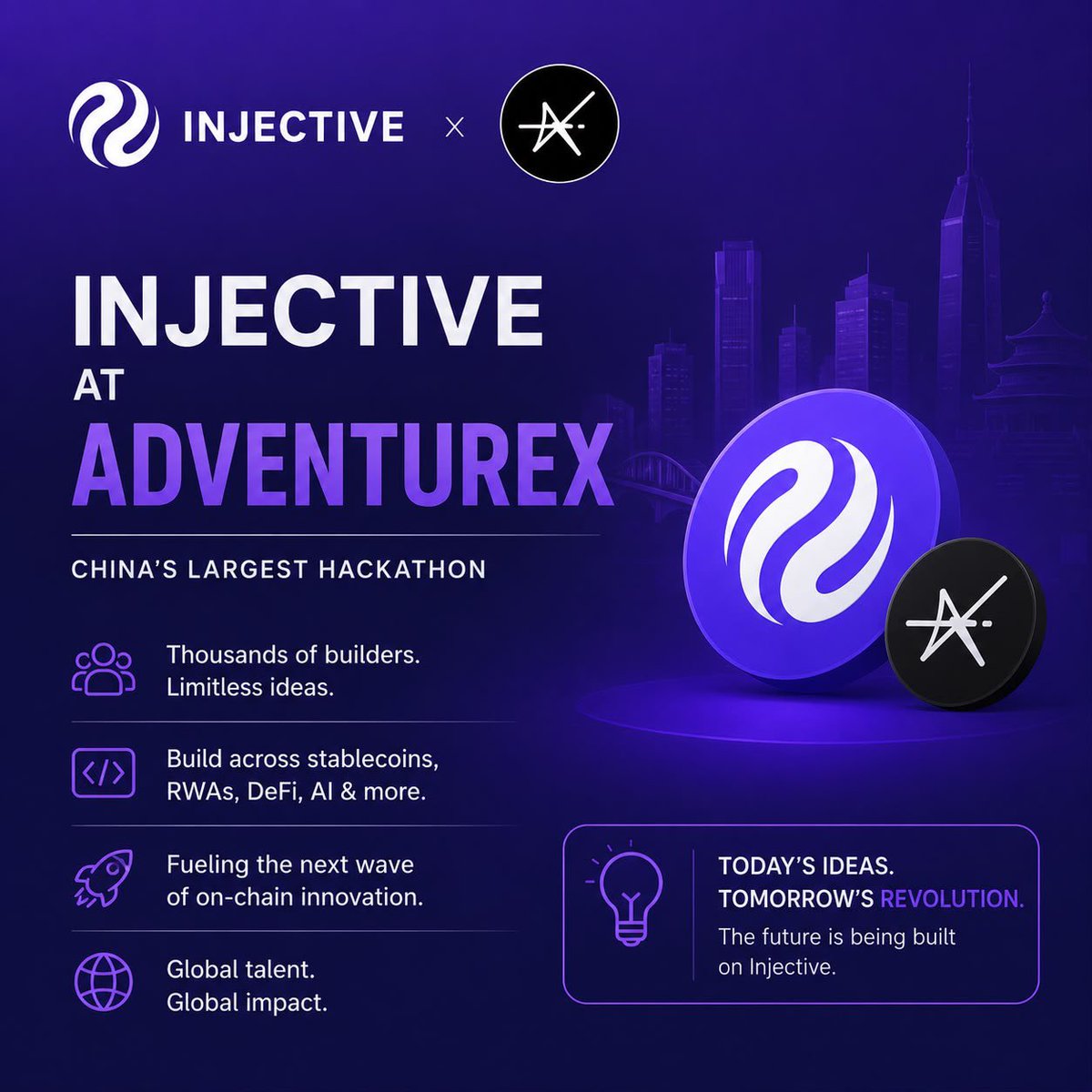
This week, @injective took the stage at @adventurex_plan, China’s largest hackathon, introducing thousands of builders to the infrastructure powering the next generation of on-chain finance.
AdventureX isn’t just another tech event.
It’s one of China’s biggest hackathons, attracting thousands of developers, founders, and innovators who spend days turning ideas into working products.
These are the people building tomorrow’s blockchain applications.
Injective showcased how developers can build across multiple sectors using its infrastructure, including:
• Stablecoins
• Real World Assets (RWAs)
• DeFi
• On-chain trading
• AI-powered financial applications
The goal isn’t just to demonstrate technology, it’s to inspire developers to build with it.
Every successful blockchain ecosystem has one thing in common:
A thriving developer community.
The more builders experimenting on a network, the greater the chances of launching new apps, attracting users, increasing liquidity, and creating lasting ecosystem growth.
That’s exactly what events like AdventureX are designed to achieve.
China continues to produce some of the world’s strongest engineering talent.
By engaging directly with developers at Adventurex, Injective is planting the seeds for future innovation, connecting with builders who could create the next generation of financial applications on-chain.
This isn’t an isolated effort.
It fits into Injective’s broader vision of expanding its global developer ecosystem through hackathons, education, AI initiatives, institutional finance, and tokenized assets.
Growth starts with builders, not hype.
Infrastructure wins when people actually build on it.
Today’s presentations could become tomorrow’s breakthrough applications.
Injective isn’t just attending hackathons, it’s investing in the builders who will shape the future of decentralized finance.
The ecosystem grows one developer at a time.
Regulation is becoming a major advantage in crypto, and @injective is embracing it.
With an SEC Transfer Agent filing in the U.S. and a MiCA whitepaper in Europe, Injective is building the foundation for regulated on-chain finance across two major markets.
The SEC Transfer Agent filing is a big step.
Transfer agents maintain ownership records, process transfers, and manage shareholder records.
Injective aims to bring these functions on-chain for tokenized assets.
It’s worth noting that this is a filing, not an approval.
The application is still under SEC review, but if approved, it could position Injective as a key infrastructure provider for regulated digital securities.
In Europe, Injective has published its MiCA whitepaper.
This aligns the project with the EU’s crypto framework, making it easier to expand through regulated channels across Europe.
These developments support the growth of tokenized Real World Assets (RWAs), including:
• Stocks
• Bonds
• Real estate
• Private equity
A strong foundation for institutional adoption.
Injective isn’t just competing on speed and low fees.
It’s combining blockchain performance with regulatory readiness, an approach that could attract more institutional participation over time.
The bigger picture:
• SEC Transfer Agent filing
• MiCA compliance
One strategy, two major markets.
Injective is positioning itself for a future where traditional finance and blockchain operate together.
ICYMI: Injective has filed its Transfer Agent License with the SEC and published its MiCA whitepaper in Europe.
This allows Injective to expand its RWA offerings alongside $INJ through regulated rails across the U.S. and the EU.