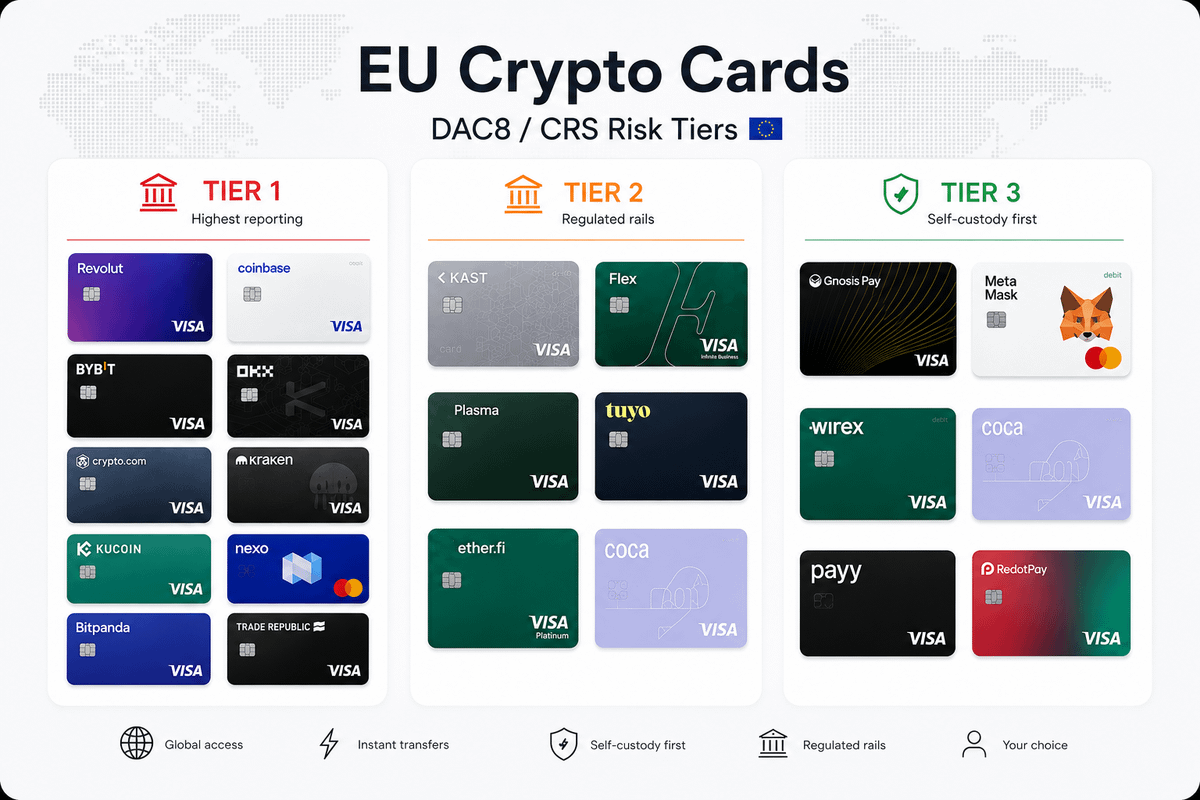
The tier list is useful. The reporting unit is not the card brand.
CARF/DAC8 starts with the RCASP: which legal entity actually provides or controls the service effectuating the crypto-to-crypto or crypto-to-fiat exchange for the customer.
The Visa sticker sits downstream of that.
Non-custodial ≠ automatically out of scope.
No MiCA licence ≠ no CARF/DAC8 nexus.
An EU IBAN can add a CRS layer. It does not do so by itself.
So after a top-up, ask:
1. Which entity provided the exchange service?
2. Where does that entity have its reporting nexus?
3. Which entity maintains the fiat account or IBAN?
4. Did the transaction fall in a year when that jurisdiction’s rules were already live?
For DAC8, 2026 is already the first reporting period. First exchanges are due by 30 Sep 2027.
Card → flow → legal entity → function → nexus → year.
That is the map. Card branding is not.
EU Crypto Cards: DAC8 / CRS Risk Tiers 🇪🇺
European crypto regulation is changing fast.
With DAC8/CARF starting to apply from 2026 and CRS already covering many financial accounts, the important question is no longer just “Is this card self-custodial?”
You need to understand who holds your funds, who performs KYC, who provides the crypto rails and whether you have an EU financial account.
Here’s how I’d split the major cards 👇
TIER 1: Highest reporting exposure
Platforms with their own EU crypto entity / CASP layer:
@Revolut@coinbase@krakenfx@Bybit_Official@kucoincom@okx@cryptocom@Bitpanda@DeblockApp@TradeRepublic@Nexo
If your KYC, crypto balance, swaps, deposits and withdrawals all happen inside the platform, reporting exposure is generally higher.
TIER 2: Card ≠ CASP, but regulated rails exist
The card itself may not be a CASP, but the infrastructure can involve Bridge, a bank, EMI or another regulated provider:
@KASTxyz@ether_fi Cash
@Plasma@itstuyo
Who handles your EU KYC, fiat account and crypto rails?
If you receive a personal EU IBAN, CRS/DAC2 can become relevant in addition to DAC8.
TIER 3: Self-custody first
Your crypto remains in your own wallet, while the card acts mainly as the payment rail:
@gnosispay@MetaMask Card
@wirexapp@coca_card@payy_link@RedotPay
But remember:
Self-custody ≠ no reporting.
@gnosispay keeps assets in your Safe, but its banking layer can involve
@MetaMask Card can see the payment transaction without automatically having access to your entire on-chain portfolio.
@wirexapp describes its crypto wallet as non-custodial, while fiat services can involve regulated EMI partners.
@coca_card / @payy_link and @RedotPay operate with different jurisdictions and partners, meaning different regulatory exposure, not zero exposure.
Other cards to check separately
@useTria@BleapApp@1inch@solflare@holyheld@oobit
Their issuer, CASP/EMI partner and jurisdiction can change the picture.
DAC8 may not directly see your self-custody wallet, but an exchange, CASP, EMI or bank can still have reporting obligations around the parts of your financial activity they handle.
In Europe, the safest approach is simple:
Don't look at the card. Look at where your money goes after you top up.
Most global platforms still ask “which country do we file in?”
Wrong first question.
The first question is which legal entity actually effectuates the transaction, and in which year that nexus becomes live.
CARF nexus is not HQ.
It is not the licence.
It is a cascading test, not a snapshot: residence, incorporation, management, regular place of business, branches, then Partner Jurisdiction status. It shifts when management, branches, or the Partner Jurisdiction list change.
Singapore’s rules are now on the page: 2027 data year, first exchanges 2028.
If you have a Singapore entity or a real place of management here, 2026 is when you build the map. Not 2027.
@FinTax_Official
Seed round, led by @yzilabs.
The date that matters is 2027, when the first CARF exchanges and DAC8 filings begin. But 2026 is already the data collection year.
Most platforms still treat reporting as a year-end export. It isn’t. It’s a data infrastructure problem.
YZi Labs Leads FinTax Seed Round, Launching Long-Term Ecosystem Collaboration
On August 27, FinTax, a provider of cryptocurrency financial and tax solutions and AI-powered infrastructure, announced the completion of its Seed funding round. The round was led by @yzilabs through @EASYResidency S4, with participation from @ambergroup_io , @hashhousetech@PundiAI ,Waverider International, and Nexus Holdings, bringing FinTax’s post-money valuation to US$40 million. Investors in previous rounds include Victory Courage, @Bgin_Blockchain , Tools Factory, and individual investor Chao Fan.
In recent years, YZi Labs has continued to expand its investments across stablecoins, RWA, payments, and institutional-grade digital asset infrastructure. Building on FinTax’s expertise in on-chain data processing, crypto accounting, cross-jurisdictional tax practice, and financial auditing of crypto assets, the two parties will explore long-term ecosystem collaboration around institutional-grade financial and tax infrastructure, compliance standards, and emerging use cases such as stablecoins, RWA, and payments. The collaboration will further strengthen FinTax’s ties with YZi Labs and its broader ecosystem partners.
Following the completion of this round, FinTax will accelerate the scaling of its five core product lines, expand its business from Asia-Pacific and North America into Europe and the Middle East, and deepen the application of AI in complex financial and tax scenarios.
The next decade will be defined by the convergence of blockchain and legal frameworks. Across dozens of jurisdictions, FinTax will continue to advance the parallel evolution of blockchain infrastructure and legal systems, connecting on-chain economic activity with real-world financial, tax, and broader financial systems, and helping blockchain move from technological consensus toward broader social consensus.
Grateful to @cz_binance, @yzilabs, @ellazhang516 and the entire @EASYResidency team for the support and an unforgettable journey in Bhutan. 🇧🇹
Demo Day is just the beginning.
At @FinTax_Official , our vision is to help blockchain move from technical consensus to social consensus — by building the financial, tax, and compliance infrastructure that connects the crypto economy with the real world.
Keep building. 🚀
Today I stood on a stage in Thimphu and gave FinTax’s 3 minute pitch, with @cz_binance and His Majesty the King of Bhutan in the room.
What we told them: 76 tax authorities have switched on crypto reporting. Platforms owe no tax. They owe data. And we deliver it, in every jurisdiction.
Special thanks to @ellazhang516, who pushed us to sharpen our story until a room full of investors could feel it. And to @jeffrey_hu, @cathyincubates and the whole @yzilabs@EASYResidency team for an unforgettable 10 weeks.
Demo Day done. Now we ship.