Depression is just the repressed knowledge that you’re living beneath your potential and/or not in line with your inner conscience.
Anxiety is actually a form of entitlement.
"Hitting is fun again!"
It’s one of my favorite things to hear from a player.
The truth is, most hitters don’t come to me because everything is going well.
They come because the game that once brought them joy has become frustrating, confusing, and mentally exhausting.
They’re thinking too much.
Pressing too hard.
Trying to fix everything at once.
Some have even started questioning whether they’re good enough anymore.
So we don’t just rebuild the swing.
We rebuild the HITTER.
And the PERSON.
We simplify. We create clarity. We remove the noise. We help them trust themselves again. We reconnect them with WHY they loved this game in the first place.
When that happens, something changes.
The barrel starts finding the baseball again.
The confidence returns.
The smile comes back.
And the words I love hearing most are:
“Hitting is fun again.”
Because when a hitter is free, they’re often at their best.
#GoodBatting
Will Clark on why he won’t coach:
“People ask me why I don’t get into coaching or get into managing and all that, I am not going to pat you on the back and tell you you’re doing a good job when you’re hitting .220 and you strikeout 100 times. You actually suck. I’m gonna tell you that you suck. I’m going to tell you to make a fucking adjustment and if you don’t make an adjustment, you’re going to the minor leagues and somebody else is going to go take your spot. Sorry, that’s the way the fucking game goes. This is a big boy game. Not a little boy game. And you have to have fucking thick skin. If you don’t have thick skin, get out the way because I’m gonna fucking steamroll you.”
Students are earning higher grades than ever. They’re also learning less.
In 2024:
• 45% of U.S. high school seniors scored below basic in math
• Only 35% were proficient in reading
Grades are rising. Achievement isn’t.
Source: Brookings Institution & NAEP
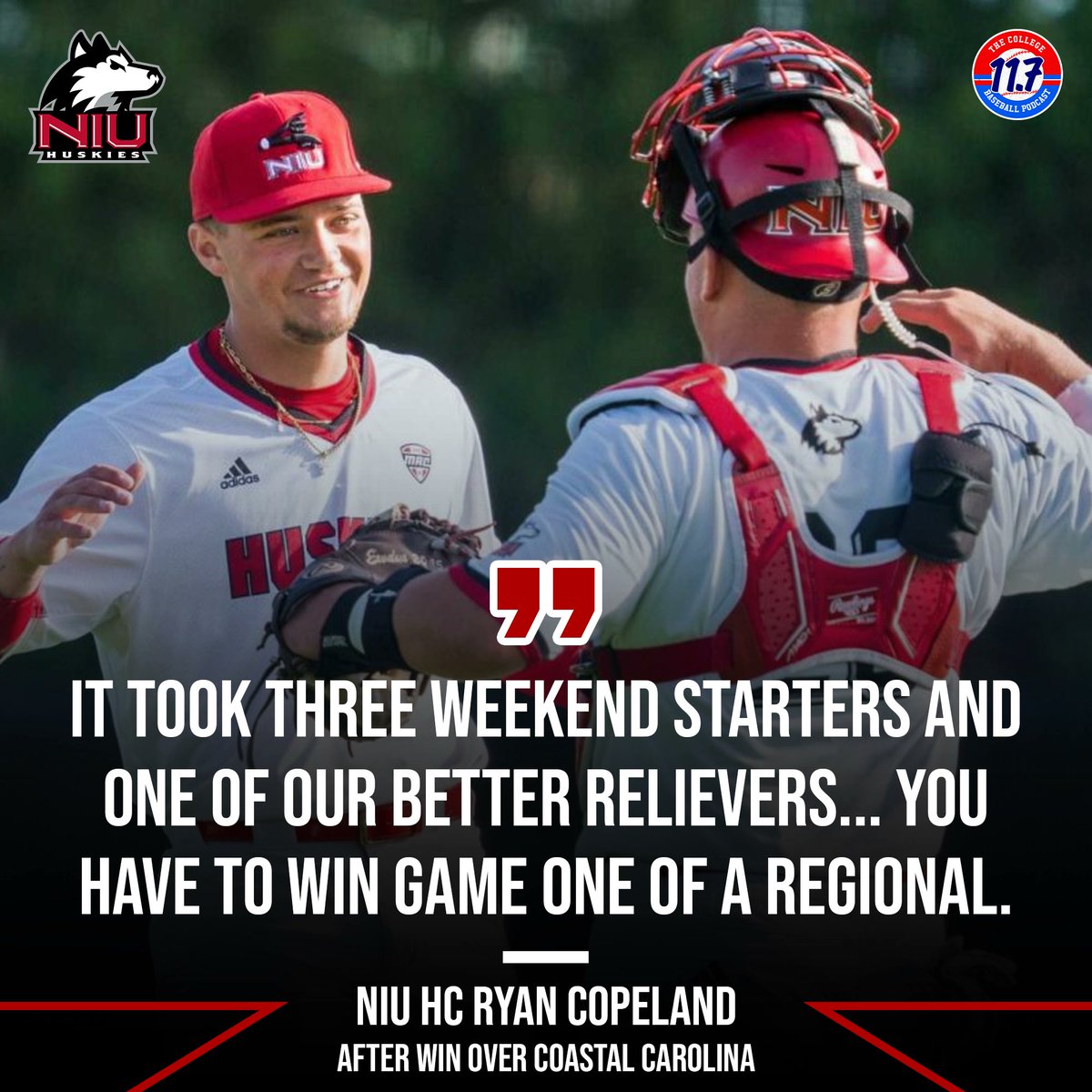
Northern Illinois used all 3 weekend starters to beat Coastal Carolina and win program's first EVER NCAA tournament game last night.
WHATEVER IT TAKES 🔥
A hitting coach operates on the threshold of excellence because they refuse to accept mediocrity.
They understand that helping hitters grow requires more than quick fixes or surface-level answers. The first explanation is rarely the full truth, so they learn to dig for facts—studying swings, listening to players, understanding emotions, and identifying what’s really creating success or failure. Once the facts are clear, the right action becomes clearer.
A great hitting coach develops a sixth sense for what will work and what won’t—not through guesswork, but through experience, observation, and constant learning. They know when to push, when to simplify, when to challenge, and when to just listen.
They tenaciously use every opportunity to help players reach their goals through communication, trust, and relationships. They understand the art of connecting with people, because coaching is never just mechanics—it’s managing confidence, accountability, preparation, and belief.
A hitting coach knows they must empower players to take ownership of their own development, but they never lose touch with the details. They teach independence without abandoning guidance.
The main difference between a hitting coach and someone who just gives lessons is attitude.
One is committed to transformation, the other is just providing information.
Georgetown HS head baseball coach Rod Sanders could have gone the easy way. Jumped on a plane to Cincinnati to see his brother Reggie go into the @Reds hall of fame on Saturday.
He went, the hard way. Taking his entire varsity team, and coaches to Cincinnati to share the moment.
Let his real family meet his baseball family. Let kids who had never flown, fly. Players who had never been to an MLB game, see a meaningful one. What a journey.
I asked Dan Hurley the same question I asked Tom Izzo: why does the media have a problem with coaches coaching players hard?
Hurley: "Society has gotten soft in a lot of ways... The real world is tough and cruel... I'm preparing my players for life."
People will try and poke holes in your career on and off the field.
People are always looking to find something about you in order to add to or subtract from their scorecard.
Too many people waste time and effort trying to convince others how to think, act, play the way they do. They are scared by different. They are scared by originality. They don’t know how to react to someone being genuine. They discard the idea of being authentic because it threatens the very existence of their conformity.
We are constantly told to play a multiplayer competitive game, both in baseball and in life. But what if we were to remove ourselves from the masses and start playing the singular game?
When it seems like everyone else is keeping score and evaluating your every move, just remember that the only scorecard that really matters in life is the one you keep for yourself. Everyone will have their opinions and they are entitled to that. But they are just that – opinions. When you put your head on the pillow at night, be at peace knowing the game of life you’re playing doesn’t fit into everyone’s playbook.
Understand that life and baseball are played from the inside out.
All the real scorecards are internal.
How to create an elite athlete:
1 Screen individuals for a set of sports very young according to morphology and other critetia, including basic athletic and skill testing, slj, throwing etc.
2 Develop basic skills + fundamental athletic and locomotor skills relevant to those sports
3 Further separate youngsters into individual sports - deeper development of fundamentals of that sport, strength, movement patterns, power, technique, endurance, etc
4 After a period of training (~1 year) weed out the slow responders.
5 Full specialisation of remaining individuals, developing gross and fine motor skills, physical and metabolic requirements. Appropriate nutrition and muscular development.
Many sports have overlapping requirements s.a. speed, quickness, agility, power, endurance, high tolerance to fatigue and injury, psychological and competitive toughness etc.
This is difficult to do in democracies because the State can't force this upon youngsters, and people have more choice. China used to take 1000s of youngsters, barely taller than the table and get them to hit table tennis balls 6 hours a day, 6 days a week. Parents sent their kids thousands of miles to these academies. I saw a documentary on it, it was insane. I understand the set-up has changed a lot.
Teach general AND specialised (for the chosen sport/s) at an early age, if you wait to long to specialise, the movement patterns wont be optimised.
If you want your child to maximise their potential in hockey, tennis, table tennis, swimming, ballet, football, gymnastics, tap-dancing...any sport - teach them the sports fundamental movement patterns when they are young. Do it in an unloaded fashion as they are not physically mature enough to handle load. At the same time they can be getting all-round ability development. Generalisation then specialisation is not the way forwards. Do both, weighted appropriately for age.