“Why are councils fucking taking more money off me and doing less?”
People don't realise how much councils spend on social care – they just see services declining
So they land on an understandable, if unfair, conclusion: councils are wasting their money
https://t.co/mdnUUkZJ4T
Worsening affordability & widening inequality are often cited as reasons for rent control
But international examples tell us that, far from fixing things, rent control can make these problems worse
My piece for @redbrickblog on what the experience of other cities can teach us
What can England learn from international experience of rent controls?
From Berlin to San Francisco, @JenMTreadwell at @lse_london examines who benefits, what happens to housing supply, and the difficult trade-offs involved in regulating rents.
https://t.co/AR6Zfksc3g
Businesses do initially benefit. But this only lasts until they renew their lease or go through a rent review
After that, landlords set rent at a higher level to capture how much the tenant is actually willing to pay
So the cut effectively becomes a landlord subsidy
I’m giving thousands of pubs, clubs and music venues a 20% cut in business rates.
I won’t stand by while these cherished local spaces disappear, replaced by boarded-up windows and ‘For Sale’ signs.
They’re the heart of our communities and it’s time we backed them.
Business Rates look like a tax on doing business, so people assume that cuts work by making it cheaper to do business
But Business Rates are a property tax, so cutting them is just a subsidy for those who own the property
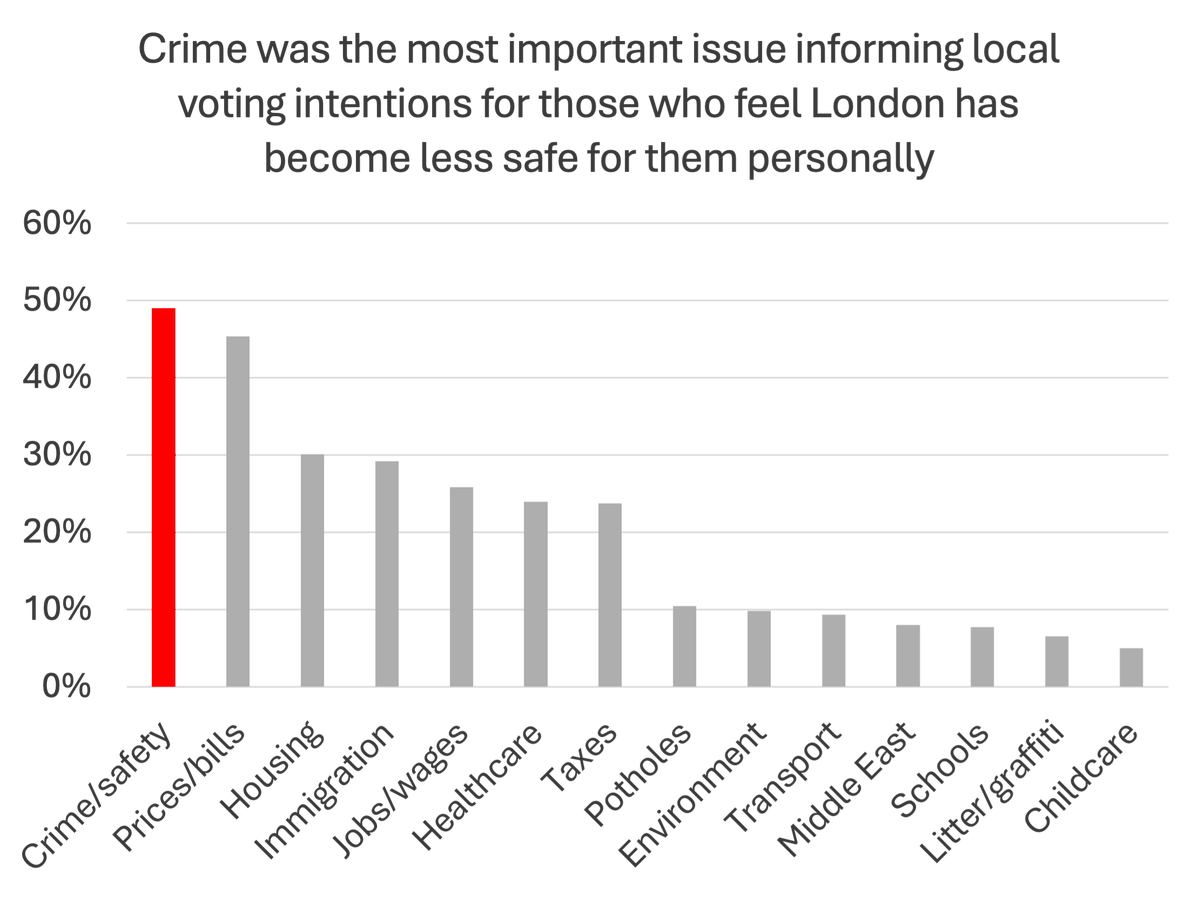
Unsurprisingly, tackling crime is a priority for those who feel unsafe
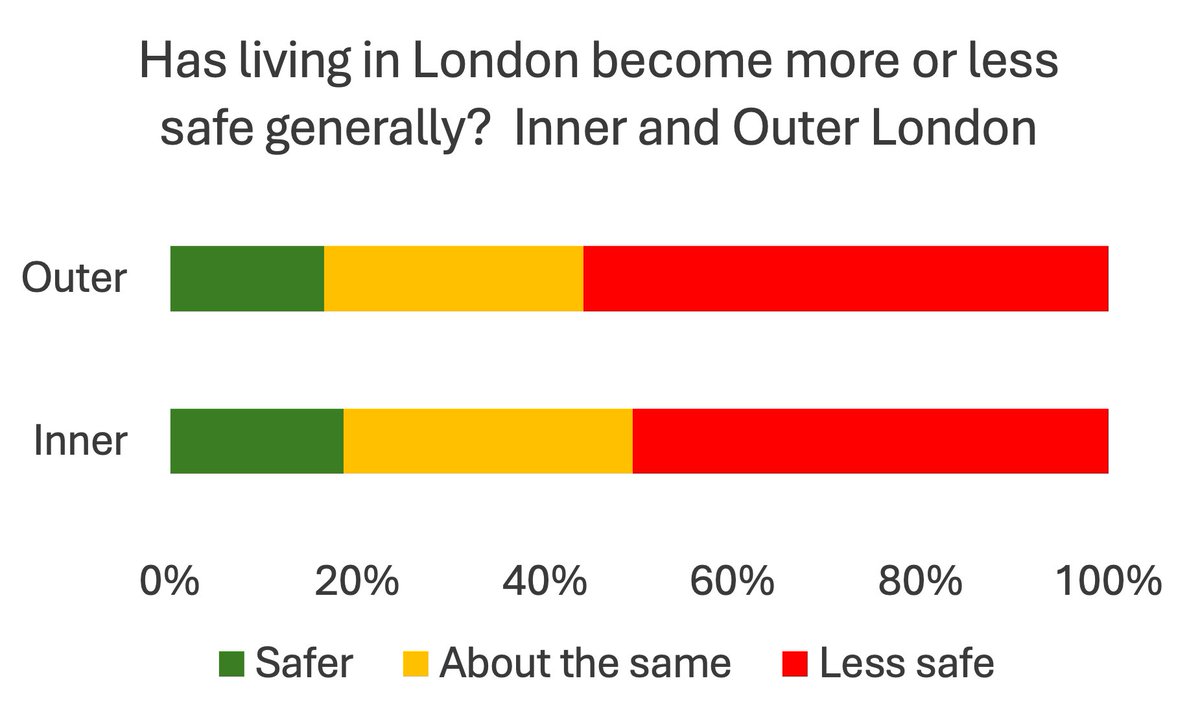
Nearly half of those who feel London is becoming less safe named crime as a top issue at the local elections
But so too did a third of those who feel London is becoming safer for them personally
Crime anxiety in London goes beyond the fear of being a victim yourself. It's a broader feeling that the city is becoming unsafe and in decline
Here's what LSE's polling says about Londoners' experiences of crime
How safe do Londoners feel in the capital?
Our Policy Fellow, @JenMTreadwell, speaks to the Evening Standard about new polling commissioned by LSE on perceptions of safety in London.
Read more:
https://t.co/0ZnIa2Mjp1
#LSEPublicPolicy
Londoners are undeniably concerned about crime
The feeling that safety is declining is shared widely, with more people believing Ldn is becoming less safe than safer across income groups, ethnicity, gender, & age
We should be able to forgive MRPs for missing these internal dynamics – that's not really what they're designed to do
But when commentators & parties treat them as a prediction for control, it can lead to misunderstandings, & in the case of parties, misallocation of resources
London polling ahead of local elections was broadly good, but the interpretation often assumed that vote share translates neatly into council control
It doesn't. And that's a lesson insurgent parties & commentators need to learn
https://t.co/wAAYXWXLH4
Me in @LSEpoliticsblog
Reform's ~30% was fairly stable across the borough. It's enough to be competitive almost everywhere, but rarely enough to finish first
MRPs can't pick up the internal quirks which are central to local elections, so they average the support to estimate borough-wide vote shares
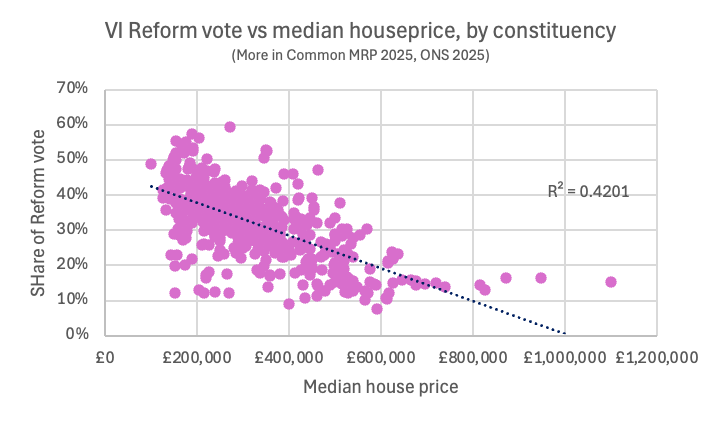
House prices indicate an area's strength. When an area is struggling, people feel locked into a declining area & resent it
Our 'place' shapes our values & politics. So, immigration becomes a tool to explain an area's loss of status: if I'm losing, someone else must be winning
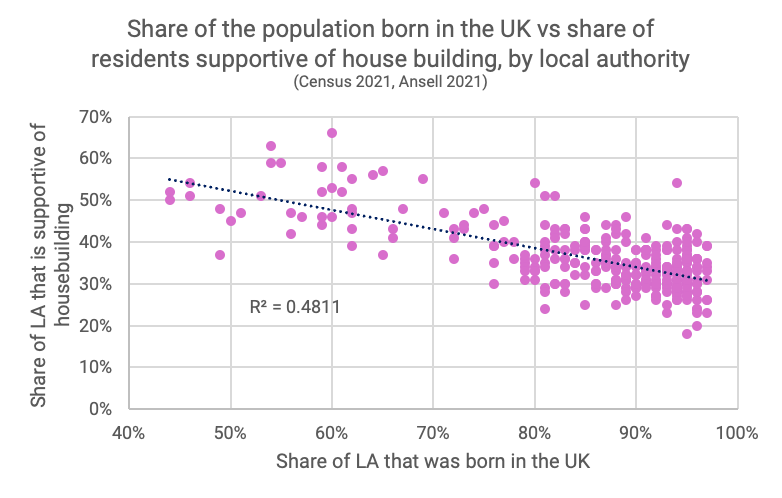
There’s a view floating around that immigration is a fundamental obstacle to YIMBY & pro-growth politics
The idea is that migration drives housing scarcity, which destroys consent for housebuilding as ppl fear only migrants will benefit
I've had a look at how this holds up👇
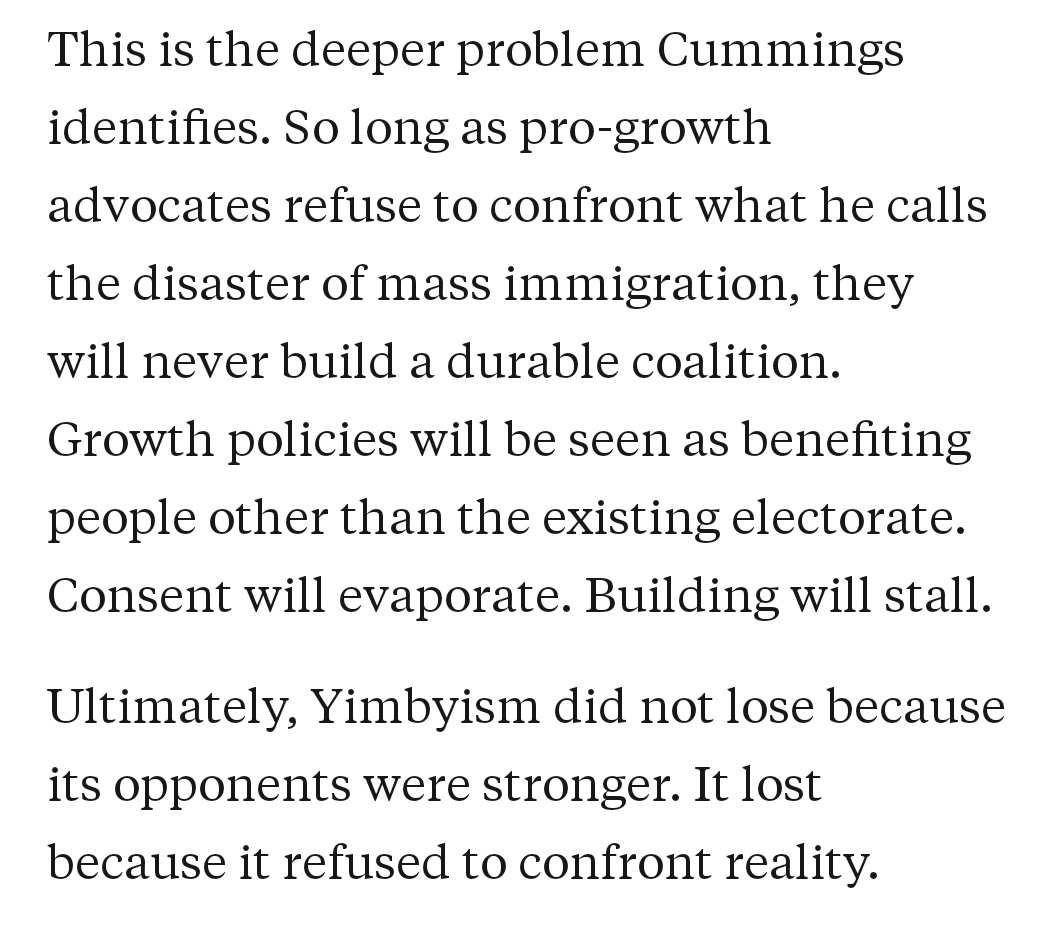
"So long as pro-growth advocates refuse to confront mass immigration, they will never build a durable coalition"
More on this today from @CJAWorrall on why YIMBYism failed.
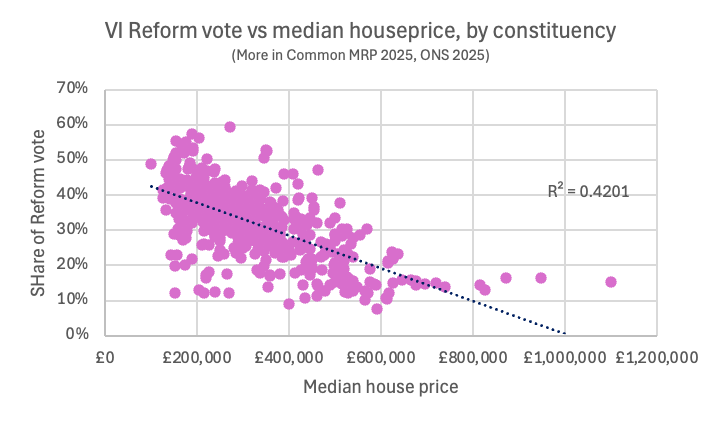
We can see this clearly when we plot Reform's vote share against local house prices. Reform does best where housing is cheapest, not where immigration pressure on housing is highest
House prices are actually a better predictor of Reform vote than average income
@Moreincommon_