Ambassador and author of books. Ex Foreign and Security Policy adviser to two prime ministers. Substitute State Secretary for Defence. Representing myself.
Ja, saker och ting kan få fel om Ryssland felkalkylerar:
”… Donald Tusk, the Polish prime minister, is not necessarily wrong to warn of the risk that something could go seriously wrong and end up costing lives, even if only through a Russian miscalculation.”.
https://t.co/8VCzCGQBrT
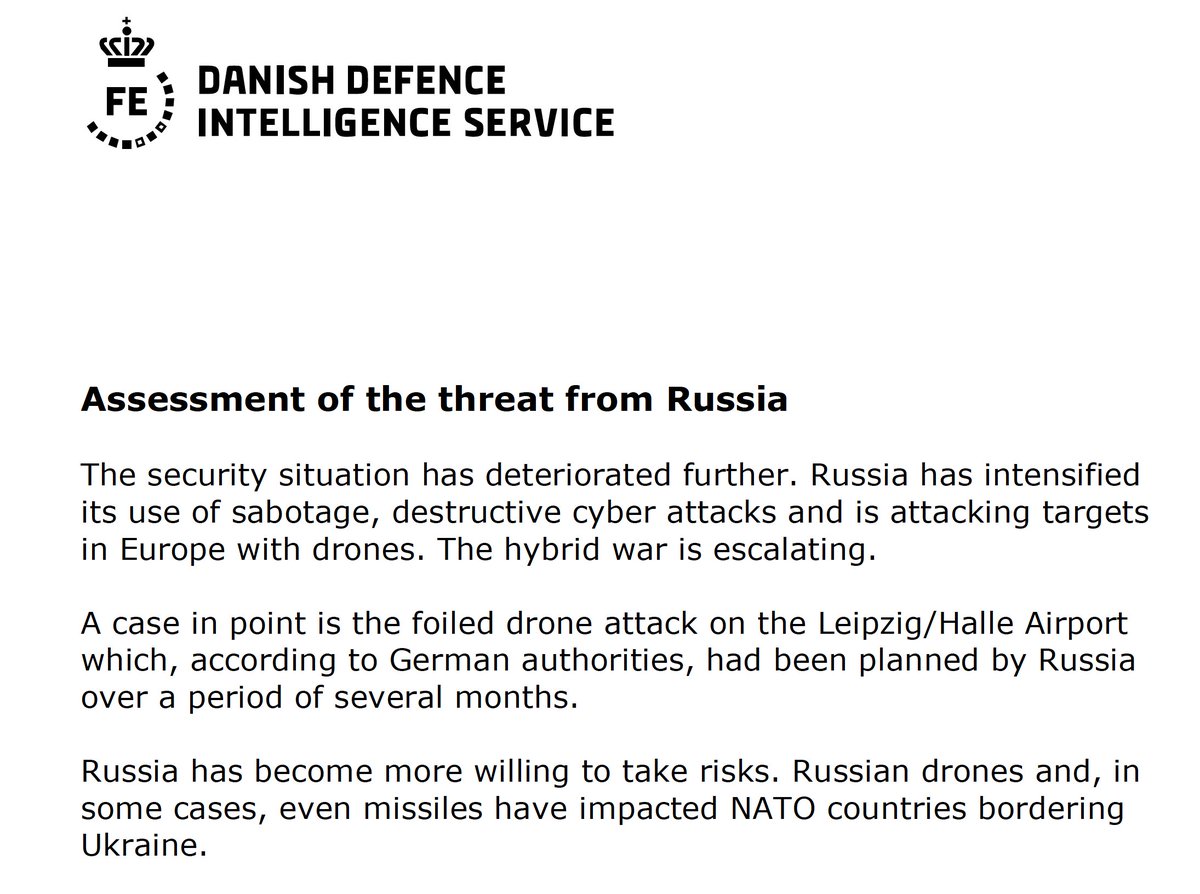
Läs denna sammanfattning och analys av den danska underrättelserapporten. Det räcker med ett parti i Regeringen som (på sikt) vill lämna Nato (MP). Så håll det andra (V) som också vill lämna utanför.
Excellent news that EU Member States have reached a formal agreement today to release 6.6 billion euro from the European Peace Facility for Ukraine.
Sweden’s position is clear: we need to increase the support to Ukraine and the pressure on Russia. That is the only way forward.
Läs denna sammanfattning och analys av den danska underrättelserapporten. Det räcker med ett parti i Regeringen som (på sikt) vill lämna Nato (MP). Så håll det andra (V) som också vill lämna utanför.
I'd encourage everyone to read the Danish military intelligence assessment in full, and not rely on excitable social media upsums.
Here is the top line: "The Danish Defence Intelligence Service (DDIS) assesses that Russia will intensify its hybrid war by carrying out more frequent attacks against the West and NATO, with greater consequences for the targeted countries than in the past. This could include destructive cyber attacks that cripple critical societal functions as well as sabotage attacks that carry a high risk of casualties."
In other words, Russia will continue doing what it's already doing (terrorist attacks against hard and soft targets, cyberoperations), only more so. This is an uncontroversial assessment across Western intelligence services, so far as I've been able to determine.
DDIS continues: "At the same time, there is a low but growing risk that Russia will launch a limited military attack against one or several NATO countries bordering Russia....Such a limited military attack could take the form of isolated strikes with long‑range weapons on infrastructure that is vital to the support to Ukraine. In this situation, Russia might then claim that the weapons only struck NATO territory because they were jammed by Ukraine. It could also be a so-called false flag operation, where Russia uses Ukrainian‑made drones to attack a NATO country."
The scenario envisaged here (a low but growing risk) is a plausibly deniable conventional attack by Russia. The objective would be twofold. First, to sow panic and confusion in the targeted country or countries, and encourage skepticism of the official government version of what just happened. "Maybe it was the Ukrainians." "Maybe it was an accident." "Maybe no attack took place and the deep state is trying to foment World War III."
Thirty seconds on this hellsite should be enough to convince you that counterfactual narratives would be easy enough to amplify, especially in countries with elections forthcoming. A "limited military attack" psychologically would just be a heightened form of "hybrid" war because it's designed to overwhelm and demoralize the population and make its think that supporting Ukraine just isn't worth it since those not at war are now liable to become collateral damage.
The second objective of such an attack would be to gauge NATO's response to it -- and this is key bit, because, as DDIS also states:
"Russia will likely carry out military attacks only if it assesses that such attacks will not result in a war by triggering a collective NATO military response. However, Russia is likely uncertain about what could trigger such a war. Consequently, there is a risk that Russia assesses that the NATO countries will not respond collectively, especially if Russia assesses that the United States cannot or will not support the European NATO countries in a potential war against Russia." (Italics added.)
You wouldn't be wrong to detect a hint of political messaging here. (All intel services deny they do any such thing but they all do.) This is Denmark, a country that just stared down a possible U.S. invasion and annexation of Greenland, which would have meant the disintegration of NATO.
Trump has spent his entire second term (and much of his first term) doubting the Inviolability of Article V. His Pentagon has given NATO allies questionnaires to fill out to prove their worthiness as allies, while it undergoes a force posture review with ominous media leaks about what Bridge Colby and his minion might do (25,000 U.S. troops withdrawn, a scuppered U.S. base in Poland, etc.)
Now comes a frenzy of intelligence reporting across Europe about a possible Russian attack on NATO, all kickstarted by a CIA briefing delivered to the Poles, Scandinavians and Balts months ago with a warning that they're probably on their own if and when such an attack happens.
Never let a good crisis go to waste... Russia isn't sure what would trigger a war with NATO, so how might NATO make it sure? A "limited military attack" can be deterred if Washington telegraphs its intent to enforce Article V in word and deed by stating clearly and repeatedly what would constitute a casus belli in 2026 and, of course, by keeping U.S. troops in Europe.
För första gången har Sverige och Finland genomfört en gemensam insats inom det nya samarbetet Quick Reaction Alert, som bland annat gör det möjligt för våra jaktflyg att utgå från varandras flygbaser.
Det är ett konkret uttryck för den beredskap och den tillit vi har byggt tillsammans – och ett uttryck för styrkan i det nordiska, nordisk-baltiska och det bredare Nato-samarbetet i vår del av världen. I ett spänt säkerhetsläge står vi starkare tillsammans.
Östersjön har aldrig varit så utsatt som nu – men heller aldrig varit bättre skyddad än just nu.
Sverige har inte råd att fokusera på annat i utrikes- och säkerhetspolitiken än närområdet inklusive Östersjön. All politisk och diplomatisk aktivitet måste koncentreras till att hålla Sverige utanför krig och bygga allianser. Glöm ”världen utanför Verona”. Ett sätt är att låta försvarsminister Pål Jonson fortsätta på sin post som konsultativt statsråd.
”För medan vi bråkar om struntsaker är kriget på väg allt närmare. Risken är uppenbar att säkerhetspolitiken blir nästa regerings största politiska utmaning”. https://t.co/1PpOK5xM1D
De vet inte bättre. I utanförskapsområdena. De fick en andra chans i vårt land och sumpade den med att älta deras gamla oförrätter - en stor anledning till Vänsterpartiets framgång. De är helt oskyddade vid ett krig hos oss. Beroende av fjärrvärme, vatten, pengaöverföringar, livsmedel och internet. ”De veta inte vad de gör”. Erfarenheten från tidigare krig på kontinenten är att gränser stängs och naturligtvis skulle flygen ställas in. Och de har liksom ingenstans att ta vägen. Det är bara sorgligt.
De vet inte bättre. I utanförskapsområdena. De fick en andra chans i vårt land och sumpade den med att älta deras gamla oförrätter - en stor anledning till Vänsterpartiets framgång. De är helt oskyddade vid ett krig hos oss. Beroende av fjärrvärme, vatten, pengaöverföringar, livsmedel och internet. ”De veta inte vad de gör”. Erfarenheten från tidigare krig på kontinenten är att gränser stängs och naturligtvis skulle flygen ställas in. Och de har liksom ingenstans att ta vägen. Det är bara sorgligt.