Dedicated to my family, serving the public, laughter, spiritual purpose, and the pursuit of knowledge. This is my personal account and the opinions are my own.
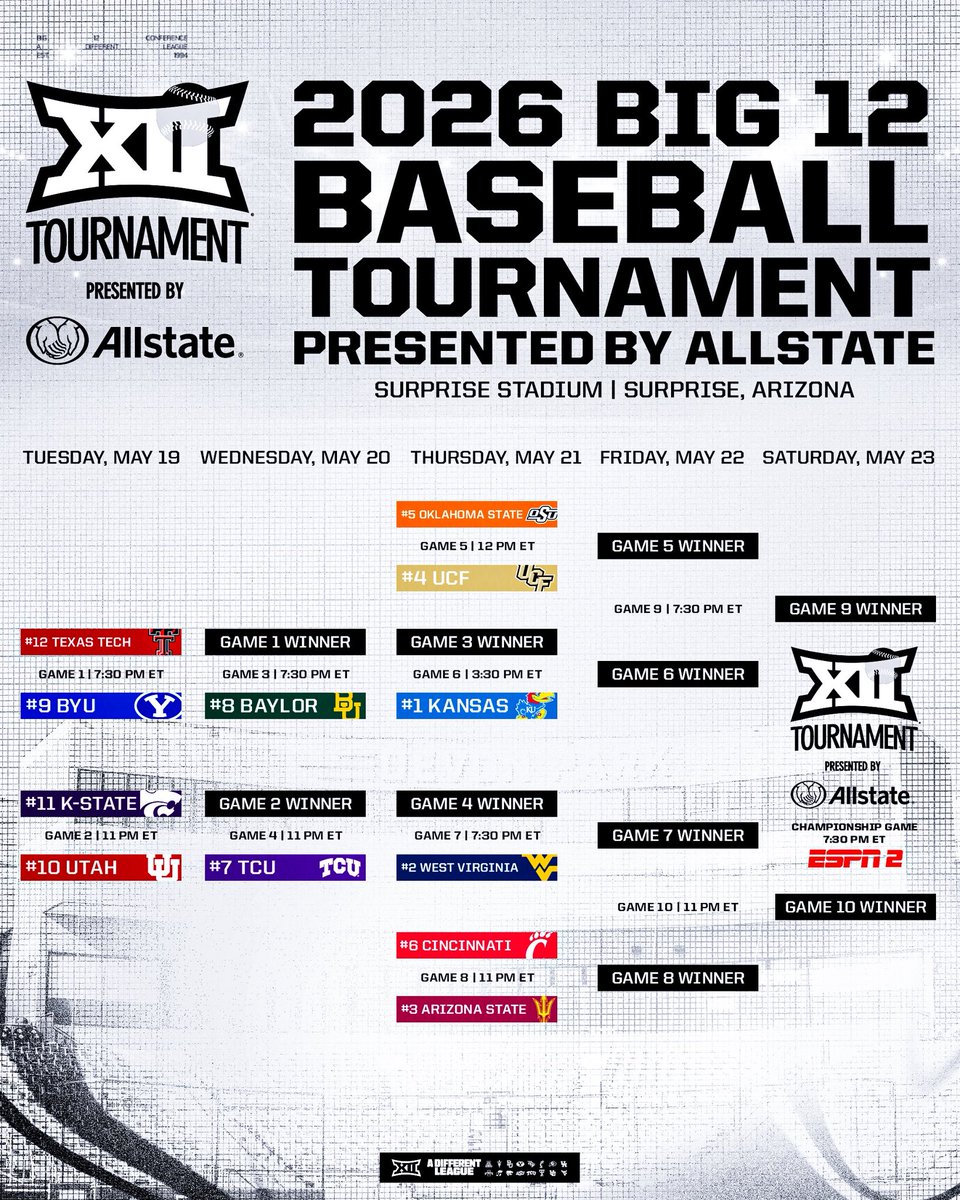
2026 Big 12 Baseball Tournament presented by Allstate Bracket Announced
next stop ➡️ Surprise, AZ ⚾️
ℹ️ https://t.co/Of8WmH4VX9
🎟️ https://t.co/k5zu1QFBS9
May 15, 1864. The Shenandoah Valley.
A Union army marched south to burn the breadbasket of the Confederacy.
Standing in its way: John C. Breckinridge, former Vice President of the United States, the man who had run against Lincoln in 1860, with 4,500 men he didn't have.
Among them, 257 cadets from the Virginia Military Institute. The youngest was 15. They had marched 80 miles in four days to reach the field, sleeping in the rain, eating nothing but hardtack.
Breckinridge ordered them held in reserve. "I will not put those children in," he said.
By afternoon, his center was buckling. He turned to his aide, eyes wet.
"Put the boys in, and may God forgive me for the order."
They advanced through a rain-soaked wheat field. The Virginia mud was so deep it sucked the shoes from their feet. The locals would call it the Field of Lost Shoes forever after.
They didn't run. They didn't break. They charged a Union battery in the open, and took it. One cadet swung the captured gun around and fired it back at the retreating Federals.
10 boys died. 47 fell wounded. The youngest killed was 17.
162 years later this morning, VMI will call their names. A bugler will play. The Corps will stand silent in formation.
They have done this every May 15 without missing a year.
Everyone loves asking: “If Grant was such a great general, how come he lost nearly every battle to Lee and suffered way more casualties?”
Robert E. Lee himself had a very different answer.
“I have carefully searched the military records of both ancient and modern history, and have never found Grant’s superior as a general. I doubt his superior can be found in all history.” — Robert E. Lee
The entire question is built on two flat-out falsehoods.
First: Grant didn’t “lose nearly every battle.” There was essentially ONE continuous campaign — from the Wilderness in May 1864 straight through to Appomattox in April 1865.
Grant seized the initiative in the very first clash and never gave it back. Lee spent the rest of the war reacting to Grant’s moves.
When Lee attacked in the Wilderness hoping the old forests and bogs would save him (like they always had), Grant didn’t retreat north like every previous Union commander. He simply disengaged, slid south, and flanked Lee again.
Lee never dictated the terms of battle after that day.
James Longstreet had tried to warn the Army of Northern Virginia: “We’ve never faced anyone like this man.” They didn’t listen. They learned fast.
Second: The casualty comparison ignores that Lee was almost always the defender. Context matters.
But the deeper truth is bigger than any single clash. Lee still fought war the old way — disconnected battles, win-loss record like a sports season.
Grant fought the next war: coordinated campaigns across multiple theaters, using railroads, telegraph, navy, and engineers to keep relentless pressure until the enemy simply could not continue.
Grant didn’t win by accident. He made contact and maintained it until victory was inevitable.
Lee fought the last war. Grant wrote the blueprint for the next one.
That’s why he was great. That's why he won.
Change your mind yet? Drop your hottest take on Grant vs. Lee below. 🔥
He won the Civil War, broke the Klan, went bankrupt at 62, got terminal throat cancer, and wrote one of the greatest books in American literature in the final year of his life. He finished it 5 days before he died.
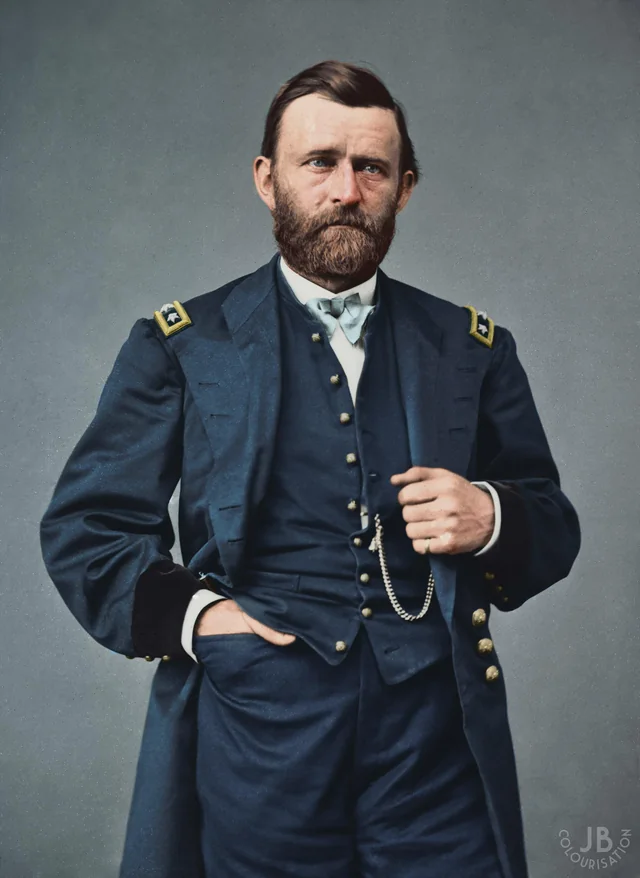
Ulysses S. Grant was born 204 years ago today.
His name wasn't even Ulysses S. Grant. He was born Hiram Ulysses Grant in Point Pleasant, Ohio on April 27, 1822. The congressman who nominated him to West Point wrote down the wrong name. Grant kept it. The "S." stands for nothing.
He hated his father's tannery and loved horses. Graduated 21st of 39 at West Point. Fought in the Mexican-American War, then came home convinced it was an unjust war designed to expand slavery. He later said he believed the Civil War was divine punishment for it.
He married Julia Dent in 1848, into a slave-owning Missouri family. His abolitionist father refused to attend the wedding. In 1859, broke and desperate, Grant freed the one enslaved man he'd briefly owned instead of selling him. He could have gotten a year's wages.
In the Civil War he became what no other Union general was: relentless. Vicksburg (July 4, 1863) split the Confederacy in half. Lincoln then gave him every Union army. His Appomattox surrender terms: officers kept sidearms, men kept horses for spring planting, no one prosecuted.
As president (1869 to 1877) he did something no president would do again until LBJ: used federal troops to crush the Ku Klux Klan. He suspended habeas corpus in 9 South Carolina counties, prosecuted Klansmen before predominantly Black juries, and broke the first Klan.
His presidency was also rocked by scandal: Black Friday 1869. Crédit Mobilier. The Whiskey Ring. Belknap. Grant himself never took a dime. He was just disastrously loyal to corrupt friends. The pattern damaged his reputation for a century.
After the White House, he toured the world for 2 years. Dined with Queen Victoria. Met the emperor of Japan. Then in 1884, a Wall Street partner named Ferdinand Ward ran what we'd now call a Ponzi scheme. Grant was wiped out. 62 years old. Penniless.
Weeks later he was diagnosed with terminal throat cancer. Mark Twain offered to publish his memoirs. Grant wrote in agony, sometimes 50 pages a day, racing the disease to leave Julia an inheritance. He finished the manuscript July 18, 1885. He died July 23.
The book made Julia $450,000, about $14M today. It's now considered one of the finest memoirs in the English language. For decades historians ranked Grant a failure. Since 2000 he's jumped 13 spots in the C-SPAN survey, the biggest rise of any president.
Happy birthday, General 🇺🇸
@LeslieRubinWCHS In 2024, the Legislature was going to pass a law that would require this alt referral model. It would provide a safety net for cases that shouldn’t have been screened out and a lifeline for families at serious risk. The bill got stalled because of promise it would be done.
They say a father is the one person who quietly roots for you to outgrow him—to go further, do better, and live bigger than he ever could. There’s something really powerful in that. 🥹💕
New: West Virginia leaders bought a new CPS referral system after a girl starved to death on her bathroom floor. It was never implemented.
My investigation is out today. https://t.co/byxNokYEP7
West Virginia’s shortage of psychiatrists worst in the nation, report says
The state has only has 5.7% of the adequate supply of psychiatrists needed to serve the state’s population. From @LoriKerseyWV https://t.co/tD723fw4lM