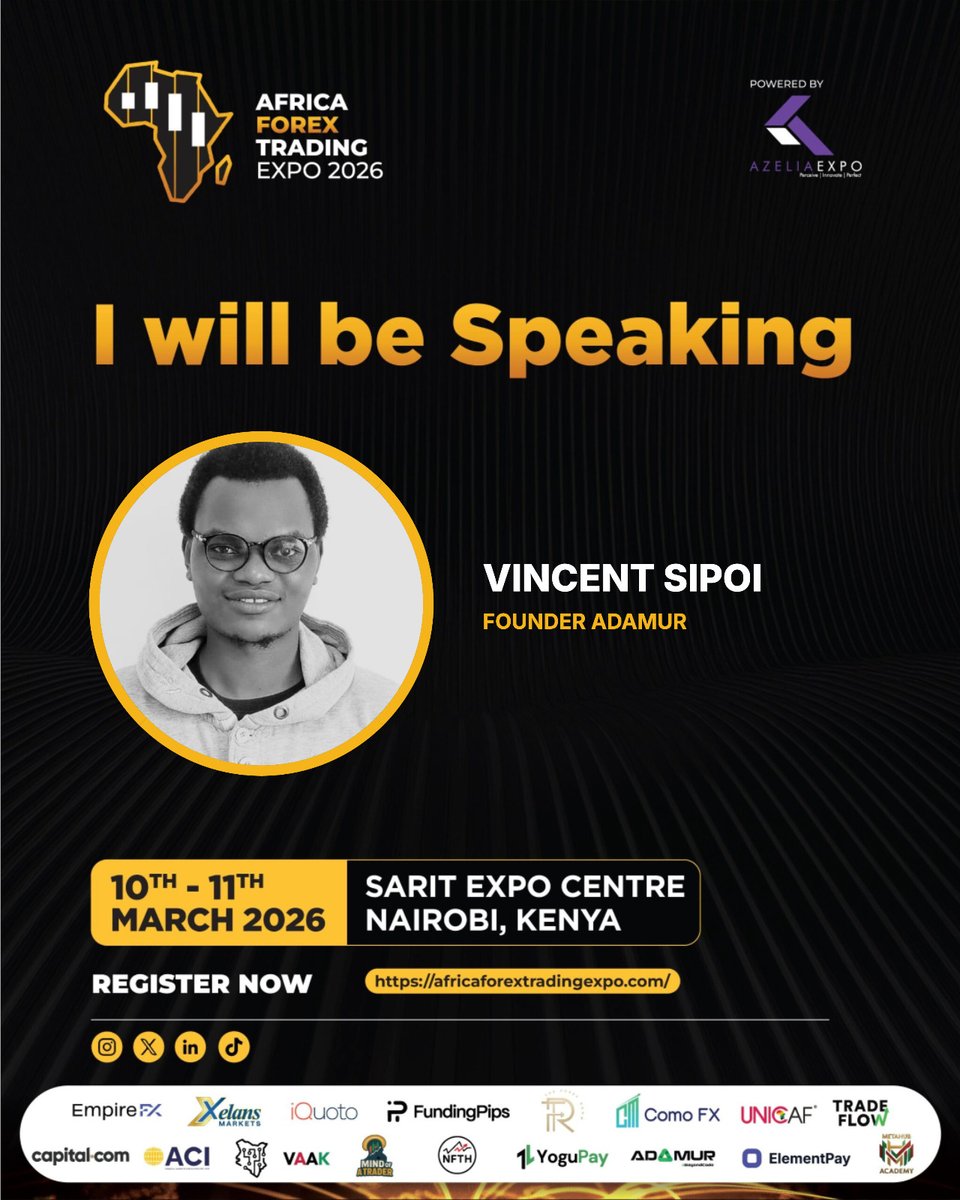
Vincent will be taking the stage as a speaker at the Africa Forex Trading Expo 2026.
A two-time tech founder and systems architect, Vincent specializes in intelligent automation and financial technology infrastructure. His work spans smart agent development, systems engineering, and blockchain applications in finance, where he focuses on building scalable and reliable systems for modern financial operations.
At the Africa Forex Trading Expo, he will share perspectives on how automation, blockchain, and advanced financial infrastructure are shaping the next phase of global trading and fintech innovation.
@ADAMUR_R
👉 IBs and Affiliates, click here https://t.co/dVowDlUhQ9 to register.
👉 Attending the expo, register via our website:
🔗 https://t.co/y6FCwWGPOv
#AFTexpo2026
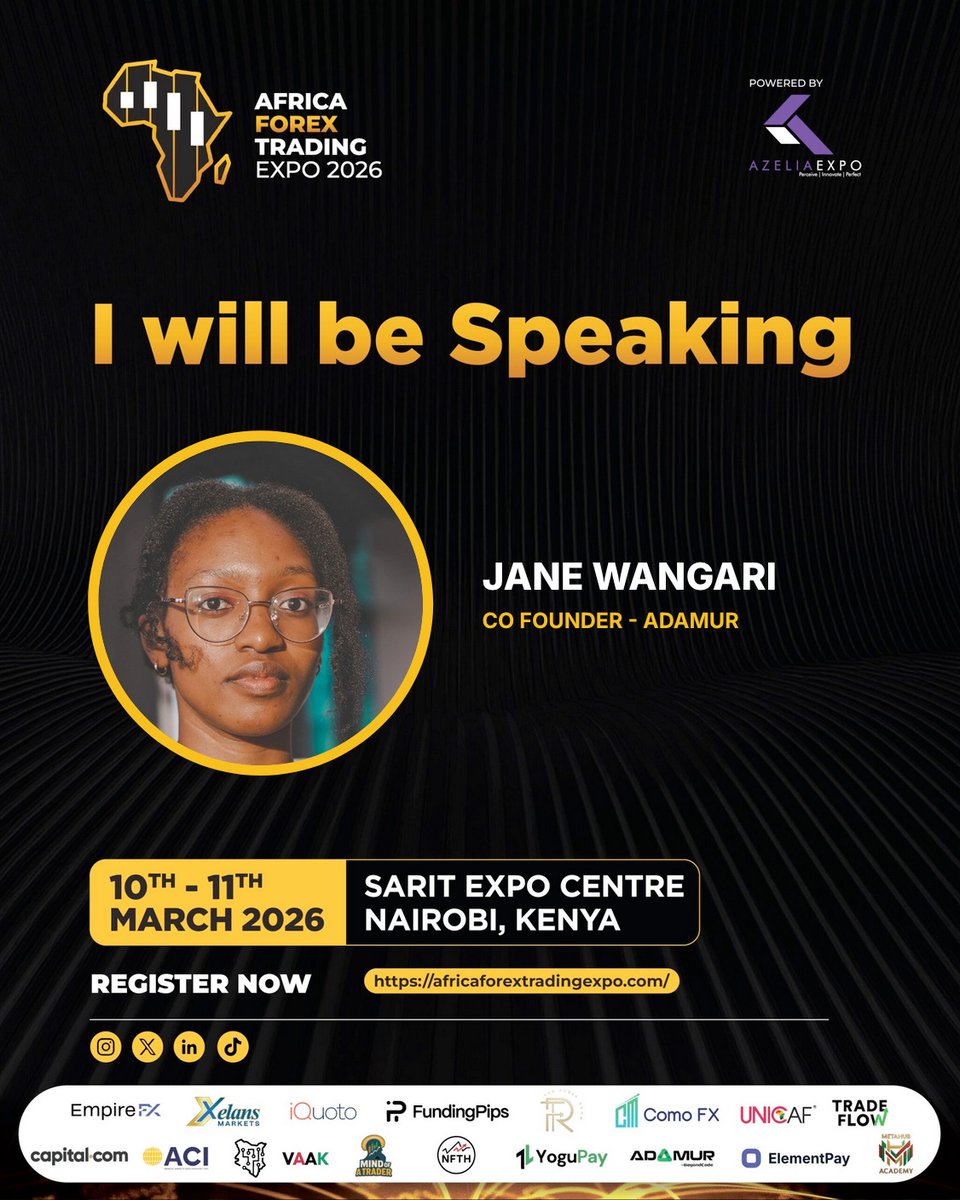
Jane Wangari will be joining the speaker lineup at the Africa Forex Trading Expo 2026.
A community and growth strategist, Jane is the Co-Founder of @ADAMUR_R, where she leads growth across narrative, programs, and execution, helping shape how emerging technologies are understood and adopted in East Africa.
She has worked with high-growth ecosystems including Base and Sui Network, contributing to messaging, community engagement, and operational rollout.
Catch her insights at the Africa Forex Trading Expo as she shares perspectives on community building, technology adoption, and the evolving digital economy in Africa.
👉 IBs and Affiliates, click here https://t.co/dVowDlUhQ9 to register.
👉 Attending the expo, register via our website:
🔗 https://t.co/y6FCwWGPOv
#AFTExpo2026
Don’t miss the Africa Forex TradingExpo, starting tomorrow and running for two days of powerful conversations around forex, fintech, and financial empowerment. Attendance is completely free. @AFTE2026#AFTE2026#AFTexpo2026
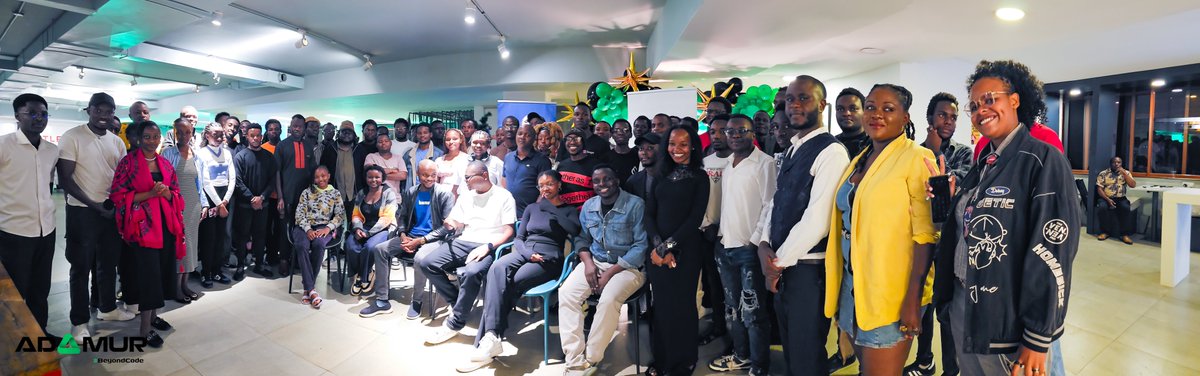
Gratitude. Gratitude. Gratitude.
This year has been many things, but our constant has been community. Yesterday was a testament to that.
We called you for a final one of the year, and you showed up as your best self. Thank you to everyone who joined, to our speakers who inspired, and to our partners who empower us.
You are what makes the Adamur tribe. Onwards to 2026!
Excited to be part of the Kenya Blockchain and Crypto Conference!
Join me as we dive into the real impacts of blockchain, engage with Kenyan innovators and proprietary traders, and participate in insightful sessions.
Driving the future of financial markets together! #KBCC2025
Good morning, we are waking up to news of many abductions of citizens the government suspect of being involved in #RejectFinanceBill2024. @LawSocietyofKe you need to sue @KindikiKithure in his personal capacity for the state abductions! Noordin, Koome, & Amin, release them!
The day is here. But the night before the day of has been fraught with the return of abductions and fearmongering. I have some thoughts about what’s at stake, and the grand game at play. A VIDEO THREAD: /1 Game theory and the stakes in #TotalShutdownKe#RejectFinanceBill2024
Here is the EVIDENCE that William Ruto is poisoning youth the age mates of his own. Watch the video as the police add a foul smelling & irritating liquid in the water they intend to spray protesters with. This is a Crime Against Humanity! Retweet widely to raise awareness
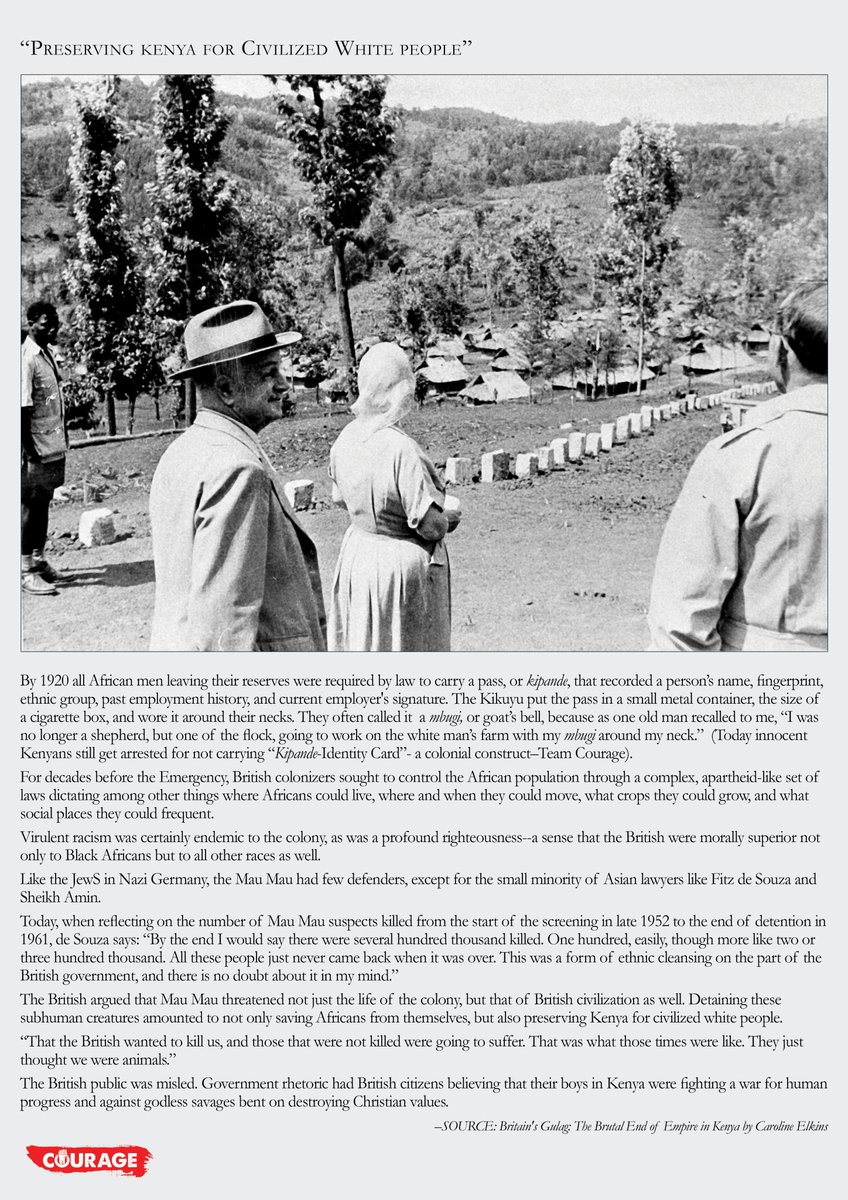
What the British did in Kenya, a thread 🧵, source: Britain's Gulag : The Brutal End of Empire in Kenya by Caroline Elkins..
"PRESERVING KENYA FOR CIVILIZED WHITE PEOPLE"
First, the colonial government established African reserves, which were defined rural areas, eventually with official boundaries, much like the homelands in South Africa or the Native American reserves in the United States, where each African ethnic group in the colony was expected to live separately. The Kikuyu had their own reserves in the Central Province district of Kiambu, Fort Hall, and Nyeri, the Maasai resided mostly in the colony’s Southern Province, the Luo lived in Nyanza Province, and so forth. This practice of divide and rule was also a cornerstone of the colonial government’s labor policy. With insufficient land in their reserves, many Africans had little choice but to migrate to the European farms in search of work, and survival.
But confining the African s was not enough to force them all into wage economy. As an additional tactic of control, the British colonial government taxed them. The second colonial regulation called for a hut tax and poll tax, together amounting to nearly twenty-five shillings, the equivalent of almost two months of African wages at the going local rate.
By 1920 all African men leaving their reserves were required by law to carry a pass, or kipande, that recorded a person’s name, fingerprint, ethnic group, past employment history, and current employer's signature. The Kikuyu put the pass in a small metal container, the size of a cigarette box, and wore it around their necks. They often called it a mbugi, or goat’s bell, because as one old man recalled to me, “I was no longer a shepherd, but one of the flock, going to work on the white man’s farm with my mbugi around my neck. The kipande became one of the most detested symbols of British colonial power, though the Africans had little recourse but to carry their identity cards at all times; failure to produce it on demand brought a hefty fine, imprisonment, or both. #SemaUkweli #RoyalVisitKenya