Fertilization is not random, and the fastest sperm does not always win: in reality, the egg decides who succeeds.
While for decades we were taught that fertilization is a race won by the fastest sperm, a study published in Proceedings of the Royal Society B shows how human reproduction actually works.
Scientists analyzed follicular fluid from 60 couples undergoing fertility treatment at St Mary's Hospital in Manchester, UK. They discovered that the egg releases chemical signals (chemoattractants) that actively attract sperm from certain men over others.
Through these chemical signals, the egg exerts its own biological selection, influencing which sperm manage to get close. The egg appears to favor sperm that offer optimal genetic compatibility with its own genome, particularly in genes related to the immune system, which may help produce healthier offspring.
Interestingly, this cellular preference does not always align with the couple’s conscious partner choice. In many cases, eggs showed stronger attraction to sperm from non-partner males.
This chemical communication demonstrates that female biology continues to evaluate and select options even after intercourse. Understanding this process could lead to more precise solutions for unexplained infertility. Science continues to reveal the remarkable level of biological interaction that occurs during reproduction.
[Fitzpatrick, J. L. et al. (2020). Chemical signals from eggs facilitate cryptic female choice in humans. Proceedings of the Royal Society B, 287(1928), 20200805. DOI: 10.1098/rspb.2020.0805]
OTD in 2012, sister Voyager 1 made her final transition from the region dominated by our Sun's solar wind into the region dominated by the other stars' cumulative winds: 'interstellar space.' For the first time, we were measuring particles mainly from other stars.
The measurements are from the LECP instrument, and the oscillations in late July and August show the buffeting nature of the boundary as it billows out from the Sun and then is pushed back by interstellar pressure, with the boundary moving back and forth over Voyager 1 several times. The August 25, 2012 transition occurred at a distance of 16H:51M light-time from the Sun, or about 121.6 AU.
Voyager 2 encountered this boundary in 2018 from early November to early December, but the boundary was smoother and closer in: from 16H30M to 16H32M, or 119.0 to 119.3 AU. Both crossings occurred during solar sunspot cycle 24, with the V2 crossing possibly occurring at a quieter time.
Astronomers just uncovered something the cosmos has never revealed before: an object that wears the face of a star while hiding a black hole at its heart.
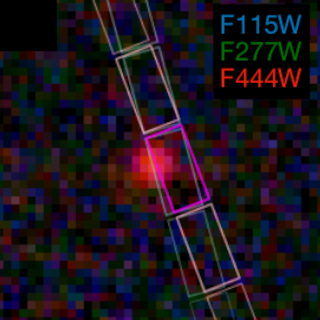
In a paper published in Nature, a team led by Rohan Naidu of the University of Hawaii describes a brilliant red speck from the early universe—roughly the size of our entire solar system. At first glance it looks like a colossal star, yet it radiates roughly 100 billion times more energy than any star astronomers have ever catalogued. Their explanation is as elegant as it is startling: a black hole swaddled in gas so dense that the outer layers shine like a stellar surface. They call it a black-hole star, and this first specimen has been christened MoM-BH*-1.
The discovery may finally unlock one of cosmology’s deepest mysteries. In the infant universe, black holes already existed that were millions to billions of times more massive than the Sun—far larger than standard models can easily explain. Black-hole stars could be the missing birth stage that allowed them to grow so quickly. The object may also solve the riddle of the “little red dots” that the James Webb Space Telescope keeps spotting: the team’s data point to hot ionized gas, not dust, as the source of that distinctive crimson glow.
Naidu calls MoM-BH*-1 a true one-in-a-billion find—nothing like it appears in any existing archive.
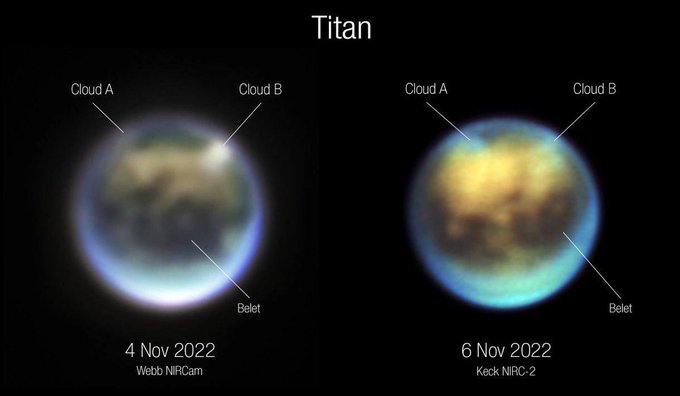
The James Webb Telescope has peered through Titan's dense haze
The observatory has transmitted the first images of the only moon in the Solar System with a substantial atmosphere and methane seas.
The images clearly reveal the sand dunes of the Belet region, the famous Kraken Mare, and clouds drifting in the sky—shifting shape even as they were being observed. This data will help scientists unravel the mysteries of this unique alien climate.
WATCH: Videos obtained by ProPublica show a private school owner encouraging students to assault their classmate.
The school continues to receive public funds. It is just one of hundreds of private schools taking state money with little oversight: https://t.co/n1FHfjx9dE
A man spends 50 years teaching at MIT.
He knows his time is running out.
So he records one last lecture — everything he knows, distilled into a single hour.
He died 5 months later.
This is that lecture.
The most important hour you'll watch this week.
Bookmark it for later!
A Scottish audio company, famous for their turntables, once invented a CPU architecture.
Their internal software kind of sucked.
Somehow along the way, the company became convinced that the problem was not from their programmers being bad.
No, instead the (logical) conclusion was that all traditional Von Neumann-style computers were WRONG. Linn (the audio group) needed to develop their own design, which became known as the Rekursiv.
Honestly, if you can get past the insanity it’s actually quite admirable. The whitepaper is clearly written by some (very) stubborn engineers; it’s like the opposite of RISC, no visible memory addresses, everything’s an object, auto GC, etc.
Oh, and they wrote their own programming language to go with it, of course (Lingo).
Un desarrollador ucraniano creó un agujero negro en su terminal para obligarse a tomar descansos.
Cuanto más trabajas sin parar, más crece y deforma tu código con su lente gravitacional. Descansas y se encoge.
Nothing prepares you for how insane this is: In 1984, astronaut Dale Gardner used a jetpack to fly completely untethered in space and capture a falling satellite with his hands.