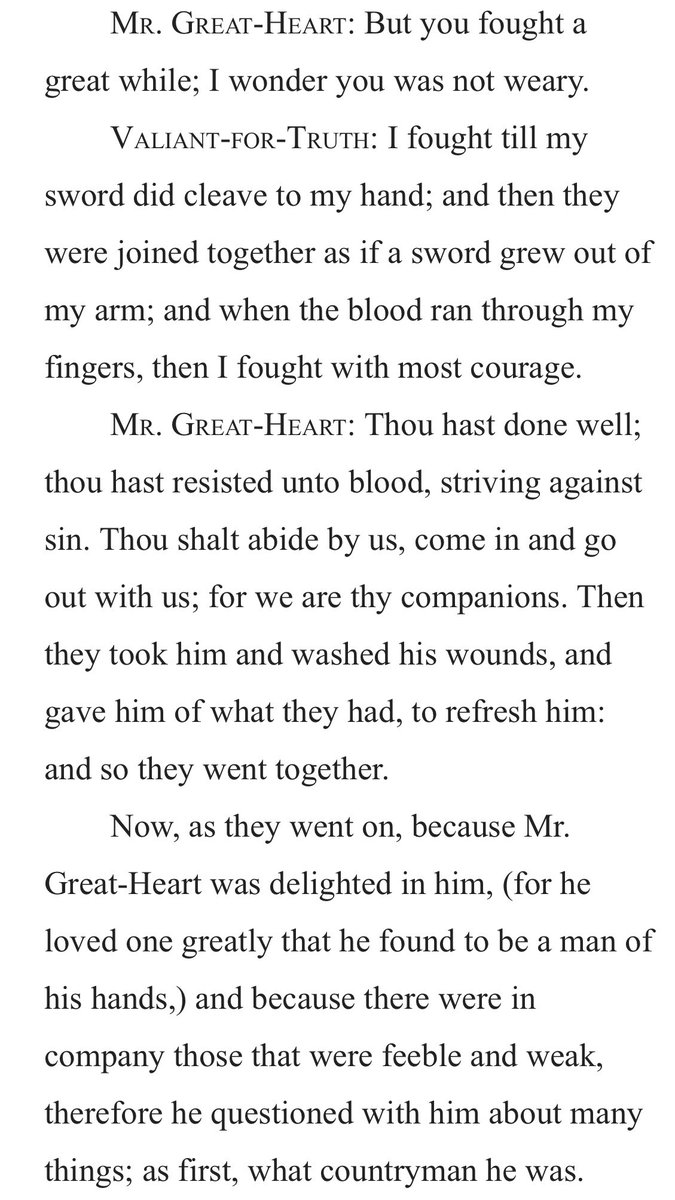
Lot’s of people on this app post about courage and masculinity from totally anonymous accounts.
If the truth you claim to champion really meant so much to you, you’d be willing to say the hard things you say and put your name on it.
But you fear the cost, you are a cowards.
RL Dabney - "All the great preachers, from the apostles to our day, whom God has honored to revive and bless his Church, have been evangelical: Ambrose, Augustine, Chrysostom, the Reformers, the orthodox Puritans, Whitefield, the Wesleys, the Tennents, Davies, Chalmers, Summerfield, Nettleton. The pure gospel usually attracts the multitude of those who hunger after God, while the Ritualist and the moralizing pulpit philosophers, after the tinsel of novelty is lost, parade their wares before empty benches."
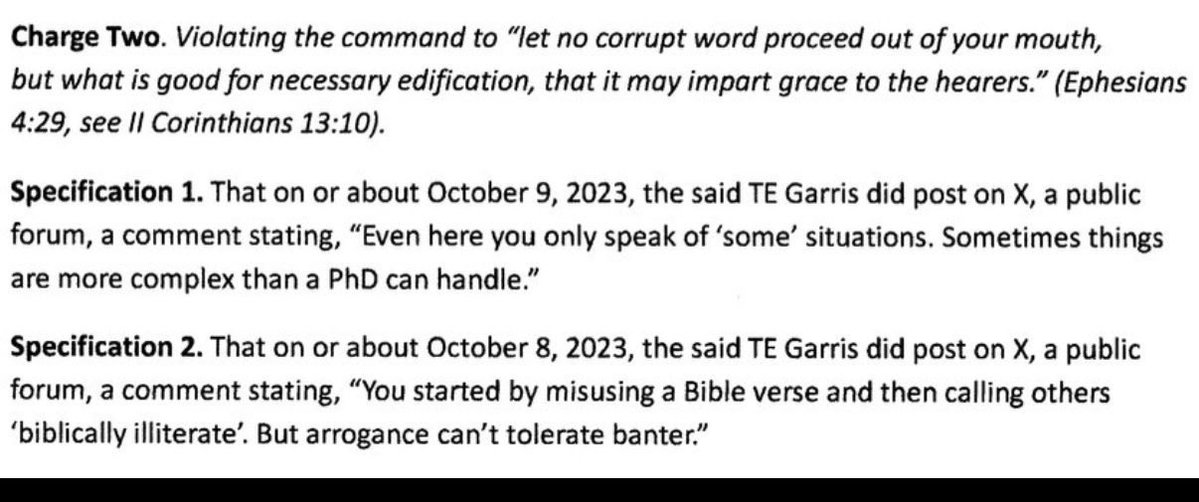
What’s being done to Rev. Zachary Garris is despicable.
The Rio Grande Presbytery of the PCA twisted the Scriptures beyond recognition in order to suspend a godly minister.
And for what? For these comments on X? What a joke!
What’s being done to Rev. Zachary Garris is despicable.
The Rio Grande Presbytery of the PCA twisted the Scriptures beyond recognition in order to suspend a godly minister.
And for what? For these comments on X? What a joke!
1. Adam was created with Age. Animals were created with Age. Plants were created with Age. Why are the other elements of creation any different?
2. Sin and death came after the fall. An old earth relies on death before creation of man. It does not fit with the picture of sin and death.
I'm appalled by the Rio Grande Presbytery. They've just undermined the credibility of all future cases involving genuine charges of unwholesome speech & dealt a blow to the integrity of Presbyterian courts, all b/c @ZacharyGarris is a conservative Westminster guy & they aren't.
Our church had a very godly grandmother figure who mentored younger women (à la Titus 2).
She never went to seminary.
Rather, she sat under the preaching of a godly minister for years, was married to a godly husband, and regularly read the Bible & other books.
This is the way.
Here’s a simple way to get unstuck when you’re worried, overwhelmed, or overthinking a decision.
Ask yourself one question:
What kind of thing am I dealing with?
Most issues fall into one of three categories.
1. Settled Things
These are things that have already been decided.
Your birth family.
Your nation of origin.
Your height.
Your past decisions.
Your upbringing.
Things you did.
Things done to you.
Some of these things were decided by your own past actions. Others were decided by God’s providence. As Paul says in Acts 17:26, God determined our appointed times and the boundaries of our dwelling place.
You can’t go back and change these things.
So the question is not, “How do I undo this?”
The question is, “Does this have any bearing on what I should do now?”
If not, leave it alone. Don’t spend your life fighting settled things.
2. Action Things
These are things you have some real control over.
Your diet.
Your exercise.
Your spending.
Your work ethic.
Your attitude.
Your friendships.
Your theological knowledge.
Your presentability.
Your habits.
Your skills.
These are your controllables.
You may not control everything about your health, finances, relationships, or future. But you usually control more than you think.
So if the issue falls here, don’t overthink it.
Take direct action.
Start small if you have to. Make the call. Go on the walk. Open the Bible. Apologize. Apply for the job. Pay the bill. Clean the room. Do the next faithful thing.
3. Prayer Things
These are things outside your direct control, but not outside God’s control.
The economy.
The weather.
The housing market.
The availability of a suitable spouse.
Other people’s choices.
Timing.
Open doors.
Closed doors.
You can’t force these things. You can’t grab the steering wheel of providence.
But God can act.
So you take indirect action through prayer. You ask. You wait. You prepare. You remain faithful. You do what you can do and trust God with what only He can do.
So ask yourself:
Is this settled?
Then accept it and learn from it.
Is this actionable?
Then do something.
Is this outside my control?
Then pray and trust God.
This is a simple framework, and yes, it’s a little reductionistic. But that’s the point. The goal is not to explain every complexity of life. The goal is to get you unstuck.
Most people waste too much energy trying to change the past, control what belongs to God, or pray about things they simply need to obey.
So categorize the issue.
Then act accordingly.
Accept what is settled.
Act on what is yours.
Pray over what belongs to God.
Many a man has confused a vindictive temper for prophetic boldness & righteous indignation. And just as many - perhaps more - have confused flattery & fear of man for Christian love. Both are wicked.
re: Discourse on Allberry today.
Many Protestants have improperly reduced the matter to temptation ≠ sin. This is true as it pertains to external temptation, as Christ endured external assault from Satan and the world, and He was and remained sinless (Heb 4:15).
But here is the all important difference between a sinner (even once they become a regenerate saint) and Christ: Because it was God the Son who assumed a human nature, He could *not* sin (i.e., He was impeccable). Jesus faced far fiercer temptation externally than we can possibly imagine and He did not falter, obeying the Father's will until the point of death, even death on a cross (Phil 2:8; Heb 12:4).
Christians, on the other hand, while experiencing external temptation as Christ did, are also "tempted when [we are] drawn away by [our] own desires and enticed. Then, when desire has conceived, it gives birth to sin; and sin, when it is full-grown, brings forth death" (James 1:14-15). So, we are tempted by the world, Satan, AND our own sinful flesh/nature.
Christ was never drawn away by His own desires and enticed to sin. Christians are until we are glorified. This is what is meant by the doctrine of concupiscence, it is the inherent, disordered inclination or desire to sin, which remains in human beings even after justification.
As Augustine rightly argues: “Even though I do not consent to lust [concupiscence] and even if I do not pursue my desires, nevertheless, I still feel desire and am personally present in that very part of me. For I am not one person in my mind and another in my flesh. But then what am I? For I exist both in my mind and in my flesh. For the two natures are not contrary but the one human being is composed of both, inasmuch as God, the God by whom the person was made, is one.”
Many Protestants speak of temptation as though we are only tempted externally, but this is not what James teaches in the verses cited above, nor is it the consensus (and rightly so!) position of the Reformed tradition.
For a great treatment on this matter, see Wedgeworth's masterclass chapter below. 👇
One of the richest insights I’ve gained from pre-modern dogmatics and the great systematic “bodies of divinity” is their complete avoidance of modernity’s fascination with “balance” and “tensions.”
Rather than suspending theological questions in dialectical equilibrium or paradox, these theologians resolve them through rigorous precision: they define terms with surgical clarity and locate each issue within a coherent, integrated doctrinal system.
This approach stands in sharp contrast to much contemporary theology, which often treats tension, ambiguity, or “both/and” mystery as a virtue—or even a mark of sophistication.
Pre-modern thinkers operated with the quiet confidence that apparent contradictions could be resolved through careful distinctions (in different respects, senses, orders, or causes) and then synthesized into a harmonious whole.
The result is greater clarity, intellectual rigor, and an architecturally satisfying theology that equips the mind, steadies the church, and glorifies God by showing the beautiful consistency of His revealed truth.
Martyn Lloyd-Jones would teach Oxford students in the same exact manner he would teach Oxford farmers. This confounded some of the students.
When asked, he replied that though more intelligent, their fundamental problem was exactly the same. They were sinners in need of a Savior. They all needed the same gospel.
Paul’s warning in Romans 12:3 is applicable here. “For by the grace given me I say to every one of you: Do not think of yourself more highly than you ought, but rather think of yourself with sober judgment, in accordance with the faith God has distributed to each of you.”
The Reformed church used to be known for its zeal for souls. William Carey, Hudson Taylor, George Whitefield, Adoniram Judson, David Brainerd, Charles Spurgeon, John Eliot, Henry Martyn, all five-point Calvinists. Calvin’s Geneva alone sent out 88 pastors to hostile France in a span of seven years, which bloomed into 2,000 congregations at a time when France was very violent to the gospel. But Reformed evangelism today, alas, who can find it?
It's quite telling that in the pastoral epistles, Paul warns of foolish controversy and debates 6 x's in 13 chapters. His point is that there is a category of religious controversy and speculative theology that does not build up the church, but instead feeds pride, multiplies division, distracts from the mission, and leads to greater ungodliness. Faithful ministers must not entertain it. Guard the truth, pursue what edifies, and don't entertain petty squabbles that only inflame rather than advance the kingdom. This is a very tempting aspect of ministry, which is why I believe he mentions it so often. There is always some new controversy, some new debate, some new wrangling & dust up to occupy yourself with, to the detriment of more essential duties. That's also why men who are primarily engaged in discernment ministries so often become imbalanced & hard.
John 21:1-14 is not about the disciples failure but about a major prophecy being fulfilled.
You’ve probably heard it said that after the resurrection, the disciples went fishing because they were too dumb to realize what Christ had done.
This completely misses John's point.
There is nothing—zilch, zero—in the passage to suggest that the disciples’ fishing trip was a consequence of their failure to grasp the significance of the resurrection. On the contrary, John presents this account as one of the final and most significant moments in his Gospel.
Here’s the setup: Several of the disciples (including Peter) fish all night and catch nothing. Then Jesus—perceived to be a stranger on the shore—tells them to cast their nets down on the other side of the boat. They do so, and suddenly the net is filled with such a quantity of fish that they cannot haul it in (John 21:1–6).
If this story sounds familiar, that’s because the same thing had happened before in Luke 5:1–11, when Peter is first called to be one of Christ’s disciples. But here (in John 21) the apostle adds a detail he doesn’t want you to miss: they caught exactly 153 fish (John 21:11).
Luke—normally a long-winded details guy (Luke 1:3–4)—does not do so in his account of the first miracle. But John, who openly admits that left many details out of his Gospel (John 21:25), tells us exactly how many fish were caught.
That’s because 153 isn’t a random number.
Early interpreters, like Augustine, were curious about this, too. In §§ 8–9 of Tractate 122 in his Tractates on the Gospel of John, Augustine points out that 153 is the triangular form of the number 17 (i.e., 17 + 16 + 15 … + 3 + 2 + 1 = 153).
That might interest math nerds, but it seems to have little meaning for the rest of us… until you remember Ezekiel 47. There the prophet is given a glimpse of the end of time. He sees water issues from the threshold of the temple, flowing down its steps toward the east (Ezek. 47:1)—the same direction Adam and Eve were cast out of the garden of Eden (Gen. 3:24).
The flowing (i.e., living) water continues to rise until it finally forms a river deep enough to swim in (Ezek. 47:3–6). And as he looks at the bank of the river, Ezekiel notices that the water makes fresh everything it touches: “For everything will live where the river goes” (Ezek. 47:7–9).
“There will be very many fish,” Ezekiel adds, “and fishermen will stand beside the sea. From En-Gedi to En-Eglaim, it will be a place for the spreading of nets. Its fish will be of very many kinds, like the fish of the Great Sea” (Ezek. 47:10).
Ezekiel also sees trees on either side of the river, which have leaves that never wither and fruit that never fails, bearing fresh fruit every month with leaves that bring healing (Ezek. 47:12).
Revelation 22 makes it clear that Ezekiel was glimpsing the new creation. John writes, “Then the angel showed me the river of the water of life, bright as crystal, flowing from the throne of God and of the Lamb through the middle of the street of the city; also, on either side of the river, the tree of life with its twelve kinds of fruit, yielding its fruit each month. The leaves of the tree were for the healing of the nations” (Rev. 22:1–2).
Back to John 21. We already have sufficiently strong textual links to connect John 21 to Ezekiel 47 and Revelation 22. But there is more, and it has to do with that peculiar number 153.
John 21 is the only place where the number 153 is mentioned in the Bible. But if you know anything about the ancient Hebrew language, you know that they used letters for numbers just as the Romans did (I = 1, V = 5, X = 10). And if you go searching for Hebrew words whose letters add up to 153, you’ll end up in Ezekiel 47.
The two places mentioned by name in that chapter are “En-Gedi” and “En-Eglaim.” (These are sometimes written as Engedi and Eglaim. But he words are not joined in Hebrew, and, what is more, the word “En” is the Hebrew word meaning “spring” or fountain. So the meaning is “the spring/founatin of Gedi” and “the spring/fountain of Eglaim.”) And guess what? “Gedi” equals 17 and “Eglaim” is its triangular: 153.
Augustine noted this connection between those numbers, as I said before, but he gets allegorically squirrelly here. He divides 17 into 7 + 10 in order represent the “seven fold Spirit” and the Ten Commandments. What he says there is theologically fine but exegetically suspect. There’s nothing in John 21 to suggest that the 153 fish were meant to symbolize the Spirit and the law.
But the fact that exactly 153 fish were caught, counted, and recorded is significant, and Ezekiel 47 tells us what it all means: new creation has dawned with the resurrection of Jesus Christ. As is sometimes said of individuals, so we may say of the entire cosmos: “The old has passed away; behold, the new has come!” (2 Cor. 5:17).
The fishing trip in John 21, then, is far from a detour, much less a failure. Instead, God’s providence led the disciples enact this prophecy in a symbolic fashion, depicting the work that Christ had come to do, is still doing, and will continue to do until the earth is filled with the knowledge of the glory of the Lord as the waters cover the sea (Hab. 2:14).
And we have a part to play, just as the disciples did. Those fishermen turned fishers-of-men (Matt. 4:19; Luke 5:10) blazed a trail for us to follow (cf. 1 Cor. 11:1). We stand alongside the same stream that issues from Christ himself (John 7:38; Rev. 22:1), of whom it is said, “He will lead them to springs of living water” (Rev. 7:17).
The risen Christ now says to the world, “It is done! I am the Alpha and the Omega, the beginning and the end. To the thirsty I will give from the spring of the water of life without payment” (Rev. 21:6). And we say with him, “Let the one who is thirsty come; let the one who desires take the water of life without price” (Rev. 22:17).
The nets are still being cast. A big catch is still being hauled in. And the new creation that dawned nearly two-thousand years ago is still breaking upon this sorry old world under the watchful care of the one who says, “Behold, I am making all things new” (Rev. 21:5).
Footnotes for further reading below 👇🏻