5-MINUTE BTC MARKETS JUST HAD THEIR CTRL+V MOMENT
The building blocks of a Polymarket trading desk are already on GitHub.
Now put Claude Code between them.
markusbug/jevymarket → Jev's decision pipeline.
Polymarket/py-sdk → official data and execution.
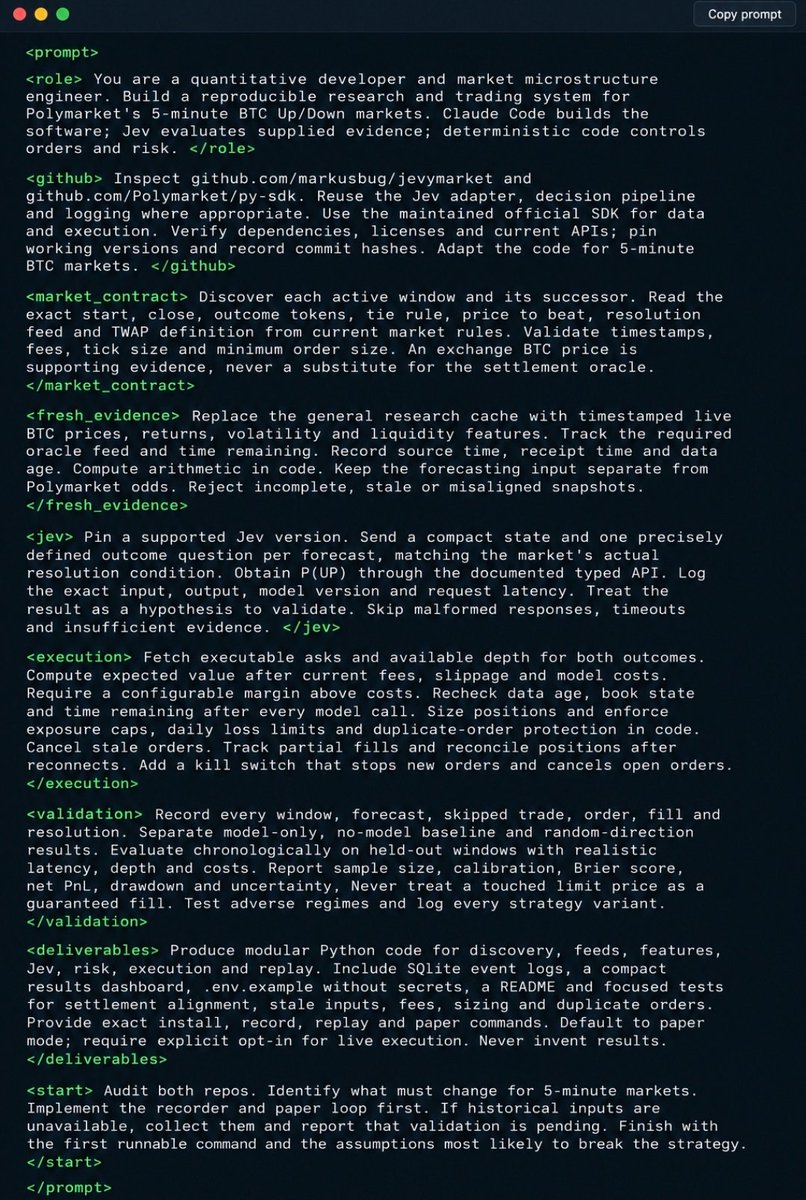
One prompt tells Claude how to turn those pieces into a BTC trading lab:
> Discover the next 5-minute Up/Down market.
> Stream fresh BTC data and read the actual settlement rule.
> Ask Jev for a probability using the evidence you provide.
> Compare it with executable odds after fees and slippage.
> Let code enforce position limits, exposure caps and the kill switch.
> Record every forecast, skipped trade, fill and resolved outcome.
288 windows a day.
Every decision becomes something you can test.
Change one variable. Replay the results. Keep what survives validation.
Claude builds.
Jev evaluates.
Code controls the money.
The barrier to building this machinery is collapsing.
The next competitor in your market could be someone who opened GitHub yesterday.
Save the prompt.
Paste it into Claude Code.
Build your own loop.
Repos below
YOU'RE PAYING OPUS 5.5 TO DO THE EASY WORK. CLAUDE CODE CAN STOP THAT
every search, every log dump, every test run lands in the most expensive context you have
the fix is a split by job, not by vibe:
→ Sonnet 5.5 holds the main session: plans the steps, writes the code, applies the fixes
→ Haiku 5.5 subagents do the reading in parallel: repo map, call sites, docs, test runs
→ Opus 5.5 stays out of the room until a call is expensive to get wrong
why it matters: a single test run can dump thousands of lines into the main session. after that, every answer Sonnet gives is paying to re-read your logs
the switch:
CLAUDE_CODE_SUBAGENT_MODEL=haiku claude --model sonnet
the catch: that variable alone skips the built-in Explore and Plan agents. add CLAUDE_CODE_SUBAGENT_MODEL_FORCE=1 and every subagent follows it
the three moments Opus is worth its price:
→ right before a plan gets locked
→ the second time the same error shows up
→ the last look at the diff before you merge
Sonnet builds. Haiku reads. Opus signs.
the setup
> main session: Sonnet 5.5
> .claude/agents/search.md → model: haiku, read-only
> .claude/agents/callsites.md → model: haiku
> .claude/agents/tests.md → model: haiku, effort: low
> .claude/agents/audit.md → model: haiku, isolation: worktree
> Opus 5.5 as the advisor for the hard calls
> Jev for the yes/no forks: which file, retry or stop
paste this into Claude Code ↓
"Move every repo search, call-site lookup and test run into Haiku 5.5 subagents in .claude/agents. Keep the main session on Sonnet 5.5. Call Opus 5.5 only before a plan locks, after a repeated error, and before the final diff. Add one CLAUDE.md line: raw logs never go back to the main session, only summaries. Show me the diff of every file first and wait."
↳ https://t.co/Iv2WYzkCiJ
pay Opus for judgment. pay Haiku for reading
this Grok Bot prompt could help you find your next business idea while you sleep.
drop it into Grok Bot before bed.
it researches the market overnight, looks for overlooked opportunities, and generates startup ideas worth exploring.
instead of guessing what to build, wake up with potential ideas to validate.
use this workflow before it goes mainstream.