I’ve committed to sharing the full journey of building EcomTraffic here on X, including the wins, setbacks, mistakes and everything I learn along the way.
But before I do that, I should probably introduce myself properly.
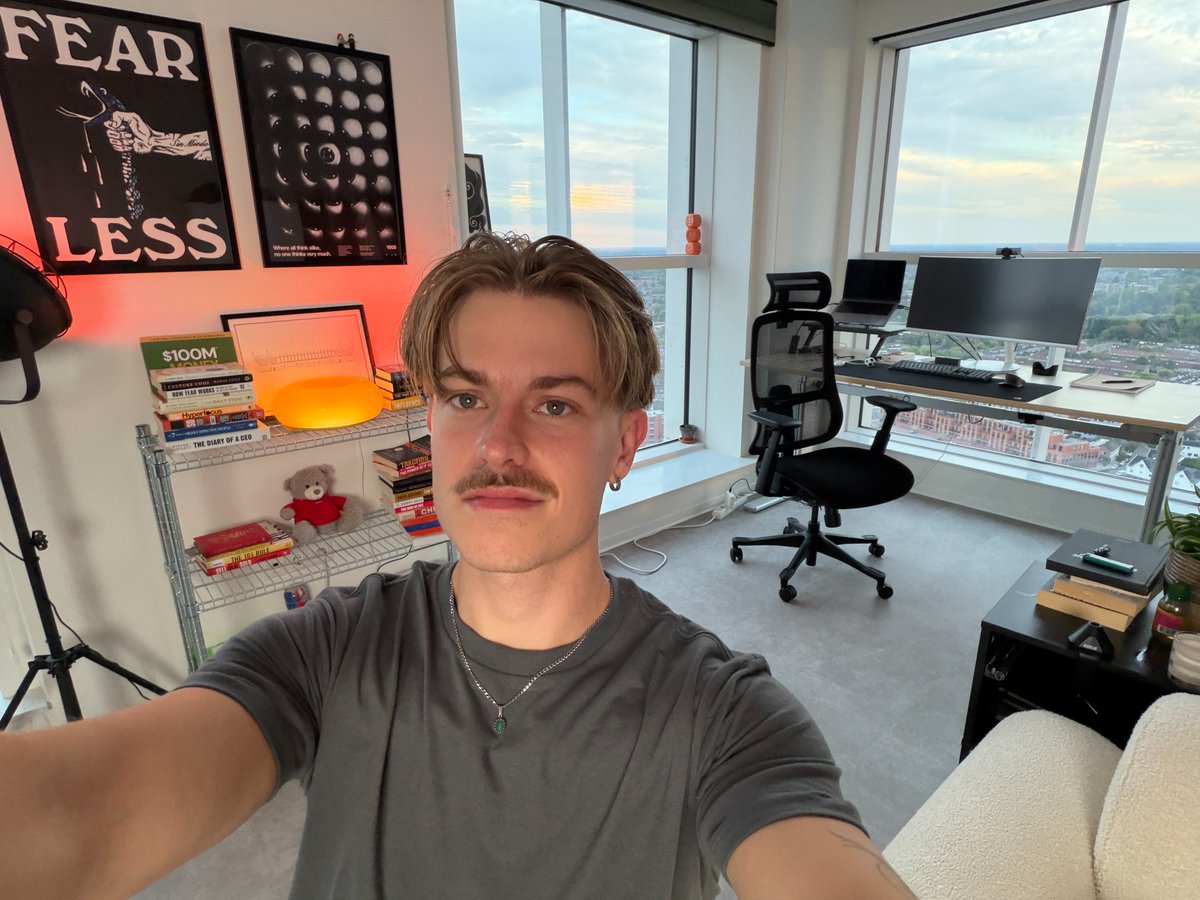
Hey, I’m Jess. I’m 24, at least at the time of writing this.
Here’s the short version of how I got here, starting in my young years:
At school, I couldn’t pay attention. I distracted everyone, skipped classes and always wanted to do things my own way.
After years of visiting different psychologists, ADHD was the label they gave it.
Mostly, I just felt like I didn’t fit into their system. I just wanted to build my own thing. Create things. I wanted to learn about following my passion, not learn to just have an average job.
My escape went towards being online. That's where everything was different. There, I could build my own world.
I hosted Minecraft servers on an old computer at home. I made edits, logos and banners for large Call of Duty trickshotting and sniping clans.
I built a YouTube channel that reached up to 200K views and created Snapchat geofilters for cities across the Netherlands.
It was all just a game to me , but really- that's where the entrepreneurship already had started.
I eventually left secundary school to study design. But even design school felt too slow and lacked the depth and ambition I was looking for.
When Covid arrived during my third year, I saw an opportunity to leave and finally build something of my own.
At 18, some friends and I discovered ecommerce. I preferred to stay away from standard shopify themes, and instead build my own ones.
Within a year, our stores had generated millions in revenue. One key thing is that I built my stores custom.
Then I made a very 18-year-old mistake:
I thought making money meant I understood business and I started a jewelry brand, went all in.
I spent too much on branding and inventory, and not enough on the commercial engine that actually had to sell it.
It failed.
That failure forced me to look at what had actually worked throughout my life: Design. I already knew what moved people, since I sold hundreds of different products online already.
"How do you make your stores convert like that" was the main question I was getting. I had to do something with that.
I then went deep into self-development and consumer psychology, completed four CRO courses, worked through the full CXL program and started EcomTraffic while working a normal job to pay back my debt.
My days were simple:
- Wake up at 4 AM.
- Work on EcomTraffic until 9.
- Go to my normal job.
- Come home and work on EcomTraffic again.
- Sleep at 8PM.
- Repeat.
Seven months later, I could quit.
Today, Christopher and I run EcomTraffic.
We help ambitious DTC and Shopify brands turn more of the traffic they already pay for into revenue through customer research, psychology-based CRO, design, development and high-impact experiments.
We’ve now worked with more than 190+ brands and generated more than €88M in additional revenue for our brands.
That includes brands such as Cloudpillo, which later won ABN AMRO Webshop of the Year in the sleep category.
But honestly, we’re only getting started.
I’m on a mission to build this to one of the biggest CRO agencies around. Strictly working with unique, founder-led brands that want to change the game.
On here, I’ll share exactly what we’re learning about product pages, offers, A/B testing, CVR, AOV, revenue per visitor and the mistakes behind the wins.
Thanks for reading. I'm excited about what is to come.
I’m 25 and I've worked with 190+ e-commerce brands. There's one number I look at before anything else, and it tells me how much more a brand can spend on ads.
Most founders I talk to only know their total store conversion rate. That number mixes every traffic source, new and returning customers, even bots. On its own, it's pretty much useless.
The number I look at is revenue per visitor.
(Your total revenue divided by your total visitors)
It tells you what every visitor is worth, and on Meta you pay for every single one of them.
It matters so much because if your revenue per visitor goes up 15%, you can spend roughly 15% more on ads without your ROAS dropping.
That's the room CRO creates, and it's where scaling really starts.
We once ran two scenarios for a brand spending $750K a year on ads:
-> Increase the budget by 20%
-> Keep spend the same, get 10% more visitors to buy, and get 10% more spent per order (AOV)
The second one made almost double the profit. With the exact same traffic.
When revenue per visitor goes up, I show it to the founder. That number gives them the safety to spend more, and that's when a brand can really start to scale.
Open last month's numbers. Divide revenue by visitors. That's what your next ad budget depends on.
Your ad budget can only grow as fast as your revenue per visitor.
Q4 is coming. The brands that will win are the brands that actually start executing on their plans.
Start building out your strategy what you are going to do…
Creative wise
CRM wise
And ofcourse funnel “CRO” wise 🤓
Time to take over and fucking crush it.
School told me I was the problem.
Yet I built a business doing millions at 18.
Here's how that actually happened.
ADHD. Years of psychologists. A label that never quite fit. What it really meant: I wasn't built for someone else's system.
I found my place online.
Hosting minecraft servers on an old home computer. YouTube edits for gaming clans. Designing snapchat geofilters across the Netherlands.
It felt like a game. It was already entrepreneurship.
Left design school during Covid. Jumped into ecommerce with some friends. Millions in revenue within a year.
Then came the mistake that changed everything.
I started a jewelry brand. Went all in on branding and inventory.
Ignored the commercial engine that actually had to sell it.
It failed. Hard.
But that failure was the best insight I'd ever had.
Design that converts was the one thing I'd always been good at.
"How do you make your stores convert like that?" was the question I kept getting.
I went deep. Four CRO courses. Full CXL program. Consumer psychology.
Started EcomTraffic while working a day job to clear the debt.
Woke up at 4AM every day. Worked before work. Worked after work. Slept at 8PM.
Seven months of that. Then I quit.
Now Christopher and I run EcomTraffic.
190+ brands. €88M in additional revenue for the brands we work with.
We're only getting started.
I've recently turned 25.
And I'm on a mission to build one of the biggest CRO agencies around.
If you're a founder-led brand that wants to turn more of your existing traffic into revenue, you're in the right place.
BFCM winners don't have the best offer.
They have the most noise.
Here's how they make the most out of BFCM. They:
- Are in your inbox before October ends.
- Run awareness spend weeks before the cart opens.
- Have SMS, email, and paid all firing in the same window.
- Post organically every day of the sale period.
- Retarget cold traffic that visited in the last 60 days.
- Build anticipation before they build urgency.
- Aren't waiting for Black Friday to start the conversation.
- Have already won by the time the discount goes live.
Most brands spend November optimising their discount. The winners spent September getting seen.
> Got labeled the "problem kid" at school
> Teachers told my parents I'd never amount to much
> Escaped online: Minecraft servers at 12, gaming clan designs at 14, Snapchat geofilters at 16
> Started my first webshops at 18
> Did over €2M in revenue, felt like I made it
> At 19 I was €50K in debt
> Money turned out to be a plaster for insecurities I didn't want to look at
> Took a normal job to pay it off
> 4AM: build. 9-5: the job. Evenings: build again.
> Studied my way out too: four courses on neuromarketing, psychology, NLP and CRO
> Seven months later I was out but with a foundation this time
> Went all-in on one thing: CRO for ecommerce brands
> Co-founded EcomTraffic
> Built case studies with the two things I know best: design and psychology
> Today: 190+ brands optimized, €88M+ in extra revenue generated
> Two brands we work with won ABN AMRO webshop of the year awards
> Worked from Thailand, Sri Lanka, and a desk facing my favourite football stadium
> It's 2026. I'm 25.
> Expanding beyond the Netherlands for the first time
> Building it in public, right here
> Fewer shortcuts. More foundation.
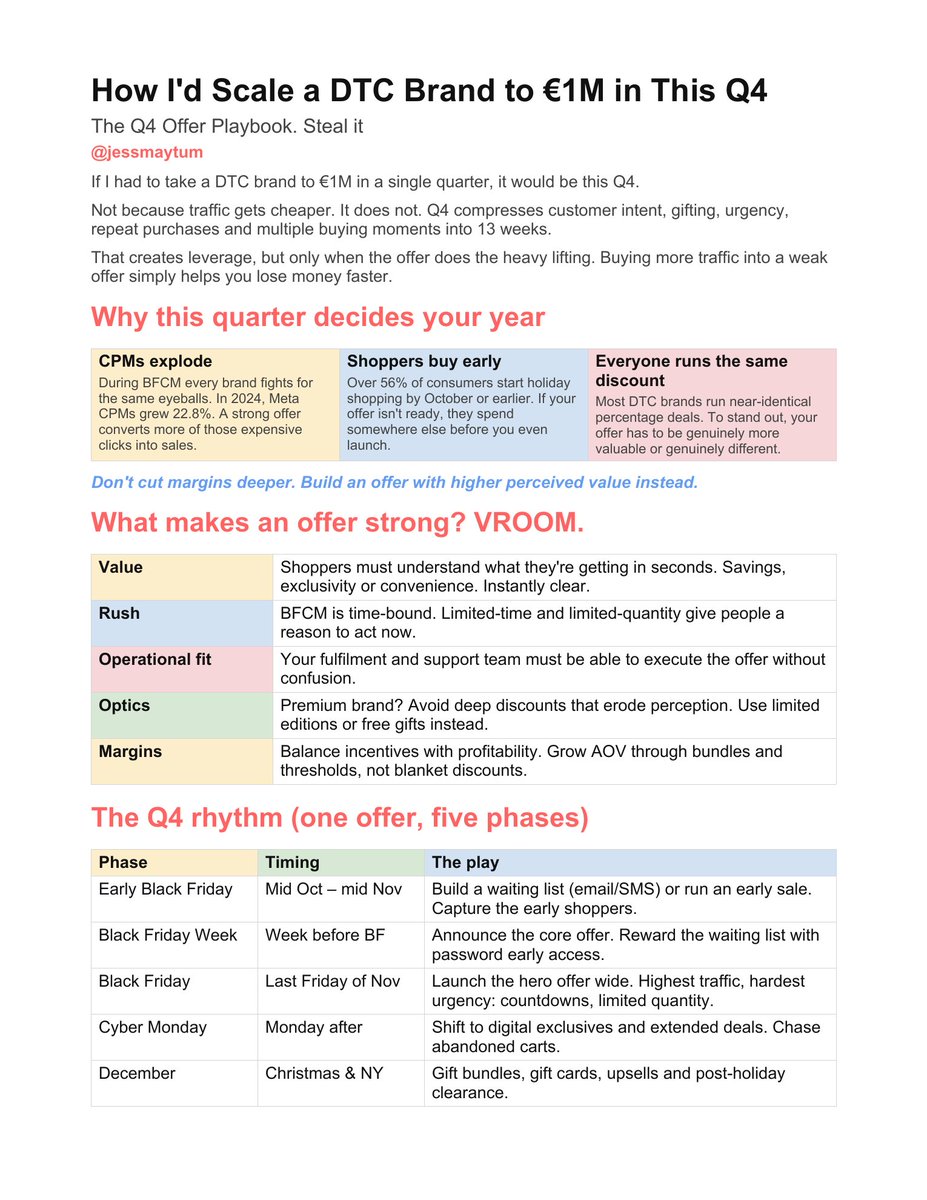
If I had to scale a DTC brand from 0 to €1M in 90 days, I'd do it in this Q4.
Not because traffic gets cheaper. It doesn't.
But because Q4 compresses intent, gifting, urgency and repeat purchases into 13 weeks.
Here's the exact Q4 offer playbook we use with our brands.
> Got labeled the "problem kid" at school
> Teachers told my parents I'd never amount to much
> Escaped online: Minecraft servers at 12, gaming clan designs at 14, Snapchat geofilters at 16
> Started my first webshops at 18
> Did over €2M in revenue, felt like I made it
> At 19 I was €50K in debt
> Money turned out to be a plaster for insecurities I didn't want to look at
> Took a normal job to pay it off
> 4AM: build. 9-5: the job. Evenings: build again.
> Studied my way out too: four courses on neuromarketing, psychology, NLP and CRO
> Seven months later I was out but with a foundation this time
> Went all-in on one thing: CRO for ecommerce brands
> Co-founded EcomTraffic
> Built case studies with the two things I know best: design and psychology
> Today: 190+ brands optimized, €88M+ in extra revenue generated
> Two brands we work with won ABN AMRO webshop of the year awards
> Worked from Thailand, Sri Lanka, and a desk facing my favourite football stadium
> It's 2026. I'm 25.
> Expanding beyond the Netherlands for the first time
> Building it in public, right here
> Fewer shortcuts. More foundation.
"There's no system to our madness."
A founder struggling to go above towards €50M/year said that to me on a call.
Most honest diagnosis of ecommerce growth I've ever heard.
Here's what it looks like from the inside: everyone on the team is testing something, and nobody can actually tell you why.
Ad spend goes up and when ROAS declines everyone blames the website.
The website isn't broken. The traffic changed.
You scaled into colder audiences and kept optimizing for the warm ones. Without a system, you can't see the difference. So the budget quietly crawls back to people who were going to buy anyway.
That's why brands park at €1 to €2M per month: Madness without a system.
Research → hypothesis → test → implement. Boring. But it truly compounds every month.
I first tasted it at 18; Over 2 million in revenue, felt untouchable.
But at 19 I was €50K in debt and had to take a normal job to pay it off.
That job wasn't the hard part. Sitting there knowing what work COULD feel like was. I missed the building. Being the one responsible. Making my own calls, taking my own risks. That freedom.
So during that time period: 4AM I built my company. 9-5 I did the job.
Evenings I built again.
Seven months later I was out, this time with a foundation under it.
"There's no system to our madness."
A founder struggling to go above towards €50M/year said that to me on a call.
Most honest diagnosis of ecommerce growth I've ever heard.
Here's what it looks like from the inside: everyone on the team is testing something, and nobody can actually tell you why.
Ad spend goes up and when ROAS declines everyone blames the website.
The website isn't broken. The traffic changed.
You scaled into colder audiences and kept optimizing for the warm ones. Without a system, you can't see the difference. So the budget quietly crawls back to people who were going to buy anyway.
That's why brands park at €1 to €2M per month: Madness without a system.
Research → hypothesis → test → implement. Boring. But it truly compounds every month.
We lowered the price of this 3-bottle offer by €10.
And the revenue per visitor increased by 52.77%.
Before this experiment, we’d already done the “right” AOV work on this product page:
1 bottle: €29.99
2 bottles: €53.98
3 bottles: €69.99
This was a previous winner, and logically: the more you bought, the lower the price per bottle.
But the customer still had to do the work. They had to compare €26.99 with €23.33, calculate the saving and decide whether spending €69.99 was worth it.
So instead of running another test on the design, copy or layout, we questioned the offer inside the selector.
We changed one thing: “3 bottles for €69.99” became: “2+1 FREE for €59.98”
We deliberately gave up around €10 on the three-bottle purchase. But we moved the value from something customers had to calculate to something they could understand instantly.
This way we frame it as the obvious reason to buy more.
The result was a +52.77% revenue per visitor.
We made less revenue on the three-unit purchase itself, but considerably more across everyone who visited the page.
This is why I think younger e-commerce brands often start CRO in the wrong place. They build a backlog of layout and copy tests while their cold-acquisition offer still asks too much of the customer.
The lesson is: If customers have to calculate the value, your offer is doing too little of the selling.
Make the value obvious first. Then optimize everything around it.
I was a Tapout Club customer before they became a client.
Now we get to help them scale by doing what we do best at EcomTraffic: making their website convert more visitors into customers.
A product I genuinely love, built by a very cool brand. Excited to get started.