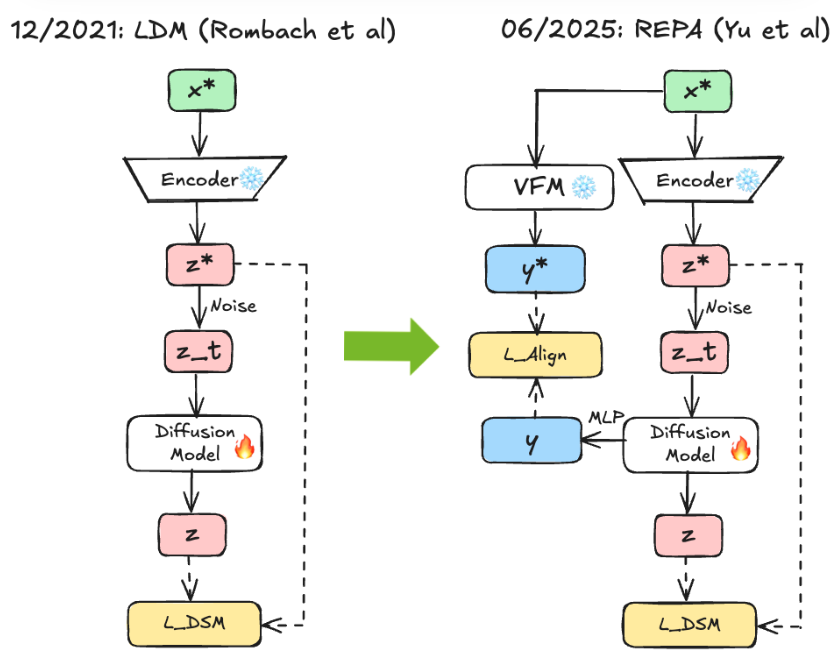
No more reliance on VAE or DINO! Similar to the motivation of RAE by @sainingxie's team
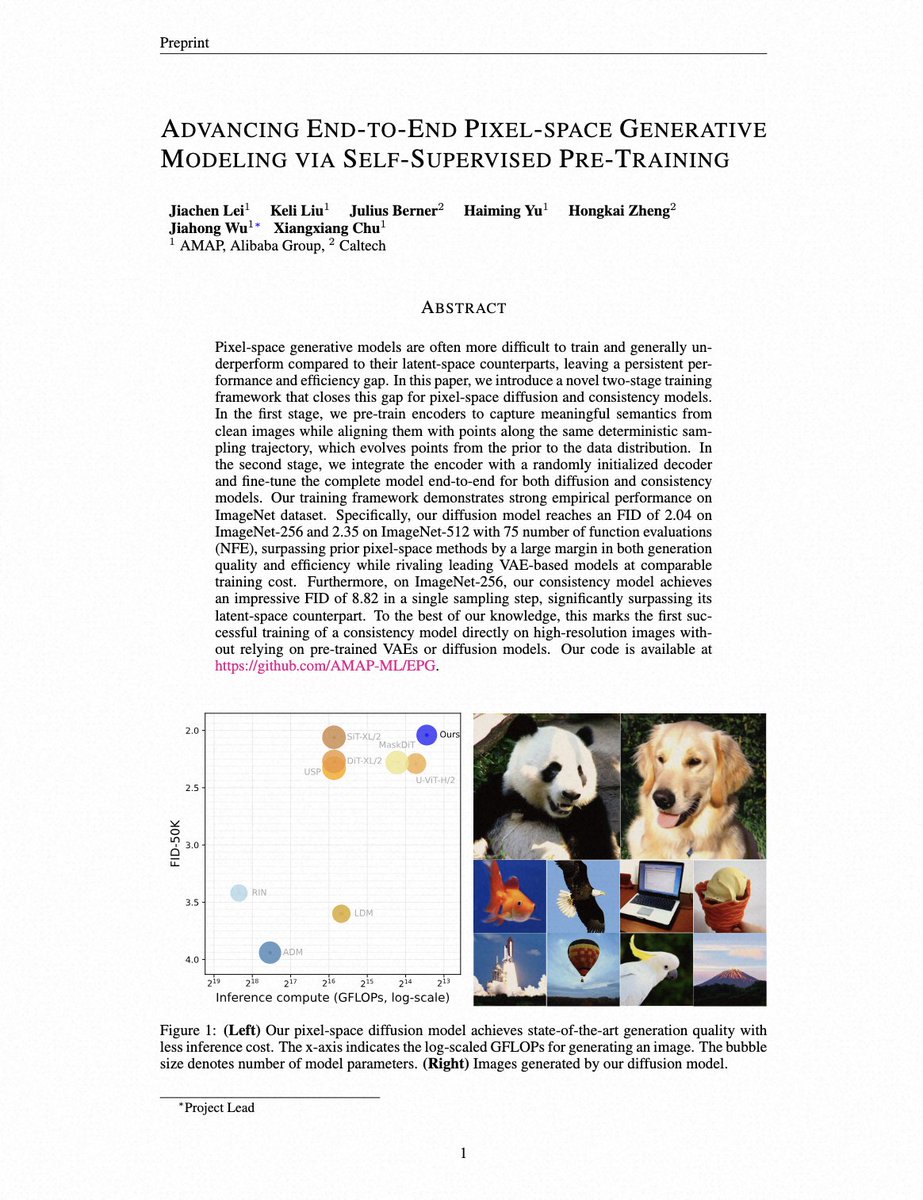
We propose EPG: SSL pre-training + end-to-end FT = SOTA FID on IN256/512!
Works nicely for both DM and CM
https://t.co/a2q4hKcBwB
(1/n)🧵
Next: Why training DMs on raw pixels is difficult?
My talk on accelerated diffusion and flow models at @BerkeleyLab's DL4Sci School is online!
Check it out for an overview on how to:
- Reduce the number of denoising steps
- Accelerate each step
📺 https://t.co/L9TCNZXzBR (jump to 22:18 to learn more about the video below)
Having worked with many distillation methods for accelerating diffusion & flow models, I’m still blown away by the simplicity of Parallel Decoding Distillation (PDD).
1️⃣ State-of-the-art quality and diversity with variable NFE
2️⃣ First to scale trajectory-distillation to few-step video generation
PDD is about as cheap and simple as it gets:
🎯single, regression-based MSE loss using 1 student & 1 detached teacher forward
❌NO data required
❌NO adversarial loss or alternating training
❌NO JVP or finite-difference approx.
❌NO additional time-embedding or trainable models (e.g. fake score, discriminator)
❌NO stabilization tricks (e.g. normalization, clipping, warm-up)
Thrilled to see Vera, my internship project at @netflix, shared here! Vera brings editable layers to diffusion models for controllable video editing.
Check out our project page for more details, the paper, and the dataset:
https://t.co/MqXkIBHEfL
Introducing DreamX-World 1.0 — a general-purpose world model with 1 minute continuous generation, real-time interaction, precise camera control & multi-style support. Beta coming soon!
🌐https://t.co/U5NIvOi6rU
Github:https://t.co/zolKYnuWjT
#WorldModel#AIVideo
New paper: AsymFlow🔥
JiT x0-prediction is not enough for pixel generation. Better keep velocity in a low-rank subspace:
- 1.57 FID on ImageNet (best pixel flow model)
- Finetunes FLUX.2 klein into pixel space, beats the original on HPSv3/DPG/GenEval (#1 overall on HPSv3)
1/7
@ZypZapCommunity Pretty Good! We've tested it across different scenarios. The overall performance is largely determined by the base model Wan2.2-5B. Have a try with our code and weights!
My first blog post in over a year is a deep dive on flow maps🗺️, or how to learn the integral of a diffusion model to enable faster sampling and several other cool tricks.
It's the longest one yet👀 Let me know what you think!
https://t.co/O8bBGZ9qjC
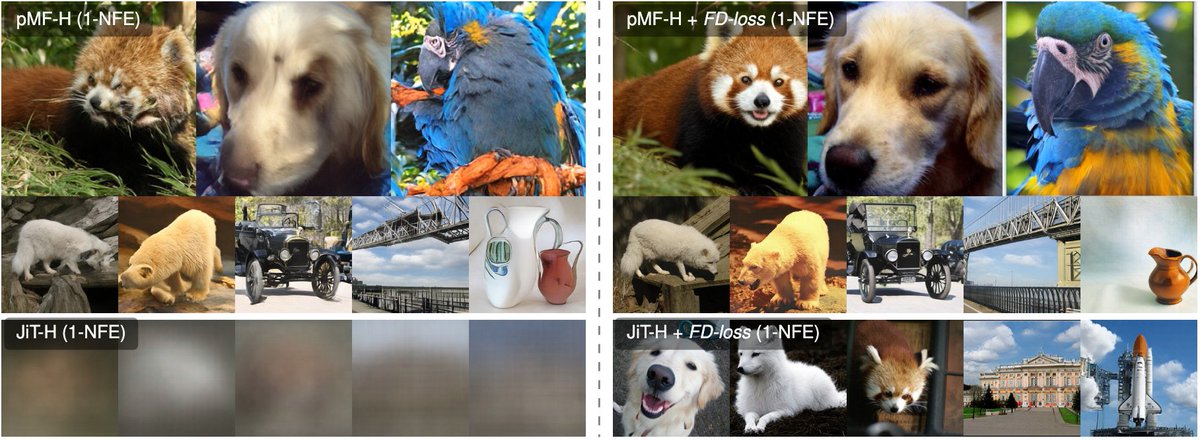
Two months ago, I vaguely posted a number: 0.9 FID, one-step, pixel space.
Now it is 0.75, and can be even lower.
Many wonder how.
I thought it might end as a small FID prank: simple and deliberate.
It started with one question: can FID be optimized directly, and what does it reveal?
Introducing FD-loss.
Only one chance in this lifetime…
Like watching sunset at the beach from the most foreign seat in the cosmos, I couldn’t resist a cell phone video of Earthset. You can hear the shutter on the Nikon as @Astro_Christina is hammering away on 3-shot brackets and capturing those exceptional Earthset photos through the 400mm lens. @AstroVicGlover was in window 3 watching with @Astro_Jeremy next to him.
I could barely see the Moon through the docking hatch window but the iPhone was the perfect size to catch the view…this is uncropped, uncut with 8x zoom which is quite comparable to the view of the human eye. Enjoy.
Happy to introduce: SeClaw (https://t.co/XutTwaqU0K) — 𝘁𝗵𝗲 secure Claw against diverse AI security threats.
SeClaw designs the system-level defense solution to build secure-version claw inspired by our NeurIPS paper (DRIFT:https://t.co/07HbeKFFH4).
Core security capabilities
🧱 #Agent Execution Isolation: SeClaw keeps the project on the host and only runs agent operations through mapped execution in Docker.
♻️ #Snapshot & #Rollback: SeClaw supports an efficient CoW rollback mechanism that can quickly snapshot and restore mounted host/container files. You can quickly restore to a known-good state after any risky operations. Let your agent run free!
🛡️ #PromptInjection Defense (System + Model Levels): SeClaw enforces Control-Flow Integrity (CFI) and Information-Flow Integrity (IFI) at the system level to constrain the agent’s valid action space and block unsafe decision paths. At the model level, SeClaw uses a guard model to sanitize suspicious tool outputs
🔍 #Skill #Audit: Scans skills for dangerous patterns (prompt injection, exfiltration, and destructive commands).
🧠 Memory Audit: Scans memory files for stored prompt-injection payloads, credentials, and PII leakage risks.
📜 Execution Audit: Records full task traces and reports potentially risky actions after each task completion.
🔐 Privacy Protection: SeClaw monitors potential privacy leaks during agent execution, including identity information, API keys, SSH keys, and other sensitive credentials. Suspicious exposures are detected and flagged.
⚠️ Risky Operation Protection: SeClaw detects potentially dangerous commands (e.g., rm -rf, sudo, or destructive system modifications). When such operations are triggered, SeClaw requires explicit user confirmation before execution, reducing the risk of unintended damage caused by agent tool misuse.
📡 Secure Communication Isolation: SeClaw isolates communication channels by maintaining separate context windows for each interaction source. This prevents cross-channel prompt injection and ensures that messages from one channel cannot manipulate the agent’s behavior in another.
🌐 Network Security Controls: SeClaw provides secure network communication through HTTPS enforcement, request timeout protection, and configurable network modes for agent execution environments, reducing the risk of network-based attacks and uncontrolled external access.
#Agent #Security #Openclaw #Safety
Github: https://t.co/VvrsY7dKDj
website: https://t.co/XutTwaqU0K
🚀 Today we’re releasing FlashOptim: better implementations of Adam, SGD, etc, that compute the same updates but save tons of memory. You can use it right now via `pip install flashoptim`. 🚀
https://t.co/nRrLSpjnwV
A bunch of cool ideas make this possible: [1/n]
Video diffusion Transformers tend to split causal semantics (early layers) and rendering (later layers). Making this separation explicit, semantic generator + renderer, has clear practical benefits.
Very nice paper with systematic probing and analysis!
If the renderer is an MF head, things get even lighter: one can restrict the jvp to the head only, avoiding jvp through the full backbone.
Too many REPA / RAE / representation alignment papers lately?
I was lost too, so I wrote a blog post that organizes the space into phases and zooms in on what actually matters for general/molecular ML.
Curious what folks think - link below!
🔗 Blog: https://t.co/6aJf8DCWTa
Struggling with slow inference of diffusion and flow models?
Check out the video below—I’ve been using our new FastGen library to achieve 7-28x acceleration for text-2-image and {text,image,video}-2-video generation without sacrificing visual fidelity!
Are ViTs secretly RNNs? #ICLR2026
Our 2-block recurrent transformer recovers 96% of DINOv2’s IN-1k accuracy & reproduces its activations 1-to-1, motivating the Block-Recurrent Hypothesis: https://t.co/72E7FhY1LK
w/ @thomas_fel_@RichieHakim@ABrondetta Demba Ba @t_andy_keller
Accepted 🥳🥳 Shoutout to the great supports from my collaborators @julberner@Hongkai_Zheng Come and take a look at our high-performing pixel-space diffusion & consistency model.
#iclr#iclr2026
We have updated EPG results on ImageNet256:
EPG-G/16 (1391M) now achieves 1.58 FID. We also show that EPG-XXL/16 (789M) reaches 1.87 FID with ~30% training cost of DiT.
Note: EPG is a pixel-space training framework for diffusion/consistency models.
https://t.co/cIi6fol9Nk
can check the ICLR results in the author console on OpenReview now. The results seem to be released sequentially according to the paper ID.
#iclr#iclr2026
@TDaulbaev@julberner@Hongkai_Zheng Thanks😊 You can check the results in the author console on OpenReview now. The results seems be disclosed sequentially according to the paper id number



![davisblalock's tweet photo. 🚀 Today we’re releasing FlashOptim: better implementations of Adam, SGD, etc, that compute the same updates but save tons of memory. You can use it right now via `pip install flashoptim`. 🚀
https://t.co/nRrLSpjnwV
A bunch of cool ideas make this possible: [1/n] https://t.co/xeaMyWztpv](https://pbs.twimg.com/media/HCgxeDgawAEzt6q.jpg)