Why Was $SCHD’s Q2 Dividend Lower Than Expected? Some Clarity from Schwab.
After reviewing additional information from Schwab, I think we have a much better understanding of why $SCHD’s Q2 dividend came in lower than expected.
The biggest takeaway confirmed something I had already suspected based on my own bottom-up dividend estimates:
$SCHD actually received and distributed more total dividend dollars in Q2 than it did in Q1.
Based on the figures Schwab shared:
• Q1: ~$707 million paid to shareholders across 2.753 billion shares.
• Q2: ~$758 million paid to shareholders across 3.001 billion shares.
From Q1 to Q2:
• Total dividends paid by the fund increased about 7.2%.
• Shares outstanding increased about 9.0%.
• Dividend per share declined about 1.7%.
At a high level, Schwab explained that the number of shares eligible for the dividend grew faster than the dividend income received by the fund.
So why did that happen?
Under normal circumstances, when investors buy more shares of an ETF like $SCHD, those investor inflows result in new ETF shares being created alongside additional underlying holdings. Those new holdings generate additional dividend income, so inflows by themselves shouldn’t be a long-term drag on the dividend per share.
According to Schwab, the key this quarter may have been when investor inflows occurred relative to when the underlying holdings paid their dividends.
If a meaningful portion of those inflows occurred after many of the underlying companies had already gone ex-dividend, those new $SCHD shareholders would still be entitled to the full ETF distribution, even though the newly purchased holdings may not have been owned long enough to collect a full quarter’s worth of dividends.
In other words, dividend income grew 7.2%, but shares outstanding grew even faster at 9.0%, temporarily reducing the dividend per share.
One thing I find encouraging is that this appears to be a timing issue within the year rather than a sign that the underlying holdings are generating less dividend income. If this timing mismatch was indeed a major contributor, those assets should now have had a full quarter to collect dividends, meaning this specific issue could be much less of a factor in Q3 and Q4 unless another unusually large wave of investor inflows occurs late in the quarter. Assuming the underlying companies continue growing their dividends, that could be a positive sign for the rest of the year.
I still have questions, particularly around how much this timing effect actually impacted Q2, since Schwab hasn’t quantified it. But the mechanics make considerably more sense to me now than they did initially.
I’ll continue digging and share anything else I learn.
P.S. Big thanks to @MrD64517207 for taking the time to discuss this with Schwab and relay the information. Much appreciated.
🚨 SCHD’S Q2 REBALANCE IS COMPLETE
$SCHD rebalances quarterly on the third Friday of June, September, and December.
Unlike the annual reconstitution that takes place each March, the quarterly rebalance is not about adding or removing stocks. Instead, it’s primarily about redistributing weight across the portfolio by trimming positions that have grown too large (above 4% cap/stock) and reallocating that weight throughout the fund.
See the image below for a quick overview of how the new Top 10 compares to the old.
NEW TOP TEN HOLDINGS
After the rebalance, the new Top 10 holdings are:
$UNH 4.36% 🟢⬆️ 2 spots (from #3)
$TXN 4.35% 🔴⬇️ 1 spot (from #1)
$PG 4.26% 🟢⬆️ 2 spots (from #5)
$HD 4.22% 🟢⬆️ 4 spots (from #8)
$AMGN 4.12% 🟢⬆️ 4 spots (from #9)
$KO 4.08% 🔴⬇️ 2 spots (from #4)
$ABT 4.07% 🟢⬆️ 6 spots (from #13)
$MRK 4.07% 🔴⬇️ 2 spots (from #6)
$PEP 3.99% 🟢⬆️ 2 spots (from #11)
$VZ 3.93% ⚪➖ Unchanged (#10)
The biggest cuts were to Technology:
$TXN: 6.39% → 4.35%
$QCOM: 6.22% → 3.59%
Combined, those two holdings went from 12.61% of fund assets to just 7.94%. That’s a reduction of 4.67 percentage points from two stocks alone.
Outside the Top 10, $QCOM experienced one of the biggest drops:
🔴⬇️ $QCOM fell from #2 to #12
At the same time, SCHD increased exposure to several defensive dividend names:
$ABT: 3.13% → 4.07%
$PG: 3.80% → 4.26%
$PEP: 3.47% → 3.99%
$AMGN: 3.56% → 4.12%
$HD: 3.63% → 4.22%
$MRK: 3.79% → 4.07%
The rebalance also reduced concentration risk.
Top 5 holdings:
25.98% → 21.31%
Top 10 holdings:
44.26% → 41.13%
Another notable change is that the largest holdings are now much more balanced. Before the rebalance, SCHD had three holdings above 5.5%:
$TXN 6.39%
$QCOM 6.22%
$UNH 5.50%
After the rebalance, no holding is above 4.36%.
NEW SECTOR ALLOCATION
Sector allocation also became more defensive:
Healthcare: 19% → 20%
Staples: 19% → 20%
Energy: 14% → 15%
Technology: 15% → 10%
Industrials remained 11%
Financials remained 10%
Discretionary remained 7%
Comm remained 6%
Key Takeaways
✅ Reduced the oversized tech exposure in $TXN and $QCOM
✅ Increased exposure to defensive names like $ABT, $PG, $PEP, $AMGN, $HD, and $MRK
✅ Lowered concentration risk in the largest holdings
✅ Made the top of the portfolio more balanced, with no holding above 4.36% versus three holdings above 5.5% before
For $SCHD investors, the most important change was probably the reduction of $TXN and $QCOM from a combined 12.6% of assets to 7.9%, while spreading that weight across healthcare, consumer staples, and other holdings throughout the portfolio.
What do you think of the rebalance?
11 Stocks to Buy and Hold for the Next Decade
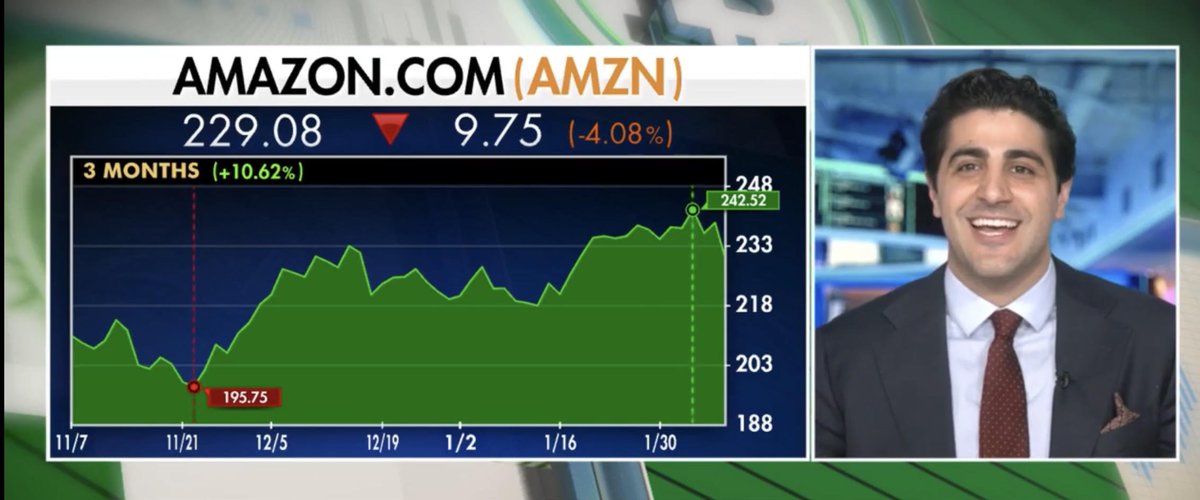
1. Amazon $AMZN
Amazon remains a global powerhouse across cloud, logistics, and retail, and is expected to maintain this leadership into the next decade through aggressive expansion in India, Latin America, and the Middle East.
AWS holds 32% of the global cloud market, and by 2035 it could remain the world’s largest cloud platform, generating $300B+ in annual revenue while expanding its AI-as-a-service offerings.
Generative AI demand is now a multibillion-dollar business, growing at triple-digit YoY rates, with demand outpacing supply.
Amazon Pharmacy continues to scale rapidly, with 50% YoY growth, capitalizing on the momentum in digital health.
With over 250M Prime members worldwide, Amazon enjoys unmatched customer loyalty and competitive advantage and expects to double Prime membership by 2032.
By 2035, ads are projected to become one of Amazon’s largest cash flow drivers, rivaling AWS. This will enable the company to continue reinvesting heavily in logistics, e-commerce, AI, and emerging technologies.
Project Kuiper has successfully launched its third satellite and already secured enterprise and government customers, positioning Amazon to compete in satellite broadband.
Thanks to its vast ecosystem, Amazon is expected to become the first company to surpass $1 trillion in annual revenue by 2029, underscoring its unmatched scale and ability to monetize across multiple industries.
Investments that will make your whole bloodline wealthy.
$VOO
$QQQ
$SCHD
$VNQ
$VXUS
$FXAIX
$VTSAX
$JEPQ
$SCHG
$VUG
$DGRO
$VTI
$VYM
$VIG
$NOBL
$VGT
$XLRE
There’s still a lot more investments that can make your whole family wealthy. 🤑
3 investments types for brand new investors.
$VOO & $VTI - The most reliable investments you will make in your life.💰
$QQQ & $SCHG - The best tech and growth oriented stocks in the market.📈
$SCHD & $DGRO - The best dividend payers. Sweet passive income.🤑
Demon Slayer: Kimetsu no Yaiba Infinity Castle will be coming exclusively to theaters globally as an epic trilogy of films!
#DemonSlayer#InfinityCastle