I returned a hat I bought for my husband so he could exchange it. After 2 emails, which seems to be the only contact, no word or help. You have my money AND his hat. This is terrible.
@bostonscally
Congratulations to @IndianaFootball on their undefeated season and national championship win! God bless these young men for sharing their strong testimonies about Jesus Christ!
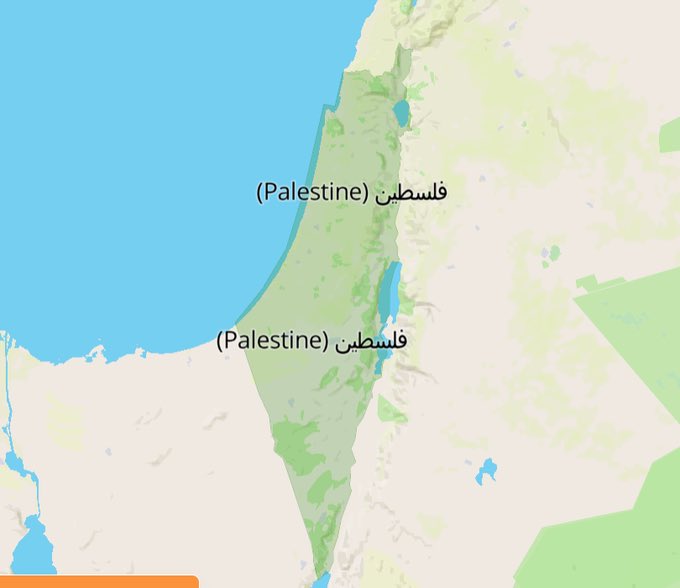
🚨 The National Education Association — the largest union in the United States — just sent out a map to all its members where Israel doesn’t exist.
In its place: “Palestine” in Arabic, covering the entire land from the river to the sea.
They erased the only Jewish country.
And replaced it with what would be the 23rd Arab state.
This wasn’t an accident.
It was distributed nationwide… as an “educational” resource.
The NEA must issue an immediate correction and public apology.
This is a disgrace.
An important thing to bear in mind regarding our relationship to creation is that we have been given a commission of dominion over it (Genesis 1:26).
First, that means we can subdue it to make it habitable. For example: to build shelters, protect them, and service them in increasingly comfortable ways.
Second, it means we can use it to serve needs. For example: wood for fire, water for drinking, minerals for manufacturing, fossil fuels, and plants and animals for food.
Third, it means we can study and understand it—as Adam named the animals, so we classify and investigate the created things.
But where is the limit?
The truth is, it’s not easy to answer this question from Scripture.
Some people have imagined the word “steward” into Genesis—but it’s not there. The words are “dominion” and “subdue” (Genesis 1:28). Neither of these seem to contain limiting language. They are permissive words.
Also, we can’t take our limits from alarmism about the end of the world. God has promised no such human-driven end will occur, but that he is in ultimate control of earth’s seasons, temperatures, days, and productivity (Genesis 8:22). That would make sense, as the One who both creates and sustains his creation . . . and has an end in mind for it.
The Bible does support cultivation. Adam is commanded to cultivate the garden, and provision is made in the Old Testament to ensure the land remains agriculturally sustainable. So, that’s something, albeit modest. Wisdom makes provision for future productiveness.
But there is a very great principle which I find most helpful in elevating our attitude to nature and constraining our destructive excesses in many significant ways.
It is this: the fact that God reveals himself to us through his creation. It is a medium through which he speaks. It points us to him—especially his glory, his power, his eternal existence, and his divinity (Psalm 19:1–6, Romans 1:20).
We do not deify or sacralise nature; it is not divine nor spiritual nor a god. Rather, it is a signpost that points us to God in our mind and our senses. It is his handiwork.
From the breathtaking vistas of a national park, and the intricate life of the animal kingdom . . . to the pleasantness of a local park, a lake view . . . even that little pot plant in your home . . . it speaks of its Creator.
Therefore, nature is also a very good thing in and of itself—it is not only good for what we can do with it and to it.
I think that balances the tension in a way that is genuinely Christian.