With a more than a $1M grant from @CIHR_IRSC, Prof @dhood_york with @YorkUHealth@YorkUKINE will delve into the role of lysosomes in the removal of worn-out mitochondria in muscle tissue, which, currently, virtually nothing is known about. https://t.co/BI94cokM6A
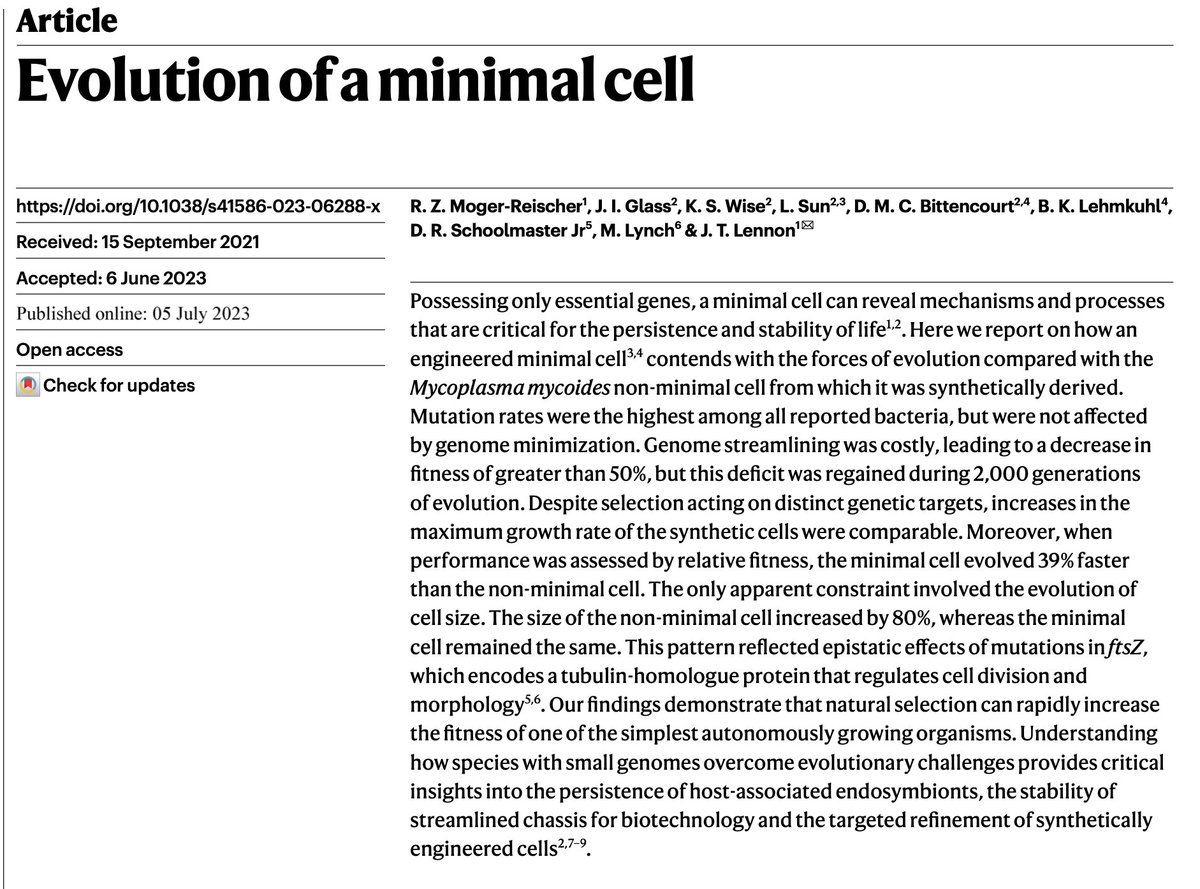
A mind-blowing paper has come out today in @Nature
In 2016, JC Venter Institute scientists trimmed a bacterial genome to its barest minimum required for life to synthesize what they called a "minimal genome" (https://t.co/Rk8oZJ0bUj).
Today, a group of scientists from Indiana University reports how that minimal genome evolved over 2000 generations in comparison to the non-minimal genome.
The authors found that even when you reduce a bacterial genome to its absolute minimum where every nucleotide matters, the genome undergoes mutational events generation after generation as much as the non-minimal genome. One simply cannot stop the evolution.
Just over 300 days of evolution (equivalent to 40,000 years in humans) the minimal cell has gained everything it lacked in fitness on day one in comparison to the non-minimal cell.
When comparing the evolved traits between the minimal and non-minimal cells, the scientists found something striking. The evolutionary process increased the cell size of non-minimal cells but not that of the minimal cell. But that is not the striking part.
The scientists were able to identify the key mutation that resulted in cell size evolution. And it turned out that the mutation that helped the non-minimal cells to grow bigger is the same that helped the minimal cells to stay smaller. Growing bigger had a survival advantage for non-minimal cells and not growing bigger had a survival advantage for minimal cells. So, the mutation had a context-dependent effect. This just demonstrates that the evolutionary effects on traits have no absolute direction. All that matter is what is beneficial for the organism's survival.
The conclusion of the paper is metaphorically a quote from the Jurassic Park movie:
“Listen, if there’s one thing the history of evolution has taught us is that life will not be contained. Life breaks free. It expands to new territories, and it crashes through barriers painfully, maybe even dangerously, but . . . life finds a way". (https://t.co/UlxRlb86CT)
https://t.co/zA9OAqSoAu
Check out the MHRC Paper-of-the-Month for March featuring Luca Delfinis, Chris Perry et al studying mitochondrial abnormalities leading to muscle weakness in a cancer cachexia model. See: https://t.co/3eTcxC547f
We are pleased to share the recent review by Slavin M. et al on regulatory networks governing adaptations to muscle use and disuse. See https://t.co/U9kj8cghiQ
We are excited for IBEC 2022 in Toronto! 214 accepted abstracts, 66 excellent speakers, 350 registrants (with room for more). It will be a great program. Sign up to attend or take advantage of our "on-demand" recorded program at https://t.co/noNDjfrb7V
Tomorrow April 20 at 5 pm Toronto time is the final day for abstract submission at IBEC 2022. It is also the deadline for early-bird registration. See https://t.co/noNDjfrb7V
The IBEC Team is pushing the limits! IBEC early-bird registration and abstract submission have been further extended to April 20. There is still time to submit your work at discount prices! Please see https://t.co/kUjN115guK
The early bird deadline for registration and abstract submission for IBEC 2022 is coming up later this month (March 25). Looking forward to seeing you all in Toronto. To register and submit an abstract, please visit
https://t.co/qIKNT1SoBP
Read the most recent #EarlyCareer blog from Dr. @MatthewTriolo, Postdoctoral Fellow at the @KhachoLab!
Explore Dr. Triolo's journey as a #neuromuscular researcher, and how his experiences as a coach, teacher, and mentor have influenced his career.
https://t.co/antlcOezy2
@YorkUHealth researchers Jonathan Memme, Ashley Oliveira & Prof David Hood have found the importance of #p53 is most evident under stress conditions where maintenance of #mitochondrial function is essential. These results address a decades-long debate. | https://t.co/rFJQZmXDRd
Memme et al.'s data illustrate exacerbated mitochondrial dysregulation with denervation stress in p53 mKO tissue, thus indicating that p53 contributes to organellar maintenance via regulation of MQC pathways during muscle atrophy — @YorkUKINE@dhood_york
https://t.co/W1YqCAasbb
We are pleased to share the preprint of our work by Jonathan Memme and Ashley Oliveira on the role of p53 in mediating the adaptive response of muscle to denervation, published in Journal of Biological Chemistry. Please see https://t.co/nhqRXwXyxt
Pleased to share our latest review published in Frontiers in Physiology, on the therapeutic effects of exercise on mitochondria, in aging, mitochondrial disorders and cancer. https://t.co/KruIvp7uNs