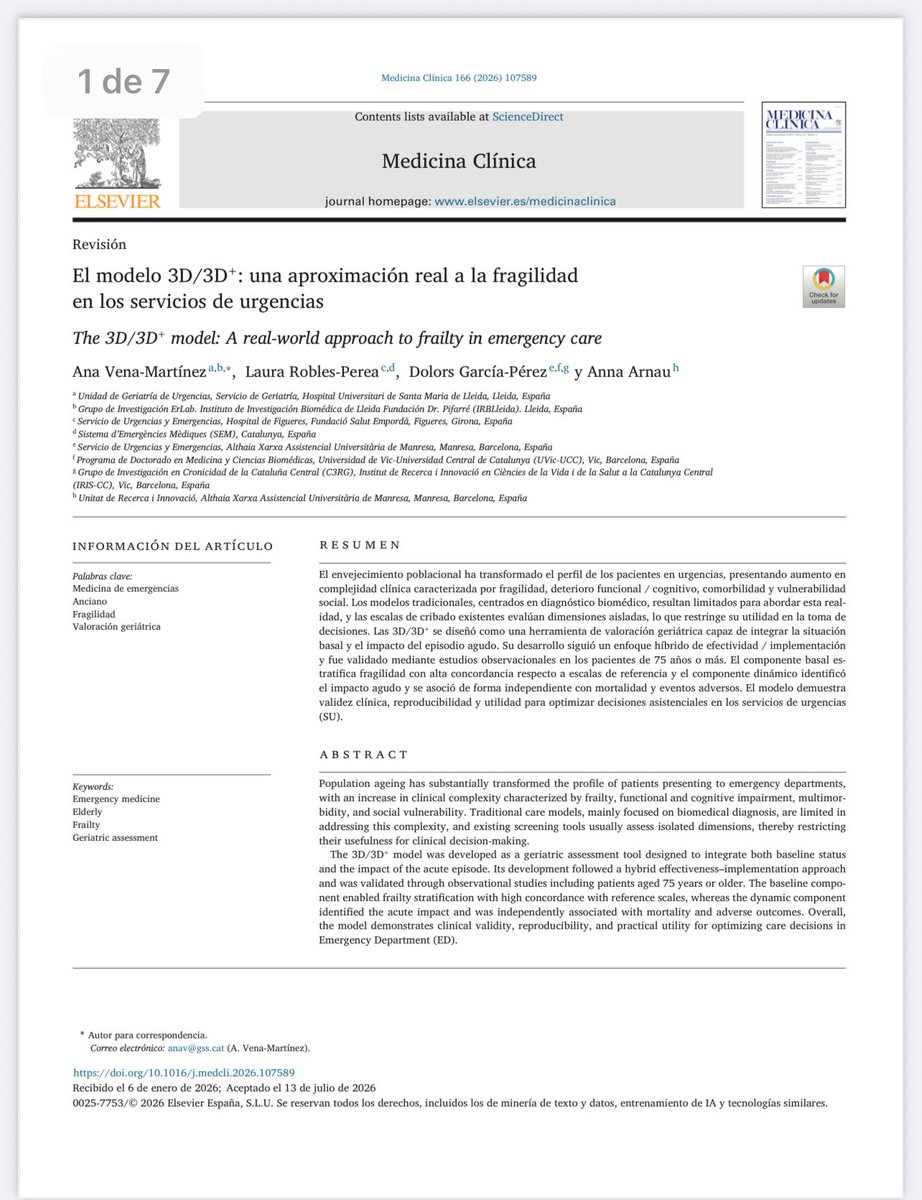
Muy contento de compartir este artículo en Medicina Clínica sobre inteligencia artificial generativa aplicada al razonamiento clínico y el diagnóstico diferencial. Un trabajo liderado por @Luis_Corral_Gud y además con @ramos_casals y @JJRiosBlanco
https://t.co/bVoNYxTVmg
La saturación de Urgencias no se resuelve tratándola como un problema de Urgencias. Es acceso, capacidad, coordinación, hospitalización y continuidad asistencial. Sobre todo, es gobernanza: servicios que responden por fragmentos, mientras pacientes recorren todo el sistema.👇
🚑 Microcredencial Universitaria en Soporte Respiratorio en #Urgencias y #Emergencias, impulsada por @SEMES_ y @UCAM
📍 Presencial intensivo: 15, 16 y 17 octubre 2026
🎓 12 ECTS | Plazas limitadas
Inscríbete ya 👇
https://t.co/o05Q6jY2bf
Continuing in our series on …
🚨 Mastering Ventilator Waveforms: A Crucial Skill for Diagnosing Pulmonary Pathophysiology 🚨
-PART 3
🌐 Building on the Basics: From the Equation of Motion to Expiratory Flow Analysis 🧐
In our previous post,we discussed the Equation of Motion, the fundamental step in understanding mechanical ventilation.This equation lays the groundwork for analyzing how the pressures and forces interact during inspiration.With this solid foundation,we now move forward to explore the expiratory phase,critical aspect in generating pathophysiologic hypotheses.
🚨 Step 2:Generating a Pathophysiologic Hypothesis from Expiratory Flow Waveforms 🚨
Understanding the expiratory flow waveform is crucial for clinicians to assess the patient’s pulmonary status. This waveform provides insights into the resistive & elastic properties of the respiratory system,particularly when expiration is passive.
Here’s how to evaluate the waveform and what it tells us:
🫁 Expiration Below the Baseline
•Expiration begins when the ventilator ceases flow,primarily reflecting the patient’s lung https://t.co/zNuvkki0AR passive exhalation,the expiratory flow waveform typically shows an exponential decay,driven by the thoracic elastic recoil.This pattern is key to hypothesizing about underlying pulmonary conditions.
🔬 Assessing the Waveform to Form a Hypothesis
•The gradient between alveolar pressure (plateau pressure) & PEEP drives the initial expiratory flow.Assessing this flow against the expiratory time constant, which is determined by resistance and compliance,is vital for understanding how quickly the flow returns to baseline or functional residual capacity.
📈 Passive Exhalation During Ventilation
•Prolonged expiratory time constants suggest ⬆️ compliance (e.g., COPD) or ⬆️ resistance (e.g., bronchospasm).
•Short expiratory time constants with rapid peak expiratory flows indicate ⬇️ compliance (e.g., ARDS).
💪 Active Exhalation During Ventilation
•Recognizing patient effort during expiration is essential,as it can alter waveform interpretation and affect diagnosis.
⚠️ Auto-PEEP
•Auto-PEEP, resulting from incomplete exhalation,can be detected through waveform analysis and confirmed with a static expiratory hold maneuver.This is common in conditions like COPD or bronchospasm.
🚫 Expiratory Flow Limitation
•Seen in conditions like COPD, expiratory flow limitation occurs due to dynamic airway collapse, affecting the waveform & often causing auto-PEEP.
🦠 Secretions
•A sawtooth pattern in the expiratory flow waveform suggests airway secretions /condensate within the ventilator circuit.
📝 Summary:
•Evaluate the expiratory flow waveform to form a hypothesis about pulmonary pathophysiology.
•Differentiate between passive and active exhalation and assess for auto-PEEP or expiratory flow limitation.
•Consider secretions when interpreting sawtooth waveform patterns.
�� Stay tuned for Step 3: We’ll discuss how to Corroborate Pathophysiologic Diagnosis based on the shape & duration of the inspiratory flow waveform.Follow for more insights!
#CriticalCare #MechanicalVentilation #RespiratoryCare #Pathophysiology #VentilatorWaveformAnalysis #ICU
#NerdyMedicine #MedX #MedEducation #Medtwitter #FOAM #FOAMed #FOAMcc #EDIC #FFICM #FICM #FCICM #IDCCM #IFCCM #CTCCM #criticalcarereviews @CritCareReviews @JVentilation @Vent_Busters @SMHCoEMV @OfVentilation @ATC_Ventilator @ArielG_RRT @DrSateeshPCCM
Would love to know ur opinions. Comment below to start the discussion . 🙏🙋
¿Puede la historia de este hospital 🏥 en Suecia servir de inspiración para el necesario cambio que necesitan nuestras organizaciones?
Lo cuento en esta entrada a propósito también de la experiencia del Hospital Militar en Sevilla.
https://t.co/Nh9ECRjn0h
Hacerse el sueco no es una buena idea cuando se trata de buscar cómo transformar nuestros hospitales.
Aquí dejo la historia reciente del Hospital Karolinska en Solna, y como ha sido posible cambiar modelos tradicionales por otros pensados en el paciente.
https://t.co/Nh9ECRjn0h