@ICannot_Enough I called it the ‘Tobacco Strategy’: Instead of spending on habits that hurt your wallet & health, why not invest that amount in your future? A simple DCA into the S&P 500 can turn wasted cash into long-term gains.
Or be bold and go all in $tsla 🚀🌕
If you're a $TSLA investor, you should listen to this.
Many investors are very frustrated with the current stock price being flat and not making a move but @wholemars breaks it down perfectly here!
He mentions some of the most important elements of being invested in Tesla. He makes you think logically instead of emotionally and this is VERY important.
We do these spaces every Saturday and lots of good thoughts, topics and discussions happen! Join us!
P.S. you may buy more $TSLA after listening to this.
NFA!
In this regard, christianity and capitalism didn’t appear in a vacuum. They built upon and transformed those earlier roots. Some historians argue the Enlightenment partially secularized Christian ideas rather than replacing them entirely. Even in coins we have religious references; constituion don't include god references but have implicit christian values
The West succeeded because of a powerful synthesis that included Christian moral foundations and the economic dynamism of markets, along with strong scientific and techological advances
Mais uma pérola dos jornaleiros dos OCS deste país e porque é que as redes sociais são um perigo para apurar a verdade.
Os anormais da @cmjornal espalham desinformação à boca cheia livremente ao afirmar com toda a certeza que num choque em cadeia um @Tesla ardeu…
Azar do caraças os Teslas têm câmaras que registam gravações em caso de acidentes etc e que as seguradoras adoram para apurar o que se passou de facto.
Inequivocamente as imagens mostram as chamas numa carrinha de nove lugares a combustão. Ou seja, a Tesla já faz Toyotas Hiace a diesel pois só dessa forma é que o Tesla ardeu.
Não hajam dúvidas, num acidente, a maior probabilidade de incêndio cairá sempre num veículo que transporta líquidos inflamáveis
Já em relação à “notícia”, foram nas redes que se apurou a verdade, as mesmas redes sociais que a UE quer controlar através do Chat Control que impôs de forma ditatorial.
Nunca acreditem piamente nos OCS pois cada vez mais são um género de telenovelas sem qualquer ética, apenas interessa a narrativa que vende minutos no ecrã e clicks em sites.
Era bom a @teslaeurope mover uma ação em tribunal para meter estes tipos no sítio. O @X felizmente ainda é um espaço que permite livremente apurar o que realmente ocorreu, graças ao @elonmusk senão seria mais um BlueSky 🤡
Marc Andreessen just named the lie that held for a hundred years and is collapsing in real time.
We gave authority to the people who explained things. Not the people who built them.
And nobody questioned why.
For a century, builders created and journalists translated. The public accepted it because complexity demanded a middleman.
But the middleman was never the expert. The middleman was the channel.
And we mistook the channel for the source.
Andreessen: “You set it loose and it will write you literally a 30-page answer. This is basically like a textbook on any topic.”
Any topic. Infinite depth. Zero cost. No gatekeeper.
He has a name for what comes next. Practitioner media.
Andrej Karpathy doesn’t sit across from a journalist. He turns on a camera and teaches the world how the architecture works. No filter. No editorial framing. No one deciding what you’re ready to hear.
The press calls it dangerous.
They are not protecting the public. They are protecting the bottleneck that gave them power.
The critic always needed the creator. The creator never needed the critic.
They just had no other way to reach the world.
Now they do.
Don’t fall for the rage bait
Also, correcting misinformation takes an order of magnitude more effort than creating it. This concept is called Brandolini's Law (or the "bullshit asymmetry principle")
Maybe X should do a automatic “is this true @grok” on every post which isn’t made by a parody account
Tesla has just launched Tesla Home, a home energy management system.
Powered by Opticaster, Tesla's AI optimization software, it predicts your energy needs, automatically adjusts your usage across your electric appliances and can help lower your electricity bills.
1) Opticaster assesses your energy usage and the weather forecast to predict your home’s solar generation and energy consumption.
2) Your system creates a plan to help you meet your savings goal. Based on this plan, your home uses solar or stored energy when utility prices are high, while your Powerwall and EV charge from solar or the grid when utility prices are low. Either way, you can minimize your electricity costs.
3) Opticaster continuously analyzes your home’s energy usage, solar production and local utility prices to improve its optimization and forecasting abilities. With over-the-air software updates, Opticaster will get better over time.
"Designed to work with a variety of home energy systems, Tesla Home connects Powerwall to Solar Panels, Solar Roof, Wall Connector and other third-party energy products, with no additional equipment needed."
Learn more: https://t.co/xuF9CgHCt1
Morgan Stanley's Adam Jonas has just initiated coverage on @SpaceX for the first time with a $300 price target & a bull case of $600/share, which would be an $8 trillion market cap.
Adam thinks SpaceX could generate $319 billion of revenue in 2030, and $3.3 trillion in 2040:
"With an 'X of 1' position in space infrastructure, we believe SpaceX can convert energy into intelligence at scale with optionality to monetize through a range of consumer and enterprise solutions for the next era of AI…the final frontier.
Key Fundamental Drivers of @SPCX Stock Over the Next Few Years:
1) How Does SpaceX Monetize Enterprise Al? While neo-cloud deals are the bulk of the business near term, we see end-to-end Al services as the longer-term business model. We believe the progress of Cursor, including annual recurring revenue estimated at $4 billion and ongoing Pareto frontier performance, remains underappreciated by the market.
2) Can SpaceXAl Achieve Industry-Leading Cost and Time-to-Power? A large portion of SPCX's capex is directed toward Terafab, Solarfab, and other vertical integration efforts (including blade/vane foundry, terrestrial communications infrastructure) to drive down both $/watt and time-to-power on Earth before moving Al "off Earth". While we are believers in the advantages of space-based Al infrastructure over the long-term, we also think the market underappreci-ates SPCX's terrestrial Al economics, with cost per watt running at half the industry average, excluding chips, and deployment speeds ~6-8x faster than peers.
3) Will Starship Achieve a Step Change in Economics? Rapid reusability of both the first and second stages is key to increasing mass-to-orbit capacity and lowering launch costs ($/kg), but the program is still in early testing. The testing regime won't be easy, but we ultimately see a path to launch costs of ~$500/kg by 2030 and below $150/kg by 2040, which could materially expand both connectivity and Al TAMs.
4) Will Starlink Achieve Broad TAM Adoption? Starship, V3 broadband satellites, and Mobile Gen 2 satellites should significantly expand available capacity, enabling materially improved speeds, lower latency, and more effective pricing across consumer, enterprise, government, and mobile mar-kets. Longer term, the primary driver is Starlink becoming a connectivity layer for virtually every data-transmitting device that requires reliable coverage beyond the reach of terrestrial infrastructure.
Our financial forecasts: Balanced execution risk near term with large TAM creation long term:
• Our 2030 revenue forecast of $319 billion balances execution, regulatory and engineering risk with the company's technological and vertical moat which allows it to move faster than peers.
• Our 2040 revenue forecast of $3.3 trillion gives the company credit for creating all new TAMs for connectivity and physical Al services.
• High spending needs ($300 billion capex/year by 2031) means SPCX is not FCF positive on our forecasts before 2035, requiring, on average, ~$84 billion of external capital needs per year from 2027-2034. Ability to secure necessary capital is one of the greatest risks to our forecasts.
• Where do we expect our forecasts to be different? General Longer-term optimism but with balanced nearer-term forecasts accounting for challenges of scaling in the physical world, conservative Starlink mobile adoption, optimistic government & enterprise connectivity opportunity particularly loT/embodied Al, conservative space/launch revenue due to majority capacity used internal, more conservative orbital compute ramp and capex but with credit for long-term scalability advantages, optimistic enterprise monetization potential with more conservative forecasts for traditional X & Grok business.
SpaceX combines near-monopoly launch economics, the world’s largest LEO satellite network, and a fast-scaling AI infrastructure business. We see the company as one of the few platforms that can link real estate in orbit, global connectivity, and compute capacity into one infrastructure stack. Our base case models revenue rising from $45B in 2026 to $319B in 2030 and $3.3T in 2040, with the largest upside tied to Starship, Starlink capacity, terrestrial compute, and orbital compute."
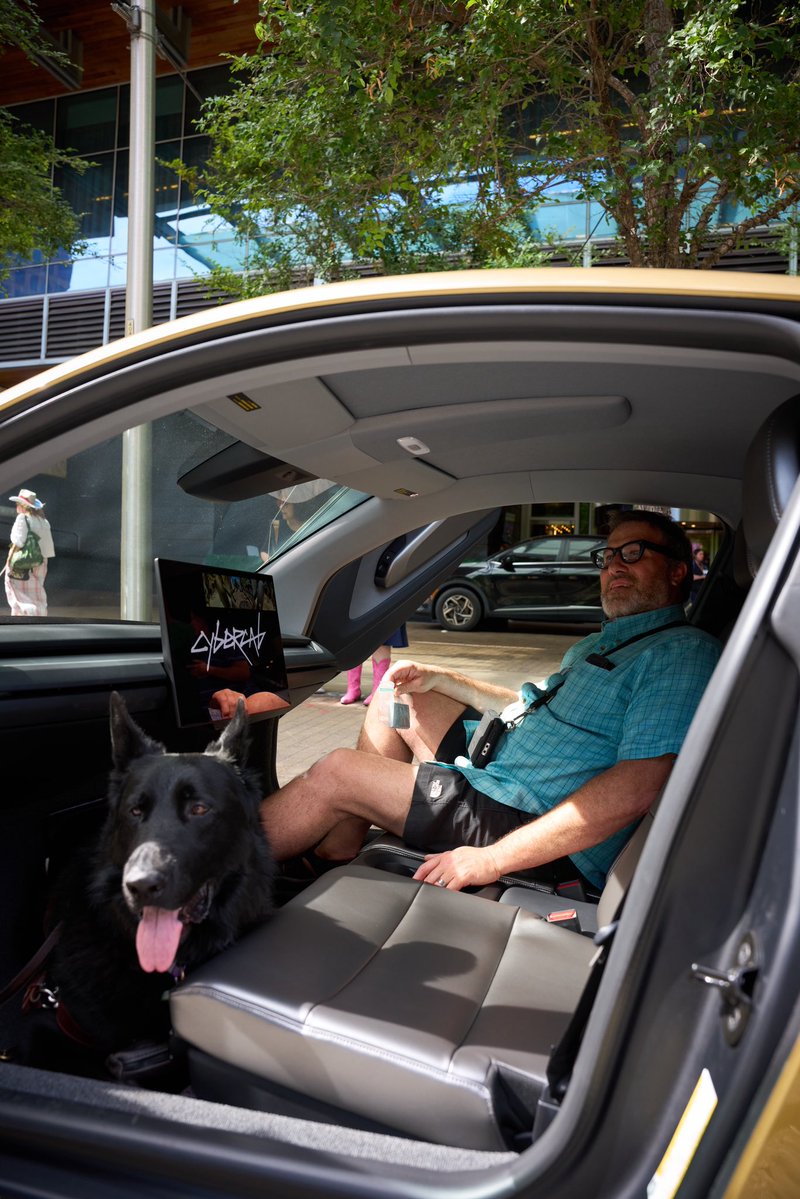
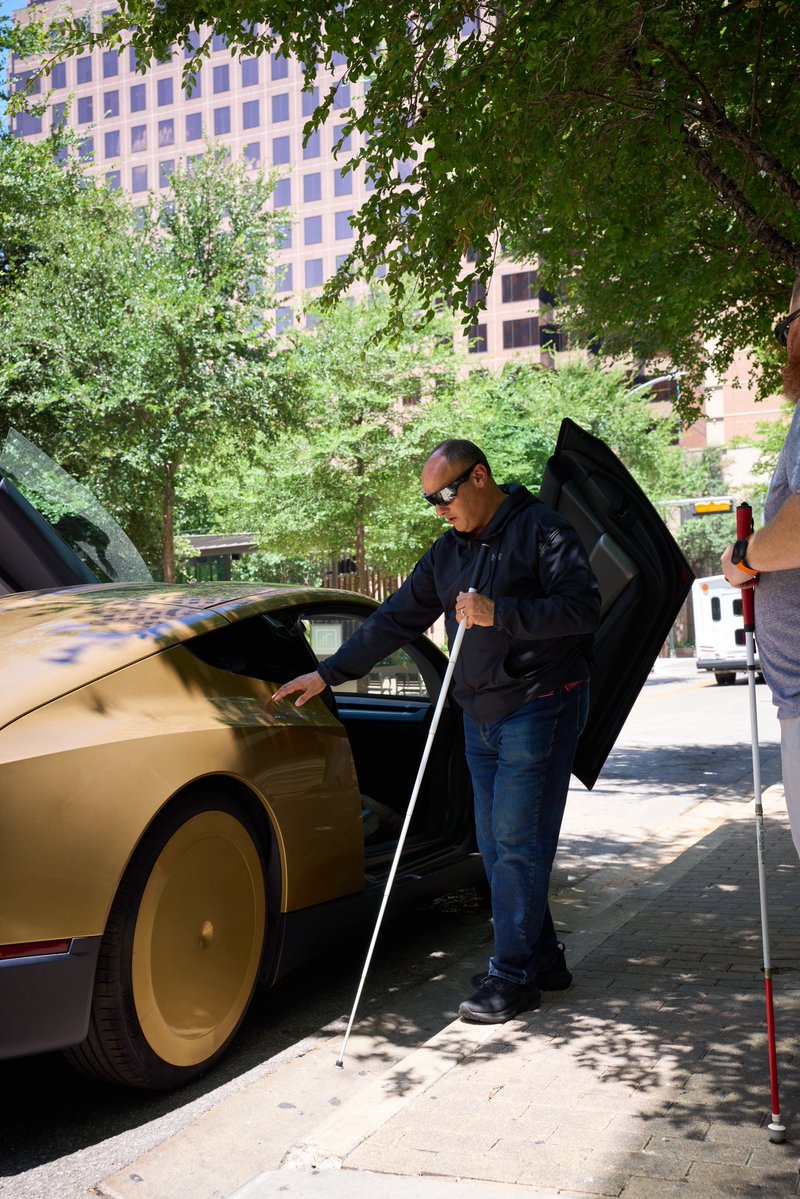
Cybercab at the National Federation of the Blind's Annual Convention in Austin for a hands-on experience of its accessibility features for blind or visually impaired customers For example: – Braille lettering on physical controls
– Space for service animals & assistive devices
– Wheelchair-height seating for easier transfers
@karlmehta “These people are stealing the weights and alpha of my business.” Alex Karp
Enterprises are literally handing over their competitive advantage. In this environment, full vertical integration starts to look like the smartest defense
https://t.co/E2DsVEUn1G
Alex Karp said this out loud on CNBC recently (https://t.co/x2AEnoup62), and it’s worth quoting directly because it frames the whole thing:
“What the technical customers want is control over their compute, their models, their data stack, and their alpha. They want to know they own the means of production, and it’s not being transferred to someone else.”
“I am paying for tokens that create no value. These people are stealing the weights and alpha of my business.”
Every API call to a closed frontier model leaks your workflows, telemetry, and edge cases. The lab uses it to ship competing verticals. You hand over your proprietary edge for token prices.
That’s why full vertical integration wins: #Tesla owns fleet data + Optimus, trains on Dojo with custom silicon, and controls the full loop. #SpaceX does the same across rockets, satellites, and autonomy (now with Terafab chips).
#Nvidia is shifting too from chip supplier to full stack (GPUs + CUDA + Nemotron models), as in its Palantir deal (https://t.co/Mg6PxTyk38)
In AI, sovereignty isn’t optional. Own the stack or fuel someone else’s roadmap
Alex Karp said this out loud on CNBC recently (https://t.co/x2AEnoup62), and it’s worth quoting directly because it frames the whole thing:
“What the technical customers want is control over their compute, their models, their data stack, and their alpha. They want to know they own the means of production, and it’s not being transferred to someone else.”
“I am paying for tokens that create no value. These people are stealing the weights and alpha of my business.”
Every API call to a closed frontier model leaks your workflows, telemetry, and edge cases. The lab uses it to ship competing verticals. You hand over your proprietary edge for token prices.
That’s why full vertical integration wins: #Tesla owns fleet data + Optimus, trains on Dojo with custom silicon, and controls the full loop. #SpaceX does the same across rockets, satellites, and autonomy (now with Terafab chips).
#Nvidia is shifting too from chip supplier to full stack (GPUs + CUDA + Nemotron models), as in its Palantir deal (https://t.co/Mg6PxTyk38)
In AI, sovereignty isn’t optional. Own the stack or fuel someone else’s roadmap
Palantir CEO Alex Karp on what customers actually want, the real business of frontier labs, and the importance of open source models:
“What the technical customers want is control over their compute, their models, their data stack, and their alpha. They want to know they own the means of production, and it's not being transferred to someone else.”
"Who owns the data? Are the prompts secure? Is this being transferred to you?"
"If it was so valuable, and I can make you a billion dollars, wouldn't I say I'll make you a billion dollars and I want 30%? Why are they charging for tokens if it's so valuable?"