Poker solvers are bullshit.
That's what I would say if I had no idea what they are for.
A strong theoretical foundation helps you identify mistakes in villains' games quickly and understand what to do about them.
Here's how to use a solver effectively to take your game to the next level.
We use @GTOWizard.
Step 1: Set a clear study goal. Instead of “Today I want to study single raised pots,” be specific: “BTN vs BB SRP on low boards.”
Step 2: Use the aggregated reports in the solution library for a rough overview of the spot. This gives a broad idea of how to approach it.
Step 3: Use custom solutions to dive deep. Focus on understanding, not copying output.
Start with ranges: how they look and interact with the board. Use the ranges tab and compare different boards to see why things happen. Then study hands and why they do what they do.
Build a simplified strategy. Don't RNG. Understand why hands bet.
For turns and rivers, group boards (brick, flush complete, paired, overcard) and repeat. Do this for all spots.
Step 4: Use the nodelocking tool to model different player types and find exploits. Ask “what happens if” when nodelocking.
Step 5: Apply what you learned. Drill the spots, play 1-2 tables online focusing on them, and review afterward.
I made a video on how to use GTO Wizard effectively. Check it out:
https://t.co/D87o5ex3VH
when your opponent has a weak range, donk leading in to them with strong hands is goated.
2 examples.
1) say we open co with a4s, button calls.
flop is q94 with a flush draw.
we check, our opponent bets ⅓ pot, we call with bottom pair.
turn is a 4, giving us trips.
great time to donk! when our opponent stabs small on a wet dynamic flop, their range is likely going to be weak, and the pool is unlikely to double barrel at a high enough frequency. but if we donk, they call way too often with hands like 9x, or pocket 8s, or weak draws.
2) say the btn opens, and we defend from the bb with a8cc.
flop k63 with 2 clubs.
we check cal with the nut flush draw.
turn is a blank. we check call again.
river is a 2 of clubs and we bink the nuts.
again, great spot to donk. the player pool will absolutely underbluff if we check to them, and they will just check back hands as strong as sets here (let alone strong pair). BUT, they often talk themselves into a call if we bet ourselves.
Got some exciting news! 🙌
Just launched my first YouTube series: High Stakes Thinking
There I'll share an in-depth, unfiltered look at how I study, analyze, and break down hands. 📚
Ep. 1: Multiway Turn Exploits:
🔗 https://t.co/Sws3SnmI19
Excited to finally bring this series to life. More coming soon. 🏆
one thing i’ve noticed: when my opponents choose small river sizes (25-40% pot) when they’re in position....
it’s almost always thin value.
it’s almost never the nuts.
and it’s massively underbluffed.
my adjustment: turn my bluff catchers into bluffs.
if i can’t beat the hands i think they’re betting for thin value, i have no problem turning middle pair, or even top pair into a bluff in these situations because i think calling sucks, folding is pretty good, but bluff raising is amazing because their range isn’t protected.
this one has worked out nicely for me.
Answer: Bet big. ✅
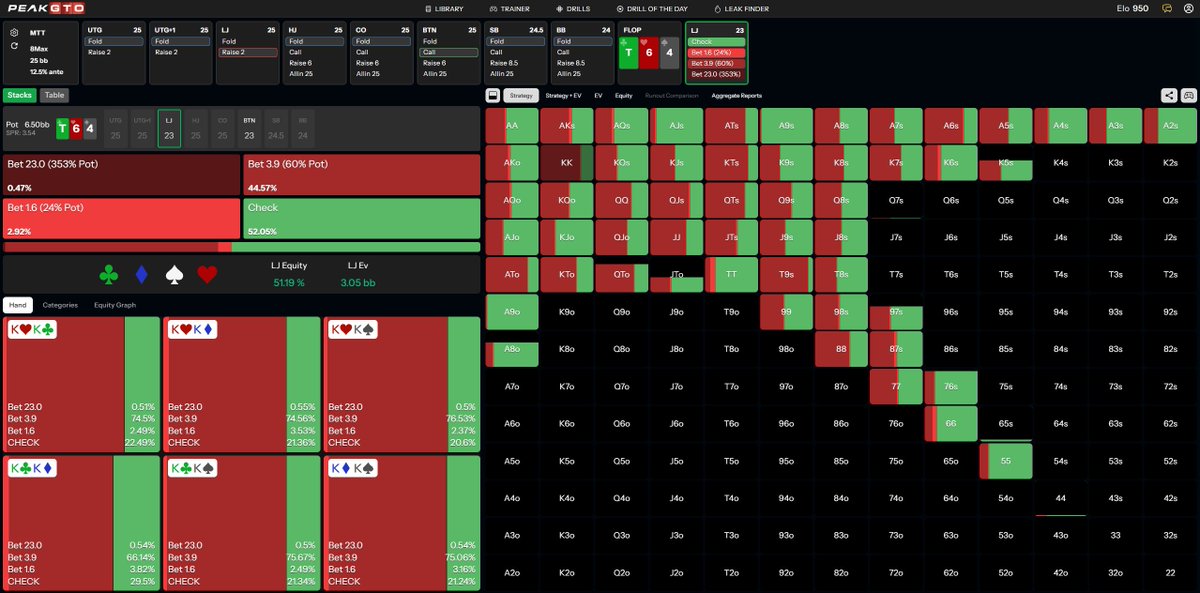
There are three key concepts to consider when deciding how often and how large to c-bet out of position:
1. Position Proximity
The BTN has the weakest in-position calling range we can face. Because they're calling from the button, their range is wider and weaker, giving us more equity and making us want to bet more often.
2. Range Asymmetry
On T♣️6♥️4♠️, we have hands the BTN doesn't. We can have offsuit Tx and overpairs like K♠️K♦️, while the BTN can't have those hands after calling preflop. This gives us a nut advantage, which favors using a large bet size.
3. Stack-to-Pot Ratio
At 25bbs deep, we don't need to worry as much about navigating multiple streets out of position. A large flop bet lets us quickly reduce the SPR and makes it easier to get our strong hands all-in.
So rather than checking and potentially losing value on later streets, c-bet frequently and use a large size with a hand like pocket kings.
Advances in study tools have enabled more players to approach GTO play on the flop. On the turn, however, significant differences remain between human and GTO strategies.
In BTN vs. BB spots where the flop checks through, the BB often uses an overbet on the turn. This tendency is especially pronounced on low boards when the turn pairs the board.
For example, on 9♠8♥3♦ 3♣, GTO overbets 38% of the time, while human regulars do so only 6.5% of the time. This suggests that human players may be missing opportunities to extract value.
GTO builds this overbet range with most trips, top pairs, and draws as strong as a gutshot or better.
Human players—especially less experienced ones—tend to have low fold-to-3-bet rates. So where do the weak hands that GTO would never call end up? One answer is overfolding to flop c-bets, particularly on low-ranked boards.
For example, on 9♠5♥5♦ in a BTN vs. CO 3-bet pot, inexperienced players are predicted to fold 20% more often than GTO against a 33% c-bet.
Let’s make them pay for calling too wide preflop.
Over the past 5 WSOPs, I've won 2 bracelets, made 13 final tables, and cashed for $1.8M+ in mixed-game events, and have been net positive at WSOP all 5 years
If you think solver outputs are enough to win mixed games, you're studying the wrong things. Here's what actually matters. 🧵👇
Humans are often considered tougher callers than GTO,
but there are many spots where they overfold.
For example, on a BTN vs. BB board like As8h5h-2d-7c,
where both the turn and river are blanks,
humans are expected to fold over 20 percentage points more often than GTO
against a 67% pot river bet from the BB after the action checks through.
The gap is large enough to justify betting
every hand with no showdown value.