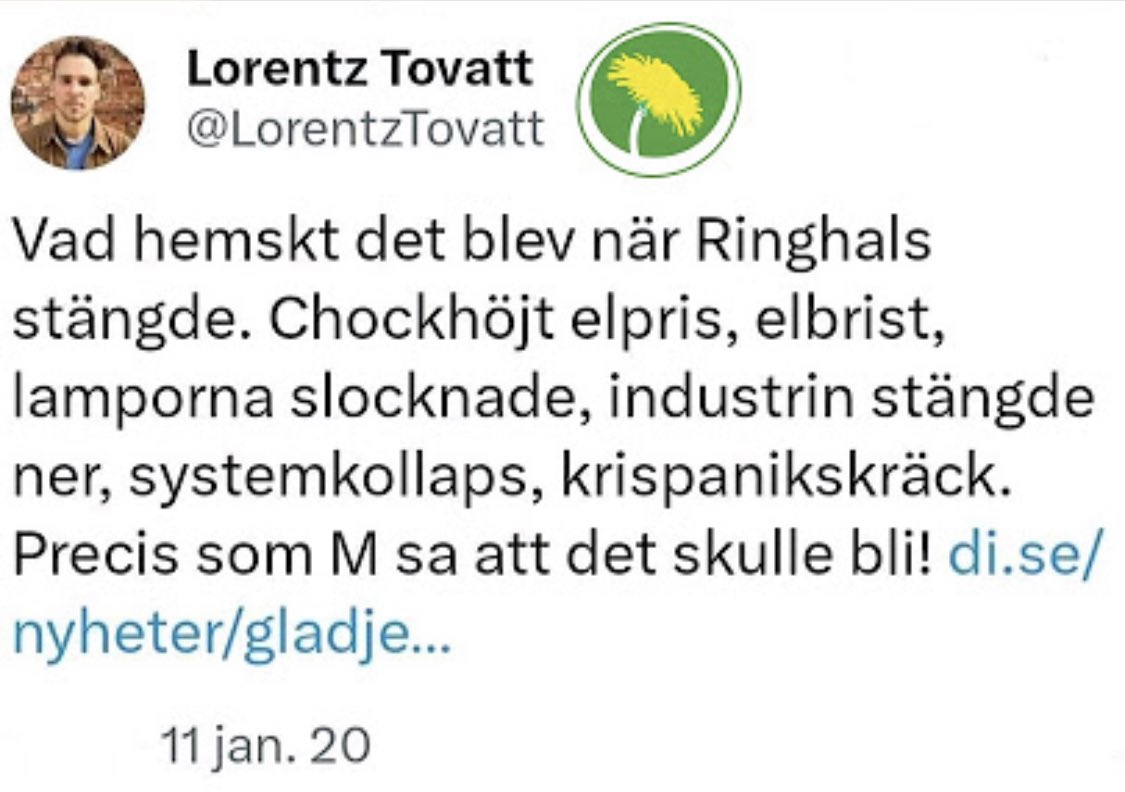
Jag tror på allvar att C riskerar att implodera inom kort.
På ena sidan har vi miljömupparna kring Nytorget samt lattemorsorna i Vasastan/Stureplan. På andra sidan skogsägare, lantbrukare och småföretagare på landsbygden.
Två väljargrupper med helt olika verklighetsuppfattningar, prioriteringar och intressen.
Det enda de verkar ha gemensamt är partibokstaven. Frågan är hur länge det håller.
Två personer har gripits i Tyskland misstänkta för terrorplaner mot synagogor.
Enligt uppgifter till Der Spiegel ska ett av målen ha varit en synagoga i Malmö.
https://t.co/Bpei8m6SNn
Socialdemokraternas tillbakagång i valen under de senaste decennierna, i synnerhet det senaste, har inte bara berott på kortsiktiga misstag eller de andra partiernas styrka.
En del av förklaringen ligger i långsiktiga politiska vägval under perioder då partiet haft regeringsmakten eller på annat sätt dominerat den politiska dagordningen.
Där partiet idag bär huvudansvaret för samhällsproblemen men saknar ett eget moment för såväl att inse sin egen skuld som att adressera problemen.
https://t.co/okfo5Rnkgb
#svpol @magdandersson@TobiasBaudin@mikaeldamberg
Man kan lyfta den här igen. Som dessutom ”togs bort” från publicistens sida.
Så här gick tongångarna om energipolitik och kärnkraft efter valet 2014. Om någon nu glömde bort det.
https://t.co/V0mJTWojiD
Moskva har under flera år haft en direktkanal in i Sverige.
Med hjälp av interna chattar från avhopparen Sanna Hill kan DN berätta i detalj vem som planterade propagandan: En agent som flydde till Moskva.
Långt reportage. Och spännande, törs jag lova.
https://t.co/avPd67WfW2
If you're worried about A.I., you should think about the tractor.
Yes, the tractor. 👇
An Iowa inventor named John Froelich built the first practical gasoline tractor in 1892. Froelich left the business, but the firm, renamed the Waterloo Gasoline Engine Company, went on to build the Waterloo Boy: a two-cylinder kerosene tractor. But that's not what really changed the world.
Ford changed the world.
As he’d done with cars, Henry Ford perfected the tractor. Ford’s tractor debuted in October 1917 at $750, or roughly $137,000 today. In March 1918, John Deere bought the Waterloo Gasoline Engine Company. The John Deere Model D arrived in 1923, stayed in production for 30 years, and sold 160,000 units. Anticipating the competition, in February 1922, Ford cut the price of his tractor to $395. The industry called what followed the “tractor wars.”
In 1923 alone, Ford built more than 100,000 tractors.
The resulting vast increase to farming productivity was probably the single biggest, most important fundamental economic change in human history to that point.
In 1830, growing 100 bushels of wheat took 250 to 300 hours of human labor with a walking plow, a sickle, and a flail. By 1930, with a tractor, a gang plow, and a combine, the same 100 bushels took 15 to 20 hours, a 95% reduction.
In 1920, American farms owned 246,083 tractors and 25.2 million horses and mules. By 1950, they owned 3.25 million tractors and only 7.6 million horses and mules. I bet you've never thought about how much that changed -- or created -- the modern world.
A mature farm horse needed about three acres of cropland for feed every year. At “peak horse” in 1915, roughly 93 million acres of American cropland grew food for horses and mules rather than for people.
The economic historians Alan Olmstead and Paul Rhode calculated that the tractor replaced 23 million draft animals between 1910 and 1960. That added 79 million acres to the effective cropland base, an area equal to two-thirds of all the cropland harvested across the Louisiana Purchase.
By 1960, the tractor cut the labor needed to grow America’s crops by about 1.7 million workers.
So who lost? The horse breeders lost, and so did the oat growers who fed the horses. The harness makers, the livery stables, and the farm blacksmiths lost too. And, of course, millions of farmers who didn’t take advantage of the new machinery and vastly expand their acreage also lost.
But… who won? America won. All of us.
In 1900, 41% of America’s workforce worked in agriculture. By 1930, the share was 21.5%, and by 2000, it was only 1.9%.
It was this fundamental change to farming productivity that created our cities. The 1920 census was the first in our history to count more Americans in towns and cities than in the countryside: 51.2%. During the 1920s, for the first time in our history, the total rural population actually fell.
So… what happened to the farmers? They followed prices (wages) to build what the economy needed. It didn’t need farmers anymore, thanks to tractors. The new economy needed cars and radios, city offices, stores, and hospitals. While they went on to build these things (and invent many others), the food they no longer had to grow kept arriving from fewer farms, at lower prices.
But hang on, didn’t the advent of the tractor and the changes to farming cause the Great Depression? Remember the “Okies”? Remember John Steinbeck’s The Grapes of Wrath?
For the farmers who couldn’t compete in the new world of tractor farming, politics held out the siren song of getting something for nothing. And getting disaffected farmers’ votes was a winning political strategy for decades.
When Herbert Hoover became the U.S. president in March 1929, he called Congress into special session to deliver “farm relief through limited changes in the tariff.”
Much like President Trump today, Hoover believed tariffs were taxes that Americans wouldn’t have to pay. Those revenues could be used to give money to farmers. Congress took Hoover’s farm bill and loaded it with protection for thousands of other businesses.
More than 1,000 American economists signed a petition begging Hoover to veto the bill. They warned “the vast majority of farmers would also lose.” Henry Ford, the man selling tractors to those farmers, spent an evening at the White House calling the bill “an economic stupidity.” But Hoover signed it anyway, on June 17, 1930.
The Smoot-Hawley Tariff did exactly what the economists predicted. Canada retaliated before the bill was even signed, and Europe followed. Our exports fell from $5.24 billion in 1929 to $1.67 billion in 1933: a 68% collapse.
From 1926 through 1929, trade accounted for 15% to 17% of American farm income. It went to zero after the tariff. Farm-state banks failed by the thousands. Between December 1930 and March 1933, about half of all American banks either closed or merged.
But the tractor didn’t cause the Great Depression.
The productivity – the enormous wealth – it delivered was real. What turned that productivity into misery was government: a tariff wall that kept American farmers from selling their incredible abundance to the world.
And that's the big risk today.
A big part of what’s driving the angst and the political resistance to artificial intelligence (“AI”) is the computer nerds (who don't understand the first thing about economics) saying that humans will never have a job again.
Nonsense.
Yes, millions of jobs will vanish. Yes, whole trades will die. Yes, prices for things like legal work, accounting, and medical diagnosis will collapse. And yes, the capital invested in the old way of doing those things will get wiped out. People aren’t going to use Google’s web search anymore.
But that doesn’t mean that Alphabet (GOOG) is going to go out of business.
Why not? Because creative destruction isn’t a flaw of capitalism – it’s the main feature.
Joseph Schumpeter, the Austrian economist, first explained all of this formally in 1942. But you still won’t see this taught in government schools.
While Marx invented the term “creative destruction,” Schumpeter correctly explained it for the first time as a process that “incessantly revolutionizes the economic structure from within, incessantly destroying the old one, incessantly creating a new one.” He wrote that
“This process of Creative Destruction is the essential fact about capitalism,” and he described capitalism itself as “the perennial gale of creative destruction.��
The logic is simple. A new machine lets fewer people produce more, so prices fall. The workers and the capital that the old method no longer needs are set free, and prices tell them where they are needed next. The market allows them to go on to build new industries that nobody could have planned.
That’s why the AI nerds believe there won’t be any new jobs: they haven’t been created yet.
Ironically, the AI that the nerds do understand is what will empower the human creativity and ingenuity that will build these entire new industries – if the government doesn’t get in the way.
Capitalism is the best way to organize a society and allocate its scarce resources for exactly this reason: it encourages creative destruction instead of preventing it. On the other hand, systems that protect incumbents stagnate. They don’t grow. They restrain human ingenuity. Poverty is the result.
We are living through a new huge “gale” of creative destruction today with AI. The temptation to stop it politically will be immense. And whether or not we – as a society – thrive or are destroyed by AI will depend on Americans continuing to choose freedom and capitalism over statism and poverty.
Given our changing demographics and the rise of communism in America, I’m honestly not optimistic. (And by the way, much of the blame for that rests with the Republicans who continue to pursue statist, big-government policies.)
The tractor of the AI age is the Nvidia (NVDA) accelerator chip: the machine that lets a small number of people do work that once took armies of them. I expect the creative destruction it unleashes to be every bit as violent as the tractor’s. And Washington has decided that the best way for us to manage it is to keep the machine at home.
The United States began restricting Nvidia’s advanced chips to China in 2022, and it still bans the export of Nvidia’s newest Blackwell and Rubin chips there. In December 2025, the White House allowed sales of the older H200 chips to approved Chinese buyers on one condition: the chips had to be routed through the United States, where the government collected a 25% tariff on the way out.
The barriers keep spreading. On Monday, the Commerce Department issued a rule requiring an export license to ship advanced chips to Indonesia, Malaysia, Singapore, Thailand, and Brazil.
We shouldn't fear AI. It's here. There's no putting the genie back in the bottle. And erecting barriers to trade is exactly what caused a great depression when the tractor arrived.
Let's not make that mistake twice.
FN har just antagit ett resolutionsförslag från Kuba som kräver att västvärldens demokratier upphör med sanktioner mot förtryckarregimer. Texten ger politiskt skydd åt diktaturer som Ryssland, Iran, Belarus och Nordkorea. Den antogs med 117 röster mot 56.
FN har just antagit ett resolutionsförslag från Kuba som kräver att västvärldens demokratier upphör med sanktioner mot förtryckarregimer. Texten ger politiskt skydd åt diktaturer som Ryssland, Iran, Belarus och Nordkorea. Den antogs med 117 röster mot 56.
Mellanösterns kristna fördrivs och deras församlingar krymper. Ändå hamnar deras öde i skuggan när vår blick ständigt riktas mot Israel och Palestina. https://t.co/V9sB9BX6NR
@markusa2011@ledarsidorna_se Nja. Bra med polisskydd förvisso men blanda inte in revisorerna i detta. Om Riksrevisionen deltar i förvaltningen så är den inte längre oberoende och vem ska då kunna granska?