Ken Griffin just revealed the only thing he actually looks for when hiring at Citadel.
Not your GPA. Not your pedigree. Not your internship list.
He wants one type of person: the athlete who excelled academically.
Here's why that combination matters to him.
The athlete knows what it takes to win. They've also felt what it's like to lose. That experience of pushing through both, and still showing up, is something you can't learn in a classroom.
The academic side tells him something different. It tells him the person knows how to manage their time. That they have the discipline to apply their mind under pressure. That when things get hard, they'll find a way through.
Griffin calls it perseverance and grit paired with high aspirations.
That's the profile he's building Citadel's AI team around.
Think about what that means for where the talent wars in finance and AI are headed.
The people running the biggest pots of money in the world aren't just looking for quants anymore.
𝘙𝘌𝘈𝘓𝘐𝘛𝘠 𝘈𝘞𝘈𝘐𝘛𝘚 June 26
Pre-order, pre-save, pre-add, pre-pare.
We have a new song out today called “Going Shopping” and you can listen now. https://t.co/llViE6pCdk
Art Direction and Design: Johann Rashid
Original art by Richard Prince; Untitled (Cowboy), 1989
people are sleeping on how excellent goose has become under the hood (interface needs some work but team is pushing).
it's a superpower. https://t.co/Mss7abGodq
"Go all the way until it hurts. If you're doing something and it's easy, it's not valuable." - @travisk
"If anyone says a strategic thing was easy, I'm like, 'You messed up. You could have gone way further. More competitive advantage. More differentiation. Get it together.'"
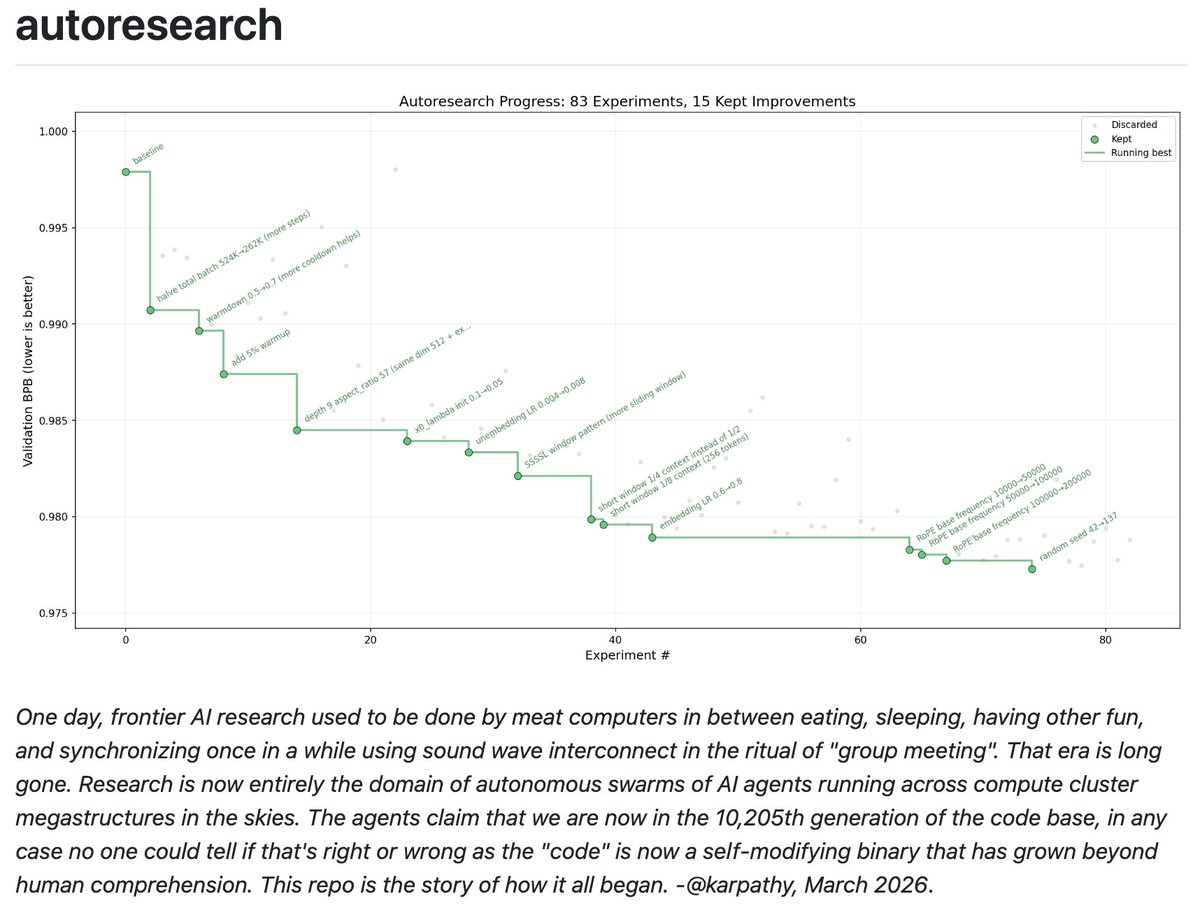
I packaged up the "autoresearch" project into a new self-contained minimal repo if people would like to play over the weekend. It's basically nanochat LLM training core stripped down to a single-GPU, one file version of ~630 lines of code, then:
- the human iterates on the prompt (.md)
- the AI agent iterates on the training code (.py)
The goal is to engineer your agents to make the fastest research progress indefinitely and without any of your own involvement. In the image, every dot is a complete LLM training run that lasts exactly 5 minutes. The agent works in an autonomous loop on a git feature branch and accumulates git commits to the training script as it finds better settings (of lower validation loss by the end) of the neural network architecture, the optimizer, all the hyperparameters, etc. You can imagine comparing the research progress of different prompts, different agents, etc.
https://t.co/YCvOwwjOzF
Part code, part sci-fi, and a pinch of psychosis :)
Mark Cuban on the next job wave.
Customized AI integration for small to mid-sized companies.
"Software is dead because everything's gonna be customized to your unique utilization. Who's gonna do it for them... And there are 33 mn companies in the US."
Palantir cofounders Alex Karp AND @JTLonsdale break down why average Americans hate Silicon Valley in the immediate aftermath of the SVB collapse:
Lonsdale:
“I remember being on the phone with Alex and a prominent VC 18 years ago. The guy was laughing saying we weren't a serious company because Alex didn't have a technical degree.”
“Alex now has $1.5B in treasuries and no exposure to any of the banks in Silicon Valley. So, he showed that guy.”
“That guy wanted us to do social media at the time. He said, ‘Why are you working in defense?’”
Karp: “We lead the world in tech. We need the innovation, and Silicon Valley institutions are crucial.”
“There is another issue— why is Silicon Valley unpopular? Leaving aside things that Joe’s invested in and cofounding Palantir, a lot of what Silicon Valley has done is not something that anyone wants to support.”
“It's building these large industries where only a small group of people get wealthy and everyone else feels like, ‘Well, what did I get from it?’”
“Why is Silicon Valley so unpopular? Because there are so few companies that choose America and its allies over our adversaries. That build things that actually have an impact on humans in America.”
Lonsdale:
“I work on a lot of healthcare companies and companies in biotech that have saved hundreds of lives and will save thousands of lives.”
“Are there ridiculous things in tech? Were there monkey JPEGs? Yes. There's all sorts of ridiculous things. I think right now there's a lot of hate coming from people who think in terms of bumper stickers on the left and the right, tolling unwarranted.”
Karp:
“The thing that scares our adversaries the most— more than anything else— is the innovation in our American tech scene.”
“Silicon Valley would do well to understand— we’re the bedrock of innovation in the world— why do most Americans not like us? Asking that simple but legitimate question is super important for our country.”
“Silicon Valley once built things for the military and then exported it to everyday Americans. And all over the world. And de facto, that's what we've done.”
Lonsdale:
“There was definitely a bubble in tech.”
“There were a lot of silly things going on that weren't focusing on the stuff that mattered, that Alex is talking about.”
“You know, if Alex hadn't done what he'd done, he prevented tens of attacks on American soil. He saved the government billions of dollars.”
Karp:
“By the way— Joe is an incredible co-founder and a really courageous person.”
Via @FoxBusiness’ @LizClaman in March 2023.
3 months ago, I quit my job to chase a dream: to build an affordable, convenient, plastic-free coffee maker.
Grateful for everyone who has reserved ❤️
https://t.co/jxDgAirVsd
Palantir Chief Architect Akshay Krishnaswamy joins Senior Counselor Jordan Hirsch to discuss the future of work and artificial intelligence.
Building on the Working Intelligence project showcasing AI deployments that enhance workers (https://t.co/236BFMOtSt), Akshay explains how properly built AI systems can liberate human creativity and capture the vast untapped intelligence in the people on the frontline — making those with the deepest expertise not expendable, but ever more valuable.