this is such facts and i've seen it firsthand
my mates older sister is a corporate recruiter for a fortune 500
few drinks in at christmas she started talking
"you want to know how many of those linkedin jobs are real?"
i said yeah
"maybe 30%. and thats generous"
she pulled out her phone
showed me the backend of their ATS
4,200 applications for a "marketing coordinator" role
position was filled internally 3 weeks before they posted it
"so why post it?"
"legal. we have to show we tried to hire externally. diversity metrics. plus the data"
"what data"
"emails. phone numbers. work history. salary expectations. we sell anonymised reports to consulting firms. and keep the rest for future roles we also wont hire for"
i asked how many CVs she actually reads
"for entry level? none. AI filters. if you dont keyword match in the first 8 seconds youre in a black hole"
"what about the people who make it through?"
"depends. if someones internal referral is in the pile we usually just pick them. the interviews are theatre"
i asked what shed do if she was job hunting
she laughed
"i wouldnt apply online. ever. id find the hiring managers linkedin, find their email pattern, and send something directly. or id get someone inside to drop my name before the role goes live"
"so the application is pointless"
"the application is a formality. the decision happened weeks ago. youre just being processed"
she said something at the end i think about constantly
"people treat job hunting like a meritocracy. send good CV, get interview, get job. it hasnt worked like that in 15 years. the system is designed to handle volume, not find talent. if youre playing by the rules youre already losing"
600 applications per role
30 seconds of human attention
the rest is database filler
stop applying
start bypassing
the front door is a trap
the side door is where deals get made
JUST IN: The Amazon Moment We Weren’t Ready For
Amazon just announced 30,000 layoffs .. the largest in company history. But the number itself isn’t the story. What’s happening beneath the surface should concern every working person on Earth.
THE SCALE
10% of Amazon’s 350,000 corporate workforce. Gone. Not warehouse workers. Not seasonal staff. Engineers. Managers. Cloud architects. HR professionals. The “safe” jobs.
This eclipses their 2022-2023 cuts of 27,000. And it’s happening while Amazon pours $100+ billion into AI infrastructure in 2025 .. up from $83 billion in 2024.
THE ADMISSION
CEO Andy Jassy said it plainly earlier this year: “We will need fewer people doing some of the jobs being done today.”
Not “different” jobs. Fewer people. Full stop.
This isn’t about pandemic overcorrection anymore. This is the beginning of structural replacement.
THE MATH THAT DOESN’T WORK
AWS, logistics, payments, gaming, devices … cuts across every division. The company isn’t struggling. They’re optimizing. Replacing $100K salaries with AI systems that run 24/7 for pennies per query.
30,000 families. TODAY. How many tomorrow?
THE VOID
Here’s what should terrify you: There is no plan.
No UBI legislation. No automation taxes. No retraining infrastructure at scale. Just unemployment insurance designed for temporary gaps, not permanent technological displacement.
We’re running 1950s social programs against 2025 AI capabilities.
THE TIMELINE
Bill Gates suggested robot taxes. Andrew Yang campaigned on UBI. Economists have been warning us for years.
We nodded. We debated. We did nothing.
Now 30,000 Amazon employees will find out what “economic transition” actually feels like. And they won’t be the last.
THE QUESTION NO ONE WANTS TO ANSWER
If AI makes workers redundant faster than new jobs emerge, who buys the products? Who pays rent? Who sustains the economy?
You can’t have capitalism without consumers. You can’t have consumers without income.
Amazon just made that math problem real.
This isn’t fearmongering. It’s Tuesday, October 28, 2025. The emails go out today.
The age of AI displacement isn’t coming. It’s here. And we’re completely unprepared.
People will be like, “generative AI has no practical use case,” but I did just use it to replace every app icon on my home screen with images of Kermit, soooo
We are taking @Box Platform on the road 🚗 — and we are starting in Austin, Texas. Yee-haw Y’all! 🏜️🤠
Register TODAY! ✅
Come learn about Box APIs and meet us in person. We can't wait to see you! 😎
https://t.co/9J6bk09eH5
#box#events#softwaredevelopment
I interviewed another towing company owner about how he retains big customers
Here's the tactic:
"I have thank you cards that my wife and I send out.
We mail out ~30 thank you cards a day and spend ~$10,000 a year on them.
Customers LOVE them and they build a ton of good will and surprisingly - word of mouth because they'll post pictures of our cards on social media.
We even have customers who occasionally call in to tell us how delighted they were to receive them.
We also give our technicians Google review cards to hand out. That’s probably how we got over 700 reviews.
The Google cards have the driver’s name on them and there the customers can leave us a review. For every 5 star review that the driver receives from the customers, the driver gets $20.
And for a long time, we had this amazing salesperson, Lou.
He would buy maybe 20 bags of pretzels a day from our local pretzel factory and drop them off at all of our accounts whether it was a small auto shop or a chain of 60.
He did this just to check in, build some good will, make everyone happy, and solve any potential issues they’ve had with us before they escalate.
Some people might consider these activities a waste of time, but losing customers is very expensive, getting new customers is very expensive, and pretzels and thank you cards are cheap.
I can count on one hand the number of accounts we’ve lost in 17 years because we do simple things like this.
No one fires the pretzel man."
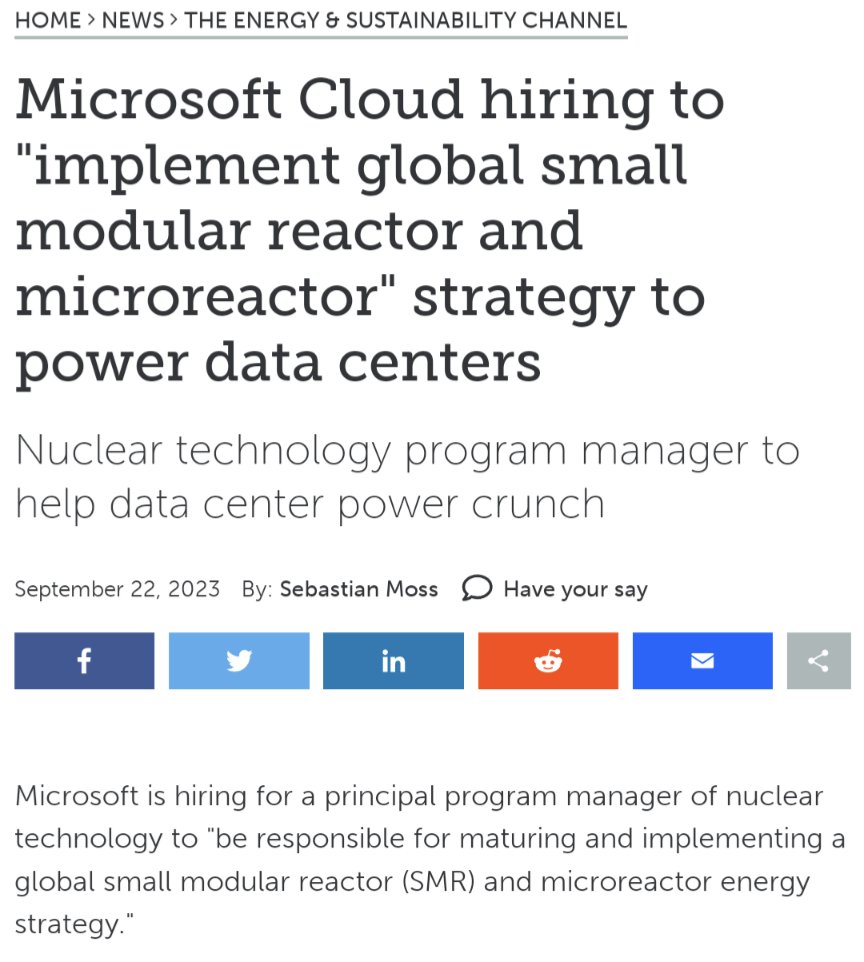
Word is out: Microsoft is plunging ahead on nuclear energy.
They want a fleet of reactors powering new data centers. And now they're hiring people from the traditional nuclear industry to get it done.
Why?
Lack of stable long-term power, whether clean or dirty, is constraining Microsoft's growth. They need to build big data centers that consume electricity all the time and the old assumption that somebody else's reliable plants will always be around to firm up your wind and solar is falling apart.
It certainly helps that founder Bill Gates was one of the earliest big business converts to nuclear energy, investing his own money to develop new reactors.
But Microsoft, like many companies, was held back by what we might consider "Enron-ism" infecting its energy thinking: renewable energy credits plus markets plus cute little lies to the public about how electricity works. Greenwashed fossil/hydro/nuclear with the ESG stamp of approval.
The problem? Eventually you run out of other people's cheap firm power.
So Microsoft has recently become a leader in openly asserting that nuclear energy counts as clean energy, as opposed to the ongoing cowardice we see from the other big tech companies who lie to the public about being "100% renewable powered."
Sure, the lawyers said it was okay to lie, but the lie doesn't give you a permanent supply of cheap reliable energy. That comes from nuclear.
A world is coming where only the tech companies willing to become nuclear power developers may get to keep expanding their cloud businesses, and only countries open to new reactors get to host this expansion.
A world where tech companies with 50% margins become the only survival hope for traditional industrial concerns with 5% margins who need someone else to bootstrap a proper electricity supply.
Where diesel backup generators are replaced with microreactors reliable enough to be trusted to keep a cluster of facilities secure in the case of public grid failure.
The race is on.
Do you know what the @Box Content Cloud is capable of? Whether you're an ITDM looking for content intelligence breakthroughs, or an IT administrator or developer looking for peer insights and best practices — Content Cloud Summit has you covered.
The results of the world’s largest trial of a 4-day week (with no loss of pay) are out:
▪️ No drop in revenue
▪️ 65% fewer sick days
▪️ 71% less burnout
▪️ 92% of companies decide to keep the policy after the trial
The conclusion is clear: we need a shorter working week.