Building useful software, AI tools & digital products | Founder, John Kenji LLC | Builder of ClauseClock
Nami Odyssey: @petah_grill | DeFi & AI builder
Back with another @namidefi flywheel breakdown! Part 4.
I've spent quite a bit of time moving liquidity between pools, first on SwapX and now during Nami Genesis.
One thing I've noticed is that a pool with better-looking rewards isn't always where your money currently sits.
And sometimes that opportunity is on a completely different blockchain.
That's where OmniShift gets interesting.
Let's keep it simple.
Say you've deposited BTC and USDC into a trading pool on Base.
You notice another BTC/USDC pool on Ethereum offering a higher estimated return.
Normally, moving means:
1. Remove your funds from the old pool.
2. Swap tokens if needed.
3. Transfer everything to the other blockchain.
4. Get the right balance of tokens.
5. Deposit into the new pool.
That's quite a few steps, especially for beginners.
OmniShift is designed to coordinate that process through one interface.
It can also help identify opportunities for the same trading pair across supported chains.
Now imagine more people moving their liquidity toward markets where it's needed.
That could improve trading conditions, which might attract more trading activity and create new opportunities.
That's the potential flywheel I'm exploring.
But here's the important part: higher APR doesn't automatically mean higher profits.
Moving costs money, projected rewards change, and liquidity positions still carry risks.
I'll show a simple example in Part 2.
Explore Nami with my referral:
https://t.co/FSWM5e9YQ2
Community-made, AI-assisted visuals based on Nami docs and my own LP experience. NFA.
#NamiOdyssey #NAMI #DeFi
Following up on my OmniShift post because there's something I think beginners should understand.
Just because another pool shows a higher APR doesn't mean moving there is automatically worth it.
Here's an example I came up with.
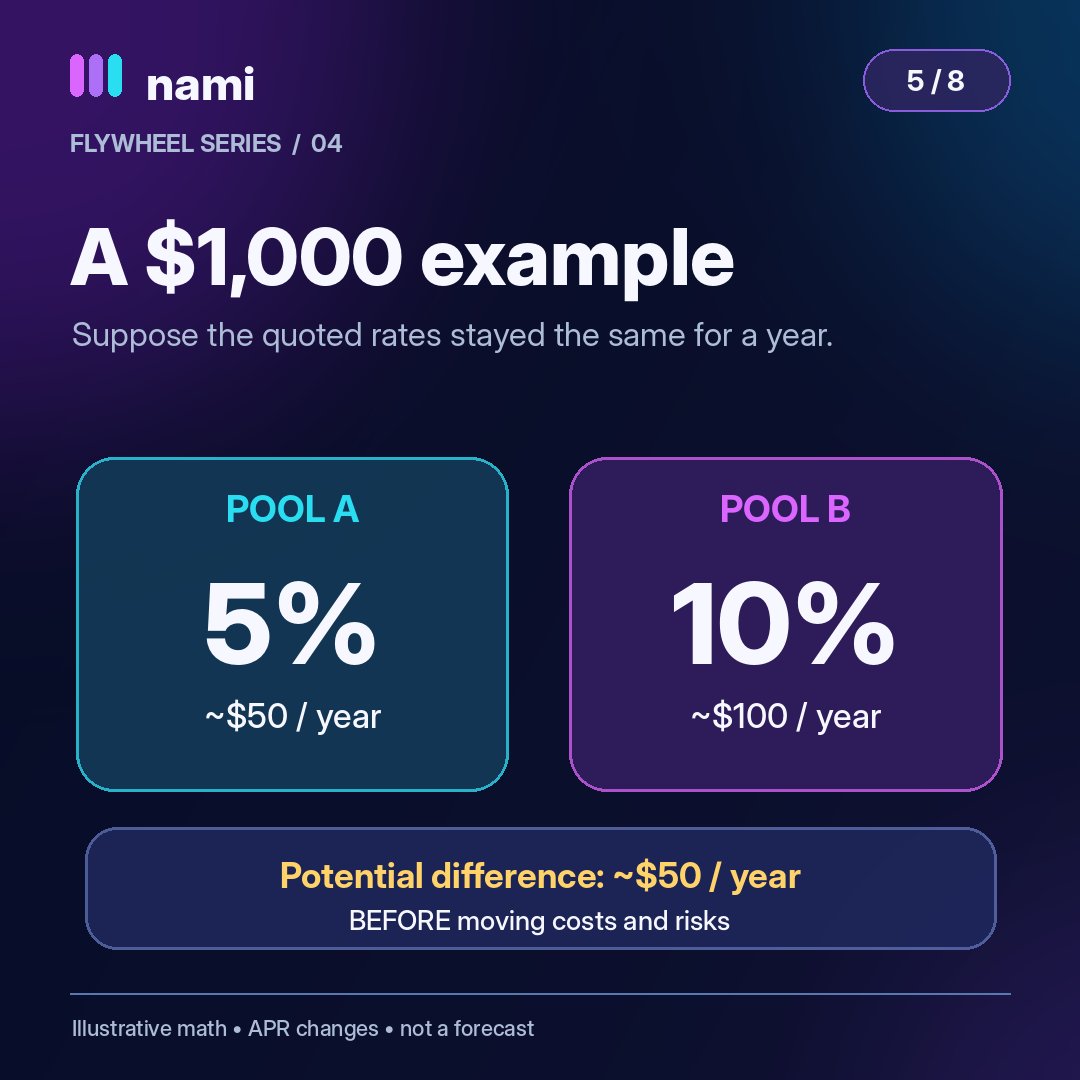
Let's say you have $1,000 providing liquidity.
Pool A offers an estimated 5% APR.
Pool B offers an estimated 10% APR.
If those rates stayed exactly the same for a full year:
Pool A = roughly $50.
Pool B = roughly $100.
That's an extra $50 a year.
Sounds better, right?
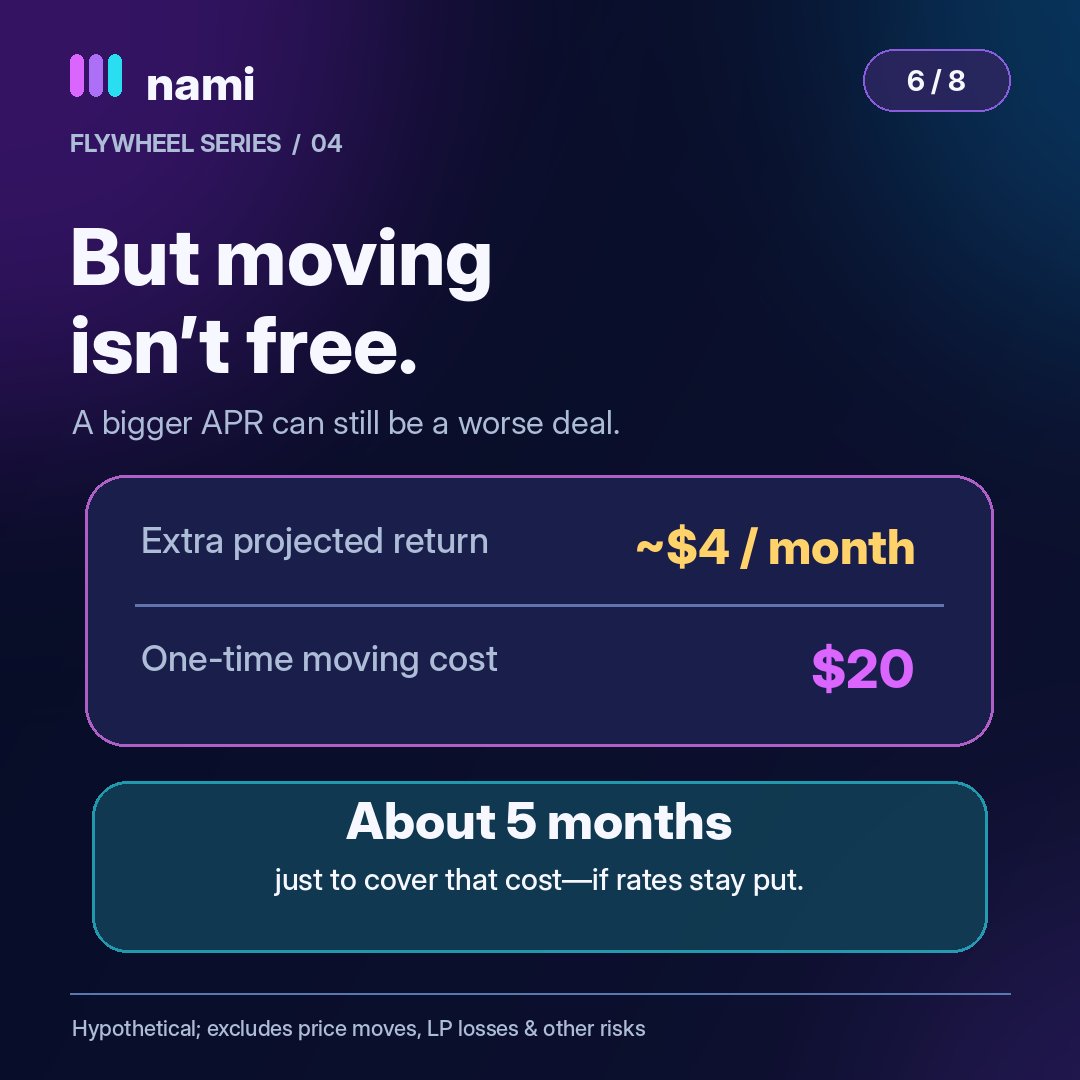
But what if moving costs $20 after swaps, gas, and cross-chain transfers?
You're only looking at about $4 extra per month.
It could take roughly 5 months just to recover the moving costs.
And that's assuming the APR stays the same, your position remains productive, and nothing else changes.
In reality, there's more to consider.
Prices move. Rewards change. Liquidity ranges can go out of range. Cross-chain transfers introduce additional risks.
So I've been thinking about three questions:
1. Is the difference in estimated rewards actually worth it?
2. How much would moving cost me?
3. Am I comfortable with the new position and its risks?
Sometimes moving might make sense.
Other times, leaving your liquidity alone could be the smarter decision.
What I find interesting about OmniShift is that Nami is trying to make the complicated part easier.
It doesn't eliminate the risks or guarantee better returns, but coordinating those steps is useful.
And this ties back to my other flywheel posts: liquidity, trading activity, fees, and incentives all influence one another.
There's more to DeFi than chasing the biggest APR.
Would you move your liquidity for a higher projected return, or rather stay in a pool you already know?
Explore Nami:
https://t.co/FSWM5e9YQ2
Examples are hypothetical. AI-assisted educational visuals. NFA.
#NamiOdyssey #NAMI
Back with another @namidefi flywheel breakdown! Part 4.
I've spent quite a bit of time moving liquidity between pools, first on SwapX and now during Nami Genesis.
One thing I've noticed is that a pool with better-looking rewards isn't always where your money currently sits.
And sometimes that opportunity is on a completely different blockchain.
That's where OmniShift gets interesting.
Let's keep it simple.
Say you've deposited BTC and USDC into a trading pool on Base.
You notice another BTC/USDC pool on Ethereum offering a higher estimated return.
Normally, moving means:
1. Remove your funds from the old pool.
2. Swap tokens if needed.
3. Transfer everything to the other blockchain.
4. Get the right balance of tokens.
5. Deposit into the new pool.
That's quite a few steps, especially for beginners.
OmniShift is designed to coordinate that process through one interface.
It can also help identify opportunities for the same trading pair across supported chains.
Now imagine more people moving their liquidity toward markets where it's needed.
That could improve trading conditions, which might attract more trading activity and create new opportunities.
That's the potential flywheel I'm exploring.
But here's the important part: higher APR doesn't automatically mean higher profits.
Moving costs money, projected rewards change, and liquidity positions still carry risks.
I'll show a simple example in Part 2.
Explore Nami with my referral:
https://t.co/FSWM5e9YQ2
Community-made, AI-assisted visuals based on Nami docs and my own LP experience. NFA.
#NamiOdyssey #NAMI #DeFi
Following up on my last Nami flywheel post because there's something else I wanted to explore.
Just because a pool gets the most votes doesn't necessarily mean it's the best one to vote for.
Here's a simple example I came up with.
Say Pool A has $700 in rewards, but those rewards are split across 70 units of voting power.
That's $10 per unit.
Now Pool B has only $600 in rewards, but just 30 units of voting power.
That's $20 per unit.
So in this made-up example, the less popular pool actually pays twice as much per unit of voting power.
Obviously, actual rewards depend on more than that, but you get the idea.
And this got me thinking about a few different ways someone could approach the system.
Option 1: Just collect the rewards.
Vote for markets you like, collect your eligible fees and incentives, and keep the earnings instead of reinvesting everything.
Option 2: Build up more voting power.
Take your rewards, use them to buy more NAMI, then convert that into veNAMI.
Over time, that could give you more voting power, which may help you earn more rewards. Just remember that converting into veNAMI comes with restrictions.
Option 3: Build an ogNAMI position.
Instead of putting everything back into veNAMI, use some rewards to buy ogNAMI and stake it.
ogNAMI stakers collectively receive 10% of eligible trading fees in USDC. That doesn't mean a guaranteed 10% return.
Option 4: Keep providing liquidity.
This is the one I'm most familiar with from farming SwapX and Nami Genesis.
Deposit funds into a trading pool and potentially earn fees and incentives, while managing price ranges and the risks that come with them.
There's also Nami Relayer, which can automate certain voting and reinvestment steps for eligible positions, for a fee.
Personally, I find the idea of combining different strategies interesting instead of relying on just one.
But I also wouldn't assume any of these will automatically make money. Fees, token prices, liquidity risks, and actual trading activity all matter.
Just a few strategies I've been looking into. I'm still learning how all the pieces fit together.
If you want to explore it yourself:
https://t.co/FSWM5e9YQ2
AI-assisted illustrations. Examples are hypothetical. NFA.
#NamiOdyssey #veNAMI #NAMI
Back with another @namidefi flywheel breakdown. This is part 3!
I've spent quite a bit of time farming on SwapX and now Nami Genesis, but I've also been looking into what happens once Genesis is over.
One thing I find pretty interesting is how voting works.
Basically, when you convert NAMI into veNAMI, you get voting power. You can use that to help decide which trading pools receive NAMI rewards.
Why does that matter?
Let's say there are two pools, ETH/USDC and BTC/USDC.
If ETH/USDC gets 70% of the voting power and BTC/USDC gets 30%, the first pool could receive a bigger share of the available NAMI rewards.
Those rewards give people another reason to deposit funds into that pool.
More funds available for trading can mean better prices for traders, which could bring in more activity.
And more trading means more fees being generated.
That's the flywheel I'm trying to show:
Voting → Rewards → More Liquidity → More Trading → More Fees
The cool part is that people voting can also receive a share of eligible trading fees and incentives.
Of course, it doesn't mean every pool will grow just because it gets more rewards. People still have to actually use it.
The 70/30 numbers in my images are just an example, not actual voting results.
I made these graphics to make the whole thing easier to understand, especially if you're new to DeFi.
There's actually more than one way to approach this, which I'll cover in the next post.
If you're exploring Nami too, here's my referral:
https://t.co/FSWM5e9YQ2
AI-assisted visuals, my own research and experience. NFA.
#NamiOdyssey #NAMI
@namidefi For anyone interested in exploring @namidefi, here's my referral link:
https://t.co/TAghdOq4Da
I've been exploring Genesis farming and learning more about the ecosystem. I'll keep sharing beginner-friendly breakdowns as I go.
NFA.
With $ogNAMI launching today, I wanted to continue my @namidefi flywheel series, but make this one easier for anyone new to crypto to understand.
I've been following Nami since SwapX, participated in the ogNAMI presale, and have been farming Genesis.
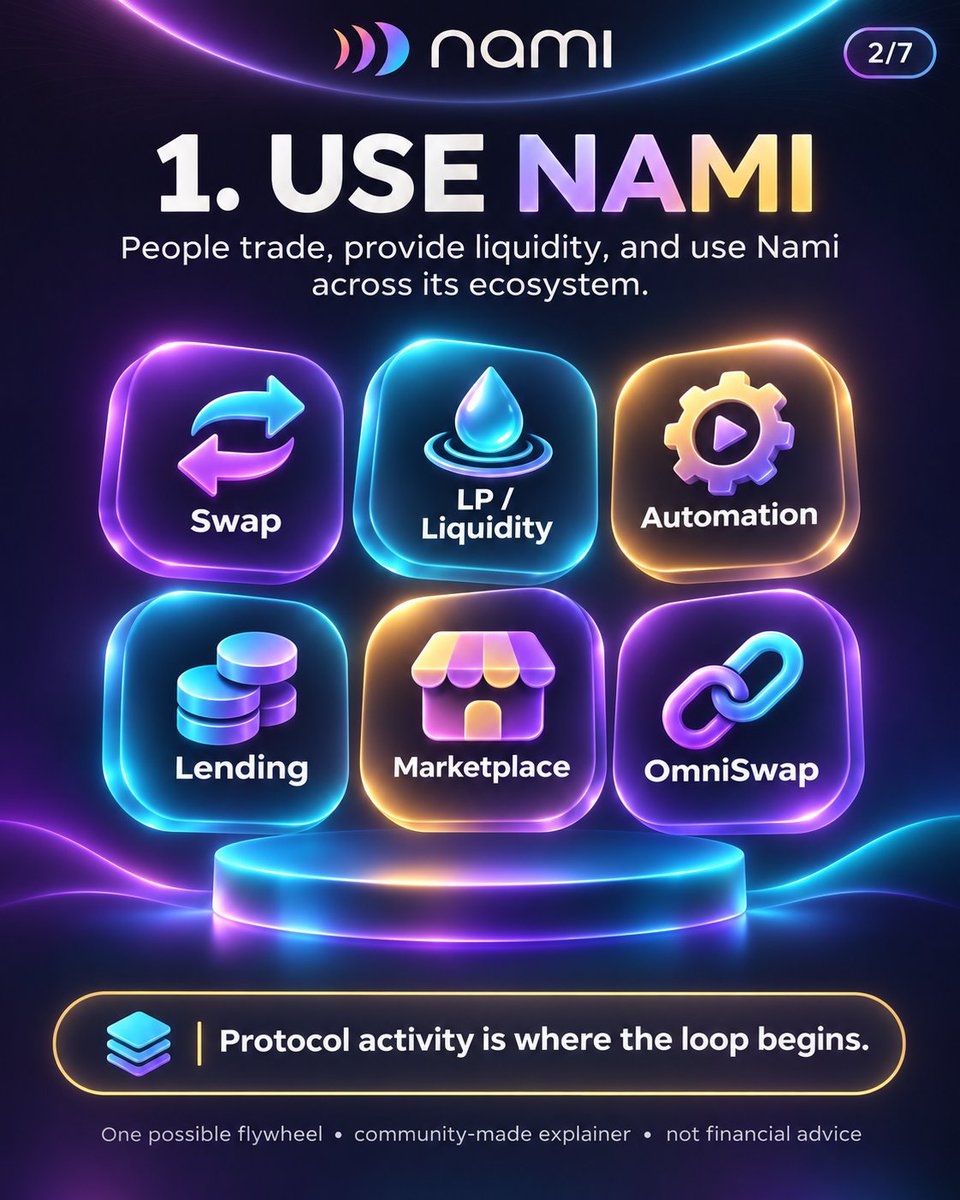
What interests me isn't just the token price. It's how Nami is trying to connect real activity with rewards.
Here's the simple version:
1. People use Nami.
When people trade, they generate fees.
2. ogNAMI holders can share in those fees.
By staking ogNAMI, holders collectively receive 10% of eligible swap fees, distributed in USDC each epoch.
That's a share of fees, NOT a guaranteed 10% yield.
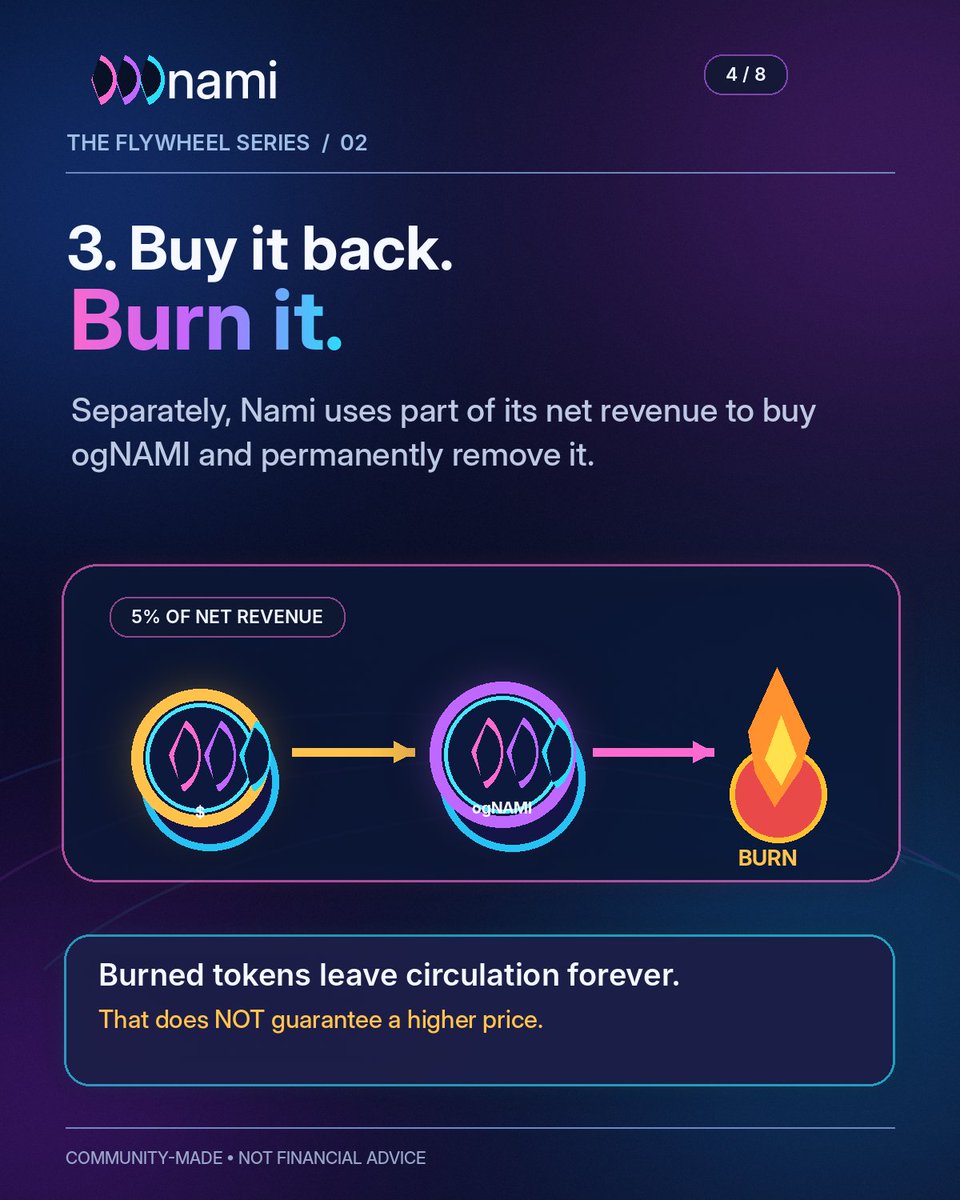
3. Nami buys back ogNAMI.
Separately, 5% of net protocol revenue goes toward buying ogNAMI and permanently burning it.
With a maximum supply of 250,000 tokens and no new emissions, these burns can gradually reduce supply.
So why might someone want ogNAMI?
The idea is to own something connected to Nami's actual usage, with potential USDC rewards and a shrinking token supply.
But it only becomes meaningful if the ecosystem generates sustainable activity.
Fewer tokens don't automatically mean higher prices, and rewards aren't guaranteed.
Here's my beginner-friendly breakdown of how it all works.
Community-made, AI-assisted educational visuals based on Nami docs and my own experience. NFA.
#NamiOdyssey #ogNAMI
Now for the part I think is just as important: what can you actually DO with ogNAMI?
I see three approaches worth understanding:
1. Buy and stake
Hold ogNAMI and participate in the USDC fee-sharing system. Rewards depend on real trading activity, and the token price can still fall.
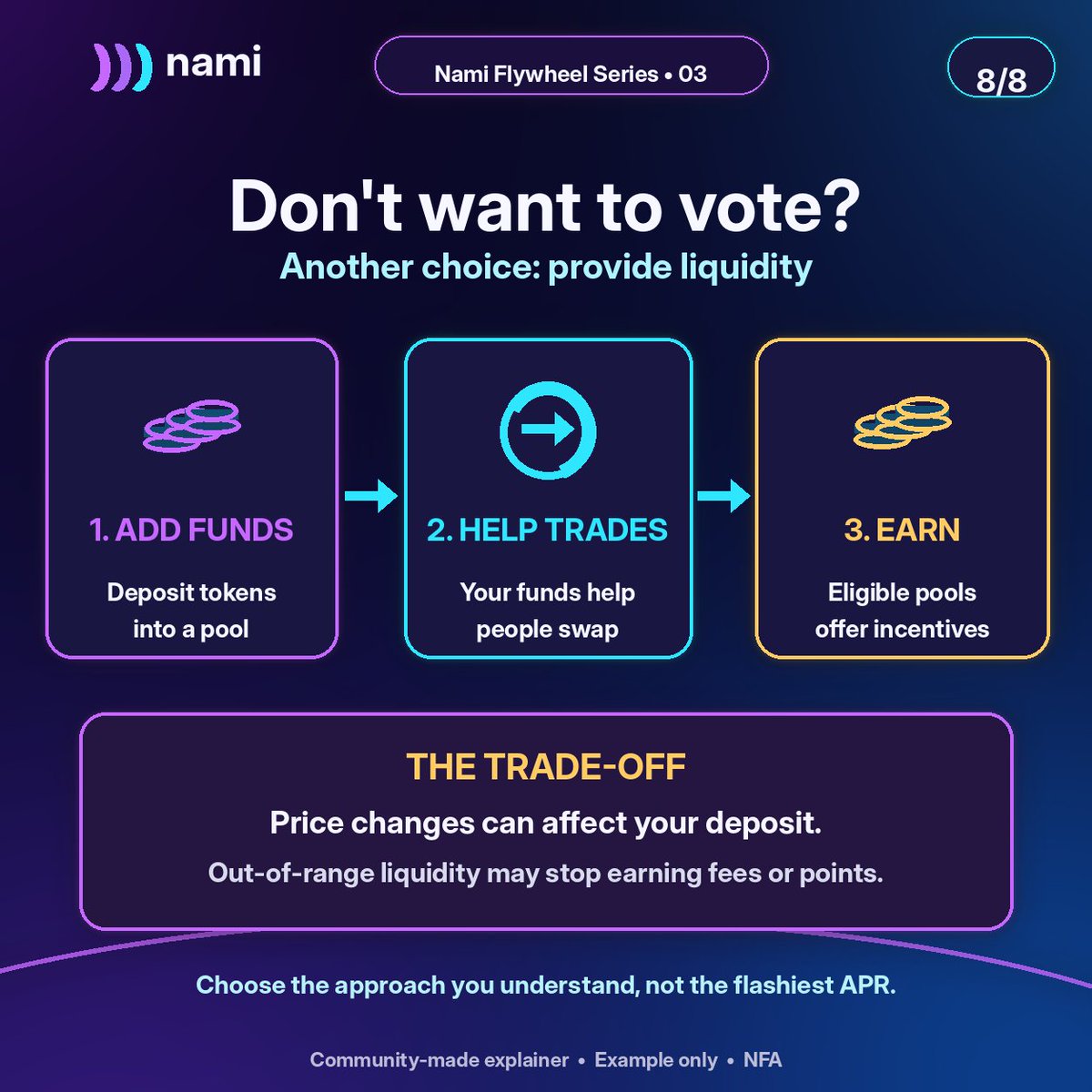
2. Provide liquidity
Supply assets to an eligible trading pool to potentially collect fees and Genesis rewards. This requires understanding price movements, changing asset balances, and concentrated liquidity ranges.
3. Watch before buying
There's nothing wrong with waiting to see actual trading volume, staking payouts, buybacks, and token unlocks.
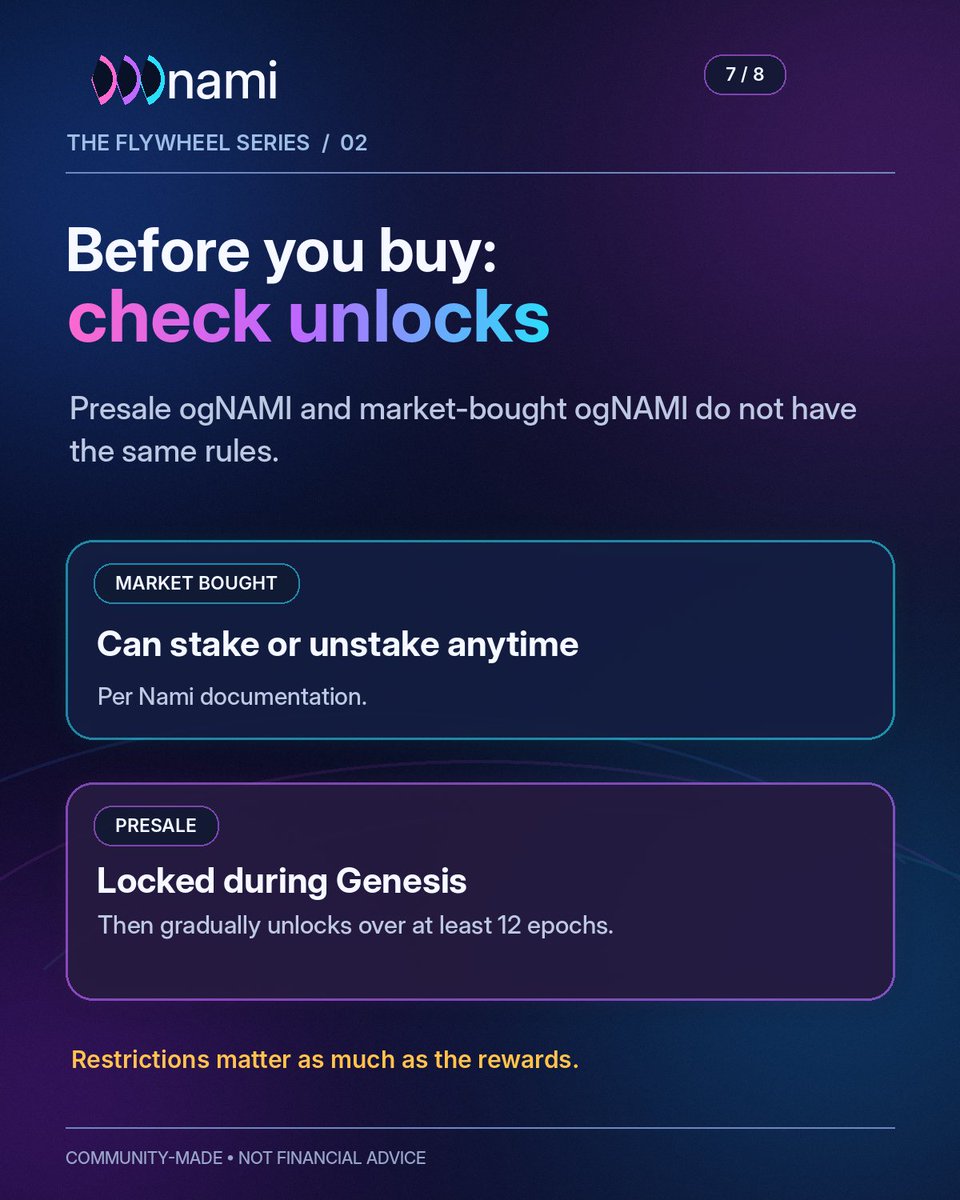
One important distinction: market-bought ogNAMI can be staked and unstaked without presale vesting restrictions. Presale allocations follow a separate, gradual unlocking schedule.
About two hours after launch, my market check showed:
• $11.71 per ogNAMI
• Approximately $353K liquidity
• 171 buys versus 11 sells
That's a snapshot, not a prediction.
Personally, I'm much more interested in how this develops over multiple epochs than what happens in the first few hours.
I'll keep exploring the different Nami flywheels and explaining them as simply as I can.
Official information: https://t.co/T6TQKRhROO
Community-made. Not financial advice.
#NamiOdyssey #ogNAMI
ogNAMI launches on Base tomorrow
Thursday 12 Nov · 11 AM ET
Launch price: $10
Fixed supply: 250,000
No emissions ▫️ Deflationary by design
FDV: $2.5M
Stake ogNAMI and earn your share of 10% of swap fees, paid in USDC each epoch.
Or simply provide liquidity and earn a share of Genesis rewards.
What you need to know before trading opens 🧵
Genesis Current Rewards Value $1,202,442
With 14days to go, you still have time to participate.
Provide liquidity in any of the 22 pools and earn a share in points or fees, or both. Its your choice.
Just filmed a pretty detailed video covering @namidefi and why I am very bullish on it.
Highly recommend watching if you want exposure to $NAMI or $ogNAMI.
Time stamps:
0:00 | Introduction
1:36 | What is nami?
2:46 | Why nami is different from other veDEXs
4:21 | OmniShift
6:29 | Dynamic emissions
9:29 | Recursive buyback engine (RBE)
14:06 | veNAMI position allocated to RBE
15:31 | Stats overview
17:02 | Tokenomics
20:40 | nami LP fees split
23:49 | ogNAMI tokenomics
28:25 | Team overview and why I am bullish
33:55 | Risks and bear case
38:06 | How to get exposure to nami
Correction: ogNAMI price discovery is launching in less than 12 hrs. I meant 17 weeks at 43:08.
Like always, nfa but I think nami will do really well over the next 6-12 months heading into the bull market. I'll be adding more if prices dip.
P.s. I'm not sponsored by nami to film this btw. I just love the team and product. I also invested into the public presale for $ogNAMI so I want the project to do well too.
The more I explore @namidefi, the more interesting its ecosystem gets. 🌊
I put together this visual breakdown of ONE of Nami's flywheels: the Recursive Buyback Engine.
Protocol revenue → Buybacks → Locks & Burns → Voting rewards → Repeat 🔄
And this is just one piece of the bigger picture!
I'll be breaking down more of Nami's flywheels soon.
My own interpretation based on Nami's docs. NFA.
Still plenty of ways to get involved! Join Nami here:
https://t.co/FSWM5e9YQ2
#NamiOdyssey $NAMI
Only 2 hours since $NAMI launched and already $690K in volume, 1,000+ transactions, and $915K in liquidity! 🔥
After my experience with SwapX on Sonic, I'm super bullish on what @namidefi is building! 🚀
And the best part? There are still plenty of ways to get involved!
Come join Nami and explore the opportunities! 🌊
https://t.co/FSWM5e9YQ2
From SwapX to Nami, there's a story behind what we're building.
Our CEO @zeroxbunny sat down with @pukecast to talk through that journey, and where we're taking Nami.
Our first AMA is out. Have a watch before TGE today 🎙️
This DeFi protocol can launch on a new chain in under 24 hours.
@zeroxbunny, CEO and co-founder of @namidefi, previously built SwapX on Sonic, which reached $75M TVL before the chain lost momentum.
After 18 months and $1M+ of development, his team built Nami as a multi-chain DeFi protocol above any single chain, with one shared economy, so liquidity can move to wherever it earns more.
On today’s episode: why traditional v(3,3) models run into hyperinflation, how Nami’s D33 model sets token emissions dynamically, a live demo of Omni Swap, Omni Deposit and Omni Shift, why six smart contract audits were the hardest part, how the pre-sale and integrations went, and how the token launch is designed to stop snipers.
Timestamps
00:00 Meet NAMI: The Team Behind SwapX
03:26 The DeFi Problems NAMI Aims to Solve
05:59 D33: Dynamic Token Emissions Explained
07:36 Building a Unified Multichain Protocol
10:32 OmniSwap: Cross-Chain Trading Walkthrough
13:17 OmniDeposit & OmniShift: Moving Liquidity Across Chains
18:24 Building NAMI: Development Challenges & Security Audits
20:48 Early Traction, Partnerships & the Presale
22:53 Token Launch & Anti-Sniping Protection
24:00 NAMI’s Five-Year Vision
NAMI launches on Base tomorrow
Tuesday 10 Nov · 11 AM ET
Launch price: $5
Initial circulating supply: up to 150,000 NAMI
Initial circulating mcap: up to $750K
Initial FDV: $1.18M
Anti-Snipe fee: 500% → 0% over 30 min
What to know before trading opens 🧵
Genesis is live. Provide liquidity, earn trading Fees and Genesis Points.
Featured pools across categories on Base, Robinhood and Ethereum: ETH/USD, BTC/USD, Stocks and Memes.
Pick a pool and choose from 3 earning options.
All audit reports for @namidefi are now publicly available on our website
Congrats to the @namidefi team on the launch 🎆
BailSec - exposes risks that others overlook ✅