Mark Carney flew to Prince Rupert to meet with First Nations and they told him they don't want a pipeline to the coast.
"We also made our positions very clear...Coastal First Nations oppose any project that proposes to bring oil tankers to the north coast."
So maybe someone can ask Mark Carney what the plan is now since he said they must have consent and how will he bring confidence to a company to invest here?
A country without investment in the long term reverts to 3rd world status. The world is moving forward and Canada can't compete. So any investment regardless of the industry is welcome. We are remote in the eyes of the world no different than Alaska or Finland. Save Canada economically first, then we can discuss what social programs we can afford and to what extent. My favourite social programs are Health and Education and Infrastructure but we are going broke so I will always support building out our resource rich country.
@MichelleLA1981 Same way herbalife and Lularoe use hype and talk big to con their followers into thinking they will all be millionaires. A sucker of a Liberal is born every second and when told to put on the rose colored glasses.
Pharaoh: “Give me 20%.” → Slave
Medieval King: “Give me 15%.” → Peasant
American Government: “Give me 30%+ and more on everything you buy and the house you own.” → FREE CITIZEN 💪🇺🇸
Totally not slavery. 🙄
I live in Chestermere. That beach is visited primarily by new immigrants from Punjab part of India. All the parks are polluted along the lake with food, litter, and not surprised about fecal bacteria to be honest. I doubt anyone in the community cares though. I accepted that the country I grew up in and the city I grew up in aka Calgary are no longer as I knew them. I just hope that we can transform and become a great country again maybe finding inspiration from Singapore or Switzerland or even Denmark. Education and building takes decades so hopefully we stop being our own worst enemies and reverse our downfall from greatness.
Written by Megan Patrick:
1/2
When I first came to Canada, I landed in Alberta. And I’ll be honest, it felt familiar. The people had a spark in their eye, the land breathed ambition, and the culture rang with a deep, honest pride. To me, Alberta wasn’t all that different from Texas. It was a land of risk-takers, builders, doers. Of families who made their living from the land, who didn’t ask for handouts, and who believed in something very old and very precious: that your life is your own.
And so for years, I assumed Canada was like that everywhere. That Alberta was simply one reflection of a larger national spirit.
But then I went further west, Vancouver, Victoria. And I felt a shift. Not just in politics or preferences, but in the very framework of belief. The worldview was different. The relationship to government was different. The definition of freedom, even, was different.
And that’s when I realized something that shook me: Alberta isn’t just a province with a different opinion. Alberta is a nation within a nation.
This isn’t about hostility. It’s about incompatibility.
You see, Alberta, and its soulmates in Saskatchewan, in the Yukon, in the Northwest Territories, in rural Manitoba and northern B.C., were not forged in boardrooms or by policy theorists. They were carved out of rock and frost, born in cattle fields and oil rigs, in mines and mills and frontier homesteads. These were places where survival meant strength, where freedom wasn’t philosophical, it was practical. It was necessary. You didn’t wait for Ottawa to tell you what to do, you just did it.
But much of the rest of Canada now operates on a fundamentally different ideology, one built on collectivism, central planning, and a trust in bureaucracy over the individual. These aren’t bad people. They aren’t villains. But they are living a different system, and one that increasingly can’t understand or tolerate Alberta’s.
It’s not that the rest of Canada is horrible. It’s not that Ontario or Quebec are wrong to live the way they do. It’s that the fit no longer works. It’s like trying to jam a round peg into a square hole, over and over again, until the wood starts to splinter and the structure begins to crack.
And the truth is, Alberta is not alone in this. The same pain lives in Saskatchewan. In northern B.C. In the far reaches of the Yukon and the Northwest Territories. Places that still value territorial integrity, individual sovereignty, and earned freedom. Places that feel more American in spirit than the government ruling them from 3,000 kilometers away.
But here’s where the grief turns into something deeper, something existential.
Because it’s no longer just a matter of cultural friction. This is now a collision between two systems of thought, two incompatible blueprints for how society should function.
One believes that the government is the solution. The other believes that the government is the problem.
One sees taxes as a duty. The other sees them as an obstacle.
One prizes conformity in the name of unity. The other prizes freedom even if it leads to disunity.
And these two systems, these two philosophies, cannot coexist forever in the same house. One will inevitably swallow the other.
That’s the tragedy playing out now, not just in Alberta, but in the heart of Canada itself. A cold war between two visions of the nation. And Albertans feel it acutely. The slow suffocation of their voice. The erosion of their industries. The cultural gaslighting that tells them they’re cruel, or backward, or radical simply for wanting the same freedoms their ancestors bled to preserve.
And that leads to grief. Not just anger, but grief. The grief of being pushed away from neighbors who once felt like family. The sorrow of watching your country become foreign to you. The ache of raising your children in a land that no longer values the things that built it.
A genuine set of questions for @MarkJCarney and @PierrePoilievre: What is the limit of the extent to which the government can confiscate our hard-earned money? Our income is taxed provincially and federally at one of the highest rates in the world. We then pay sales tax on what we spend both provincially and federally. We also pay property tax, school tax, exit tax, and endless other forms of taxation. The taxation oversight and burden is simply astounding. And yet we know that countless people in the political class find ways to avoid paying taxes. Is a human being a free individual if 50%-70% of their earnings are taxed? What are the philosophical and moral principles that animate your right to steal our financial future, our peace of mind, and the fruits of our labor to such an extent? Every time that I work hard to be a productive member of society (in my case by being a professor and author), I end up at the same financial place (if not worse) because my taxation burden keeps increasing. I can't escape Canada's taxation system even when most of my income comes from outside of the country. Is there no sense of shame? When does it become too much in terms of what you take from your most productive citizens? I am being fully transparent here: There is nothing that has traumatized me more in my life than the taxation that I face, and I faced the Lebanese civil war.
Former UK Prime Minister: “I worked with Mark Carney and he ruined our country. I have no idea how he’s even Prime Minister with no elected seat”
Canadians: 👨🦯➡️
The Liberals are now SCREAMING their intentions for Canadians:
- Double our current population to 100M
- Freeze ALL Oil & Gas projects.
- Take away ALL guns from only Licensed gun owners
- Carbon Tax the hell out of ALL Canadians
- Decimate our economy
- Destroy our relationship with US
While ignoring:
- Veterans
- Elderly
- Homeless
- Addiction
- CRIME
It truly baffles me how any Liberal supporter can vote for this simply because they don't like Pierre.
Canada has sunk to 18th in the world for happy places to live. And we will go further down that list. A lot.
This next election is going to make or break Canada. 🆘
As a trained profiler, I was taught to pay close attention to people's word choice because, subconsciously, word choice often reveals much more than intended.
Mark Carney here, chose to leave out her first name and since his post is long form, character limits were not the reason. This potentially indicates two things. The first is an impersonal relationship or even strained relationship with Danielle Smith. The second reason is, to subconsciously assert dominance and authority over her. It’s a common trait in hierarchical structures like the military or police, where they only use last names for that reason.
The use of “my government” instead of “our government” is also telling, as most people would instinctively say “our.” In negotiation theory, people often use language that reflects the opposite of the actual power dynamic, and do so usually subconsciously, unless they’ve been trained otherwise. For example, a hostage taker, who is fully in control, might use words like “we” or “our” to distance themselves from responsibility. On the other hand, when someone else is in charge, they’ll use words like “I” or “my.” It makes a person wonder: who’s really in charge of this government, if not Mark Carney?
The globalist elites he’s been surrounded by his whole life, perhaps?
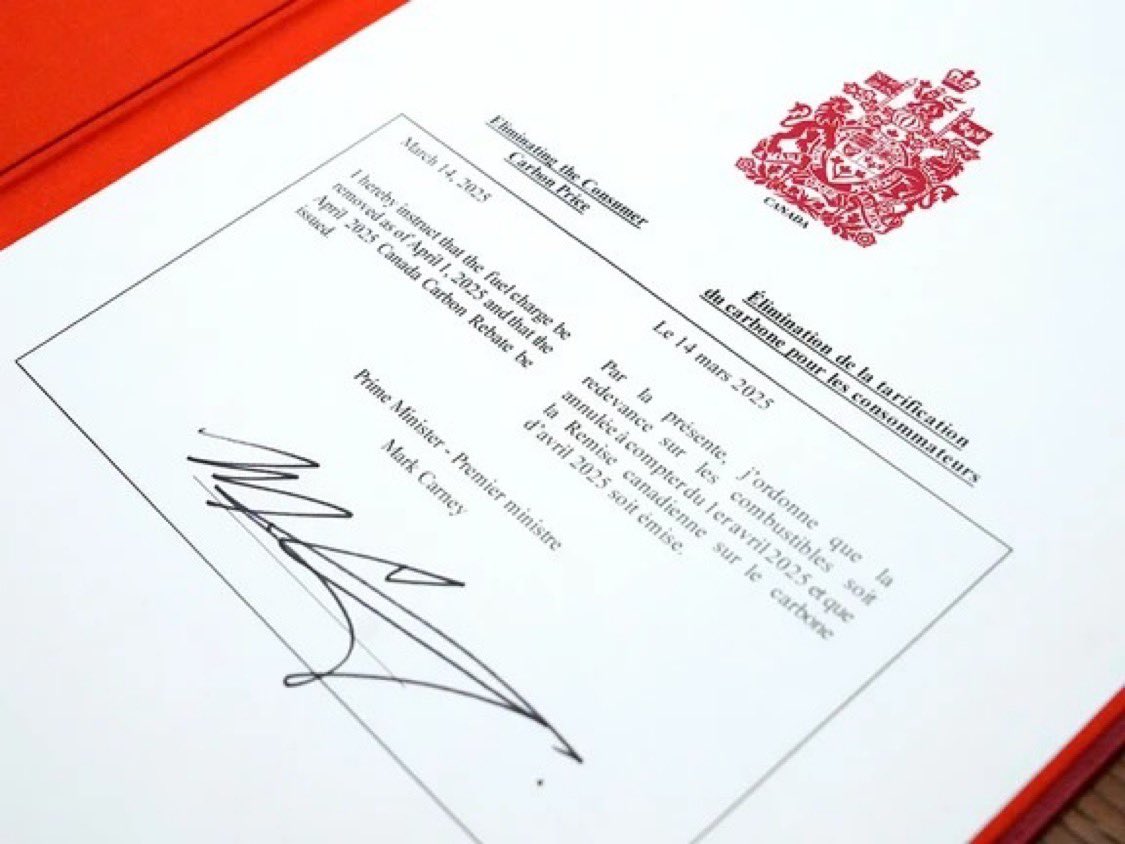
Attn. Carney/Trudeau fans:
This prop page is most decidedly NOT an Order in Council and is not a legal instrument to effect a change to a 206-page Act of Parliament.
Signed,
Senator Denise Batters, K.C.
(until prorogation, Deputy Chair of the Standing Senate Committee on Legal and Constitutional Affairs)