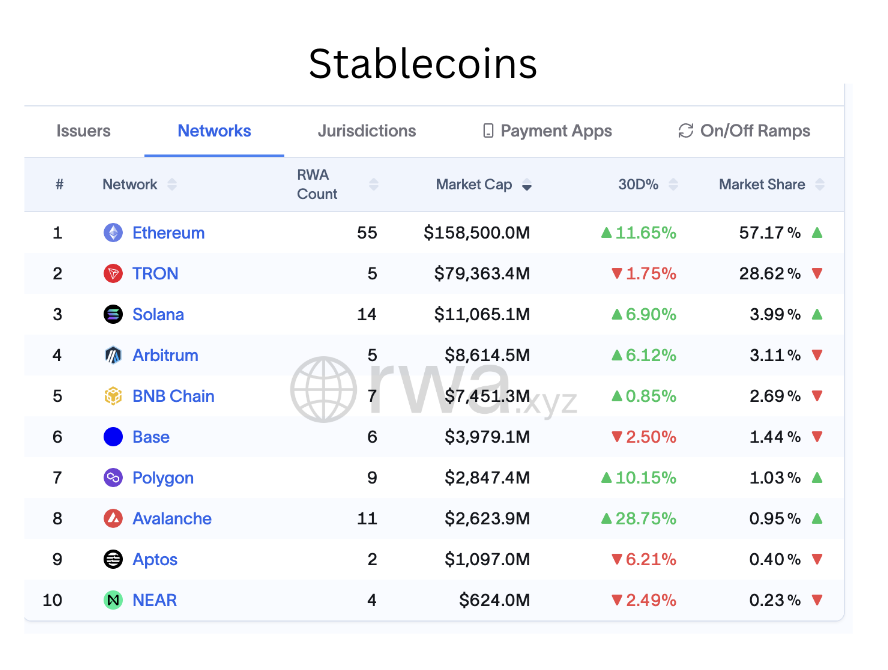
Ethereum is winning the war for real world assets and nothing is close.
I just looked at the numbers and oh my god.
Two things to establish.
First, RWAs are a network effect game. Liquidity begets liquidity. Institutions go where there's liquidity. Power laws win.
Second, the network effect game is three fold. There's a good, better, best for Ethereum network effects.
Good = Ethereum virtual machine (EVM)
Better = Ethereum L2
Best = Ethereum L1
Ok.
Let's go category by category on RWAs.
Stablecoins.
Ethereum has almost $160 billion of stablecoins on its L1, that's 57% of all stablecoins - already impressive.
If you add EVM share you get 95%.
That means 95% of all stablecoins reinforce Ethereum's existing network effects. Newer stablecoin focused networks - Stripe Tempo, Circle Arc, Plasma Tether - all EVM. Strange as it sounds, EVM momentum is dominant but increasing.
Stablecoins are the king of RWAs, the OGs - 90% of all RWAs are stablecoins. No RWA class is as mature. All other assets will go where the stablecoins go.
Winning stablecoins probably means winning RWAs and Ethereum stablecoin network effects are staggering.
Treasuries.
Ethereum L1 has $5.2 billion here, that's 70% share. Add EVM and you get 86% share of onchain Treasuries.
All issuers that matter - BlackRock, WisdomTree, Franklin, Ondo have treasuries on Ethereum. No one gets fired for deploying on Ethereum, so everyone does - 34 total issuers on Ethereum, the next closest doesn't have half that number.
Treasuries are the world reserve asset and Ethereum is the onchain home for treasuries.
Gold.
Ethereum L1 has 78% of the worlds tokenized gold - almost $2B worth. If you add the EVMs, it's 99.96%. Utterly dominant.
Tokenized gold is poised for growth with crypto native issues like Paxos and Tether tripling down. And when the big gold institutions enter - say BlackRock's Gold EFT - where do you think they'll deploy?
If you're bullish onchain gold you're bullish Ethereum.
Stocks.
Tokenized stocks are the most nascent of onchain markets and the most regulated - only $420m so far. Stocks is the one category Ethereum is not yet dominating.
Ethereum L1 has $65m - that's only 15%.
But look more closely - Algorand and Stellar only have 1 stock each, whereas Ethereum has 200. Exodus Movement is the single stock on Algorand and worth $215m alone, a clear outliner experiment - likely incentivized by Algorand.
Remove those and Ethereum L1 is closer to 44% of total, trailed closely by Solana at 30%. Does Solana stand a chance here?
Maybe.
But consider the heavyweights about to enter - Robinhood, eToro, even Coinbase - all of these are preparing to list tokenized securities on Ethereum L2s. All of these will be ready when the SEC greenlights tokenized stocks.
Robinhood alone has $170 billion in stocks it could move onchain to Ethereum.
Hard to win against these network effects.
Let's zoom out
Adding stablecoins and non-stablecoin RWAs together you see Ethereum dominance.
Ethereum L1 = 79% marketshare ($160B)
Add Ethereum L2s = 86% marketshare ($185B)
Add Ethereum EVMs = 93% marketshare ($200B)
93% of RWAs are good for Ethereum.
86% of RWAs are really good for Ethereum.
79% of RWAs are really really good for Ethereum.
This is why people like @fundstrat say things like institutions are building on Ethereum - they are.
Ethereum is winning the RWAs game and nothing is close.
What if the EVM wins but Ethereum doesn't?
Some people still find a way to believe that the EVM will win but Ethereum won't - they point to permissioned corporate chains building separate L1 EVMs and say, a-ha! They're building a better Ethereum!
My friends - every centralized EVM chain just cements Ethereum's lead - the only thing the corp chains will agree on is using Ethereum for security and neutrality, none can compete on this dimension.
What if Ethereum wins but ETH doesn't?
Others will find a way to believe none of these RWA adds value to ETH the asset. How is this accretive to Ethereum revenue?
My friends - if Ethereum becomes the world ledger you think it's farfetched to believe ETH the asset - with lower issuance than bitcoin or gold and better censorship resistance - you think it's farfetched to believe ETH will catch up and even exceed these other store of value assets?
ETH issuance is .7% - issuance is capped - the world is starved for fixed supply assets that aren't anyone else's liability and have no counterparty risk.
Once they see it the world will catch on.
Ethereum = world ledger
ETH = world reserve asset
Ethereum can rewrite the entire financial system.
We are aligning ourselves with Ethereum’s long-term potential. Bit Digital accumulated 100,603 ETH — and we intend to aggressively add more to become the preeminent ETH holding company in the world.
We have converted BTC holdings into ETH, and have raised an additional ~$172MM to purchase ETH.
We are returning to our roots: a cryptocurrency company positioned as a focused Ethereum treasury platform directed at one of the most impactful assets of our generation: ETH.
There is no second best.
The stars are aligning for ETH:
⏩ $1.25bn ETF inflows over 19 straight days
⏩ Adoption as a treasury asset
⏩ Price turnaround (+100% from lows)
Institutions are noticing.
We’ve come together to tell the world why.
Introducing ETH: Digital Oil for the Digital Economy
(1/7)
Follow @frontofficefant and RT this tweet for a chance to win $500! 1 winner randomly chosen.
Closes 12pm EST March 20 2025
Fill out a free college basketball bracket with additional $500 prize pool
ELI5 why we cannot "rollback" Ethereum?
After yesterday's Bybit hack, crypto commentators are again asking why Ethereum cannot "rollback" the chain to reverse the hack.
While experienced ecosystem actors near-unanimously agree that this is infeasible, it's worth breaking down why this reasonably sounding proposal is technically intractable for less knowledgeable observers. If that's you, consider this an "ELI5" version of why this is impossible.
First, some context on rollbacks:
The idea of a blockchain "rolling back" stems from an early incident in the Bitcoin blockchain. In 2010, less than two years since Bitcoin's launch, a bug in the client software caused 184 billion (yes, *billion*) Bitcoins to be minted in block 74638.
To fix this, Satoshi released a software patch to the Bitcoin client which invalidated the transactions. This had the effect of "rolling back" the chain which had kept growing in the meantime to block 74637. In less than a day, the new chain had accumulated enough proof-of-work to become canonical and all user transactions that had been rolled back were included in the new chain. Note that at the time, Bitcoin's mining difficulty was 10 billion times lower than today, and the BTCUSD price was about 0.07$.
In short, this situation was unique in that a clear protocol bug led to the problematic transactions, which could easily be identified due to their large amount. Additionally, Bitcoin's limited adoption made it easy to distribute a new client version and quickly mine a new chain segment.
Ethereum and TheDAO:
Ethereum's early history had a superficially similar crisis which often leads to confusion about the practicality of rollbacks. In 2016, a popular Ethereum application, TheDAO, had ~15% of all ETH in existence under its control. Unfortunately, a hacker found a bug in the application's code that allowed them to steal all of these funds. This was notably different than the Bitcoin situation because the Ethereum protocol worked as intended, it was the application built **on** Ethereum that had an issue.
Luckily, the developers of TheDAO had implemented a failsafe where withdrawals from the applications were frozen for a month before they were completed. This presented a unique opportunity to address the bug: the code of the application could be changed to prevent the funds from ultimately going to the hackers.
Because there was no way in the application itself to do this, Ethereum protocol developers had to make the change directly in the blockchain's history. This is called an "irregular state change", because the "state" of the application was changed by manually updating the database, rather than, say, by a valid Ethereum transaction.
A rough comparison to the Bitcoin bug above would be to have set the balance of the addresses that received the 184 billion BTC to 0, rather than re-mining a chain excluding those transactions.
This upgrade was contentious and the Ethereum community effectively fractured over it. A subset of miners refused to run the software patch and kept mining on the chain where the hack happened, which still exists as Ethereum Classic. The chain that is known as Ethereum today is the one where this software upgrade was activated.
Again, this situation was unique. Hacked funds from TheDAO were effectively frozen for a month, giving time for the community to coordinate on a software upgrade. The funds being frozen had another major advantage: there was no "contagion" from the hack. Had the hacker been able to move funds at will, "freezing" the funds would be an impossible cat and mouse game, as the protocol is open source and any potential change which froze the funds would have to be broadcast to the hacker, giving them plenty of time to move their funds elsewhere.
Which brings us to the Bybit incident.
Why we can't rollback Ethereum
Earlier this week, the Bybit exchange had 401,346 ETH (~1.4B USD) stolen. The theft was caused by the custodian of the funds signing a misleading transaction in a compromised multisig interface.
The root cause for this hack was higher up the stack than both TheDAO and the Bitcoin overflow bug. There were no issues with the Ethereum protocol, or even with the underlying multisig application used by Bybit. Instead, a compromised interface made it appear as though a transaction was doing one thing while it was actually doing another.
From the perspective of the Ethereum protocol, there is nothing to distinguish that transaction from other legitimate transactions on the network. There is no protocol rule that was broken where patching the issue would isolate the hacked funds, like in the case of the Bitcoin exploit.
Furthermore, the funds were immediately available for the hacker to spend. Unlike in the case of TheDAO, where the community had a month to deploy a surgical intervention, here the hackers immediately started moving the funds onchain.
Even if we could solve the cat and mouse game described above, the Ethereum ecosystem is far different today than in 2016. DeFi and bridges to other chains mean that any stolen funds can easily be mixed within a web of applications. For example, stolen funds can be swapped on a decentralized exchange, with the resulting tokens being used as collateral in a DeFi protocol, where the borrowed assets are bridged to a completely separate chain.
This level of interconnectedness means that any irregular state change, even if socially palatable, would have near-intractable ripple effects. A "full rollback", where a portion of the recent chain history was invalidated, would be even worse. Any settled transaction, many of which have implications outside Ethereum (e.g. exchange sales, RWA redemptions, etc.) would be undone, with no way to revert the offchain half of it.
So, to conclude, while Bitcoin was able to "rollback" its blockchain 15 years ago, today, the interconnected nature of Ethereum and settlement of onchain <> offchain economic transactions, make this intractable today.
Technically, irregular state changes are still possible on Ethereum in cases where funds are frozen and isolated. The last time such a change was proposed, in 2018, to address a bug in Parity's multisig wallet where ~500,000 ETH were frozen (see EIP-999), it was strongly opposed by the community of the contention resulting from TheDAO.
My bat signal 🦇🔊 will return when ETH is ultra sound again, soon enough™.
ETH supply currently grows 0.5%/year. That's 1%/year of issuance minus 0.5%/year of burn. To become ultra sound again, either issuance has to decrease or the burn has to increase. I believe both will happen, let me explain :)
ETH vs BTC
Before diving into Ethereum's issuance and burn, quick interlude on ETH vs BTC.
Internet-native money is an enormous opportunity, think tens of trillions of dollars. Monetary premium rarely accrues at scale. You need a truly attractive asset with outstanding properties for society to coordinate around.
At first approximation moneyness is a zero-sum game. Gold is primed for demonetisation in the internet age. There are only two candidates to supplant it and win internet money—BTC and ETH. Nothing else comes close. IMO the determining Schelling points are credible neutrality, security, and scarcity.
Since the merge, ETH is definitely scarcer than BTC. It's remarkable BTC supply grew 666K BTC, worth $66B, all while ETH supply stayed flat. Today BTC supply grows 0.83%/year, 66% faster than ETH. And for those looking ahead, as I explain below, ETH supply is poised to decrease again.
Scarcity is important, but ultimately the fight for internet money will likely be settled by security. Ironically, the famous 21M BTC cap is to blame. BTC issuance is going to zero—that's Bitcoin's strongest social contract. In a few halvings, issuance will be so small as to be irrelevant.
Here's a shocking stat: in the last 7 days only 1% of miner revenue came from Bitcoin fees. Yes, 99% came from issuance. And that's despite 4 halvings that reduced issuance by 16x, and despite 15 years of search for transactional utility on Bitcoin.
IMO the Bitcoin blockchain is cooked. It takes roughly $10B and access to 10GW to permanently 51% attack Bitcoin. The cost is peanuts for nation states. As for the power, Texas—a single state of a single country—can produce 80GW. The BTC security ratio is 200-to-1, it's a $2T asset secured by $10B of economic security.
Any shortable instrument correlated to BTC mining incentivises an 51% attack attack. There's $20B of Bitcoin mining stocks—those would insta-nuke. There's $40B of open interest on BTC perps—direct short exposure. Not to mention potential short exposure through the $100B in ETFs and the $100B in MSTR.
Will BitVM solve the fee problem? Any BitVM bridge is an incentive to 51% attack Bitcoin. Indeed, a 51% attacker can censor fraud proofs over the challenge period and drain BitVM bridges. Ironically, BitVM is arguably a direct attack on Bitcoin. And no, Bitcoin doesn't have social slashing to recover from 51% attacks.
What if the BTC price grows by 10x, flipping gold, is Bitcoin safe then? Let's say this happens in the next 11 years. BTC would be a $20T asset but issuance would shrink 8x because of the three halvings. The security ratio would grow beyond 1000-to-1. IMO this is untenable especially as BTC institutionalises, becomes more liquid, and ultimately become easier to short in size. Imagine $1T of perp open interest but just $10B of economic security.
Can Bitcoin somehow fix itself before it's too late? Bitcoin is the epitome of blockchain ossification. Can it have 1%/year tail issuance? Ha, good luck fighting the 21M cap! Maybe Bitcoin can switch to PoS and rely on minimal fees? PoS is sacrilege. Maybe Bitcoin can change to another PoW algorithm? Nope, that nuclear option won't help. Maybe Bitcoin can have big blocks and sell data availability at scale? Ser, a holy war was fought over small blocks.
If you made it this far and understood the above, congrats. Even today few appreciate how screwed Bitcoin PoW is long term and what the ramifications are for BTC the asset. This is a frontrunable opportunity but it requires patience. The time frame is not 1 month or even 1 year—it's 10 years.
Talking about long time frames, the Lummis proposal to lock BTC for 20 years is kinda insane—Bitcoin will be smoked by then. Worse, if the US were to hold trillions in BTC it would directly incentivise US enemies to muster a 51% attack. Contrary to popular belief, Bitcoin is not remotely resistant to nation states—China and Russia can pull off a 51% attack with ease.
ETH issuance
Ok, back to ETH :) The current issuance curve is a trap. Unfortunately, like Bitcoin's issuance, Ethereum's issuance was misdesigned. It guarantees 2% tail APR, even if 100% ETH is staked. Every rational ETH holder is incentivised to stake as staking costs are significantly lower than 2%.
We all lose when most ETH stakes:
→ ETH displacement: Liquid staking tokens like stETH and cbETH displace pristine ETH as unit of collateral. This injects systemic risks—custodial risks, slashing risks, governance risks, smart contract risks—into the core of defi. This displacement also erodes ETH as a unit of account, with further knock-on effects to monetary premium.
→ real yields and taxes: Real yield, i.e. the yield adjusted for supply growth, decrease as more ETH stakes. When 100% of ETH stakes all ETH holders get equally diluted. Worse, income taxes are drawn on nominal yield. It would be a tragedy of the commons for no staker to enjoy positive real yield and for all ETH holders to suffer billions of dollars per year of tax sell pressure.
IMO the issuance curve should drive discovery of a fair issuance rate through staker competition—no arbitrary 2% floor. This means the issuance curve must eventually decline and return to zero with increased ETH stake. My suggestion is "croissant issuance".
Croissant issuance is a simple half-oval with two parameters:
→ soft cap: The staking fraction where issuance returns to zero. To me a 50% staking soft cap feels credibly neutral and pragmatic. In particular it's large enough to address discouragements attacks.
→ peak issuance: The theoretically-maximal issuance borne by ETH holders. An arbitrary round number like 1%/year will do as ultimately the equilibrium rate would be market-set.
EF researchers have studied issuance for years—IMO there's rough consensus the current curve is broken and needs to change. Navigating the social layer to change issuance won't be easy. This is an opportunity for a champion to rise to the occasion and coordinate change to mainnet over the next couple years.
ETH burn
IMO the sustainable way to burn vast amounts of ETH is to scale data availability. It's much more lucrative to have 10M TPS with each transaction paying $0.001 in DA than it is to have 100 TPS at $100/tx.
Yes, the data availability supply shock from EIP-4844 that introduced blobs temporary lowered total burn. This is the nature of supply and demand. When demand for DA catches up expect the blobs to burn hard. The Pectra hard fork, in a couple months, will double blob count. The short-term goal is growth and I expect lots of it.
For the next couple years it will be a cat-and-mouse game between supply and demand as full danksharding is deployed. I wouldn't be surprised if this year we see hundreds of ETH per day of blob burn, and then that burn suddenly collapsing again with peer DAS in the Fusaka fork.
Zooming out, we're here to build infrastructure for the next decades and centuries. Fundamentals will play out over years. Whether it's Bitcoin security, ETH issuance, or the ETH burn, stay patient and have conviction :)
Ethereum’s $ETH total addressable market is $500T+ (tokenize stocks, bonds, real estate, treasuries, etc)
Bitcoin’s $BTC total addressable market is $18T+ (gold 2.0)
No need to over complicate things. It’s really that simple
You want $500T+ upside OR $18T+ upside?
$ETH is king and will flip $BTC within 10 years
@tomkysar What I don't see mentioned here is that sometimes prediction markets are used as a hedge, or that one side of it might include a better course of action, which invalidates the hyper-efficient reflection of the market theory for prediction markets.
So many people out there fully convinced that their preferred public chain is going to be the chain that banks and asset managers will deploy onto
Did any of y’all actually watch Swift’s @Sibos conference last year? The largest banks, CSDs, and asset managers in the world have already told you what their tokenized asset and blockchain strategy is
Launch their own permissioned blockchain environments and connect them to other blockchains to facilitate cross-chain tokenized asset settlement workflows
They’re not fading public blockchains either mind you, but they need the right interoperability, privacy, and identity infrastructure to be in place first before it’s feasible, it’s a multi-step process
Outside of the crypto twitter bubble, there’s been multi-year discussions and active developments occurring within the capital markets around this very topic
Just because you saw Larry on TV talking about tokenization doesn’t mean you’re fully caught up to speed
Do you care about decentralization and public goods? Your time is now! Donate to any of the projects participating in the @EthStaker Quadratic Funding round, and unlock over $350k in matching funds! #Raisethestakes https://t.co/c5bjbNpy6f