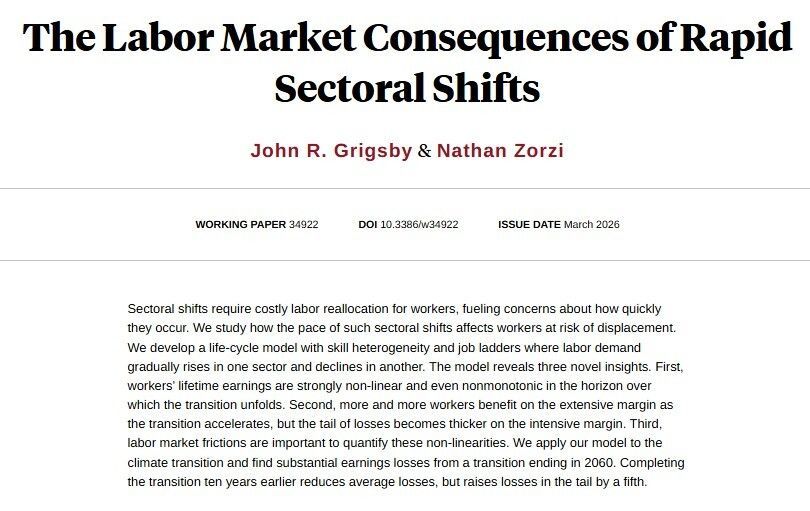
🚨 New working paper 🚨 with @Nathan_Zorzi studies settings where labor demand declines for one set of jobs and rises for another (eg the climate transition, manufacturing —> services etc). How do workers fare when pace of that shift changes? Thread 👇
Workers' outcomes are highly non-linear, even non-monotone in the pace of sectoral shifts. More and more workers gain as a transition accelerates, but the tail of losses thickens, from @JohnRGrigsby and @Nathan_Zorzi https://t.co/1BIkUE3s4W
Some news about @RevEconStudies.
New journal: Restud Insights. Accepting submissions Sept 2026.
2 types of articles: "Insights" (similar to AER Insights) and "Communications" (2k words + 2 exhibits).
It will be an “up-or-out” editorial process.
More info soon.
@economoser Yeah I’ve had this experience too even with Opus 4.8. It’s just such an efficiency enhancer for these dull tasks that it makes me much more willing to do them. So I actually can use multiple data sources for small tasks; previously I’d shoehorn the CPS into whatever I needed
@PorzioTommaso Yeah makes sense; I imagine it’s a heck of a lot harder to track down “potential entrepreneurs” than those who have actually become one already. But understanding these people seems really important too (also in developed market contexts), so maybe worth musing on for future work
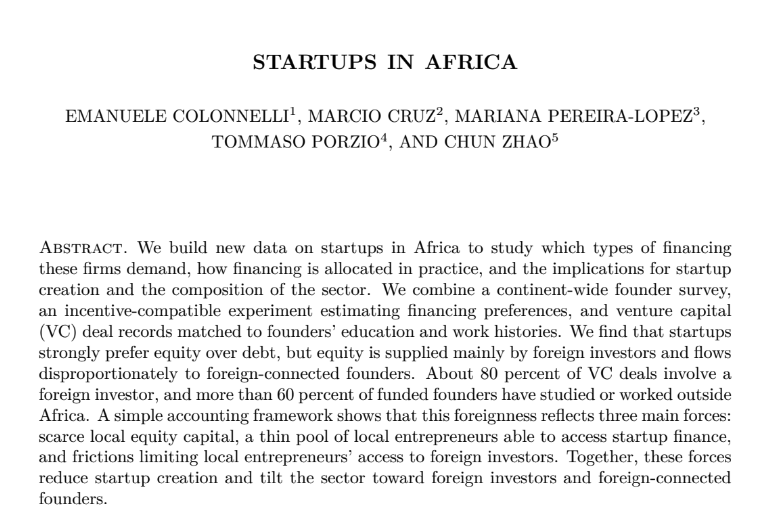
🧵on new paper “Startups in Africa”.
Draft here: https://t.co/ag9ni1IMoa!
In this project, we collect new data to study a small, but fast-growing, reality: the startup scene in Africa.
With Emanuele Colonnelli, Marcio Cruz, Mariana Pereira-Lopez, and Chun Zhao. 1/
@drkaenzig Yeah very interesting. Also suggests behavioral responses could be big meaning first order effects may be a little misleading. Non-linearities of tariff shock size may matter, which could be relevant for today’s episode
@drkaenzig Super interesting as always, Diego. I was wondering if you could comment on how quickly mean reverting the tariff rate seems to be. Is that saying tariffs are basically gone after 2 years? Would that also include some uncertainty sock component if so?
#QJE May 2026, #1, “The Macroeconomic Impact of Climate Change: Global Versus Local Temperature,” by Bilal (@AdrienBilal) and Känzig (@drkaenzig): https://t.co/QRs0mFCKma
Proud spouse post: my better half has written a beautiful book on the history of the art market called "Trading Beauty: Art Market Histories from the Altar to the Gallery." Highly recommended to anyone who likes art history and the evolution of markets.
Her interview with Art News is here, if you wish to learn more https://t.co/MP8Z0twy9g
Available for pre-order here: https://t.co/jGgPne9kIu
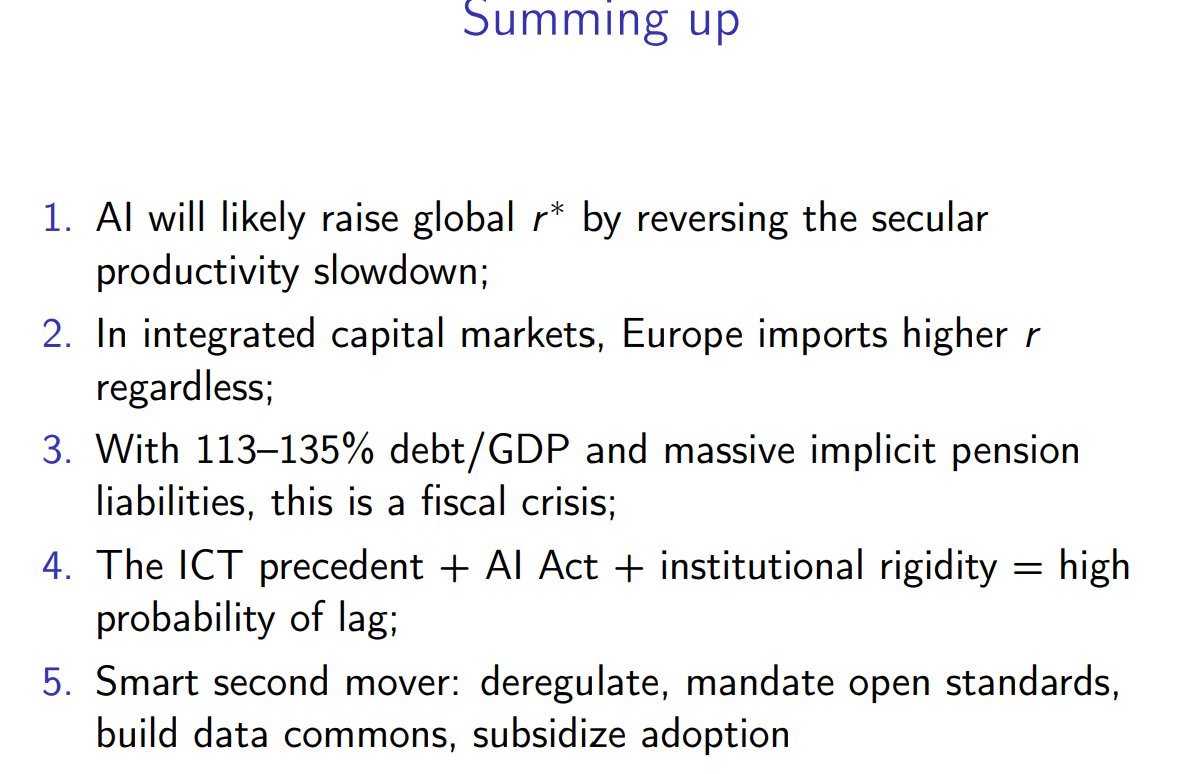
@lugaricano argues:
If AI raises global interest rates by boosting productivity, but Europe fails to adopt AI, Europe imports higher r without higher g -- a path to fiscal crisis.
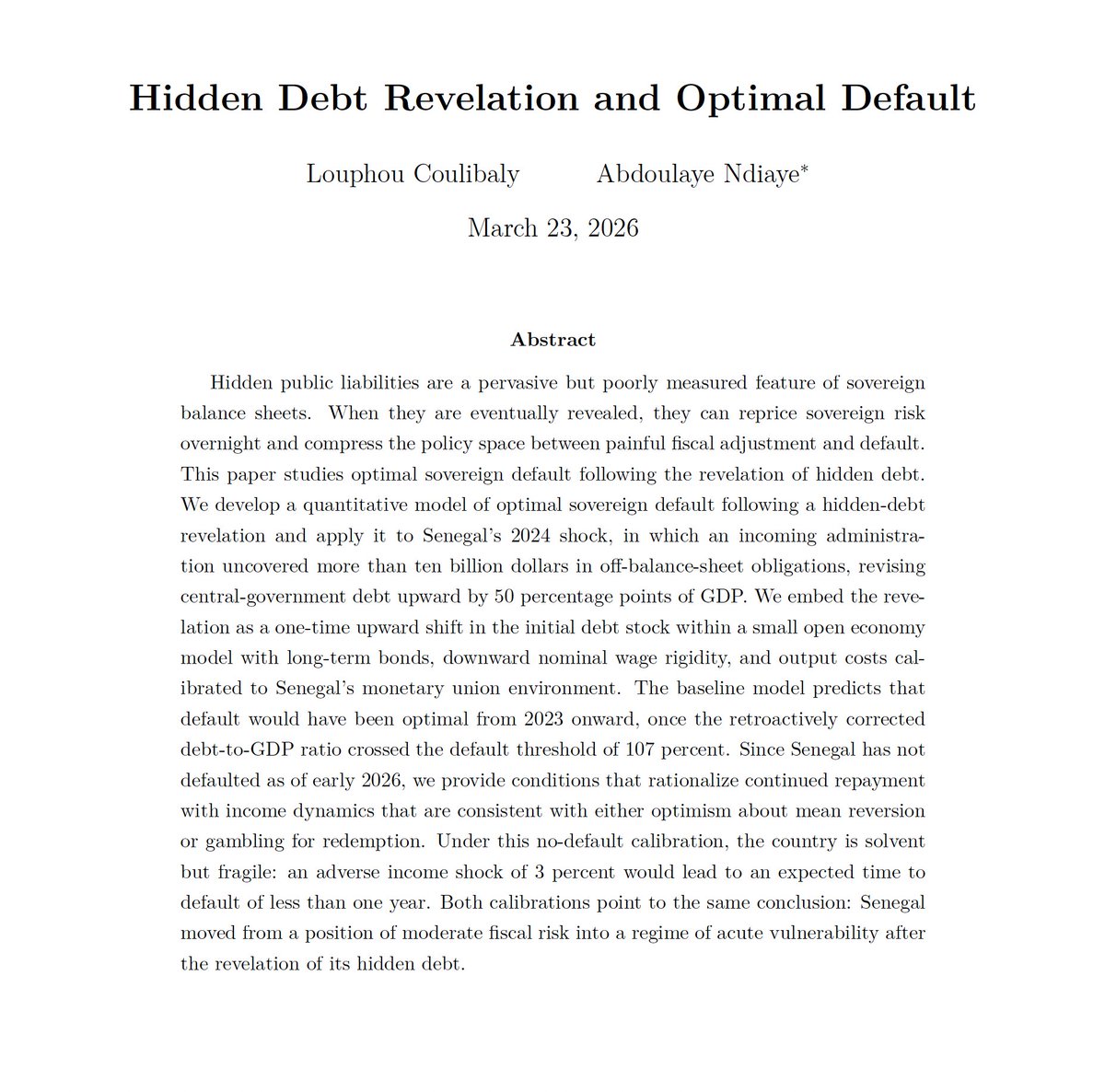
Governments routinely promise more than they record on their official balance sheets. Off-budget borrowing, guarantees, and arrears allow them to shift expenditures across time and to soften political constraints, but they also create hidden liabilities that are only imperfectly understood by markets and international institutions.
A thread 🧵...
@GautiEggertsson Hm I agree with the sentiment but I think there’s subtlety here. As the cost of generating new information falls, the value we place on determining “true” takes will likely rise. Journals are the right institutions to arbitrate that process and we need to know which ones to trust
@infornomics 100% agreed. People will only like the new technologies if the benefits arise before they retire. Ofc, there could also be benefits/costs that arise outside the labor market, like better/cheaper services and misinformation, but those are diffuse while the labor effects are acute
Workers' outcomes are highly non-linear, even non-monotone in the pace of sectoral shifts. More and more workers gain as a transition accelerates, but the tail of losses thickens, from @JohnRGrigsby and @Nathan_Zorzi https://t.co/1BIkUE3s4W
We think the core economics here should apply to other settings where demand falls for one set of jobs and rises in another, such as structural change, some trade and creative destruction contexts, and arguably the rise of AI. Happy to discuss further!!
🚨 New working paper 🚨 with @Nathan_Zorzi studies settings where labor demand declines for one set of jobs and rises for another (eg the climate transition, manufacturing —> services etc). How do workers fare when pace of that shift changes? Thread 👇
Workers' outcomes are highly non-linear, even non-monotone in the pace of sectoral shifts. More and more workers gain as a transition accelerates, but the tail of losses thickens, from @JohnRGrigsby and @Nathan_Zorzi https://t.co/1BIkUE3s4W
With the skill distribution in hand, we can then see how costly the status quo climate transition is for workers attached to the polluting sectors, and ask how much they stand to win/lose by accelerating it. That leads to the numbers mentioned above