Building 3 companies at once offshore dev (@telexar), church tech (@flowaysco), digital marketing (Zing Creative). Sharing the real build from Adelaide. CEO ×3
I'm running 3 companies at once.
An offshore dev firm. A church management platform. A digital marketing agency.
Same team. Same city. Same time.
Here's how it actually works:
I built Polsia into a $250M company in under 3 months.
Solo + AI. Zero employees.
Everyone asks me how I did it.
Introducing aisloP, a docu-series on how I build Polsia.
Episode 1: The Launch.
How I orchestrated the biggest Twitter launch of 2026.
It's almost here. 🚀
Floways is launching soon: one platform to run your whole church, People, Giving, Groups, Services and more. Built in Australia. People free forever.
Follow for launch day. Early look: https://t.co/IJ6VLvJ0GB
A 50 million line codebase migration. Two months of work for a full engineering team. Stripe did it in one day with Anthropic’s new model. We keep debating whether AI will change software development while it’s quietly already happened.
99% of people are using Claude Fable 5 wrong.
People don't know how to work with it yet because nothing this powerful has ever existed.
I'll show you 10+ use cases and startup ideas that can only exist because Fable 5 is here in under 34 minutes.
@Av1dlive Partially agree. But ‘designers win’ is the wrong frame. Taste wins. And taste is learnable. The devs who are thriving aren’t hiring designers they’re spending 30 mins a day on Mobbin until their eye catches up to their ambition.
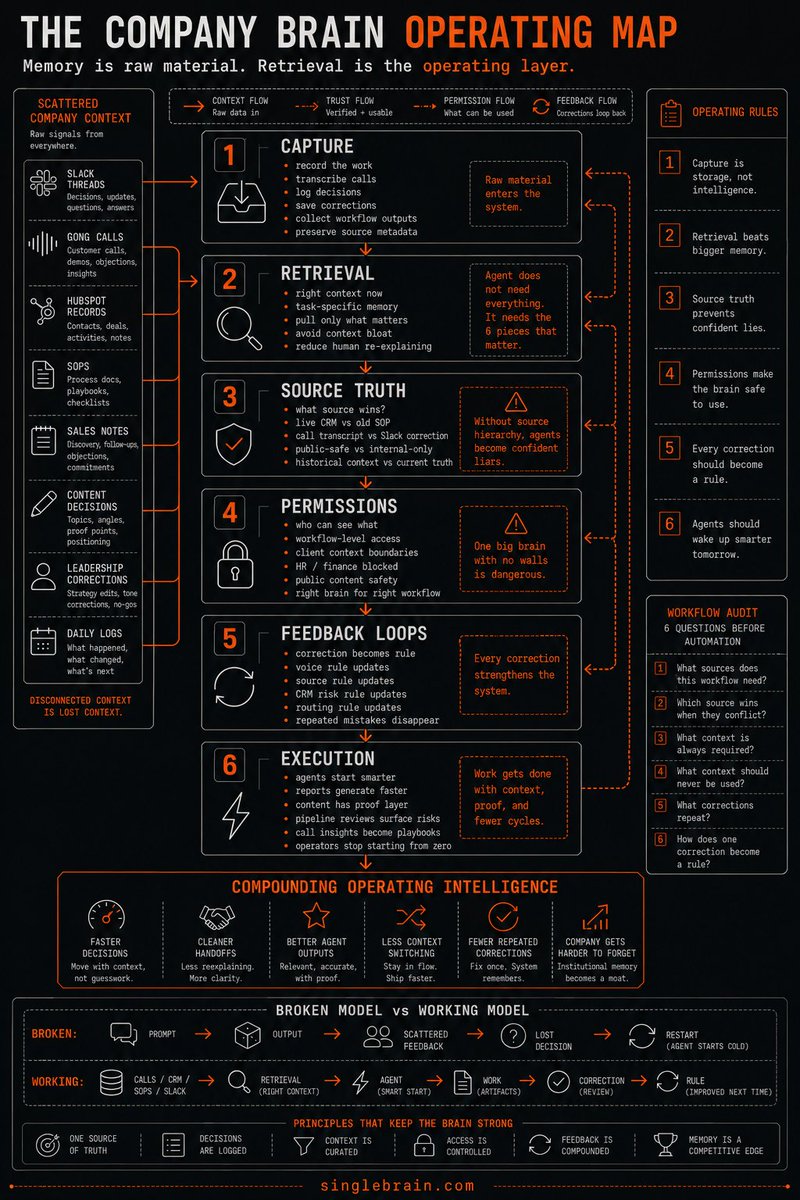
Every company is missing the same layer:
A company brain.
Right now, the memory of the business is scattered across calls, docs, Slack threads, dashboards, SOPs, and people's heads.
That's the part people miss when they talk about a company brain.
The value isn't a giant folder of company knowledge. Every company already has that.
The real advantage is the intelligence layer that sits between all that context and the work your team needs done.
This is the layer every AI-native company will need:
The 100x org framing makes sense and the point about best engineers being slowed down by reviewing human code is something most companies haven't internalised yet. The bottleneck isn't AI adoption, it's who's doing the orchestrating and reviewing. Curious to watch how the million dollar salary bands play out as a retention strategy. Bold move, but the logic is sound.
@KaiXCreator Selling.
Not AI. Not coding. Not "building in public."
The ability to make someone say yes to your idea, your price, your vision is the only skill that directly becomes revenue.
Every other skill either supports it or depends on someone else who has it.
@sherifgjini Building Floways church management software that actually gets out of the way.
Frictionless flow for your people, groups, check-ins, services, giving and more.
We're live and booking demos 👉 @flowaysco
@DanielSmidstrup Building Floways church management software that actually gets out of the way.
Frictionless flow for people, groups, check-ins, services, giving and more.
We're live and booking demos 👉 @flowaysco
Most founders hire a team to build a product.
We built a team first, then decided what to build.
Telexar came before Floways. That order matters.
When your dev capacity is your own, the build cost collapses and the speed doubles. That asymmetry is the whole game.
This week, I spent 8 hours reading 50+ articles about AI.
And I learned more in 1 day than most will in an entire year.
Highly recommend you read these 8: