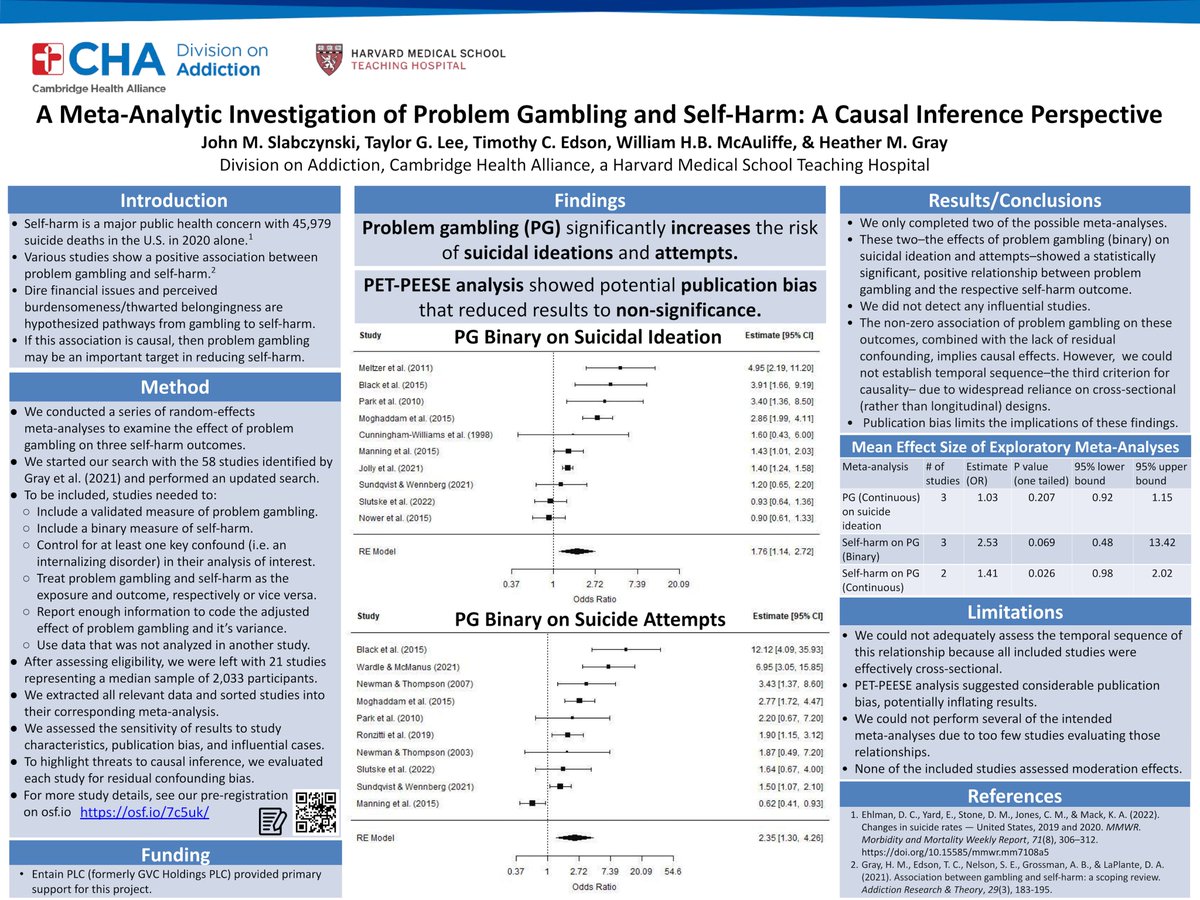
@bencook_equity @Div_Addiction That’s a great point! We approached this via our moderation analyses though this was limited. We included aspects such as sampling strategy and problem gambling measure though we were unable to account for factors like handling of missing data or open science practices.
@Div_Addiction Quality longitudinal studies are very expensive to run and with this being a relatively under-researched area, the likelihood of grants going to studies investigating this topic is low. Hopefully this study will bring attention to the significance of gambling disorder as an (1/2)
@Div_Addiction Gray et al,. (2021) and coding, we condensed these due to a lack of literature. We still considered it important to stratify the results by self-harm outcome as best as possible though because, as shown, these results can vary between outcomes (2/2)
@Div_Addiction The 3 outcomes were suicide ideation, suicide attempt, and ‘self harm’ which included everything from NSSI/ideation through completed suicide. We also considered additional outcomes including NSSI, suicide plans, and completed suicide but based on the initial study (1/2)
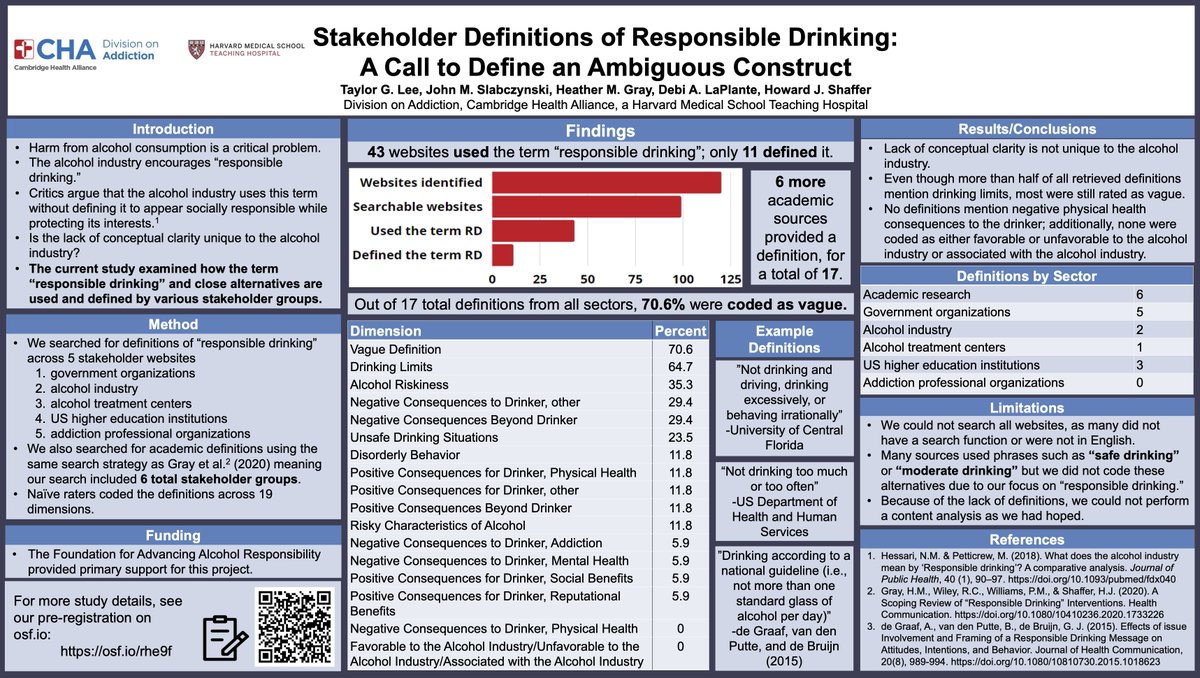
Stakeholder Definitions of Responsible Drinking: A Call to Define an Ambiguous Construct. Presented by Ms. Taylor Lee. Comment below with questions for @taylorg_lee! #CHAvirtualposter
A Meta-Analytic Investigation of Problem Gambling and Self-Harm: A Causal Inference Perspective. Presented by Mr. John Slabczynski. Comment below with questions for @JohnSlabczynski! #CHAvirtualposter
@bencook_equity @Div_Addiction Interestingly, there were a few studies that employed longitudinal data though functionally, none of the studies could be assessed for temporal sequence. The analyses of interest in the longitudinal studies typically measured self-harm and problem gambling over the lifetime.
@Div_Addiction Both of these variables are also related to suicidality and thus may mask any effects the variable of interest (problem gambling) has. Testing for moderation effects allows us to isolate the effects of problem gambling and demystify the picture. (2/2)
@Div_Addiction Moderation effects are important because they can help explain the larger picture. For instance, gambling disorder is highly Conor I’d with other psychiatric disorders. Additionally, gender has been shown to be a significant factor in the development of gambling disorder (1/2)
@Div_Addiction Publishing format. One of the best ways to reduce publication bias is to incorporate more open science practices (pre-registrations, open notebooks/data) and include non-significant results in publications. These practices increase transparency and encourage collaboration. (2/2)
@Div_Addiction Publication bias is multi-faceted but is most often seen as the systematic preference towards significant findings. Non-significant findings are typically not reported in a manuscript or rejected by publishers. P-hacking is also an issue as it is incentivized in our current (1/2)
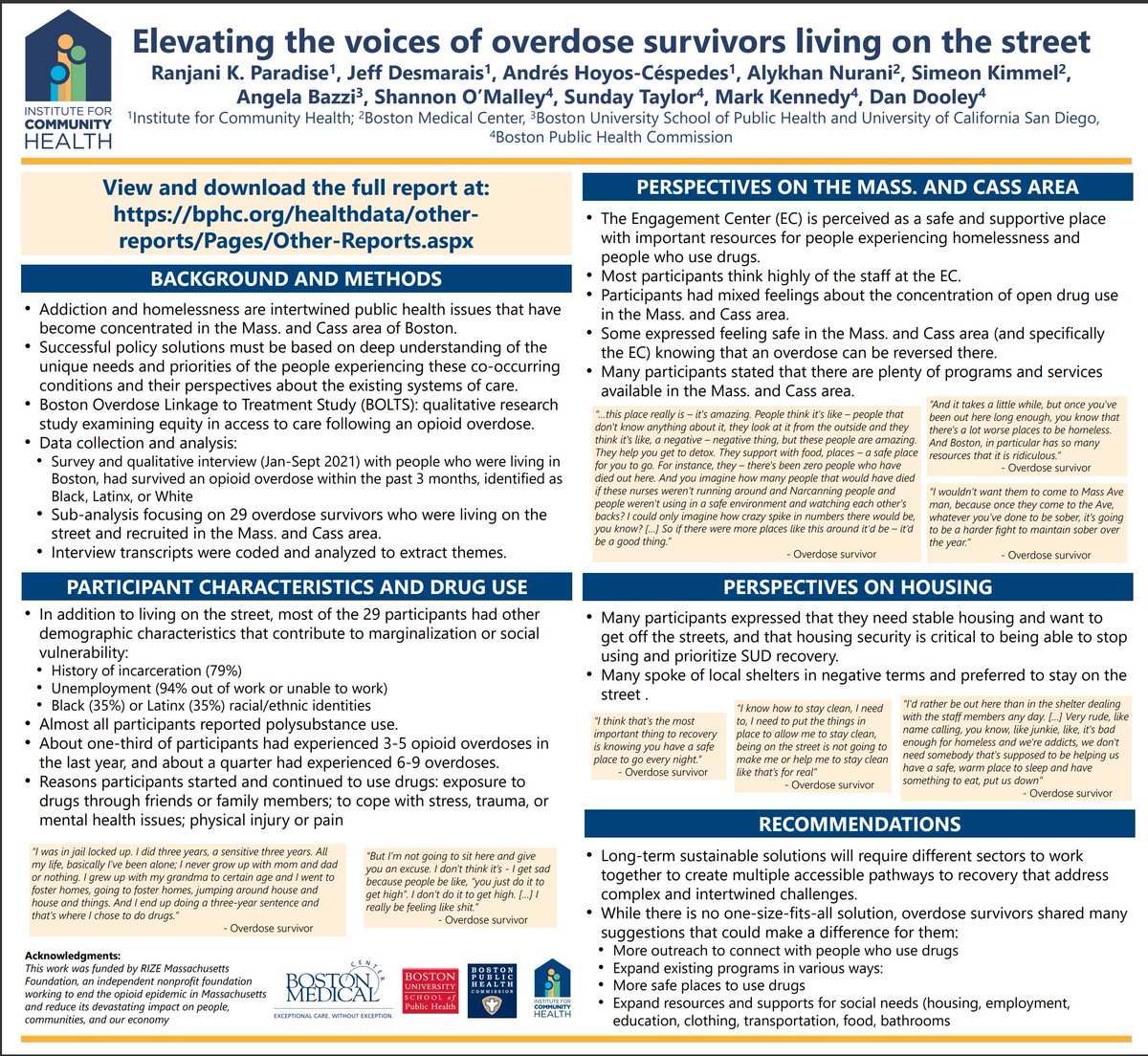
@icommhealth @JalbertSarah Thanks for sharing this! Do you have any theories on why there is such a difference between the EC and local shelters in terms of the positive and negative views of staff?