President World Council of Arameans (Syriacs), @wca_ngo: UN NGO & global umbrella organization | Author book on THE LAST ARAMAIC-SPEAKING CHRISTIANS MIDDLE EAST
SHUDOYO 2026 — The Aramean Action Summit
For decades, our gatherings created inspiration for a moment, but little lasting momentum afterward.
SHUDOYO — the Aramaic word for promise, commitment, and pledge — was created to break that cycle. It is an action-oriented summit focused on reviving Aramean identity, responsibility, youth engagement, and strengthening long-term cooperation.
On 4 July 2026, 100 committed Arameans will gather in Gütersloh, Germany, to help shape the future of our people.
Our heritage. Our voice. Our future.
Together we act.
Applications are limited: for more information and registration, see:
🔗 https://t.co/VoP7kwm7sY
Melki Toprak truly was a great Aramean patriot who dedicated decades of his life to serving his people with sincerity, humility, and commitment.
From Switzerland to the home countries and the broader Aramean diaspora, his contributions and loyalty to our people will not be forgotten.
His absence will be deeply felt throughout our communities! May his memory be a blessing.
A small tribute to a man who served our people for decades.
From Switzerland to Turkey, Syria, Iraq, Lebanon, the Holy Land, and the diaspora, Melki Toprak, Chairman of the Federation of the Arameans in Switzerland, dedicated his life to helping fellow Arameans, especially refugees and families in need.
On the occasion of the 40th anniversary of the World Council of Arameans (Syriacs), on 16 March 2024, we publicly thanked and honored him for his lifelong service to the Aramean people, never imagining that it would be one of our final moments together.
Taudi, thank you, dear Melki. May your memory be a blessing. ❤️
Why are Syria’s oldest indigenous people still being overlooked in discussions about Syria’s future?
In our newly published opinion article in the Dutch newspaper @ndnl (ENG translation in comments below), former MEP Albert Jan Maat and I address a serious blind spot in Dutch and European Syria policy: the continued exclusion of the Arameans.
Recognition, equal rights, cultural preservation, and genuine inclusion should apply to all communities.
Link: https://t.co/wWpeTmEPG4
Why Are the Arameans, So Many of Whom Live in the Netherlands, Being Overlooked in Our Syria Policy?
Opinion Dutch policy on Syria has a blind spot: the Arameans. While the Netherlands advocates inclusion, human rights, and sustainable stability, Syria’s oldest indigenous population continues to be structurally overlooked. This undermines the credibility of the policy itself, argue former Member of the European Parliament Albert Jan Maat and Johny Messo, President of the World Council of Arameans (Syriacs).
Albert Jan Maat, former Member of the European Parliament for the CDA
Johny Messo, President of the World Council of Arameans (Syriacs)
Saturday, May 9, 2026, 8:30 PM
The Arameans are regarded as Syria’s oldest indigenous population group and speak one of the oldest living languages in the world. Yet Arameans are largely absent from discussions surrounding Syria’s reconstruction and long-term stability.
How this plays out in practice became evident earlier this year. Through a presidential decree, Syrian President Ahmad Al-Sharaa recognized the Kurds as an integral part of the Syrian people and elevated Kurdish to the status of a national language. A welcome step.
However, the decree remains silent regarding other population groups, including the Arameans, who have lived in the country for millennia. This community, which belongs to the groups most severely affected by the Syrian conflict, should be central to any serious discussion on social cohesion, inclusion, and sustainable stability. Yet they remain largely invisible in both policymaking and international programs.
The World Continues to Look Away
Aramean communities received little international assistance during the conflict. The survival of their language and cultural heritage is under serious threat, yet the world continues to look away.
In The Hague, this imbalance is now increasingly being recognized. CDA Members of Parliament Maes van Lanschot, Elles van Ark, and Tijs van den Brink recently submitted critical parliamentary questions to the Ministers of Foreign Affairs and of Foreign Trade and Development Cooperation.
Among other things, they seek clarification on how Dutch and European Syria policy addresses vulnerable minorities, whether indigenous communities are granted equal recognition in shaping the future structure of the Syrian state, and to what extent humanitarian aid and reconstruction support actually reach them. These are precisely the questions that have remained unanswered until now.
Overlooking the Country’s Oldest Population Group
This is remarkable, given that the Netherlands presents itself internationally as a defender of human rights and inclusive governance. Such a position requires a coherent and consistent approach.
A policy that systematically overlooks the country’s oldest population group undermines its own foundational principles. The Netherlands can play an important international role, particularly within the European context, in protecting ethnic, linguistic, and religious minorities during Syria’s reconstruction.
Thirty Thousand Arameans in the Netherlands
The Netherlands is not an outsider when it comes to the Arameans. Our country is home to an Aramean community estimated at around thirty thousand people, with roots in Syria and strong ties to the region. This diaspora possesses linguistic knowledge, local networks, and direct engagement, precisely the expertise indispensable for a realistic Syria policy.
Yet this expertise is scarcely utilized. That says much about how the Netherlands and Europe approach inclusion in fragile states. Anyone who truly takes inclusion seriously cannot afford a selective approach. Excluding communities fuels tensions, undermines trust, and erodes cultural diversity.
Two names. One ancient people. One living language.
The Syriac Catholic Archbishop in Jerusalem, H.E. Mor Yaacoub Ephrem Semaan, holds up the Aramaic flag and makes it clear:
Aramean/Aramaic = Syrian/Syriac.
Two names, one people.
This remarkable civilization — indigenous to Syria, Southeast Turkiye, Lebanon, and Iraq — gave the world its first world language, the mother tongue of Jesus, and a legacy stretching three millennia.
The World Council of Arameans (Syriacs) is proud to share this important voice from the Holy City.
What do you know about the Aramean people, language, and history? Share your thoughts in the comments. 👇
#Arameans #Syriacs #Aramaic #Syriac
#CulturalDiplomacy #CulturalHeritage #MiddleEast
Yesterday, a Dutch ruling party (@cdavandaag) submitted a set of essential parliamentary questions to the Minister of Foreign Affairs @ministerBZ and the Minister for Foreign Trade and Development Cooperation @ministerBHOS regarding the position of the Arameans in Syria, following engagement with the World Council of Arameans (Syriacs).
At a critical moment for Syria’s future, this marks an important step toward justice and long-overdue recognition of one of the country’s oldest indigenous communities.
Inclusion. Recognition. Protection.
Key priorities raised:
– equal treatment of the Arameans as an indigenous people.
– access to humanitarian and reconstruction support.
– preservation of the Aramaic language and cultural heritage.
– stronger engagement with the Aramean diaspora.
An inclusive and stable Syria cannot be built while indigenous communities are overlooked.
Read more in the comments or via the link below:
https://t.co/OWX6nJfIRf
P.S. With appreciation to @MLanschot, @ellesvanark, and @TijsvandenBrink for submitting these questions.
Dutch ruling party (CDA) submits parliamentary questions to Ministers on the position of the Arameans in Syria
Following engagement with the World Council of Arameans (Syriacs), the CDA, one of the Netherlands’ governing parties, yesterday submitted a set of essential parliamentary questions to the Minister of Foreign Affairs and the Minister for Foreign Trade & Development Cooperation regarding the position of the Arameans in Syria.
The fourteen questions, submitted by CDA Members of Parliament @MLanschot, @ellesvanark and @TijsvandenBrink, address urgent and long-standing concerns regarding the situation of Arameans as an indigenous community in Syria, including their recognition, equal treatment, and access to humanitarian and reconstruction support.
Among others, the questions call on the Dutch government to:
· explicitly embed the inclusion and recognition of vulnerable groups such as the Arameans in current Syria policy.
· ensure equal treatment of indigenous groups in constitutional processes, including the Arameans with a recorded 3,000-year presence in Syria.
· ensure that humanitarian and reconstruction aid effectively reaches vulnerable minority communities.
· support the preservation of Aramaic as an endangered language and cultural heritage.
· better leverage the knowledge and engagement of the Aramean diaspora in the Netherlands.
“At a critical moment for Syria, the inclusion of indigenous groups such as the Arameans is not optional, but essential for sustainable stability, social cohesion, and long-term reconstruction,” said @johnymesso, President of the World Council of Arameans (Syriacs). “We welcome this parliamentary initiative and the growing cross-party support to ensure recognition, protection, and a viable future for our people.”
The Arameans represent Syria’s oldest living civilization, with a continuous presence spanning three millennia. Their language, Aramaic, which served as the principal language of Syria for two thousand years, is now endangered, underscoring the urgency of meaningful inclusion and preservation.
Further updates will follow as responses from the Ministers are received.
###
@GermanyOnMENA Es war mir eine Freude, Sie kennenzulernen. Ich hoffe, dass sich unsere Wege bald wieder kreuzen. Für Ihre Zukunft wünsche ich Ihnen alles Gute - und Ihrem Nachfolger viel Erfolg.
@wca_ngo#BundesverbandderAramäerinDeutschland
13 years. No answers. Not forgotten.
On 22 April 2013, Archbishops Mor Gregorios Yohanna Ibrahim (Syrian & United States citizen) and Boulos Yazigi were abducted near Aleppo. Their fate remains unknown.
Today we remember them — and we demand the truth.
Join our global campaign: share your memories, prayers, and reflections using #RememberAleppo and #TheTruthAboutAleppo, either in the comments below or on your own account.
Every voice helps break the silence.
📷 Read the full press release in the comments below or at https://t.co/rpqxVf8yGo
Happy Easter to the Orthodox faithful and all who celebrate!
He spoke Aramaic. He prayed in Aramaic. And His last words were in Aramaic.
Like His disciples 2,000 years ago, we proclaim His resurrection today in the same tongue:
Mshiho Qayem Mu Qawro - ba-shroro qayem
ܩܡ ܡܪܢ ܡܢ ܩܒܪܐ. ܫܪܝܪܐܝܬ ܩܡ
Happy Easter to the Orthodox faithful and all who celebrate!
He spoke Aramaic. He prayed in Aramaic. And His last words were in Aramaic.
Like His disciples 2,000 years ago, we proclaim His resurrection today in the same tongue:
Mshiho Qayem Mu Qawro - ba-shroro qayem!
ܩܡ ܡܪܢ ܡܢ ܩܒܪܐ. ܫܪܝܪܐܝܬ ܩܡ!
#Easter #Qyomto #Resurrection #Arameans #Aramaic
President al-Sharaa’s visit to Berlin tomorrow:
a test for Syria, a responsibility for Europe.
Daniyel Demir, Chairman of the Aramean Federation in Germany, and I argue that this trip is more than diplomacy.
It raises urgent questions about long-term stability, reconstruction, the investment climate, and the future of Syria’s ethno-religious diversity and equal rights.
👇 Read more
https://t.co/ZR4phTaTA7
🇩🇪 German version:
https://t.co/wtzkf546MR
@wca_ngo
Deeply alarming development in NW Syria: a Christian city is under attack.
Disturbing videos circulating online appear to show scenes resembling a pogrom, with targeted violence, looting, and vandalism.
This must end. NOW.
Urgent Alarm Over Violent Attacks Against Christian Civilians in Al-Suqaylabiyah, Northwest Syria
The World Council of Arameans (Syriacs) (WCA) raises urgent alarm over escalating violence in the city of Al-Suqaylabiyah, located in Syria’s Hama province in northwest Syria, where the predominantly Christian population has reportedly been under attack for the past three hours.
According to eyewitness reports, what began as a local dispute following harassment of young Christian women quickly escalated after Muslim individuals from the nearby village of Qalaat al-Madiq returned with reinforcements from surrounding areas.
As circulating videos show, armed groups on motorcycles and in vehicles have since entered Al-Suqaylabiyah, destroying a Marian monument, looting shops, vandalizing property, and injuring an unknown number of defenseless civilians.
Residents describe scenes of chaos and fear, with large numbers of attackers arriving while women and even children can be heard in distress in the background. For over three hours, residents report a lack of effective intervention by local security forces, leaving civilians exposed and raising fears of further escalation.
The situation is currently extremely critical. The apparent sectarian nature of these attacks, targeting a predominantly Greek Orthodox Christian town, raises serious concerns about escalating intercommunal violence.
@johnymesso, President of the World Council of Arameans (Syriacs), stated: “What we are witnessing is deeply alarming. No community should be left exposed to such violence and fear. The protection of civilians, especially vulnerable minority communities, must be immediate and unconditional.”
These developments raise serious questions about accountability and the enforcement of the rule of law in this area. The apparent ability of armed individuals to act against unarmed civilians is extremely concerning. If such acts are not immediately addressed, they risk fueling further violence, eroding public trust, and destabilizing already fragile intercommunal relations.
WCA calls upon the Syrian government for immediate action to:
· Protect all civilians and restore order;
· Stop ongoing attacks and looting;
· Safeguard religious sites;
· Hold perpetrators accountable.
The international community must urgently monitor this situation and ensure the protection of vulnerable communities. The people of Al-Suqaylabiyah must not be left defenseless.
@SecRubio@statedeptspox@StateDept@StateDept_NEA@USAMBTurkiye@USEmbassySyria@AuswaertigesAmt
🇺🇸 A highly constructive meeting took place at the U.S. Embassy in Berlin with Mr. Brett Eggleston, Chief of Political Affairs, and his team.
Our delegation presented an in-depth overview of the situation of the Arameans in Syria, including our 7-point position paper and a new strategic summary on Syria’s Aramean Christians.
We are encouraged that our concerns and proposals were received with great attention and will be conveyed directly to the U.S. State Department and the White House.
@johnymesso, President of the World Council of Arameans (Syriacs), and Daniyel Demir, Chairman of the Federation of Arameans in Germany, also raised urgent concerns regarding Lebanon, where Aramean Christians and other communities are once again being drawn into a conflict not of their making.
This engagement marks an important step forward. We look forward to building on this momentum and advancing our cooperation in the period ahead. @usbotschaft
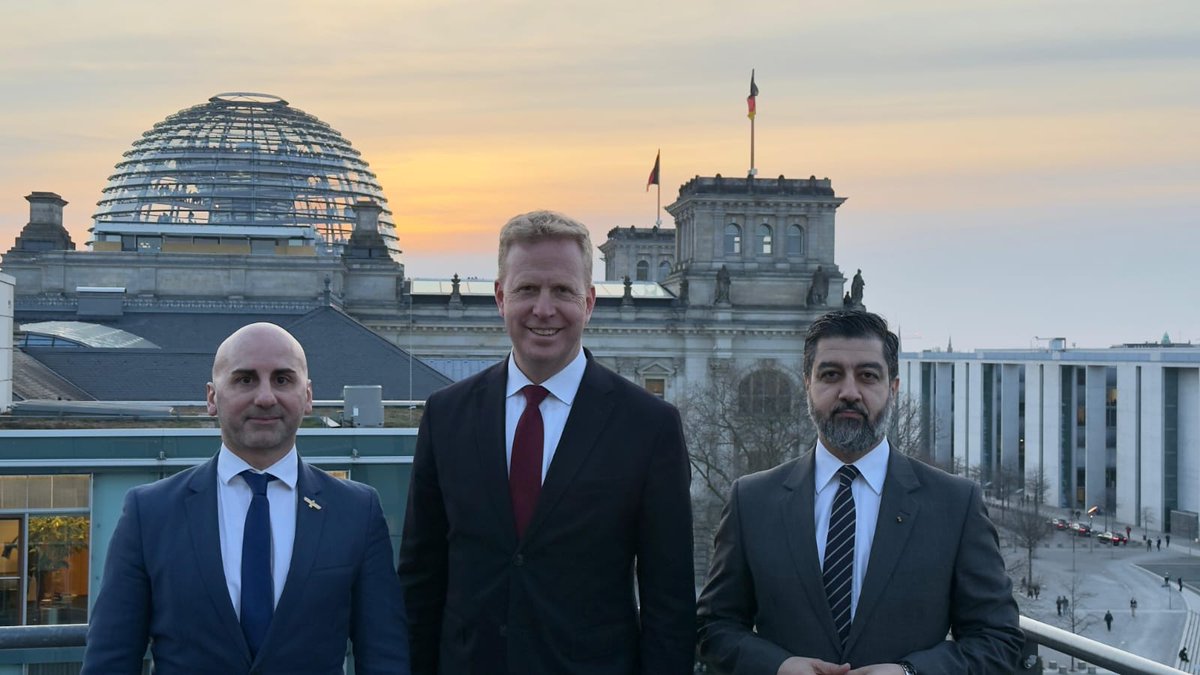
Impressive setting above the rooftops of the German Bundestag in Berlin and a very pleasant reunion with the distinguished Member of the Bundestag @HenningRehbaum (CDU).
@johnymesso, President of the World Council of Arameans (Syriacs), and Daniyel Demir, Chairman of the Bundesverband der Aramäer in Deutschland highlighted the situation of the last remaining Arameans in Syria and the TourAbdin region in southeastern Turkey, while also addressing key domestic issues shaping Germany’s growing Aramean community.
In a short story by the famous writer Franz Kafka, a man spends his life standing before a door he never enters. Not because he can't, but because he keeps waiting.
For generations, the Arameans have stood before their own door. But what is the cost of waiting, and how much longer will they stand before finally entering it?
Here are some thoughts on that door, and a message to this generation: 👇
https://t.co/kALejIxLq7
Important high-level meeting in Berlin with Minister of State Serap Güler at the Foreign Ministry.
Syria and the Arameans were front and center in a dynamic exchange with a highly understanding government representative responsible for the Syria file; in my view, Europe could use more such caring and inspiring state officials.
On behalf of @wca_ngo, my longstanding colleague and friend Daniyel Demir, Chairman of the Bundesverband der Aramäer in Deutschland, and I held a substantive discussion on Germany’s Syria policy.
One of our key messages was the need for Germany’s support to help secure an inclusive and stable future for Syria - one in which Aramaic, Syria’s former national language, and the Arameans, the country’s oldest continuously living indigenous people, are equally cherished, recognized, and supported.
The Arameans gave the world its first global language.
They helped shape the Bible, the Quran, and Western civilization.
Today, only a small fraction of them remain in their ancestral homeland.
This is their story. And mine.
I've just written my first Substack piece about who I am, why I write, and what to expect.
If you're interested in the deeper roots of the Middle East, especially its languages, religions, and cultural identity, read it here 👇
https://t.co/cuyXdvw6kj
@elongilad Sad news. Ages ago, I attended his classes and benefited greatly from his Hebrew & Aramaic grammars, as well as his insightful articles. May he rest in peace.
ܡܪܝܐ ܢܗܘܐ ܠܗ ܡܚܣܝܢܐ