Community Health Impact Coalition is making professional community health workers the norm worldwide by changing guidelines, funding, and policy. Join us!
https://t.co/q8HwaDjAEK
We’re excited to share that CHIC has been named a winner of the 2025 Skoll Award for Social Innovation!
We are thrilled that this Award is shining a spotlight on our ongoing efforts to support community health workers.
Thank you to the @SkollFoundation for amplifying the voices of innovators around the world.
During outbreaks like Ebola, CHWs help counter misinformation, promote protective behaviors, and build confidence in public health interventions.
No other actor in a health emergency holds that position.
➡️ The role of proCHWs in outbreak preparedness + response: https://t.co/L2E0kBK1UT
Community health can be discussed as an expense. Kenya is making the case that it's an investment.
At #WHA79, Kenya's Principal Secretary of Health Mary Muthoni Muriuki highlighted how scaling community health interventions can reduce healthcare costs, strengthen productivity, and build resilience against future health threats.
As countries navigate tighter budgets and shifting funding landscapes, Kenya's demonstrate how investments in community health can support both stronger health outcomes and stronger economies.
There are thousands of papers on CHWs, yet few were written by or with CHWs.
Last month in Uganda, CHIC convened CHWs, researchers, and partners around one question: what does it take for CHWs to lead research, not just appear in it?
Explore CHWs as researchers: https://t.co/OCrlbE4B1v
56 countries have proCHWs policy.
But policy adoption is only part of the story.
Are CHWs financed? Supervised? Supported by the systems needed to deliver care at scale?
CHIC's proCHW Policy Dashboard V 2.0 helps answer those question: https://t.co/T2ODFyPtrZ
Entrepreneurial models of community healthcare turn CHWs into sales associates and communities into customers.
CHWs should be able to focus on providing quality healthcare, not boosting product sales.
Explore why these models underperform + the evidence for proCHWs: https://t.co/w2lVbN1r6O
What would strengthen the Ebola response?
CHWs in Uganda + DRC told us that while community engagement is essential to containing Ebola, communities must be part of shaping preparedness + response efforts—not just implementing them.
More about the role of proCHWs: https://t.co/CJgTVl7OU9
proCHW policy is needed to make proCHWs the norm worldwide. But policy alone doesn't guarantee systems will hold.
Since 2023, CHIC’s proCHW Policy Dashboard has tracked where commitments exist. Version 2.0 examines whether they are translating into implementation.
→ https://t.co/8ilC5Srl50
1984. That's when Malawi began paying CHWs as salaried members of the public health system.
But longevity doesn't guarantee systems hold.
CHIC's proCHW Policy Dashboard Version 2.0 explores whether policy commitments are translating into implementation.
➡️ https://t.co/7ReBgUixVx
proCHW policy is essential to making professional CHWs the norm worldwide. But policy alone doesn’t tell us whether programs will hold in delivery.
What matters is whether those commitments are backed by the systems required to sustain them. How CHWs are financed, supervised, and integrated into primary care.
In 2023, CHIC launched the proCHW Policy Dashboard to track where policy commitments exist.
Today, we’re launching Version 2.0 to ask a harder question: are national policies being implemented?
The Dashboard is both a scoreboard and a strategy tool for the proCHW movement:
→ By detailing existing policies, it maps proCHW investment opportunities.
→ By showing where strong policy and implementation are in place, it tracks progress.
→ By flagging policies set to expire within the next 24 months, it highlights key windows for policy action and renewal.
It is built as a shared resource for the proCHW movement to help drive progress toward stronger adoption and implementation of proCHW policies.
Where does your country stand?
Find your country and use the Dashboard to identify opportunities for action, investment, and policy renewal: https://t.co/aIGM7VEBVq
To achieve health for all and make #proCHWs the norm worldwide, policy cannot stop on paper.
At CHIC's event on the sidelines of #WHA79, Kenya PS of Health Mary Muthoni Muriuki shared what leadership can look like in practice. Budgets allocated, commitments to timely commodities and stipends, and a call for partners to align behind national priorities rather than fragmented approaches.
This is how to move from policy to implementation. Not parallel systems. Not siloed investments. Coordinated action designed to sustain support.
"Without leadership, sovereignty, and political commitment, everything will fail." — Hon. Ussene Isse, Mozambique Minister of Health, at CHIC's All Roads Lead to proCHWs side event during #WHA79.
Conversations in Geneva this week are full of lofty ideas and broad commitments. While those matter, so do the practical decisions that turn commitments into durable systems. Hon. Isse brought those decisions into the room.
He shared concrete commitments already underway: a law making the community subsystem a national priority, work toward formal status for community health workers, and a pathway for CHWs to become state employees.
This is what leadership looks like. Making bold commitments to proCHW policy while doing the harder work of building systems resilient enough to sustain them.
CHWs are among the most cost-effective investments in primary health care.
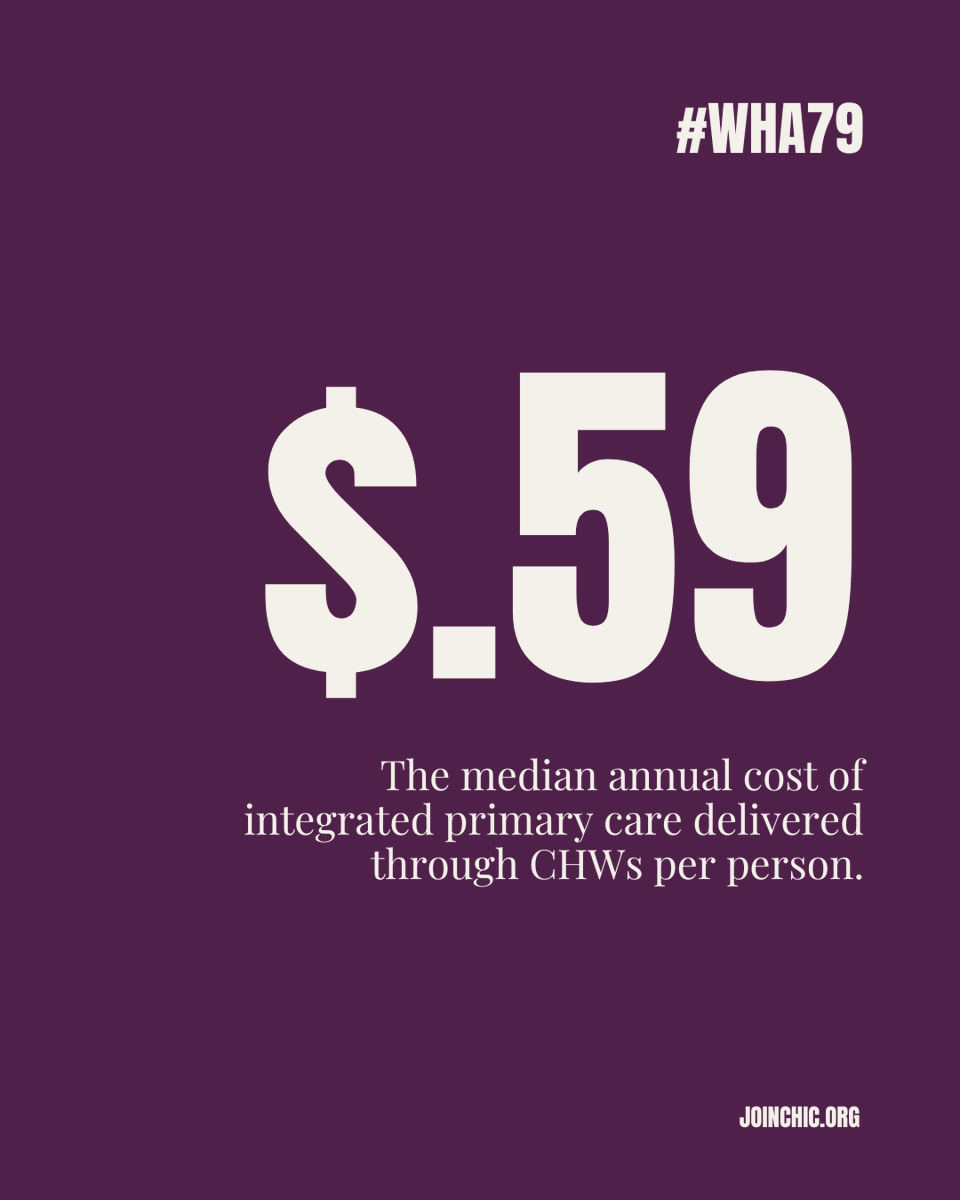
CHW-delivered primary care can cost as little as $0.59 per person a year, with returns up to $10 for every $1 invested.
→ At #WHA79, explore the evidence shaping the case for #proCHWs: https://t.co/KJRyih2CAX
Last year at #WHA, CHW Millicent Miruka joined Dr. Sania Nishtar, CEO of @gavi, to discuss what it takes for CHWs to be recognized and supported as professionals within health systems.
This year in Geneva, the conversation continues: how do we ensure #proCHW policy translates into reliable access to care? Follow along with CHIC at #WHA79.
At #WHA79, delegates will discuss how health systems can deliver more with less.
For community health, the answer cannot be more short-term projects.
Sustained domestic financing for #proCHWs helps ensure policy commitments translate into care that continues reaching communities.
What does it take to sustain #proCHWs?
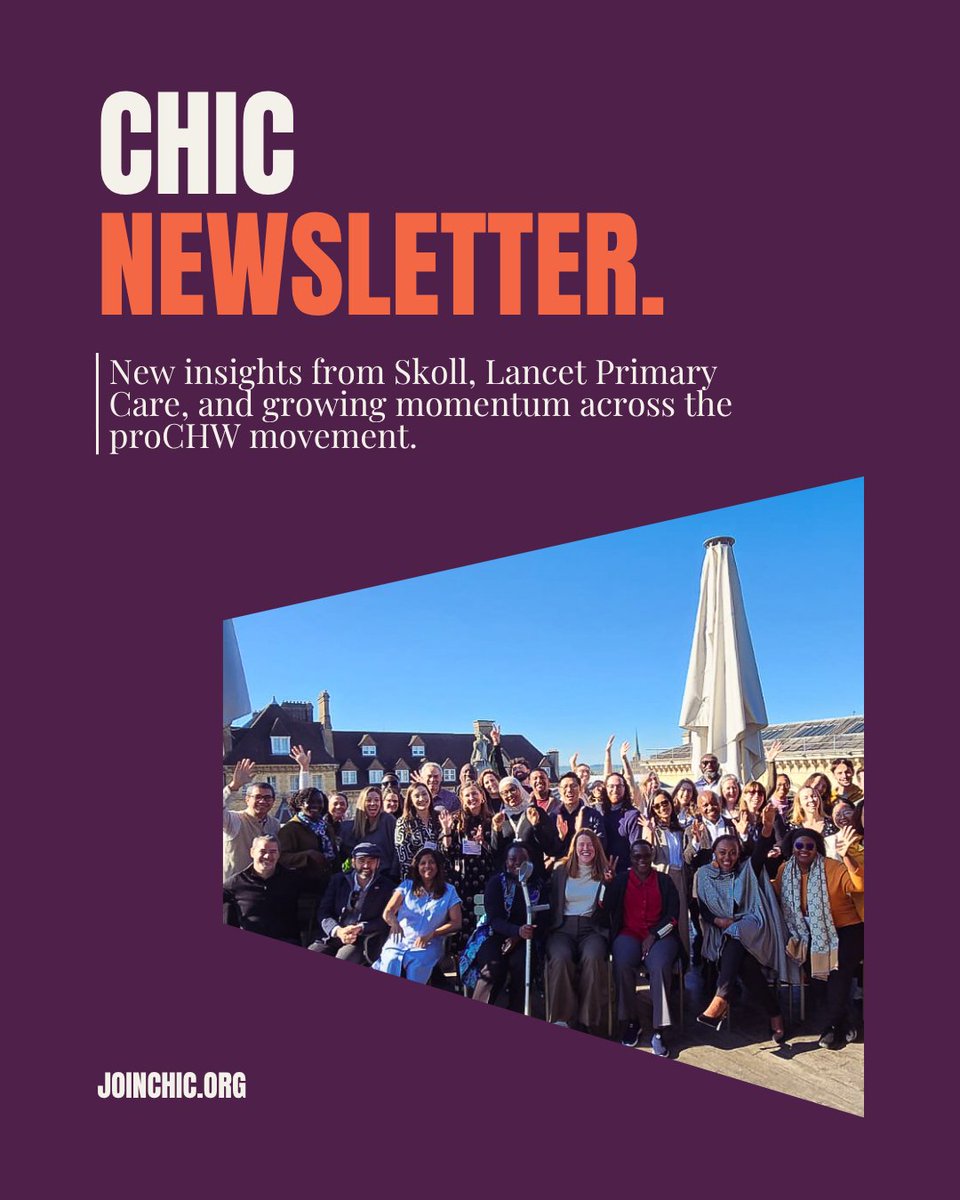
This month, conversations across the proCHW movement focused on a shared challenge: what it takes to move from policy momentum to systems that can sustainably support CHWs in practice.
From Skoll World Forum to new research on AI and community health to preparations for #WHA79, our latest newsletter explores how the movement is increasingly shifting from recognition to implementation.
Read more: https://t.co/QMZihxm2mf
As health systems are being asked to deliver more with fewer resources, how do countries sustain access to care?
That’s one of the defining questions at #WHA79.
Our answer: catalytic funding that helps countries transition #proCHW programs into national systems, backed by sustained domestic financing.
The conversation continues in Geneva next week. If you’ll be at #WHA79, let us know in the comments ⤵️
Global health is at risk of repeating its pilot problem — this time with AI.
We've seen this pattern before: rapid experimentation, weak public ownership, limited integration, and eventually — tools that exist in parallel to the systems they were meant to strengthen.
At Skoll World Forum last month, CHIC convened a workshop where CHWs, governments, frontier AI labs, implementers, funders, and researchers to take stock of the rapidly evolving intersection of community health workers and AI.
Are we using AI to strengthen community health systems or layering new tools onto fragmented ones?
The consensus was clear. You can't AI your way out of a broken system.
If AI is going to support CHWs, it must be integrated into professional, supervised, government-connected health systems. That means CHWs helping shape the tools they use, governments stewarding AI as public infrastructure, and funders investing in long-term integration instead of endless pilots.
The next phase of AI in global health cannot just focus on innovation. It must focus on public system integration.
→ CHIC contributors recently co-authored a new Lancet Primary Care commentary on AI and community health exploring what it will take to move from disconnected AI pilots to integrated public systems: https://t.co/nxaydAqz8F
CHWs should not just experience the effects of global health funding decisions. They should help shape them.
Prossy Muyingo, a CHW from Uganda, is helping bring frontline perspective into broader conversations on global health funding, including recently with NPR: https://t.co/EjDGkAh8yY
In 2025, global health financing came under pressure. Yet, investment in proCHWs increased.
The Global Fund raised funding for proCHW programs by 32% to +$900M.
How institutions frame investments shapes what countries can implement.
Our 2025 Annual Report explores: https://t.co/Oon6YrDrFW
Immunization coverage depends not only on vaccines—but on how health systems support the workforce closest to communities.
Angelica Mutete Kiilu, a CHW from Kenya, shares why making professional CHWs the norm matters for immunization delivery.
#WordlImmunizationWeek