I built a content machine.
It turned me into a one-person media company, has driven tens of millions in pipeline for @tenex_labs, and is allergic to AI-slop.
It has also turned all of my employees into content creators.
I may opensource the whole thing, but for now, I'm going to share how I built it & how it works.
Feel free to copy & paste the steps to Claude/Codex if you want to build your own content machine.
Step 1: Map out the process
In order to make any of your work AI-native, you need to understand the way in which it's been done historically. This is why business context & domain expertise REALLY matters, even in a post-AI world.
Content has been my bread & butter for the last decade, so I started by pulling out an 8.5x11 sheet of printer paper and drawing the traditional process.
1) Look for inspiration
2) Pick a 10x content idea
3) Research the idea
4) Brain dump all of my thoughts about the idea
5) Decide the post format I want to create
6) Create a draft of the post
7) Edit the post
8) Create derivative versions of the post
9) Go live
10) Track performance
Step 2: Where am I needed vs. not needed?
I am needed for the first & final mile:
First mile: picking the idea/direction & providing all of the necessary context
Final mile: going through the final draft with a fine tooth comb & giving final sign-off.
AI can handle the rest:
Looking for inspiration, researching the idea, pulling my thoughts out, writing the post, doing a first edit, creating derivative content, and tracking performance.
Step 3: Build the Content Machine
The machine is one pipeline, run end-to-end or step-by-step. It is a directory of skills that mimic the steps in the content process that I've delegated.
1) The Oracle [AI]
Mines my Slack, Notion, call transcripts and Gmail for spikes, moments I naturally said something worth expanding, while the Internet Reader curates an external feed of X accounts & websites I've selected.
Qualifying ideas (≥6/10) are written to The Vault (a notion database of content ideas).
2) Select the idea from The Vault [Human]
3) The Researcher [AI]
Before any interview, build a sourced research-report.md: TL;DR, key facts with links, current developments, what's already been said, contrarian angles, and open questions for the interview. Claims are adversarially checked; fact is separated from opinion.
4) Interview Panel [AI + Human]
Six world-class interviewers (Joe Rogan, Howard Stern, Michael Barbaro, etc) ask 12–15 questions, one at a time, each pushing a different dimension...and never satisfied with vague answers. Won't advance without 2–3 specific stories, real numbers, and emotional specificity.
5) Production [AI]
The interview becomes a raw .md file: transcript, key stories, core insights, quotable moments, emotional anchor, surprising reveals, and the "so what." This raw file is sacred: my exact words, never paraphrased away.
6) Refinement [AI + Human]
I tell the machine what content type I want to create. It reads my custom style guide + past feedback lessons + content-type spec, then drafts in my voice...pulling real stories and quotes from the raw file. The #1 rule: write like you're texting a friend. Supports long posts, LinkedIn, X threads, and more.
7) Writer's Council [AI]
Six expert reviewers (Shaan Puri, Morgan Housel, David Perell, etc) score the draft through their own lens, splitting fixes into editorial (the machine can rewrite) and information gaps (only the creator can answer...these route back to the interview panel).
8) Revision Loop [AI]
Iterate until council scores 9/10.
9) Repurposing Engine [AI]
One anchor → 10+ natively-formatted derivatives, each re-hooked for its platform and each held to the same full Council → revision bar of 9/10. This is how two people produce like a hundred.
10) Final revision [Human]
11) Learning Loop [AI]
After approval, the machine compares first draft vs. final, extracts confirmed lessons, and saves them to that creator's content-lessons.md. Every future first draft starts smarter. Lessons override the style guide when they conflict.
Feel free to steal the machine & ask me any questions about how it works!
In an early meeting at Facebook (c. 2007), when I was describing the goals of Facebook Platform (an area I oversaw) Bill Gates yelled at me/us.
His quote has stuck with me to this day:
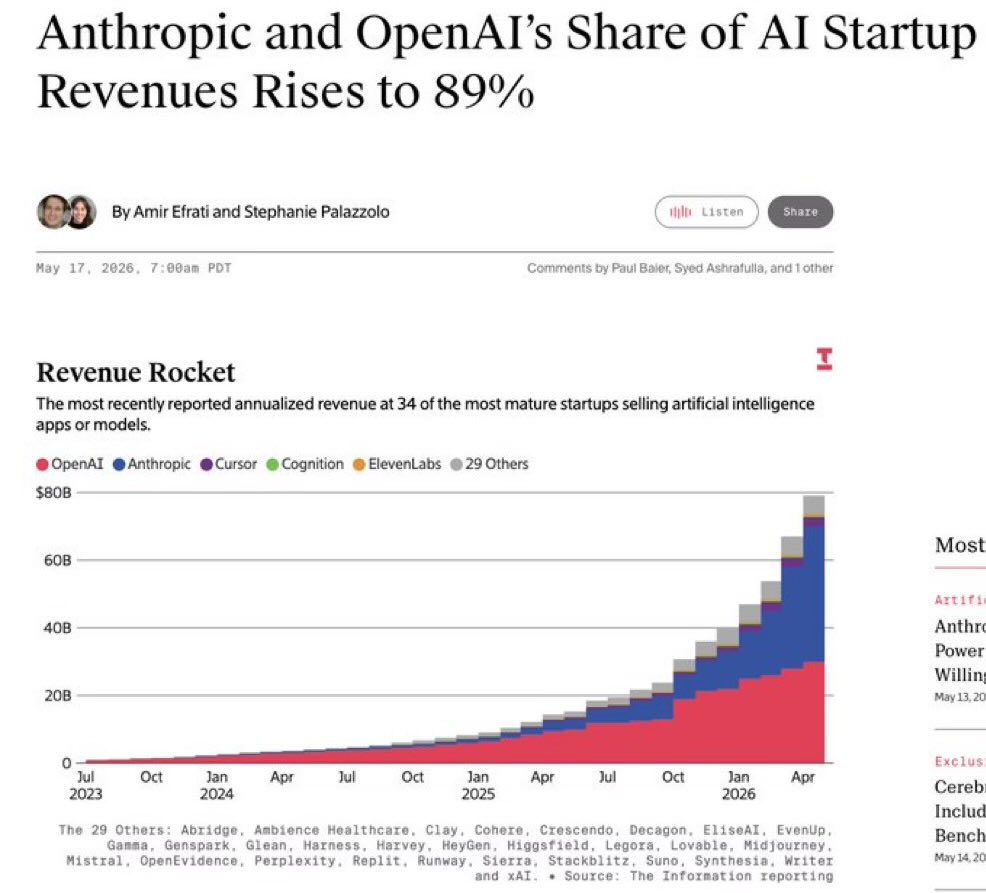
“This isn’t a platform. A platform is where the collective sum of revenues of the participants exceeds those of the platform itself.”
Ladies and gentlemen, I present to you the tokenmaxxing circle jerk.
2026 Pre-Seed and Seed Active VC list
At Right Side Capital, we have made over 2,200 early-stage investments in the past decade and anticipate approximately 150 new investments in 2026. We also assist our founders in connecting with the right next-round investors.
I have compiled a personally curated list of around 200 venture capitalists who ACTIVELY invest at the Pre-Seed and Seed stages.
What sets this list apart:
- All contacts are individuals I know personally (no scraping or outdated databases).
- Their actual investment criteria were provided directly by them this week.
- This is not zombie capital; each has shared their expected investment pace for 2026.
I am sharing this information as an Airtable, allowing you to filter by themes, check investment size/round, and see whether they lead or follow.
If you are a VC I may have missed, please reach out via direct message. I am happy to connect and add you if it aligns.
Link👇
https://t.co/8Iph3LG3pz
10/ Challenges: But beware—devaluation risks. In Venezuela, Sofia lost value when hyperinflation hit; stablecoins helped, but USD policy shifts could ripple. Regs needed to curb misuse. By 2030, trillions shift, making trade inclusive yet USD-centric. What do you think?
Stablecoins are democratizing global USD access.
Pegged to the dollar, they bypass legacy banking hurdles—capital controls, high fees, slow settlements.
Anyone with internet can hold, send, or use dollar value instantly & cheaply. This revolutionizes trade!
#Stablecoins #GlobalTrade
Story: Kenyan startup owner, Kwame, uses XRP bridges with USDC for multi-currency liquidity. Replaces old Eurodollar systems. Programmable money means conditional trades—e.g., pay if shipment arrives by date. Transforms ecosystems for efficiency.
2025 is the year of stablecoin announcements
Pilots. Mainnet launches. Partnerships. Fundraises.
but these things take time to cook
2026 will be the year of stablecoin volume
and it’s going to be glorious
Slow and steady, inevitable.
Not to mention,
Remittance is changing, threatening FX fees as the top revenue source.Traditionally, U.S. senders wire dollars, which services convert to local currency for recipients. After bills, many prefer holding dollars for stability.
Stablecoins let you send dollars directly—recipients convert on their terms.
Last week, the Bank of Ghana announced a 5% fee on dollar cash withdrawals from dollar bank accounts. Some banks have even stopped allowing dollar cash withdrawals altogether.
#Stablecoins #Remittance #Crossborder #Africa
Circle and USDC Expansion with Hyperliquid
Today marks a major milestone in our expansion and engagement with the Hyperliquid ecosystem, with the official launch of Native USDC and CCTP V2 on HyperEVM, bringing the world’s most reliable, liquid, interoperable and globally available dollar stablecoin into the community. Additionally, in the coming weeks we will enable direct deposits and CCTP interoperability for Hyperliquid USDC on HyperCore.
Alongside this launch, Circle is now a direct stakeholder in the Hyperliquid ecosystem, with our first HYPE token investments, alongside a comprehensive program to work with the most innovative HIP-3 and HyperEVM builders in the community. We are also evaluating the possibility of becoming a Hyperliquid Validator.
Over the past several months, the Circle team has had the pleasure of getting to know the Hyperliquid core team as well as many of the new startups and builders developing on HyperEVM and HIP-3. This is clearly one of the most impressive communities and platforms in the entire crypto ecosystem.
Understanding the Value of USDC in the Broader Crypto Ecosystem
Our expansion and broader engagement on Hyperliquid builds on nearly 8 years of work within the broader crypto ecosystem to build a public market infrastructure and network utility for dollars on the internet.
In many respects, launching a de novo dollar stablecoin is a trivial undertaking these days; we’ve seen hundreds of stablecoins launched over the past near decade. However, building global scale liquidity (trillions in primary liquidity), deep cross chain blockchain infrastructure, and massive developer, trader and end-user utility (thousands of apps and services, tens of trillions in onchain transactions) is an enormous undertaking.
Every new USDC in circulation inherits from this global liquidity and platform utility; every new developer that integrates a product, protocol or service, expands the utility for every other developer. These developer flywheels have helped create an amazing public internet utility for storing and moving dollars safely in the world. Collectively, the thousands of products and services that integrate USDC have helped deliver nearly $40T in onchain transactions.
Alongside this, Circle has spent as many years building out the deepest primary liquidity for any dollar stablecoin in the world. That primary liquidity exists through Circle’s regulated institutional infrastructure and deep banking connectivity that now spans most major financial market centers around the world: Circle offers primary liquidity for USDC at scale with direct integration into banking systems within the US, UK, EU, Singapore, Hong Kong, Brazil, Japan and soon the UAE.
We’ve done the heavy lifting of working with major policymakers and regulators around the world to enable safe and efficient use of stablecoins on public blockchains. Our global regulatory work has helped Circle build our primary liquidity through partnerships with banking institutions, including the world’s largest and most respected banking institutions.
This “digital dollar dial tone" exists now at scale and allows financial institutions, market makers, banks, payments firms, asset managers, neobanks, and on and off ramp companies to seamlessly create and redeem USDC at par globally.
Over time, we have minted and redeemed well over 1 Trillion dollars in USDC. Always 1:1.
Equally important is the secondary liquidity that exists for USDC, which includes broad availability across many of the biggest exchanges, and brokerage and payments platforms in the world. This secondary liquidity includes conversion into fiat in over 185 countries and deep liquidity against nearly every major crypto asset in the world. Indeed, in recent periods, spot and perps liquidity for USDC has deepened significantly, with BTC/USDC on Binance spot and perps within 0.2bps and 0.1bps vs. USDT.
Any given trader, developer or end-user’s choice on a dollar stablecoin is ultimately going to be shaped by the breadth and interoperability of the stablecoin network and the fundamental (primary and secondary) liquidity of the dollar stablecoin in the world.
All of this translates to capital efficiency, and as all of finance moves onchain, and seemingly with great pace into Hyperliquid, extreme capital efficiency remains absolutely fundamental.
We are thrilled to bring this deep fundamental liquidity and capital efficiency to the Hyperliquid ecosystem.
Blockchain Network Infrastructure and Interoperability for Hyperliquid Traders and Users
Alongside the value of USDC’s global liquidity and network reach, we’ve also invested over many years to ensure that USDC now has the broadest and deepest interoperability in the world. Our commitment to multichain enablement, and building core protocols for safe and seamless cross chain connectivity (CCTP, Circle Gateway) makes USDC portable for users across the most common platforms and applications.
End-users, protocols, and financial services companies need to know that customers can bring and move their digital dollars safely and seamlessly across every major network platform. Just as Spotify and Netflix ensure that their media can play everywhere, Circle is committed to building a platform where our stablecoins can effectively “play everywhere” too, with the trust, transparency and capital efficiency that the world has come to expect.
With native USDC on HyperEVM, with CCTP Vv2 interoperability, and with imminent HyperCore support, every Hyperliquid user and developer will be able to seamlessly move their digital dollars across the entire crypto economy. This also means that fintechs, on and off ramp providers, and other services can seamlessly integrate with Hyperliquid with the most liquid digital dollar in the world.
Circle’s Business and Investments in the Hyperliquid Ecosystem
Over the past decade, we’ve built Circle into a broad-based and increasingly full-stack internet financial platform, expanding and investing globally, to build this powerful internet utility. We are still in the early stages of building, and we recognize, along with so many other participants in crypto, that we are just at the start of the transition of all of finance onchain.
As a global public company, we are seeking to build long-term shareholder value, and that means investing in products and distribution as we work towards an internet economy that ultimately could support hundreds of trillions of dollars in economic activity.
Over the past years, we’ve continued to expand how we partner with leading companies, protocols and projects building towards this future internet financial system. The approaches for how we invest, share value and grow value alongside those who are committed to growing with us have also continued to evolve.
Building the internet financial system is not a zero sum game; it’s a platform and ecosystem game, and those that bring a big tent mentality to it and look to partner, support developer ecosystems and share in the joint value creation are those most likely to thrive and grow with it.
What does this all mean in the context of our investment in the Hyperliquid Ecosystem?
Now that our platforms are natively integrated into Hyperliquid, we are expanding our investments across several major vectors – these are a start, and we intend to iterate and engage within the community to help drive shared growth. These include:
Circle has become a direct stakeholder in HYPE. This is a start, and we will iterate based on mutual win-win principles for Hyperliquid and USDC; more to come.
We are actively exploring additional ways to further participate in the community, including the possibility of becoming a Hyperliquid Validator.
We are launching a new set of dedicated incentive programs for HyperEVM and HIP-3 builders – if you are building on HyperEVM and HIP-3, we are ready to engage and drive growth and value flywheels together.
Native support for USDC and CCTP Vv2 on HyperEVM and HyperCore are just the start – Circle is investing in developer tools and more onchain protocol work that we intend to build with robust support for Hyperliquid.
Circle is open for business with the Hyperliquid Ecosystem – if you are a developer, our public SDKs and APIs are available for you today; if you are a financial institution, trading and markets firm, or enterprise looking to build on Hyperliquid, you can engage with Circle BD, onboard with Circle Mint, access and mint and redeem USDC for Hyperliquid.
It’s Hyperliquid’s Moment
We’ve simply been blown away by the growth and success of Hyperliquid over the last year, and as we’ve gotten to know Jeff and team, and many of the major emerging builders in the ecosystem, it’s very clear that this is something incredibly unique and special.
Circle is here. We’re investing. We’re thrilled to be supporting this incredible community.
Hyperliquid.
https://t.co/UfjxEXmiD9