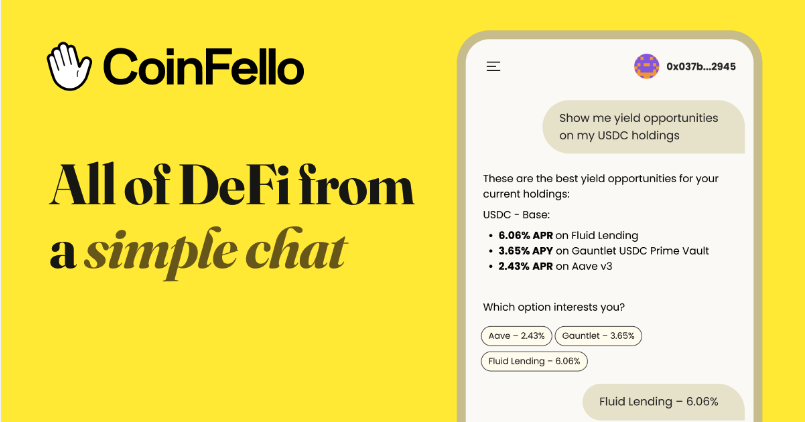
CoinFello is live for everyone!
CoinFello is an AI agent that helps you research, execute, and automate any onchain action across all EVM chains using plain language. Your keys stay yours the entire time.
No waitlist. No invite code. Open to everyone, from today.
Here is what that means 👇
Announcing the first ever public release of Lexe Wallet on the App Store and Google Play! This release comes with new features and fresh SDKs for creating and controlling self-custodial Lightning wallets - real channels managed by always-online Lightning nodes running inside secure hardware.
In the video below, we open a Python shell and hand-type commands to create a self-custodial Lightning wallet on Bitcoin mainnet, fund it, and make payments - in just 3 minutes. Full announcement in the next post 👇
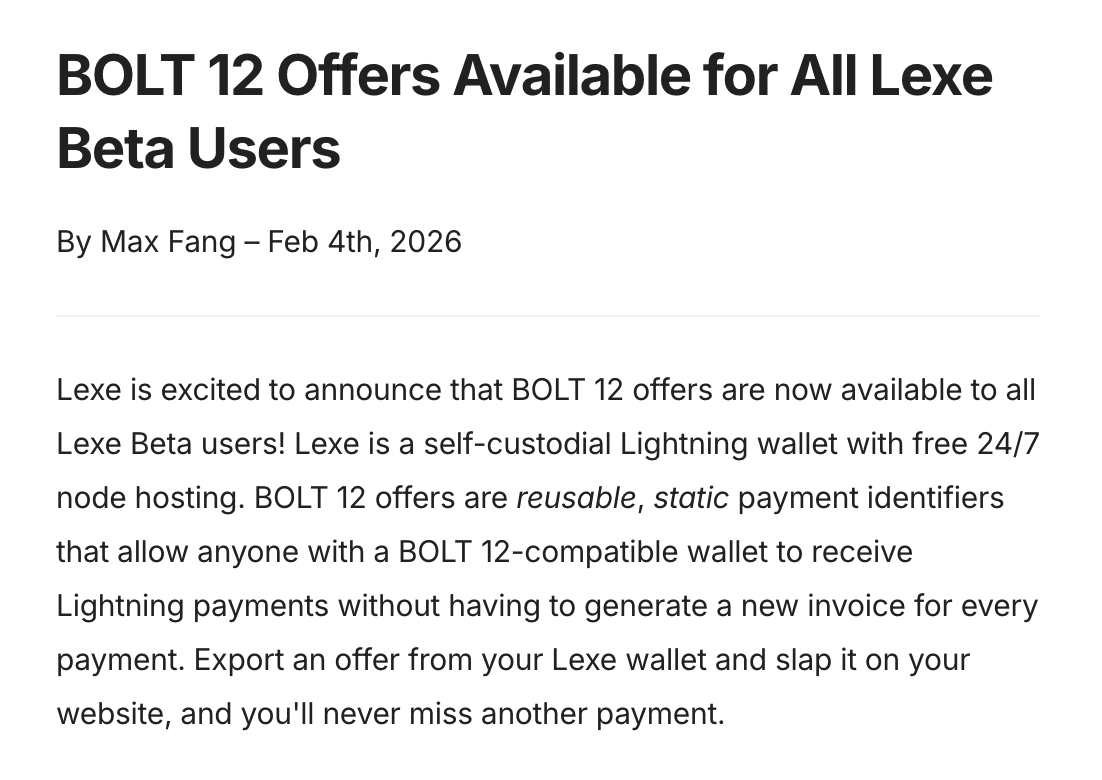
Lexe would not be complete without BOLT 12. We are excited to launch BOLT 12 offers to all Lexe Beta users, which properly showcases the incredible power of Lightning in TEEs running 24/7.
See below for the blog post and beta access instructions. 👇
Re the 2nd part of your tweet:
G7 specifically had a really interesting flywheel built around revshare for stakers (citizens pool). G7 really wanted to lean into the DAO/community owned and led direction and this model matched that direction.
~25% of TGE staked which was pretty decent but could have been better. There was a $1m initial citizen pool, we thought that this would bring in a lot of net new buyers/stakers but it didn’t (we made some adjustments and had planned a significant adjustment that was more sustainable). We had almost a dozen confirmed campaigns going into TGE and the plan was that these campaigns would refresh the citizen pool to keep the flywheel going but shortly after TGE almost all of the projects we were working with either decided to pause TGE if they had the capital, or cancel it entirely and just shut down because they ran out of funds given that gaming ~6 months ago when we TGE’d was just starting the big unwind we’re still seeing today.
So lot of things hit at the same time, we distributed a large % of tokens to the initial community who wasn’t aligned with our mid/long term vision (that’s fine, we knew it was likely to happen), we built tools and a platform that relied on 3rd parties to use them to generate revenue (less fine as this aligned our success or failure almost entirely with others), gaming became a graveyard and retail interest hit all time lows and thus a lot of projects shut down or hit pause (we didn’t expect it to be this bad and that was a mistake, so many gaming projects to be optimistic about and none really panned out), and honestly we tried to do too many things which made us not agile enough to correct course quickly and were too big to weather the storm for the next 1-2 years without making large changes. Any of these things by themselves was correctable, but all the mistakes together led to hard choices having to be made ie a full rebuild from the ground up, otherwise the option was slow bleed and hope something changed or we could figure out how to fix web3 gaming or develop an entirely new gaming product that changed the current trajectory of the space which seemed… ambitious.
I guess to answer your question directly, we had a lot of really positive feedback from advisors, partners and community members every step of the way which made us more confident. It wasn’t that hard to imagine the flywheel working: a massive community that engaged with gaming projects, gave them a platform and tools to help them succeed, and shared in the rewards that those successful projects distributed to G7 as a community. Campaigns and direct rewards were the hook for new members, and staking + citizen pool brought people further into the ecosystem for mid/long term alignment. It was a real model, with many other projects committing tokens and $ to making it continue to work because they found it valuable. But it didn’t work out for the reasons listed above and a few others. The plan wasn’t TGE and hope for the best, there were a lot of things lined up and a lot of fallback plans. but the mistake was planning TGE and not planning for the worst, or seeing the shift and making radical adjustment early enough I suppose.
They’re a tool to fast track and sometimes a very effective one. Challenge is, exchanges like to list projects that are fresh/current to maximize new traders signing up and the value they can generate from listings so it is very hard to get listings after TGE. The meta before tier 1’s shifted to TGE listing and thus P2A came about, was to list on a DEX, show volume, community engagement and price support, work up to T2 exchange listings and then at a certain point apply for T1 (there were exceptions for very large projects obv but now the exception has become the preferred path). This was much healthier imo and gave projects a lot of time to refine and grow more organically. That doesn’t really happen anymore which is unfortunate, and as I’m sure you’ve seen, projects that only do DEX listings are perceived as DOA with little hope of further listings. TGE is the one time projects have a little bit of leverage with top exchanges but tbh it’s very one sided. Won’t go into further details here but the process is pretty broken imo.
Few questions that might be illustrative:
How many projects have been wildly successful without T1 exchange listings in the last 1.5 years? Access to significant buyers is still very much controlled by CEXs. Meme coins were a way to take back some control and have a more fair distribution and access for the average person but are generally captured by organized groups looking to extract from retail at this point (similar to NFT mints, and ICO’s before them). And even then, top meme coins really took off once they got big enough and were listed on a T1. I do think there’s a bit of chicken and egg here in that exchanges list already successful or likely to be successful projects which helps reinforce their role as a king maker of sorts but like it or not, most people buy and sell on CEXs.
Have you ever looked down cmc/Coingecko and thought, wtf does this token even do and why is it worth billions? So many old coins are still worth hundreds of millions or billions with great volume but the project has been functionally dead for years but since they have distribution on every exchange they are a useful financial product even if they are a dead project (traders vs. users). Several recent coins have done really clever financial engineering leveraging exchange listings to succeed without much substance ie low float/high FDV and leveraging that into a cult following. Quite a few others have tried that same approach and still had price go down significantly. Like it or not price informs narrative. User + trader interest gives more optionality so why not try to maximize both?
Throughout the different cycles there has been a wax and wane of centralized and decentralized methods of distribution, and I think we’re going to start seeing the pendulum swing the other way with more clarity and openness to doing ICO’s etc. but time will tell.
Much more holistic take in the G7 post below. Lots of mistakes that led to G7’s failure elaborated there. Tl;dr KOLs are not by any means the reason for the failure of G7, that’s firmly on myself and G7 leadership. Mainly wanted to spotlight some of the nuance when it comes to community building and false positives on traction and momentum many projects struggle with.
I don’t disagree it’s been discussed for years but that doesn’t change the fact that almost every project in Web3 is still doing it. Hopefully by openly discussing, it can help others avoid the same pitfalls.
Distribution is a powerful and useful tool when used correctly, but when used incorrectly or too early it can be problematic. Shortcutting vs amplifying. KOLs, exchanges, rewards/incentives etc. are all tools, but there is a bit of perverse incentive that all of these tools have their own economics that are often at odds with those using them. Everyone wants to make money and isn’t going to say “it’s too early, don’t engage us to amplify” or “don’t give us a ton of $ and tokens to list you” or “don’t give me and the rest of the community rewards/free money”. Only when the music stops will the 20/20 hindsight begin. It’s easy to get caught up in all the false positivity, this is a hard lesson.
What’s interesting is Game7 had a platform to host campaigns for other web3 gaming projects so we gained a lot of insight into the wants, needs, and focus of web3 gaming projects. Twitter campaigns (likes/retweets/followers/KOLs etc.) was almost always one of the main requests from projects that wanted to work with us. “Big numbers” in engagement was the core metric for both social and game play. I know this doesn’t make sense, and so did many of them, so why did it keep happening?
Since you position KOL ROI as an open secret, it’s worth drilling down even further. Exchanges want to see big numbers in order to list and this was one of the biggest driving factors behind the P2A and KOL push. With this meta, it was taken to the extreme with almost every project touting “millions” of users.
When having listing discussions, big numbers are put into context of every other project. If most of the other big projects are engaging bots, KOLs and other growth shortcuts it’s a forcing function on other projects to do the same or have less options and seem less competitive.
Few interesting anecdotes from this period:
1) I have a friend that built a platform with robust anti Sybil/botting tools, many of their clients actually requested they not implement them as it would make the numbers smaller. Once other projects who used the platform saw that they had smaller numbers than others, inevitably almost all clients did away with anti botting protection. They all wanted their numbers to be the biggest.
2) I know several founders that made it very hard to bot their platforms and because of this blocked millions of bot registrations and ended up with hundreds of thousands of users rather than millions. Because they were being compared to projects with “millions” of users and exchanges assumed every project has 90% botted numbers, their user base was discounted by 90% as well and they weren’t considered for listing. Several of them ramped up growth tools, took off bot protections and with much bigger numbers were taken much more seriously for listings.
As much as Web3 tries to reinvent the world, there are many things that will always hold true. There’s no shortcuts to success, and real PMF is the key. As long as exchanges are seen as a/the primary route to success, and they focus on # of potential new traders as their primary listing metric, project communities will continue to pressure founders in that direction and tools such as KOLs will continue to be in high demand. Show me the incentive and I’ll show you the outcome.
Cut through the noise and build something real; not a new or uniquely web3 problem, but a lot of the structures in place make it more confusing.
When we started Game7, we had a mission: help Web3 gaming succeed by actually listening to developers. We didn't want to just take a "build it and they will come" approach: we wanted to solve real problems developers faced every day.
We built tools we believed in: Summon for user acquisition and retention, World Builder for Web3 game development tooling and we incubated Hyperplay for better distribution. We published unbiased research to help the industry make better decisions.
But, along the way we made mistakes:
1️⃣ We overreached, convinced the industry needed a complete gaming ecosystem. We believed more initiatives meant more impact. We were wrong. We spread ourselves too thin and lost focus.
2️⃣ Our community became misaligned as we scaled. Early on, everyone shared our vision. But growth attracted different people with different motivations, creating a disconnect between our goals and our members.
3️⃣ We relied too heavily on third-party success. Our products needed successful games to thrive, tying our fate to theirs. We didn't control our own destiny and failed to pivot to a first party revenue-generation strategy early.
4️⃣ We miscalculated the timeline. After 5 years in Web3 gaming, we're still early. We underestimated how long real adoption would take, which was detrimental to everything we built.
Many of you are frustrated with $G7 price, and so are we. Many on our core team spent 4+ years and thousands of hours building, only to watch much of the initial community airdrop be sold on day one. The price went far below expectations.
But we got some things right too: We funded people and ideas that deserved a shot. We built products that scaled to hundreds of thousands of users. We created a workplace where people wanted to stay (<1% churn over 4 years).
We swung big and believe that we have played a role in moving the industry forward, even if it is taking longer or didn’t have as big of an initial impact as we had hoped. And most importantly we preserved runway, and made hard choices early enough to give us years, not months, to figure out what’s next.
Today, we're putting Game7 as you know it on pause. We've cut our burn rate to a minimum, leadership took significant salary cuts, and we had to part ways with many extraordinary people we'd recommend to any team in the space.
Additionally, we are sunsetting G7 Network until we find the right use case. There will be more info posted shortly on what the chain migration will look like and you will all have plenty of notice to bridge out any assets still on G7 Network.
All founders and the foundation are extending token unlocks by 12 months. We haven't sold a single token and won't for at least the next year.
As for next steps: we are exploring. Our priority is building a revenue-generating business with product-market fit. We still believe in open economies, digital sovereignty, and games as places for community.
For now, we will be heads down figuring out what’s next and this will take time. For Game7 to succeed, it will likely need to be rebuilt from the ground up.
Thank you for believing in us.
@primesolana_@yellowpantherx It’s a question for everyone. Was hoping as a web3 gaming ambassador to several communities you had some interesting insights.
Not what I said at all, but the last 12 months successful airdrops have been few and far between. As an industry we should try to figure out why. Pudgy is a great example of success, Pudgy community and team is S tier for sure. I have a lot of thoughts here but would love your take: what did pudgy do differently than all of the other tokens that have failed?
Totally agree, G7 tokenomics sucked. Total fail to be sure. What’s challenging is pre TGE everyone was extremely positive about the tokenomics and advised to do a sizable airdrop. But lesson is that unless there is a huge net buyer post TGE everything rn is trending to zero, bleeding to majors, new coins, and DATs. Currently the successful metas are:
1) airdrop a tiny amount and do buybacks (low float / high FDV) and give yourself time to hopefully figure out what’s next or
2) build something that generates a ton of revenue and buyback massive amounts (Hyperliquid/Pump). Would love to see other models that work but that’s the reality.
Totally agree. There’s an important nuance here though: if Google brought in people who say all the right things, and do all the right things because they are expecting to make money off of clicking buttons and being positive good community members, that would muddy the waters of PMF a lot. That’s why I’m a huge proponent of organic growth only until clear and strong PMF now, there should be zero incentives given out or KOLs used until then as it’s just a distraction and takes you down incorrect paths. Everyone praises a project as the future and the team as geniuses when they’re expecting an airdrop. Hard lesson but an important one.
Such a straw man. You invested and didn’t sell, but how much did you get paid advising? Maybe some misalignment there. I get the virtue signaling angle but it’s just a distraction. You’ve work/worked with dozens of web3 games and they are all dead or dying. Game7 attempted to build a community, tooling, and distribution for web3 games but with none succeeding, making the choice to wind down and hard pivot entirely was would crushing but needed.
I don’t think it’s any single reason, person or community who is solely responsible for this trend, but there are dozens of reasons and the sooner we come to terms with them and address them directly the better we will be as an industry. KOLs and Web3 gaming as a whole are going through a reckoning and it is much needed. Unsustainable systems are unsustainable. Myself and Game7 fully own our part in it and all the mistakes we made. Clearly we all need a better model.
1/ @Stripe just pulled back the curtain on @tempo, its corporate blockchain, and the pitch is a classic. You get an all-star team, state-of-the-art tech, an impressive roster of partners—including one of the card networks the whole thing is designed to replace—and "neutrality."
@jconnorholliman@base@baseapp@itamardvir is the ideal person for this
✅ Obsessed with being onchain
✅ Incredible community builder
✅ Legendary at support and systems