#BILD macht's möglich: Der "Journalist" nicht nur als Freund und Helfer israelischer und ukrainischer Faschisten - nun auch als ideologischer Scout von Menschenjägern.
I am often asked, "isn't there a chance Trump had some ideas or good intentions upon taking office?"
Answer: No - there is zero chance Trump had any relevant ideas or ambitions of his own coming into office.
Elected officials in the US hold zero power besides rubber stamping policy put in front of them, selling it to the public, and/or creating drama to distract public attention away from policies.
Trump was/is no exception.
This is why I correctly predicted even before his first term in office he was going to be 100% committed to continuity of agenda.
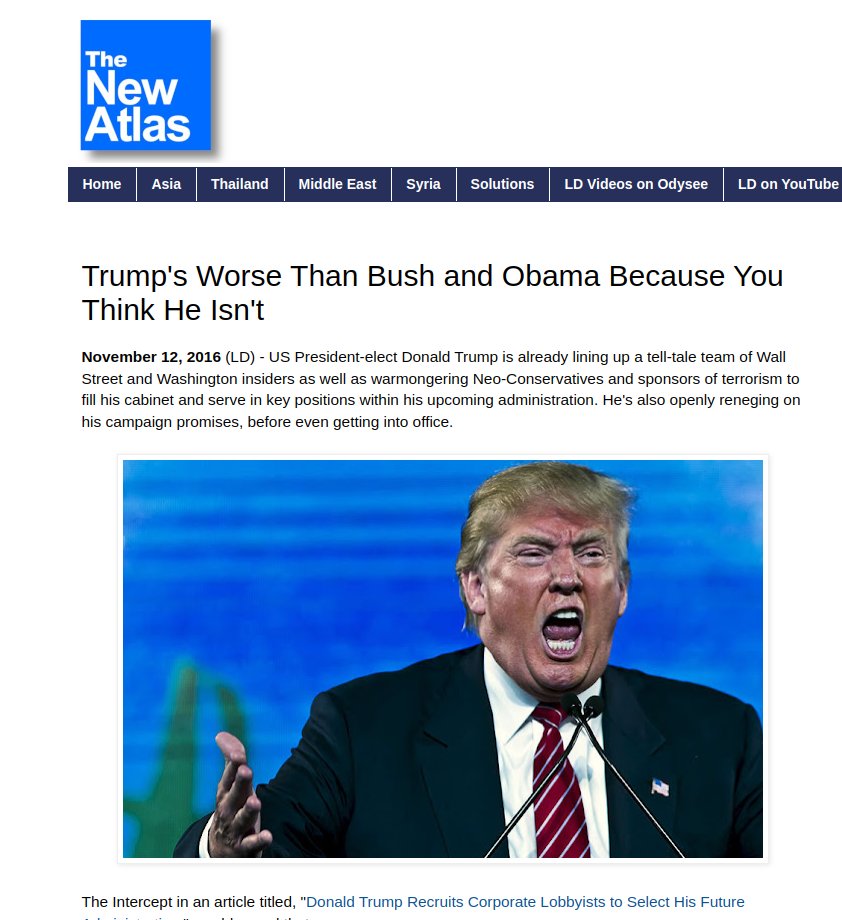
This was a warning back in 2016 before Trump's first term in office: https://t.co/EZ0lZdghlE
I also warned about Obama in 2012 before he started his second term: https://t.co/cl5eZb3DNF
Do people think it is "luck" that I'm always right about this - or are they ready to at least consider Western politics are a layer of orchestrated control rather than one of "self-determination" or a means of "change?"
(Note: before I started doing videos I wrote under several pen names including "Tony Cartalucci" just in case anyone was wondering why my name isn't on these articles).
Retaliation Targets: Iran Lists Sites That Would Trigger a Major Global Crisis
Rumors indicate that Trump, together with Netanyahu, is preparing to resume intense bombing of Iran, this time focusing heavily on civilian infrastructure.
Iran, for its part, has released a list of targets that could collapse the economies of Israel, Jordan, and the Gulf states if it is attacked.
The United States and Israel appear to calculate that the operation will be so intense that the Iranians will be unable to do much more than they did during the previous 40 days of war.
Netanyahu is confident and is already breathing the possibility of his own political survival.
But what about the Gulf countries? Trump and Netanyahu tried every available means to drag the GCC states into their war, without success. With the proven exception of the Emirates, these countries limited themselves to political pressure.
Trump used the period of relative calm to pull Israel back from the front line and work on bringing the GCC into the conflict, still without success.
Continuous and simultaneous operations by the Gulf states against Iran was the second front Netanyahu and Trump dreamed of. It has not materialized. It has not materialized yet, because the Iranian target list will hit the populations of these countries hard and will once again pressure their governments to reconsider that decision.
The truth is simple: the greater the destruction, the smaller the chance of future reconciliation, and the higher the likelihood that the GCC will pivot toward the Abraham Accords.
The list of targets Iran has threatened to strike if the coalition attacks its territory includes:
Saudi Arabia
Ras al-Khair complex: one of the largest hybrid power-generation and desalination plants on the planet.
Shuaiba plant: a mega-facility on the Red Sea coast.
Jubail complex: a vital cogeneration facility that supplies the capital, Riyadh.
United Arab Emirates
Jebel Ali complex (Dubai): a massive desalination and power plant located near the port.
Taweelah complex (Abu Dhabi): a large reverse-osmosis desalination plant.
Fujairah F1 / F2: critical installations on the country’s eastern coast.
Barakah Nuclear Power Plant: included on maximum-retaliation lists.
Kuwait
Doha West complex: the massive plant that supplies the majority of Kuwait’s electricity and residential water.
Bahrain
Integrated coastal water co-generation plants that supply the island.
Qatar
Ras Laffan complex: the main industrial hub for processing, power generation, and LNG exports.
Jordan
Water-supply infrastructure: included because of the country’s logistical cooperation with Western forces.
If these targets are hit, they will trigger an economic, social, and environmental crisis across the region, a scenario I am not even capable of fully imagining.
By a bitter irony for Netanyahu, a successful Iranian strike against the listed targets in Israel, which are few, would also paralyze Israel’s basic functioning, producing an immediate systemic collapse of its electricity, water, and economic networks.
Continue reading:
https://t.co/WylTLIReb2
Ich weiß, als Marxist hätte ich zynisch & abgeklärt zu sein, aber wenn ich die letzten fünf Jahre überblicke, bin ich doch von der Geschwindigkeit überrascht, mit der hier alles in Richtung Barbarei marschiert.
As I’ve been saying for a while now, the war never actually ended. It was just a truce to ease economic pressure and restock arsenals. The decision makers are under heavy pressure.
By all accounts, it is about to resume with new fronts and more players, an escalation I’ve already warned about in my articles.
Fasten your seatbelts, because if no one can cool down the tensions, we’re going to see something on a much bigger scale than what we've witnessed so far.
https://t.co/P6RN2eyQzB
US plans for destroying nations like Russia, Iran, and China have been publicly published, talked about, and implemented for decades.
Politicians do not make these policies. They simply sell it to the public or distract the public away from these policies.
Multinational multi-billion dollar corporations don't sit there every 4-8 years leaving their future/fate and US policy to "voters" and the clowns they pick for office.
Instead they have created a political system to serve as an "explanation" for and/or a distraction away from their own continuity of agenda.
Corporations fundamentally pursue the maximization of power and profit - and therefore their collective agenda driving US policy is to maximize US power and profit - hence endless exploitation at home and hegemonic war worldwide no matter who you vote for.
This should be beyond commonsense.
But instead of understanding this as the fundamental nature of the US system and going on from there - people cannot help but to indulge in the daily political circus and attempt to cobble together fictional narratives to explain why "Obama" or "Trump" or "Biden" are doing the things they're doing - essentially continuity of agenda - without actually acknowledging continuity of agenda itself and the real interests driving it.
Instead, the "reason" Trump is continuing wars the corporations have planned and implemented for decades is because "he's blackmailed" or "has bad advisors," or "lost his temper" and not because the US political system is a deliberate system of control rather than a process of self-determination.
If you understood continuity of agenda and that unelected corporations drive it - BEFORE the 2024 elections you would have known these wars would continue and others would be started - just as they now have been - regardless of who won.
These people ignoring continuity of agenda and doing "analysis-by-official narrative" or "analysis-by-political party" are constantly wrong precisely because of this.
They are the same ones who said Trump would end all these wars in the first place (simply because he "said" so) or that Iran "won" and the US would leave West Asia (because the Western media suggested it), and are still looking for reasons to explain US policy in terms of "Trump," his "emotions," and the circus performed by him and those around him and even those "opposing" him.
And because they are doing this - they will continue to be wrong.
Truth is arrived at through first principles and scientific analysis and an understanding of material reality.
Like a math problem, if you don't get it right from the very start - everything you do onward will drift further and further from the right answer.
Go back to the beginning and start over until it all actually adds up.
Demokratie ist eine Herrschaftsform. Sie funktioniert bestens darin, die Untertanen ihre Unterwerfung akzeptieren zu lassen und zwar in der Wahnvorstellung, ihre Bedürfnisse kämen in eben dieser Herrschaft zu ihrem Recht.
Wenn der Dings wiederkehrt, wird er nicht sagen...
Welch Ironie, vor paar Tagen erst mit so einem Jugendantifa Song die deutsche Öffentlichkeit zu provozieren.
Popular (and independent) Russian milbloggers Shiryayev & Shiryayev write that Kremlin’s response to Ukrainian deep strikes will at the first stage include lifting humanitarian self-limitations on strikes in Ukraine (happening now) and then proceed to all-out hybrid war against Western targets across the globe (they primarily mention vessels).
Analysing Ukrainian strikes, the bloggers point out random, non-strategic targeting, as in shifting to lower-value targets like online shopping storehouses after higher-value targets like oil refineries.
Then comes this passage: “The strategic plan of bombardment is not aimed at collapsing the Russian economy, but at creating a social and political crisis. The Ukrainian leadership, many NATO leaders and Western journalist believe not just in lowering [Putin’s] ratings but in the literal possibility of a new February 1917 revolution and the fall of the current tsardom. This calculus is hopeless”.
I’d add that although the calculus indeed appears to be based on madcap illusions, it all starts to make sense if you presume that lobbyists promoting it are interested in the conflict per se, not in any particular outcome, like Ukraine’s victory or even self-preservation.
Houthis launch missile salvo against Saudi oil facilities
Saudi Arabia struck a Yemeni port area yesterday. The outcome was entirely predictable: Houthi forces responded not with a single missile, but with a salvo of at least five ballistic missiles against the Aramco complex in Jazan, on Saudi Arabia’s Red Sea coast, followed by another wave of missiles and drones targeting the Khamis Mushait military base.
In a statement, Yemeni forces called on workers at Saudi ports to evacuate immediately. The declared targets include the ports of Jeddah, King Abdulaziz Port in Dammam, King Abdullah Port, King Fahd Industrial Port, Yanbu Commercial Port, as well as Aramco facilities and refineries.
In response, the Saudis launched strikes on the Yemeni capital, confirming that the escalation is now underway.
The Saudis and Yemenis had maintained a fragile truce that somehow held throughout the entire period of the US-Israel-Iran war.
To prolong the truce, Riyadh even maintained a financing arrangement with the Houthis that included cooperation against piracy off the Horn of Africa.
This escalation against Yemen places Saudi Arabia in a vulnerable position with much to lose, whereas the Houthis have very little at stake, having grown resilient through years of continuous rebuilding.
The Houthi ballistic arsenal spans from tactical rockets to long-range strike weapons.
At its core is the Burkan series, a lineage derived from the Iranian Qiam-1 and classic Scud with a range of 800 to 1,200 km. For strategic reaches, the group deploys the Toufan, a Shahab-3 derivative approaching a 2,000-km radius, and the newly unveiled Palestine-2, a solid-fuel, two-stage missile built to strike targets beyond the 2,000-km mark. Complementing this, they have the heavy Zelzal-3 artillery rockets, which are increasingly upgraded with precision guidance kits.
In cruise missiles, they operate the Quds series, compact turbojet-powered systems based on the Iranian Soumar/Paveh design, with ranges approaching 2,000 km and modern navigation.
We are talking about an arsenal of roughly 1,000-1,500 missiles assembled in Yemeni facilities with Iranian components.
Full article:
https://t.co/sKvvqriUK5
The exchange of Fire
Just as American attacks degrade Iranian defenses in preparation for future operations, Iran is currently using a mix of older missiles and drones aimed at striking U.S. targets while also depleting American interceptor stocks.
This week, after decades out of service, the United States was forced to use aging PAC-2 interceptors, a clear sign of the chaotic state of its interceptor inventories.
Interceptor production is slow, and global stocks are in no condition for large-scale reallocations.
But is the production, refurbishment, and upgrade of Iranian missiles moving at a much faster pace?
This is the decisive factor for what lies ahead.
I would say yes, the Iranians are ahead. The Americans and Israelis will try to compensate by bringing in NATO ships to assist with interceptions. That should add no more than roughly 200–300 additional interceptors.
Even so, the Iranian arsenal will continue to pose a serious problem for interceptors in certain areas.
Destroying Iran’s Infrastructure Is a Hard Task, and There Are No Effective Means to Do It at Scale
In many countries, striking the power grid would create immediate chaos and constitute a terrifying threat. In Iran, however, the task is far more difficult.
The Iranian electric grid is one of the most decentralized in the world, with around 130 to 150 large power plants, primarily gas-fired thermal plants.
No single facility dominates large portions of the country’s electricity generation. The largest plant, Damavand near Tehran, has a capacity of approximately 2,868 MW, only about 2.9% of total installed capacity.
Other major plants, such as Shahid Salimi Neka, Rudeshur, Kerman, and several hydroelectric facilities on the Karun River (including Karun-3), range from 1.6 to 2.2 GW each.
Even combined, the five to ten largest plants account for less than 15-20% of total capacity. The rest is spread across dozens of smaller and medium-sized facilities.
When these medium-sized plants and small distributed power stations are added, the total number of generation points connected to the national grid exceeds 1,000.
This forms a highly decentralized system explicitly designed to withstand high-intensity conflict.
To effectively paralyze Iran’s electricity supply, an adversary would also need to target the transmission and distribution network, which stretches over 133,000 kilometers, and exceeds 1.3 million kilometers when rural and urban lines are included.
Adding Iran’s oil and derivatives infrastructure makes the challenge even greater. This sector includes approximately 350 to 400 main facilities distributed among processing, storage, and export units.
These comprise 9 main refineries, 66 drilling platforms, and more than 10 large complexes, occupying a combined area of over 500 km² spread across Iranian territory.
To obliterate both the electrical and oil sectors, multiple waves of missiles and guided bombs would be required against each of these targets. We are talking about 6,000 to 10,000 projectiles, attacks that would take weeks.
The ammunition simply does not exist in the American arsenal available today, except for short-range bombs. Those short-range bombs would force aviation deeper into Iranian airspace, significantly increasing aircraft losses.
Even if such an operation were attempted, it would almost certainly be followed by Iranian retaliation that could leave the Gulf in the dark, with refineries burning across the region.
Read More:
https://t.co/Z829aD73JO
Germany and Britain are evacuating their diplomats from Kuwait, Bahrain, Qatar and Saudi Arabia. The US has advised its citizens to leave the Middle East region. A lot of indications that massive escalations are being prepared.
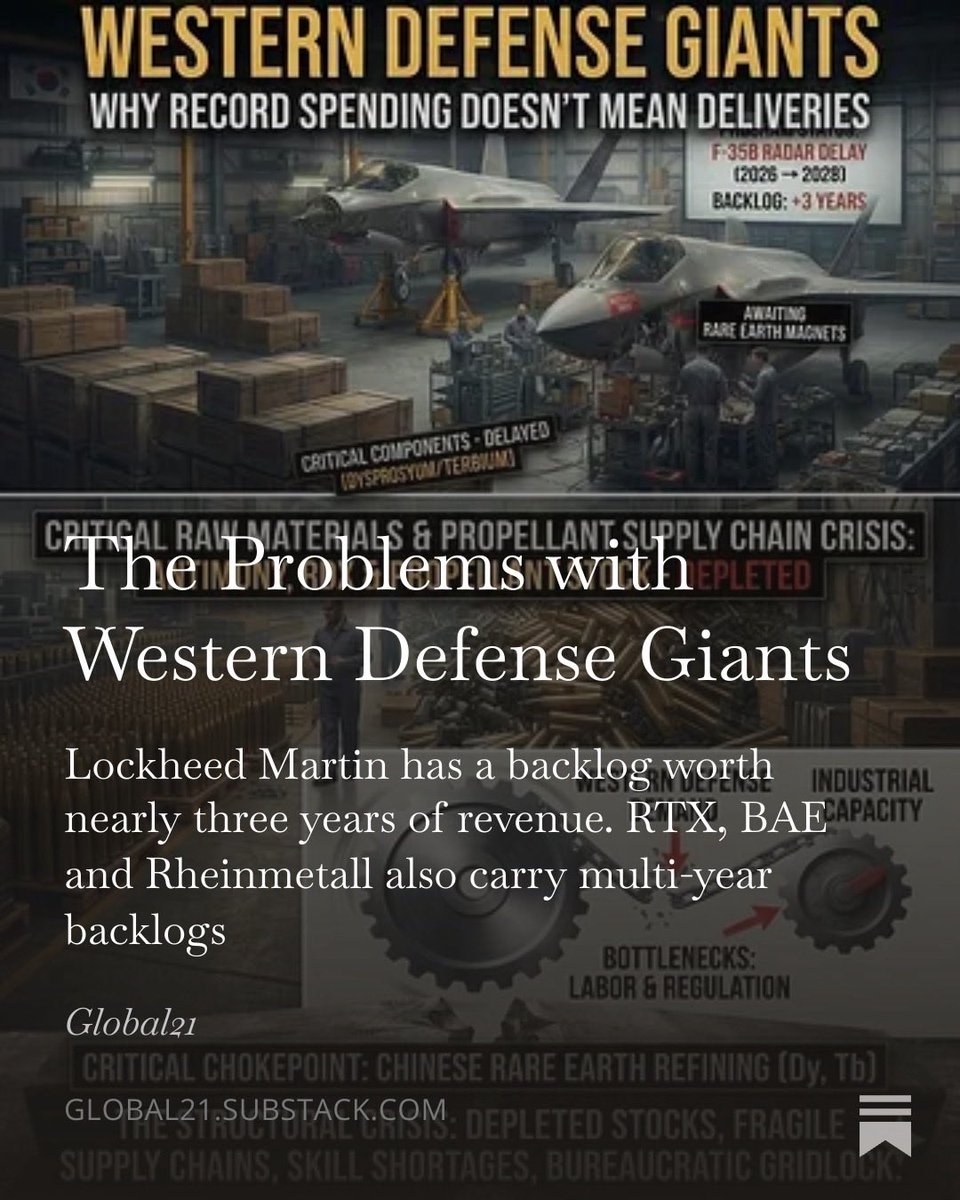
The Problems with Western Defense Giants
With the wars in Ukraine and the Gulf, defense spending in the West surged and order backlogs hit record levels. Hundreds of new contracts were signed.
On paper, everything looks strong. In reality, turning those contracts into delivered systems is proving extremely difficult. Multi-year delays are now the norm.
Demand for air defense missiles, guided munitions and artillery shells exploded. The industry still had large undelivered backlogs from Ukraine and simply added more contracts on top.
The same supply chain bottlenecks that already existed did not disappear. China, seeing the vulnerability, tightened export controls on critical minerals in response to Western sanctions and tariffs. More paper signed. Even longer delays.
During the Cold War the West controlled key mineral mines, had multiple competing suppliers and worked with large strategic stocks. A new fighter or armored vehicle took five to seven years from design to delivery.
After 1991 the Pentagon cut budgets and pushed consolidation. The U.S. went from 51 major independent defense suppliers to five giant primes, and similar concentration occurred across the entire Western industry. Rare earth processing and many critical components moved almost entirely to China. The industry adopted civilian Just-in-Time practices and got rid of strategic reserves.
Today major programs take at least twelve years. The ecosystem has become an oligopoly with high margins and very little flexibility. Four structural problems explain why.
1. Dependence on Chinese rare earth processing
Mountain Pass was once the world’s largest rare earth mine. Now the West depends overwhelmingly on Chinese refineries for separation and purification. One missing element as neodymium, dysprosium or terbium, can stop billion-dollar programs.
2. Extreme consolidation + Just-in-Time
When there were dozens of suppliers there was redundancy. Now if one subcontractor fails to get material or components, the F-35 line stops. The lack of strategic stocks of steel casings, RDX or propellants turned artillery shell delivery times from months to two-to-four years once demand spiked.
3. Skilled labor shortages and heavy bureaucracy
Security clearances and specialized skills are scarce and audits, contract changes and ITAR rules take months or years even in wartime. European projects like FCAS are already late before production starts. The West built so many rules that the system struggles to function under real pressure.
4. Technological complexity
Modern weapons depend on software, sensors, microchips and tight systems integration. They are far more fragile and slower to produce than the analog systems of the Cold War.
Read more:
https://t.co/iLg2wES4YO
Berlin: 1st time since WW2 production of artillery shells+bullets in a former auto-parts plant.
Berlin protests, but is faced with a corrupt government + violent police.
These fine folks blocked the plant, for a bit!
#RheinmetallEntwaffnen
Video: IG demokratischejugend.b
🇷🇺 Russia’s political leadership has officially acknowledged that the special military operation has escalated into a war against NATO countries providing military aid to Ukraine.
Moscow’s retaliatory actions represent a move up the escalation ladder:
- Strikes against Ukrainian infrastructure used to launch means of air attack on Russian territory;
- The potential extension of strikes to the territories of countries producing components for Ukrainian means of air attack.
Indicators that this step is being considered include public leaks from the Russian Ministry of Defence containing lists of potential targets in NATO countries, as well as President Putin’s instruction to analyse the extent of the alliance’s involvement in the conflict.
Strikes against NATO countries could lead to one of two outcomes: either a direct military confrontation or a deep rift within the alliance due to a lack of consensus over whether to enter a war with Russia.
The second scenario is more likely.
European NATO members are not prepared for a war with Russia without US support and are keen to secure American military protection for the next ten years.
At the same time, Washington has no interest in a thermonuclear war, the outcome of which would be predictably catastrophic for the United States.