JUST IN: Plaintiffs in the lawsuit to restrict ICE’s use of force in Minnesota filed an emergency motion with the 8th circuit court of appeals tonight to reinstate those restrictions.
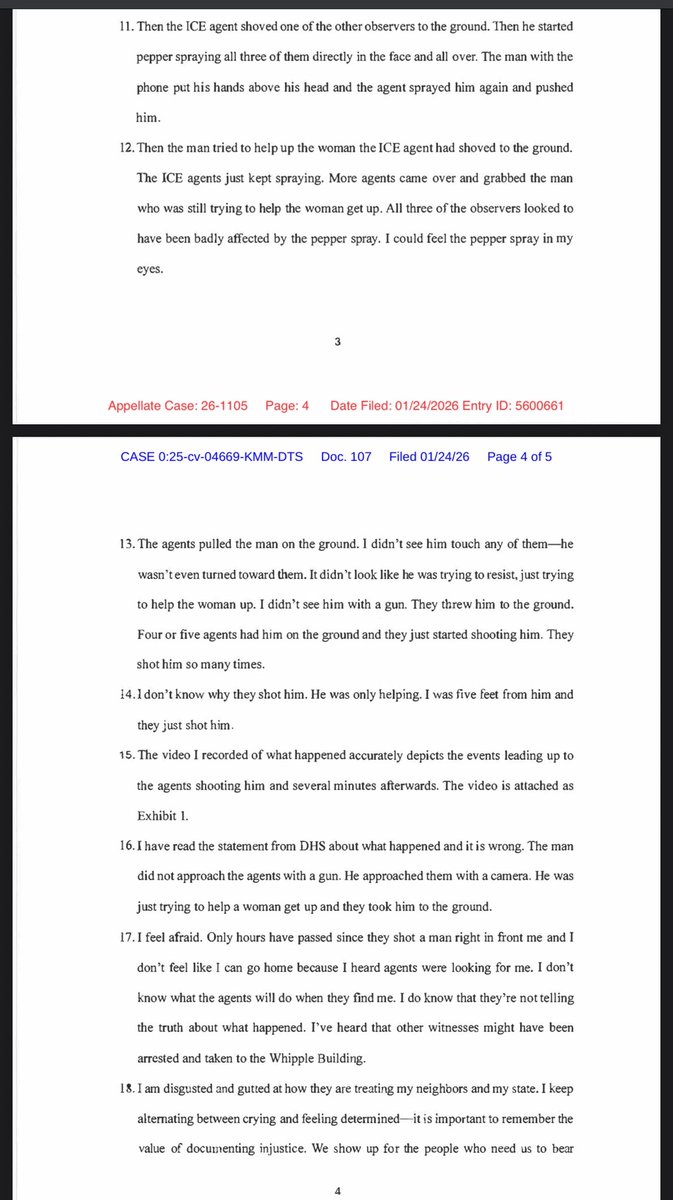
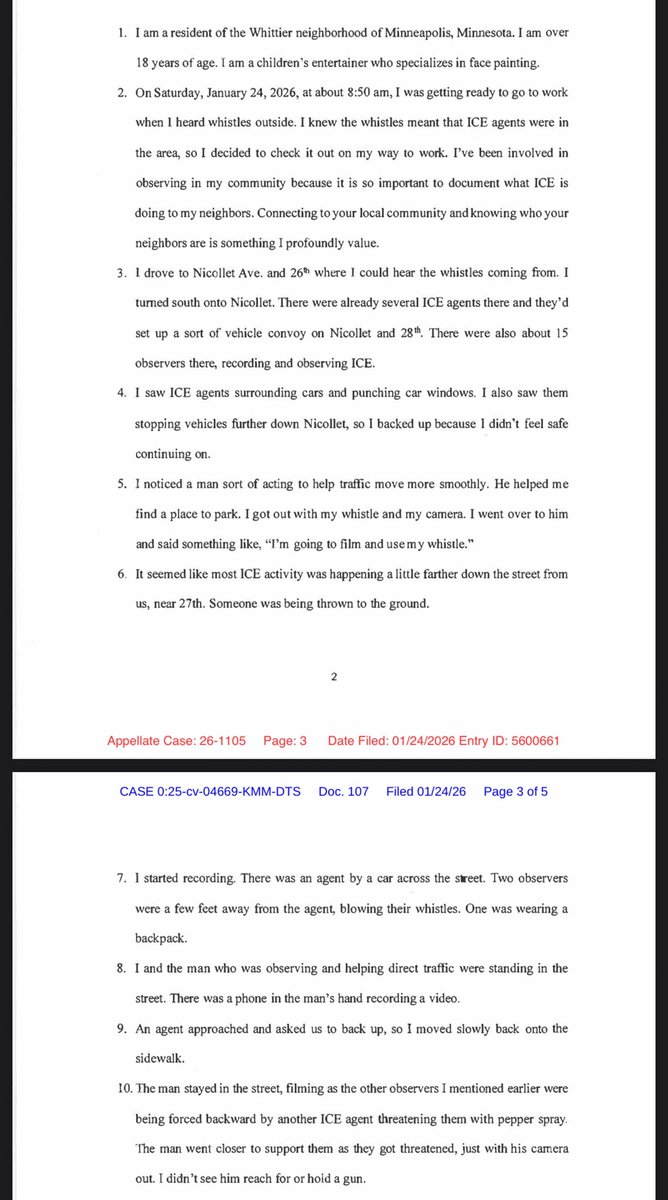
It included this affidavit from a person who witnessed today’s shooting:
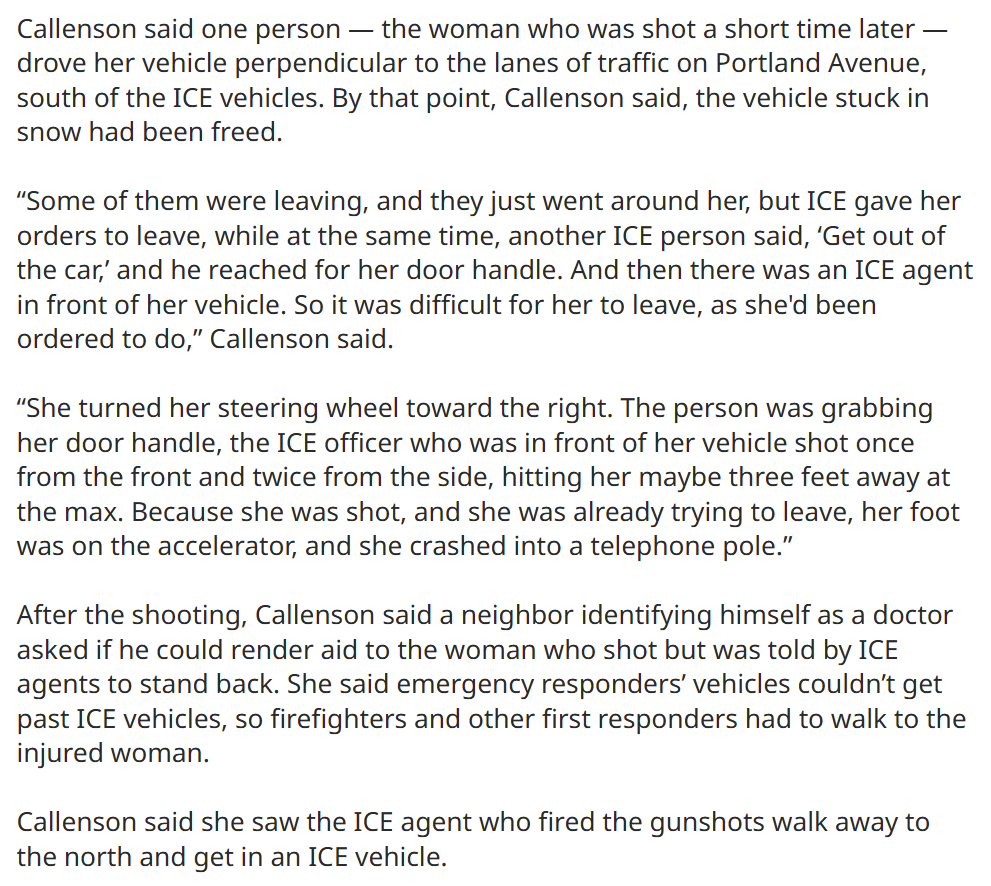
According to another eyewitness, ICE gave the woman they killed contradictory instructions, then aggressively surrounded her vehicle. One told her to leave, then as she complied, another tried to open her car door & told her to get out of it, while the killer got in front of her.
1/ On Measuring Network States
Do they exist?
What are the conditions of success?
And why those conditions are: decision-making ability, dGDP and NFTs?
2/ @balajis popularized the term so we can start with his definition
“A network state is a highly aligned online community with a capacity for collective action that crowdfunds territory around the world and eventually gains diplomatic recognition from pre-existing states.”
3/ Some design features he thinks are relevant: "moral innovation" (mission), on-chain metrics, crypto-native, non-contiguous jurisdiction, forkability.
4/ I am not going to attempt to summarize all his views here (he wrote a whole book about his views that you can read)
I have some quibbles on the margin (e.g. maybe “network society” is more accurate and would not trigger pedantic reactions about the definition of a “state”) but, for today, these don’t matter.
We take his concept and build on it.
5/ First, do they exist?
Well, pre-crypto network states definitely exist.
Take the Catholic Church. It has a moral mission, it coordinates globally around that moral mission, it acquires fragmented land, and the Holy See has earned some form of diplomatic recognition.
It has also found an accommodation with classic nation-states in most parts of the world (“Render unto Caesar”), that I think is a useful analogy.
6/ Of course, the Catholic church does not meet his definition because it is not on-chain and crypto-centric.
So what network states exist today? I am not sure tbh.
7/ There are startup cities like Prospera and Praxis but they are too focused on one physical location to meet my definition.
There are a variety of DAOs trying to do things but they mostly do not strike me as overly ambitious.
You could stretch the definition and say the “Bitcoin or Ethereum community” but I think this is not how people see it.
8/ At a first approximation, it is mostly an idea or rallying cry at this stage. It is a good idea and it is an inevitable idea. It is the type of idea that can only exist 5-15 years after crypto-based smart contracts exist, not before.
9/ The version of this idea I am interested in adds another condition – it needs to be decentralized, permissionless, uncensorable, nation-state resistant.
Call it a decentralized Network State, or a civilizational Network State, if you like.
10/ So, there may be many Balaji-style network states in the broad sense. I am talking about the much smaller subset that matters as a civilizational counterweight in an AGI era.
11/ what I mean by this is:
a/ BTC- and ETH- level resistant
b/ no single jurisdiction whose policy change can end the project
c/ no person or small group of people who can be coerced into stopping it.
12/ This is a very strict standard. Realistically, none of the proto-network states are even close to this standard.
13/ It also means that, relative to @balajis view, I put more importance on getting the decentralized cryptographical layer right first, and then go to land. It is a trade-off – you look more trivial first, but in time it is more robust. Land is still useful, but in an adversarial world any physical node must be disposable.
14/ Forcing permissionlessness and state-resistance on this idea makes it much harder, it reduces your degrees of freedom, it makes everything slower and more painful.
Why set this condition? Because in the decades to come, with the vast centralizing arc of AGI coming our way, it will be the most important thing in the world to have a counter-balancing decentralized network that can make decisions and take actions.
15/ I am not saying that you can’t have a successful network state without this condition. If you want to make the network state for people who want to be ultra-fit or sponsor art or what have you, life is easier and more fun if you don’t bother with decentralization.
16/ I am saying the network state that may make a major impact for humanity has to have this condition, for the same reason that BTC has to have this condition.
A civilizational Network State will look like this.
17/ Condition of Success #1: You can make and execute non-deterministic (subjective) decisions in a decentralized, trustless manner
Honestly, this is the single hardest thing. It is what we are focused on at 6529 and it is, in many ways, the final frontier of crypto
18/ Crypto has invented a variety of mechanisms to make deterministic decisions in a decentralized manner (“who has what BTC?”, “what is the output of this smart contract”).
These are fine for rules-based and deterministic outputs.
19/ There are efforts being made now to back into decision-making through prediction markets.
Now mostly prediction markets are about gambling, but Vitalik seems to think they can be used for decisions (Futarchy / prediction-market governance) and some similarish ideas are behind Eigenlayer (re-staking).
These are also fine because they are also ultimately deterministic.
20/ I note all this but think about how my day goes on a professional, personal and family level.
I make dozens, if not hundreds, of decisions every day. Some of them are trivial (“where should we eat”), some of the very important (“do we approve this expansion”) and most are in-between.
21/ These decisions are non-deterministic. I do not know what the right answer is when I have taken them and MOST IMPORTANTLY I do not know the right answer AFTER I have taken them.
“was it RIGHT to eat pizza?”
“was it RIGHT to make the logo blue?”
“was it RIGHT to add a 4th production line?”
22/ I mean maybe it was a good or bad decision, but maybe also there could have been better or worse decisions too. You will never know for sure if your optimal move was 3, 4 or 5 production lines.
23/ The degrees of freedom of “who won the presidential election?” or “who won the NCAA finals?” or “how many times did DJT mention the word “great”?” are trivial.
24/ The degrees of freedom of “running NVIDIA” are almost impossible to fathom.
NVIDIA as an organization makes millions of small/medium/large decisions a day, then executes them with fallible people in better or worse ways, and nobody knows if there was a different set of decisions that would have had a better outcome and, in any case, life is path-dependent so next day sun is up and you need to make decisions based on the actual decisions you took and how well you executed them.
25/ I cannot imagine a deterministic blockchain system like BTC or ETH being of any use in “running NVIDIA” but I equally cannot imagine you could run NVIDIA with prediction markets.
a) it would be horribly inefficient – every decision would need a market of informed participants
b) it would be illiquid
c) it would 100% be manipulated
26/ Prediction markets might help on a few big questions, but they can’t be the primary coordination mechanism for millions of messy, path-dependent decisions.
27/ The fact that crypto has not had as big an impact in “real world” as we would have hoped is that crypto - fully decentralized trustless part - has not yet shown it can organize to make and execute complex, high-stakes real-world decisions.
TBH, I’m not sure you could use just the BTC network to run even a 10-year-old’s lemonade stand in a truly decentralized way.
28/ Decisions in real-life are organized on a very abstract basis:
a/ alignment: we spend decades getting aligned with society so most people, most days do not make actively destructive decisions
b/ authority: each of us has a scope of authority in which we are allowed to make decisions
c/ identity: in order for b) to work, you have to know who is who
29/ We think we have a starting point at 6529 to solving this – so far at a toy level, but in the right direction. We are curating The Memes every week using the principles in #25: alignment (shared culture), authority (TDH), and identity (on-chain, TDH-based). It’s a toy system, but it makes hundreds of subjective decisions and actually ships.
30/ Condition of Success #2: dGDP (decentralized GDP)
If you want to throw around the word “Network State”, then you need to toughen up and measure yourself by the same measure.
The measure is dGDP, namely the goods or services the network state has helped to coordinate through its substrate.
31/ If you think about GDP (regular GDP) it is also largely activity for which the state has provided the coordination substrate.
In other words it is not the state that organizes you to squeeze lemons, add sugar, sell them to your neighbors and pocket the profit.
You do that all by yourself
32/ The state however provides a substrate, a more or less functional environment for you to do that.
It is also how I think dGDP should be measured.
It is also how I think dGDP should be measured: how much revenue is generated annually by the members of the network state that would not plausibly exist in that form without the mechanics of the network state.
33/ Conditions of Success #3: NFTs
I know, I know, I know you are tired of hearing NFTs.
Haven’t I heard the 2021 bubble has burst, it is over, it is Beanie Babies, it is time to get back to serious things?
34/ Nonetheless, as tired as you are of hearing it, NFTs are in some ways the most important thing in the world and eventually you will realize it.
Everyone understands why BTC is important. It is a decentralized database of money that has impact well beyond its own network.
35/ NFTs are the decentralized database of “everything else.”
No modern society or state can run without a modern database that stores not just numbers, but words and images and even sometimes videos.
And no decentralized network state can run without that layer either.
36/ So, if you believe it is important to be able to make and execute decisions, globally, in a decentralized manner, then you need NFTs to exist, you need NFT infrastructure to exist and the stronger the better.
37/And then you somehow squint and think that NFTs are oddly the most important thing in the world or at least “the most important thing relative to their maturity and strength,” because, like, oxygen is certainly more important than NFTs but that is well-known and society is on top of it.
38/ This is why you have never heard me say a single bad thing about an NFT ever – good NFTs, silly NFTs, Grail™ NFTs, NFTs minted on Art Blocks or Manifold, NFTs minted at Art Basel for People Who Have Not Committed Themselves to Satoshi, utility NFTs, identity NFTs, NFTs with frogs, NFTs without frogs, NFTs from Very Serious Artists That Museums Like™, NFTs with butts on them, NFTs that are using the blockchain in a Very Pure On-Chain Way™, NFTs that forgot to include the image with the NFT (hello CryptoPunks) – I am in favor of all of them.
39/ So, to conclude:
a/ Network states are a good idea and there will be many of them
b/ But we need at least one civilizational level network state that cannot be killed
c/ Making subjective decisions is the final frontier
d/ dGDP is the right metric to figure out if you are doing anything
e/ NFTs, well, we always need NFTs
If you made it all the way to here, THANK YOU FOR YOUR ATTENTION TO THIS MATTER
okay this is the first time in the gerrymandering discourse I've seen an account of a fully neutral definition of non-gerrymandering that we could in principle enshrine in law: the median-mean constraint.
Enjoy your crypto gains this year and remember you can get a nice tax deduction by donating some of it to your favorite nonprofits!
We're still out here making that possible with 0 fees! 💪
I loved learning how other nonprofits are using Web3 and sharing @LifeYouCanSave’s efforts in this inspiring series! We’re proud to facilitate zero-fee crypto giving to 20+ high impact charities + work with @Gitcoin’s @GrantsStack to develop new ways to fund social impact.
# 7 - The Life You Can Save, ft. @JonBehar
✨ About @LifeYouCanSave ✨
TLYCS is on a mission to improve the lives of people living in poverty by changing the way people think about and donate to charity, identifying where donations will have the highest impact! ❤️
8/12
🎙️ This is an episode not to be missed! Our co-founders, Charlie Bresler and @PeterSinger, speak about how it all started on the Musings Podcast. Learn about the origins of our organization, sparked by the book written by Peter, The Life You Can Save.
Charlie and Peter muse about the nature of giving, exploring how personal history and psychology influence our actions towards those in need. Their conversation navigates societal norms and the concept of "diffusion of responsibility." Discover these insights and much more in this engaging episode here: https://t.co/GEB4KG6Xqn
Our cause funds make it easy to support a diversified mix of high impact, independently vetted nonprofits that work on the issues you care most about. Support your favorite cause on @Gitcoin’s @GrantsStack.
https://t.co/rcjT7x7nWo
I just donated to The Life You Can Save on @gitcoin's @grantsstack. Join me in making a difference by donating today, and check out the projects I supported on my Donation History page!
https://t.co/dryQPqbz7E
@LifeYouCanSave@JonBehar@PeterSinger 🙏
If you missed this space, definitely check out the recording! In addition to @DWSimon from @Crypto_Altruism, we were lucky to be joined by @Gitcoin’s own @BenWest- thanks Ben and Drew for sharing your insights! And don't forget to support our round on @GrantsStack!
1/2 We’ll be talking about our campaign on @Gitcoin’s @GrantsStack with an expert at using #Web3 for the common good: @DWSimon from @Crypto_Altruism. Dec 19, https://t.co/OCCp1YRp7a! Set a reminder to join the conversation!