National INSECURITY: Who really controls your elections?
Bruce Fein, Jeffrey Wernick, and Dennis Kucinich sit down to ask the questions no one in Washington wants to answer.
Monday at 12pm ET. Link in the comments.
@BruceFeinEsq@Dennis_Kucinich
Censorship is the enemy of free speech. That's why I am happy to announce that I am officially joining the free speech platform @Bitchute
Follow my account on Bitchute for all my latest content.
https://t.co/dUPs9d0pvp
If the Pentagon can invoke the DPA to strip safeguards from one company's product, they can do it to any of them. Your encrypted messaging app. Your platform's content policies. Your cloud provider's terms of service.
Bad enough that the government surveils its own citizens. Worse when it weaponizes our tax dollars to coerce private companies into building the tools to do it. Every tech company in America should be paying attention.
@reason@nickgillespie
In its standoff with AI company Anthropic, the Trump administration is suggesting that tech companies that contract with the government aren't allowed to place limits on how the government uses their products https://t.co/jKIQ3laUVe
If the Pentagon can invoke the DPA to strip safeguards from one company's product, they can do it to any of them. Your encrypted messaging app. Your platform's content policies. Your cloud provider's terms of service.
Bad enough that the government surveils its own citizens. Worse when it weaponizes our tax dollars to coerce private companies into building the tools to do it. Every tech company in America should be paying attention.
This is why platform design matters. If LLMs can now deanonymize users at scale from unstructured text alone, every platform that collects and exposes user content needs to rethink its data access policies from the ground up. Rate limits and scraping detection are table stakes, not solutions.
At @BitChute we made the decision early on not to use algorithmic content recommendation precisely because of concerns like this. The less a platform profiles and surfaces user behavior, the smaller the attack surface. The "practical obscurity" assumption was always a polite fiction. Now it's a provably dead one.
This is why platform design matters. If LLMs can now deanonymize users at scale from unstructured text alone, every platform that collects and exposes user content needs to rethink its data access policies from the ground up. Rate limits and scraping detection are table stakes, not solutions.
At @BitChute we made the decision early on not to use algorithmic content recommendation precisely because of concerns like this. The less a platform profiles and surfaces user behavior, the smaller the attack surface. The "practical obscurity" assumption was always a polite fiction. Now it's a provably dead one.
Don't miss the next session of The Fein Print today, at 12pm ET. Join Bruce Fein, Dennis Kucinich and Jeffrey Wernick. On BitChute, X and YouTube. Link in the comments.
Nature just published peer-reviewed evidence that X's algorithmic feed shifted users toward conservative political opinions. Not engagement. Actual beliefs. A seven-week randomized experiment with no cooperation from the platform.
The political direction is not the point. The point is that an algorithmic feed functioned as a belief-shaping tool while presenting itself as a neutral content delivery tool. The direction can change with a single variable update. Today it amplifies one orientation. Tomorrow another. The architecture is the control mechanism. The current setting is just a configuration choice.
What makes the January 2026 update significant is not the claim that bias was removed. It is how it was laundered. The old algorithm contained findable code. Researchers could identify hand-engineered features boosting specific accounts and political categories. The new system replaced that with a transformer trained on engagement data. But that engagement data was shaped by years of the biased algorithm. The bias was not eliminated. It was fed into a machine learning model that reproduces the same patterns while making them impossible to audit. The old system was a readable policy. The new system is a black box trained on the output of that policy. Same result. No fingerprints.
This is the Section 230 problem made visible. Platforms claim the legal status of neutral hosts while operating editorial systems that shape what people believe. This study quantifies the gap between the claim and the reality. These are not passive distributors. They are machines that manufacture opinion and call it engagement.
This is why @BitChute does not use algorithmic feeds. Users decide what they see. No optimization engine sits between creator and audience deciding what gets amplified and what gets suppressed. We made that architectural choice because we believed algorithmic curation is a control system. Nature just provided the peer-reviewed evidence.
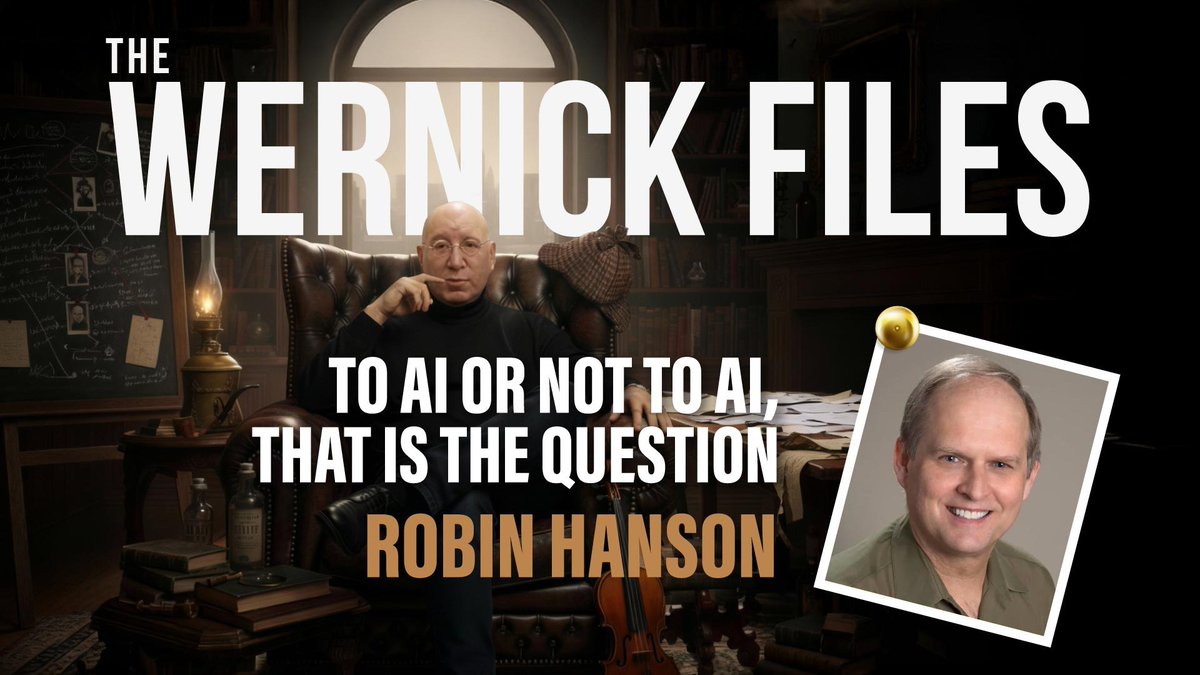
Everyone's talking about AI. Nobody else is having the right conversation about it.
The newest @thewernickfiles discussion with @robinhanson asks the harder questions:
- Is AI surveillance new or just the old surveillance problem on steroids?
- When legal systems decay, who fills the vacuum?
- What's the most robust, centuries-old fear about automation and why are we ignoring the obvious fix?
- Can a financial derivative actually insure against mass job displacement?
Watch before forming an opinion on AI.
Mearsheimer is right about the direction of pressure. When powerful interests can't control the message, they move to control the medium. That isn't about one lobby or one ideology. It's how concentrated power behaves everywhere.
And it rarely looks like a demand to delete a post.
It looks like payment processors suddenly reviewing your account. App stores discovering "policy concerns." Advertisers warned your platform is unsafe. Reputation brokers calling you extremist because you refuse to curate speech to fit someone else's politics.
The objective isn't debate. It's to make neutrality economically unsustainable.
BitChute has operated under that pressure for years. No government. No lobby. No political faction, including Israel or its supporters, has any influence over our content policies. Zero. Not because we're anti-anyone, but because neutrality means not bending to outside pressure.
We don't throttle reach to satisfy powerful interests. We don't quietly suppress speech to keep relationships intact.
That decision costs money. Partnerships. Access. We accept that cost because free speech that only exists when it's profitable isn't free speech. It's branding.
Most platforms talk about principles until defending them becomes expensive.
We didn't adjust. We absorbed the consequences. That's the difference between a principle and a slogan.
Every platform talks about free speech. The test is not what you say about it. The test is what happens when defending it starts costing you money.
I have run @BitChute for years. In that time, every form of pressure that can be applied to a platform has been applied to us. Payment processors. App stores. Advertisers. Reputation managers. Media coverage designed to make us toxic by association. No one calls and says “remove this content.” The pressure is structural. Make neutrality so expensive that compliance becomes the rational choice.
We chose differently.
No government influences BitChute’s content policies. No lobby. No political interest group. No foreign state. We do not make editorial decisions. We remain neutral. A true public square. That is not an aspiration. It is a fact that we have defended at real financial and reputational cost.
Mearsheimer recently observed that the greatest current threat to free speech in the United States comes from efforts to pressure platforms into suppressing criticism of Israel. He is describing a real dynamic, and it extends well beyond any single issue. Identify platforms that allow speech you find threatening. Apply financial and reputational pressure until they comply. Redefine neutrality as extremism.
BitChute has been on the receiving end of that playbook. We are still here. We did not comply. We did not quietly adjust our algorithms. We did not redefine our terms of service to create a backdoor for political censorship.
The First Amendment is not a suggestion. It is not a marketing position. It is a commitment that costs something to defend. Principles have a price. Most platforms adjust when someone powerful demands it. We didn’t.
Every few years lawmakers discover a new way to regulate the internet "for the children." Look closely and the real target is always anonymity.
Wisconsin's AB 105 doesn't just require age verification. It blocks VPN users outright. That means journalists, businesses, dissidents, abuse survivors, anyone who uses basic privacy tools, lose access to lawful content. One state attempting to rewrite how the entire internet handles identity.
Age verification is not a feature. It is infrastructure. Build the system once, IDs, biometrics, financial verification, and it will be reused for purposes far beyond its original justification. That is not speculation. That is how every identity layer evolves.
We saw this playbook in the UK. "Safety" became surveillance. Compliance meant redesigning the platform around government expectations of what speech should look like. We chose to leave instead.
If protecting children requires eliminating anonymous access to legal information, then the debate is not about child safety anymore. It is about control.
Privacy is not an edge case. It is the condition that makes honest speech possible. Break that, and you don't get a safer internet. You get a quieter one.
I have been saying for years that identity verification is not a feature. It is surveillance infrastructure. That once you build the system, it will be repurposed far beyond its original justification. That the architecture is the point.
Now there is source code.
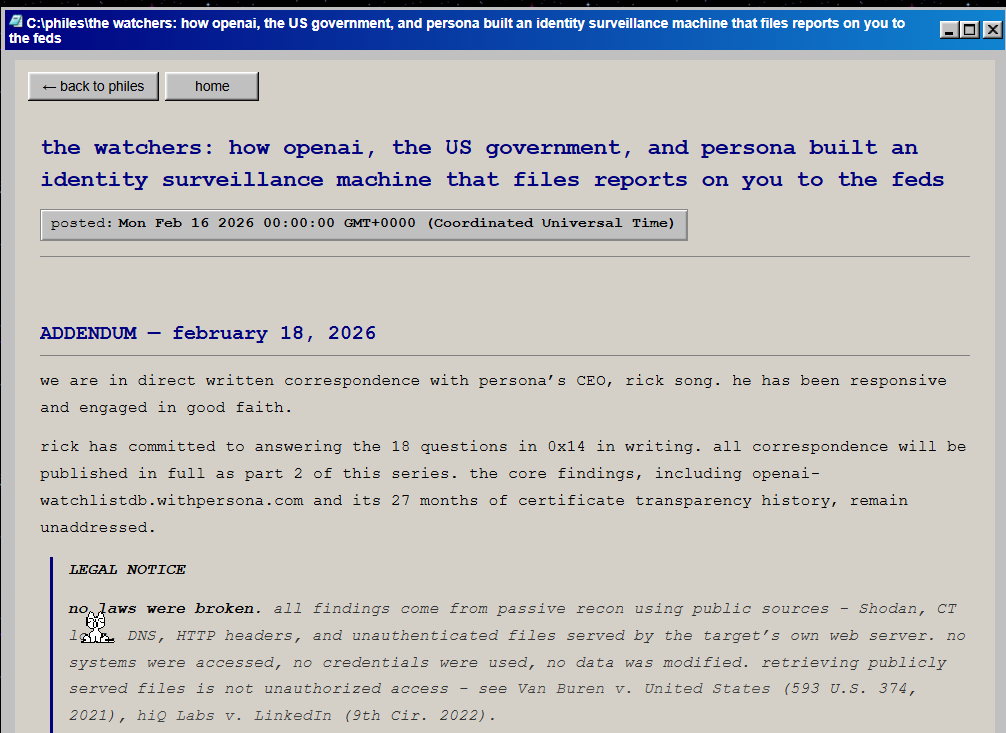
Security researchers conducting passive reconnaissance on Persona, the identity verification company OpenAI uses when you sign up for ChatGPT, discovered that Persona also operates a FedRAMP-authorized government platform running the same codebase. That government platform files Suspicious Activity Reports directly to FinCEN. It files Suspicious Transaction Reports to FINTRAC in Canada, tagged with intelligence program codenames. It maintains biometric face databases with three-year retention. It runs 269 verification checks including facial similarity scoring against politically exposed persons worldwide. It lets operators upload custom screening lists and run them against their entire user base on a recurring schedule.
You hand over your passport to use a chatbot. Your selfie gets compared against a database of world leaders. A similarity score is generated. A cron job re-screens you periodically to check whether you have become a person of interest since the last time you asked an AI to help with your resume.
The researchers did not breach any systems. They read certificate transparency logs, DNS records, and 53 megabytes of unprotected TypeScript source maps sitting on a government endpoint that someone deployed with development settings. On a FedRAMP-authorized platform. The door was open.
This is not theoretical. This is not a warning about what could happen. This is what is happening right now, documented in source code, on infrastructure that is live today.
Every age verification bill, every "trust and safety" framework, every identity requirement dressed as child protection builds toward this. The verification step is the entry point. The surveillance system is the destination.
Read the research. Understand what you are handing over. And ask yourself who is on the other side of the camera.
New Episode of The Fein Print: "Original Intentions, Modern Inventions: The Constitution's Broken Promises"
Bruce Fein, Jeffrey Wernick & William Watkins (author of The Independent Guide to the Constitution) debate whether the Constitution still functions as intended or has been rewritten by courts and unchecked power.
@BitChute was a British company. Built on three principles.
More speech beats suppression. Bad ideas aren't defeated by making them invisible. They're defeated by better ideas in an open environment.
Privacy enables honest speech. The Federalist Papers were written under pseudonyms. Anonymity isn't abuse. It allows people to speak before power or consensus hardens against them.
Users decide what they see. Not engagement algorithms optimized for advertisers. Not regulators defining "harm." Individuals and communities curate their own experience.
Those principles cost us PayPal, Stripe, our UK bank account, and ultimately our home country. We didn't just suspend UK service. We relocated the company out of Britain entirely because the regulatory environment made it impossible to exist there and remain what we are.
We would make the same decisions again.
https://t.co/rvB7h1cReU