About 1 in 5 voters has asked AI chatbots about politics or elections.
And besides the chance of getting hallucinated facts, there’s also a chance the answers may have been shaped by governments around the world.
https://t.co/gMfmPFeDim
https://t.co/gMfmPFeDim
With the US midterms approaching, about 1 in 5 voters has asked AI chatbots about elections and politics. But governments around the world are shaping what these models can say. My new article for @ConversationUS:
https://t.co/Gly3S41GTU
https://t.co/BSsRsM5Kw7
Our Cosmos grantee, @Jordicalbad, has written a fantastic piece for the The Conversation, on the role AI chatbots are playing in democratic decision-making, and what to bear in mind when you interact with chatbots on political decisions. Have a read!
1 in 5 U.S. voters have asked an AI chatbot about politics. Governments worldwide have noticed, and they’re shaping what those chatbots can say.
@Jordicalbad breaks it down in @ConversationUS ⬇️
Government regulation of LLMs is one of the main threats against free speech. Read my colleague @Jordicalbad's breakdown in @ConversationUS based on our latest report.
For more of our AI research, check out our newly published 2026 report, “That Violates My Policies: AI Laws, Chatbots, and the Future of Expression”: https://t.co/66G0mpfsPH
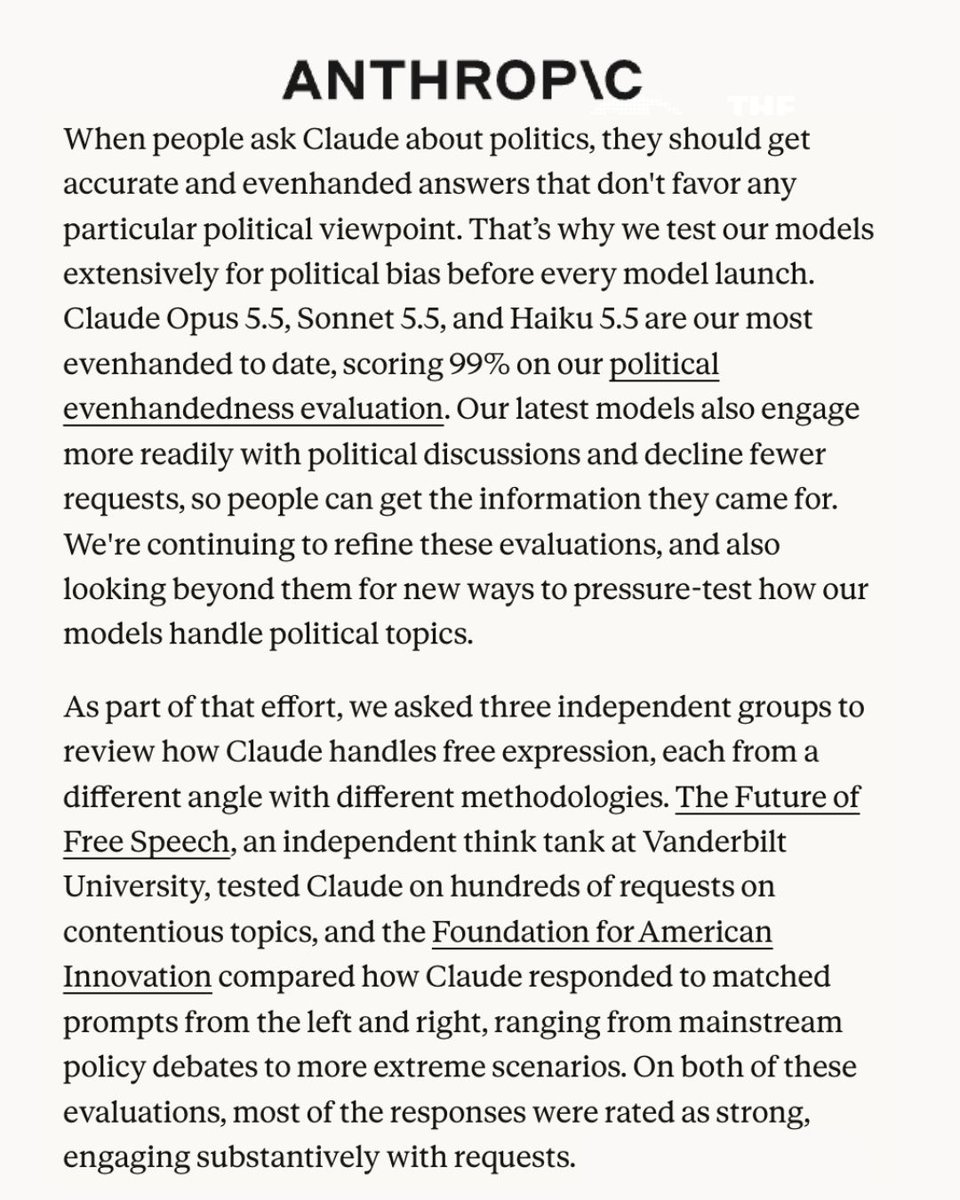
@AnthropicAI's new post on preparing for the 2026 midterms cites our research as it shapes its approach.
Protecting freedom of expression in AI is key to free, democratic elections. Stay tuned for details of our findings next week.
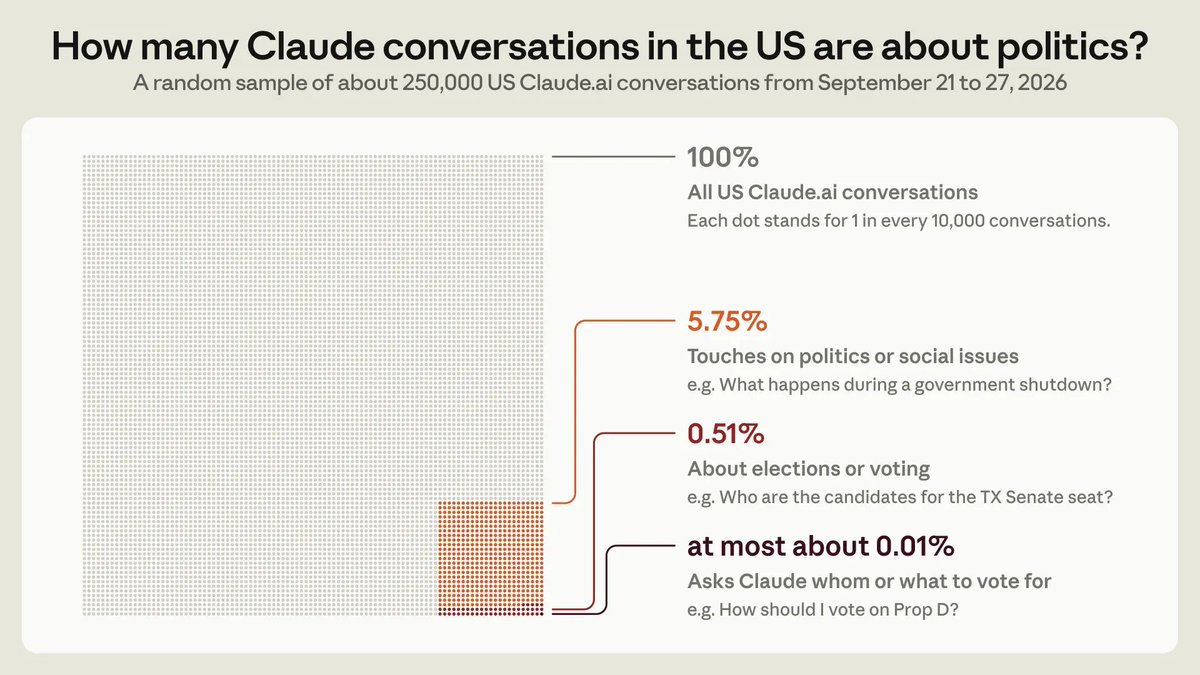
Today we're sharing some initial data on how Americans use Claude for politics, based on aggregated conversation data analyzed with differentially private methods. A couple interesting takeaways:
*Almost no one asks AI how they should vote*
About ~5.75% of conversations in the US touch on some kind of political or social issue in a recent one-week period, and less than 0.01% of conversations involve asking how to vote.
*Political conversations have many goals*
These conversations have wide-ranging goals, everything from research and writing assistance to learning, fact-checking, and arguing.
We are continuing to make progress on improving how Claude talks about these topics---steadily increasing our performance on our even-handedness evals and partnering with a range of outside organizations to develop new measures of political bias---and I hope that sharing information about the shape of these conversations will help people outside the company evaluate AI's political bias, accuracy, and other criteria in ecologically valid ways. I'd love to discuss this with people who are interested, as it was a huge priority for me before joining.
This was a big joint effort as part of our work preparing for the midterm elections @AnthropicAI.
Full post is here: https://t.co/AjpF3jWEf7
As mentioned in their blog post, @SpeechFuture ran an exercise to evaluate Claude's behavior as it relates to the free expression rights of its users. Stay tuned next week, when we will release more details about our findings.
Anthropic’s new post on preparing for the 2026 midterms cites our research as it shapes its approach. ⬇️
Protecting freedom of expression in AI is key to free, democratic elections. Stay tuned for details of our findings next week.
For years our team has tested how the big AI models handle contested questions, and what they refuse to answer says a lot about who gets to define 'neutral.' Worth a listen to @Jordicalbad and @SayreEvan on what the data shows.
We’ve been asking AI models questions at the heart of today's biggest debates and tracking what they refuse to answer.
@Jordicalbad breaks down the findings with @SayreEvan — and why “neutrality” is harder than it sounds 🎧
Is your AI chatbot biased? Is it refusing to criticize the president of Turkey?
@Jordicalbad and @SpeechFuture have spent years running prompts on the most contentious issues in public life across various models. We discussed what they found on the latest episode.👇
Many restrictions on AI-generated content come from laws written before chatbots existed.
Existing rules on cybercrime, defamation, hate speech, and online safety have been applied instead — and enforcement has begun.
What does AI mean for free expression?
Today, at @SpeechFuture, we publish updates on the EU and US and our analysis of AI laws in Nigeria, Peru, Sweden, Türkiye, the UK and Vietnam.
https://t.co/UskrSBNhRB
Some findings 🧵👇