Ex Google CEO, Dr. Eric Schmidt: AI may hit a money wall before it hits a power wall.
Perf per watt had a good run. At 6%, a trillion in debt costs $60B a year.
"The real limit to AI is not energy; it is actually cash. When you add up the cost of these things, if you take round numbers, say $50 bn per gigawatt, then 10 gigawatts is half a trillion dollars.
How many companies, countries, and so forth can hand an industry a trillion dollars of capital? Very, very few. The Chinese could certainly do it. I do not know if they are doing it, but I am going to try to find out.
In America, there are people who hope that is going to happen. It is interesting that you can finance these things because the brilliance of the American capital market allows us to borrow that kind of money. For example, the Europeans cannot do this, which they are sort of sore about."
---
Full video from 'Special Competitive Studies Project' YT channel ( link in comment)
@Frederi55284379 J’ai aussi l’intention de doubler mes postions liées à la crypto (COINBASE, CIRCLE et GALAXY) mais je préfère attendre que la Clarity Act soit voté… je risque d’acheter plus cher mais avec plus de visibilité..
@Auphelle@Frederi55284379 Idem. Bluffé par la capacité de Bessent à tenir les marchés. Pour l’instant, il gagne son pari, malgré 3 marchés énormes à gérer. Je doute que ça tienne éternellement, mais je n’ose pas jouer contre lui. Mieux vaut step aside. Mais je reste Long GOLD 💛📈
@Frederi55284379 Il partage la même vision sur l’OR 🚀😉 Plus les scénarios se compliquent, plus une chose reste simple : l’or finira par tirer son épingle du jeu : Inflation, déflation, crise ou reprise, ils imprimeront. Les choses les plus simples sont souvent les plus évidentes…
@finneko_prgrm@d_depassage Ok, même si on ne revit pas l’inflation des années 70, il faudra quand même traiter le problème obligatoire via le YCC, la répression financière, les taux réels négatifs, etc.
Rien de tout ça ne remet en cause la tendance haussière de l’or 📈😅
I used to be in charge of all the crude and product tank inventories in the refinery.
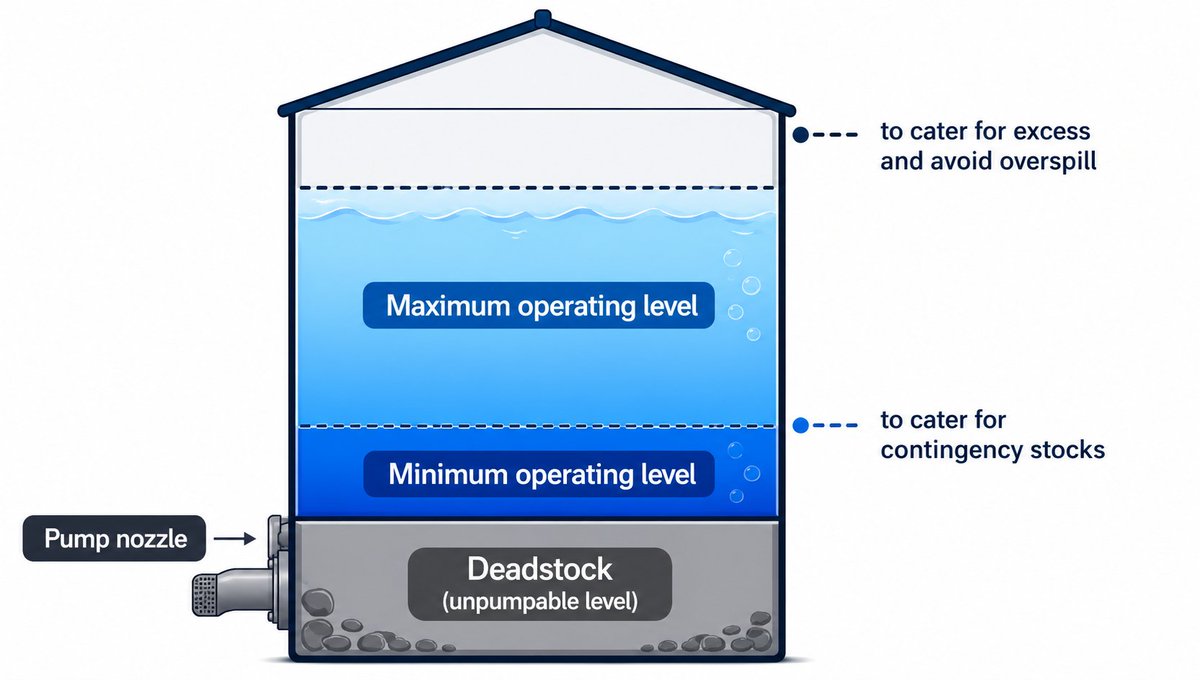
Here is a simple picture of the operating levels of the tank. You've got deadstocks at the bottom of the tank because the pump nozzle is positioned slightly above a certain level. We used to call this 'the unpumpables'. Go below this level and your feed pump would cavitate. Big no-no.
Then you get a minimum working level after catering for contingency levels (e.g. enough product stocks to cater for x days of unplanned shutdown).
And although you have a huge tank that can technically fill to the brim, the actual working volume at the top is lower than the absolute max to also factor in for contingency levels (e.g. enough capacity to store off-spec rundown for an unplanned shutdown). Tank top scenario is a horror nobody wants to face due to risk of loss of primary containment (i.e. a safety incident).
In the current low stocks environment in the US, you are going to 'scrape tank bottoms', up to the minimum working level. So you will always have some stocks because you can't draw to absolute zero.
#oott
@Frederi55284379 Tu oublies de mentionner Figeac, Viridien 🎯👏 J’aime bien les recovery, ça apporte une diversification “distress” décorrélée des marchés, pas plus de 5/10% du portefeuille. Latecoere tjrs en retards mais je suis patient. Merci Fred
@Frederi55284379 Si c’est confirmé c’est le braquage du siècle : un transfert de richesse stratégique vers des intérêts privés… le trade parfait pour les raffineurs 🚀 c’est injuste, comme le sauvetage bancaire de 2008, socialisation des pertes et privatisation des profits.
@BurggrabenH @gemoscatelli @Edsterling4 Wouldn't sugar be even more at risk in this environment? It needs fertilizer, but much less than corn and wheat, but it's primarily a substitute for petroleum to create ethanol in Brazil… 📈
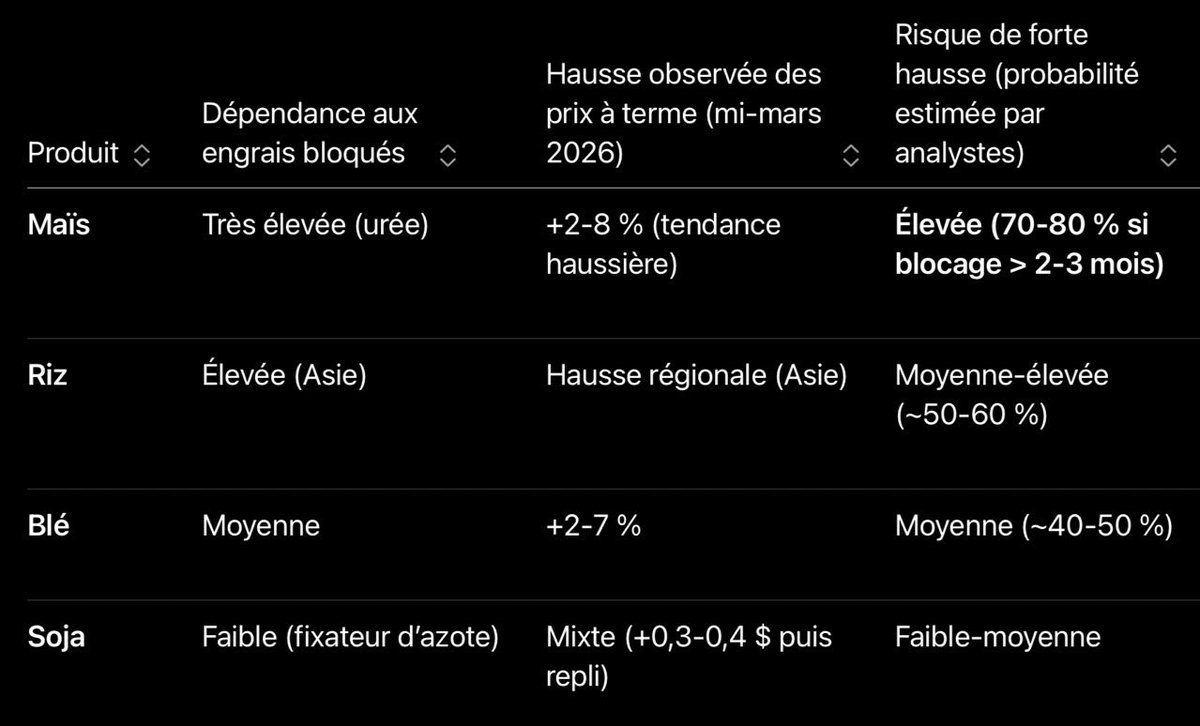
@Frederi55284379 Le maïs ou le riz utilisent bcp + d’engrais azotés (urée et ammoniac) que le sucre. Tu serais pas tenté par un CALL sur CORN ou DAB (un peu+ diversifié)? 30 à 35 % du commerce mondial de l'urée passe par Hormuz, et 20% à 30% pour l’ammoniac.
@Frederi55284379@MikeZaccardi@InvestInAssets Top 👍 Si on devait établir un calendrier, avec les élections de mi-mandat, je pencherais pour un changement de cap monétaire de la Fed vers fin août, autour de Jackson Hole. Cela pourrait entraîner un rebond des marchés en sept et oct. J’ai privilégié des échéances de septembre
Iranian oil has been sanctioned for many years. The 140 million barrels he is referring to are part of the "dark fleet" that has been shipping Iranian oil to Asia (mainly China) for years. Iran gets money for oil, and China buys it at a discount.
So, this oil already exists in the world market. It doesn't matter who buys it, or under what scheme (sanctioned through a dark fleet or legitimate open market sale), as a barrel sold anywhere, for whatever reason, adds to world supply.
To emphasize, these barrels are already part of the world supply. These barrels are not randomly floating in a tanker on some ocean (for years?), waiting for sanctions to be lifted before they can be sold and offloaded.
By allowing oil to be unsanctioned, all Bessent is doing is allowing Iranian oil to be sold to places like Japan or South Korea. In other words, all he did was raise the price of Iranian oil because they now have more bidders.
He just made Iran wealthier and did nothing for the price of crude oil.
Soon, countries across Europe will begin subsidising energy costs as prices surge. Apart from the fact that many of these governments helped create this vulnerability by undermining their own energy security, the result will be extremely paradoxical.
Most of these countries already run structural budget deficits, leaving very little room to manoeuvre. That will only reinforce the "instinct" of policymakers to raise taxes in an attempt to contain those deficits. In other words, households will end up paying for their own energy subsidies (with some income leveling in between.
That process will continue until the next crisis arrives. And when it does, the familiar slogan of policymakers will return: "We must stabilise the economy, or the financial markets, or both." At that point, governments will once again allow deficits to explode, knowing that central banks will ultimately be forced to absorb the newly issued debt, buy bonds, and turbocharge the money printing machine.
The same dynamic applies to rising healthcare costs, expanding welfare bills, and higher defence spending. Once you understand that, you will see the issue right in front of you. If you are a sitting duck, tied to assets that cannot yield a (real) return or be moved across borders, such as real estate, then your exposure to this system is far greater than many realise.
And once you see that clearly, the conclusion becomes hard to avoid: your portfolio needs a massive rebalancing to protect itself from that dynamic.
From “… the dollar is our currency, but it's your problem …” to now something that now sounds like “… the Third Gulf War was our idea, but it’s now your peacekeeping problem …”