Sesión, Cookie, JWT, Token, SSO y OAuth 2.0 explicados en un diagrama animado.
Te cuento qué significa cada concepto con ejemplos:
Sesión: El servidor guarda tu identidad y envía al navegador una cookie con un ID de sesión. Esto le permite al servidor reconocer el estado del usuario en cada solicitud. Sin embargo, las cookies pueden tener problemas para funcionar de manera consistente en varios dispositivos.
Token: Tu identidad se representa en un token que se envía al navegador. Este token se utiliza en solicitudes posteriores para autenticación. No es necesario que el servidor almacene la sesión, pero los tokens deben estar encriptados para mayor seguridad.
JWT: Los JSON Web Tokens son un formato estandarizado de tokens que incluyen firmas digitales para verificar su autenticidad. La firma está dentro del token, por lo que no se necesita almacenar sesiones en el servidor.
SSO: El inicio de sesión único (Single Sign-On) usa un servicio de autenticación centralizado, lo que permite que un solo inicio de sesión sea válido en varias aplicaciones o sitios web.
OAuth2: Permite que un sitio web obtenga acceso limitado a los datos de tu cuenta en otro sitio, sin que tengas que compartir tu contraseña. Este sistema es utilizado, por ejemplo, cuando permites que una aplicación acceda a tus datos de Google o Facebook.
Magic Link: Te envían un enlace a tu correo electrónico que contiene un token de autenticación temporal. Al hacer clic en el enlace, te autenticas sin necesidad de ingresar una contraseña. Es una forma de autenticación sin contraseña que depende de la seguridad de tu correo electrónico.
El Magic Link es cada vez más popular porque simplifica el proceso de inicio de sesión, eliminando la necesidad de recordar contraseñas.
2FA (Autenticación de Dos Factores): Agrega una capa extra de seguridad al requerir, además de tu contraseña, un segundo factor de autenticación, como un código enviado a tu teléfono móvil, una aplicación de autenticación o un dispositivo físico. Esto asegura que incluso si alguien obtiene tu contraseña, no podrá acceder a tu cuenta sin este segundo factor.
El 2FA es una de las medidas más recomendadas para mejorar la seguridad en los sistemas de autenticación, ya que reduce el riesgo de accesos no autorizados, incluso si las credenciales son comprometidas.
¡Espero que con todo esto tengas una mejor idea de cómo funcionan las sesiones en las páginas web!
🚀Build a Streamlit Chatbot using Langchain, ColBERT, Ragatouille, and ChromaDB
Great resource on how to use ColBERT + Ragatouille +
@trychroma + mixtral-8x7b-instruct-v0.1 + our EnsembleRetriever
s/o @aigeek__ for building!
Code: https://t.co/Yh2Ti1eV29
🦜🕸️LangGraph
We introduced LangGraph last week, but are excited to launch it more officially today (blog and YouTube series). It includes:
🤖Example of replicating the LangChain AgentExecutor
💬A chat agent executor (aimed specifically at chat models)
LangGraph makes it easy to modify agent runtimes. Examples of modifications we included are:
🔧Force calling a tool
🫅Human-in-the-loop
🧱Returning structured information
⚒️Dynamically calling a tool
🏃Managing agent steps
We've got a lot more exciting things coming via LangGraph :)
Blog: https://t.co/2r7HrhgcTd
YouTube: https://t.co/62RcC4WBzn
Pandas is a powerful data analysis and manipulation library for Python!
NVIDIA just made Pandas 150x faster with zero code changes🔥
All you have to add is just a couple of lines of code:
%load_ext cudf.pandas
import pandas as pd
Thread🧵👇
The famous "Chihuahua or Muffin" problem in computer vision is considered solved by GPT-4V on social media. But really? The answer is NO. GPT-4V cannot reason well about the same images in the original "Chihuahua or Muffin" grid when they are in a different layout.
I experimented by rearranging the same images from the classic 4x4 grid into a different layout. First, GPT-4V does not directly recognize the content in details and miscounts the number of images. Then, when being asked about the third image on the top row, GPT-4V misrecognizes a Chihuahua as a muffin.
So the "Chihuahua or Muffin" has not been solved yet. But how can GPT-4V work so well on the original image? My guess is that since that image is everywhere, GPT-4V was very likely to be trained on it and memorize its labels.
👀 Trabajando en un nuevo artículo científico me he topado con esta herramienta de #IA gratuita que es como tener un editor académico en casa🙌
😱 La de tiempo, quebraderos de cabeza y dinero que me hubiera ahorrado de conocerlo cuando escribí mi tesis
👉 https://t.co/Sbxrukw6gB
Code Llama is free for both research and commercial use and we've made three different models available:
- Code Llama
- Code Llama - Python
- Code Llama - Instruct
More details on each of these models and how you can download them ➡️ https://t.co/yLBEKVJhU5
Calling all JS developers! We just released 2 example Next.js applications which show how to use Transformers.js for client-side (in-browser) or server-side (Node.js) inference. 🤗
Building full-stack AI applications has never been this easy! 🚀
Tutorial: https://t.co/vVG4Cpen50
You can now fine-tune an LLM without writing a single line of code!
A breakthrough in the open-source LLM space that can increase the speed of AI development and adoption by an order of magnitude.
Let me start from the beginning:
A Large Language Model comes out of the factory knowing many things but with little expertise.
Take GPT-4, for example. It can speak without pause about mathematics but struggles to solve most problems. It knows about photography but not about my photos. It knows about business but can't say a thing about yours.
Fortunately, we can teach these models specialized knowledge. For example, we can force a model to always answer in a specific way or show it facts about a domain it didn't know before.
We call this process "fine-tuning."
For many use cases, fine-tuning a model is the difference between getting mediocre answers or feeling the tool is pure magic.
While OpenAI's models attract much attention, many companies use open-source models like LLaMA and Falcon. This gives them more control over their data, expenses, and how the model responds.
Unfortunately, fine-tuning a model is neither a simple process nor cheap. It takes a lot of time and GPU computing. It's also hard to find experienced people who know how to work with these models.
While you can choose your adventure and do everything yourself, the @monstersapi team released the ability to fine-tune a Large Language Model without writing any code. You can use it with any of the following models:
• LLaMA 7B, 13B
• Falcon 7B, 40B
• OPT 125m, 6B
• GPT J 6B
• Stable LM 3B, 7B
• GPT 2 XL
Besides the obvious advantages of not dealing with code, complexity, or hardware, using their no-code tool will also let you fine-tune a model at a fraction of the cost! Their secret is using a decentralized GPU platform, which makes the process much more cost-efficient.
There's a simple step-by-step demo you can follow that will show you how simple the process is. Link in the next tweet.
You can try their platform with 5,000 free credits using the code SANTIAGO.
Super excited to share that today we release MusicGen: a simple and controllable music generation.
🤖 🎵 🔊
📜 Paper: https://t.co/9ALor2ziwj
🖥️ Code and models avail under: https://t.co/H66XKjppTJ.
🎵 Samples can be found here: https://t.co/5c5Ru3ebma
See more details👇
Meta just released MusicGen, a simple and controllable model for music generation
MusicGen is a single stage auto-regressive Transformer model trained over a 32kHz EnCodec tokenizer with 4 codebooks sampled at 50 Hz. Unlike existing methods like MusicLM, MusicGen doesn't not require a self-supervised semantic representation, and it generates all 4 codebooks in one pass. By introducing a small delay between the codebooks, can predict them in parallel, thus having only 50 auto-regressive steps per second of audio
try out the @Gradio demo: https://t.co/1UvsU6UTzS
Models on @huggingface: https://t.co/7uTFxSdhQa
github: https://t.co/d23lrVLhlE
Introducing Whisper Web: ML-powered speech recognition directly in your browser! 🚀
This comes with the release of Transformers.js v2.2.0, which now supports multilingual transcription and translation for over 100 different languages! 🤯
Check it out: https://t.co/E73L05tom1
Want to try @Google’s #PaLM2 API but prefer a visual interface that can be chained with almost anything to explore its capabilities? Our #VisualBlocks framework now supports PaLM2 text nodes you can use in minutes with your API key.
Try it yourself → https://t.co/ZhGocjJEZk
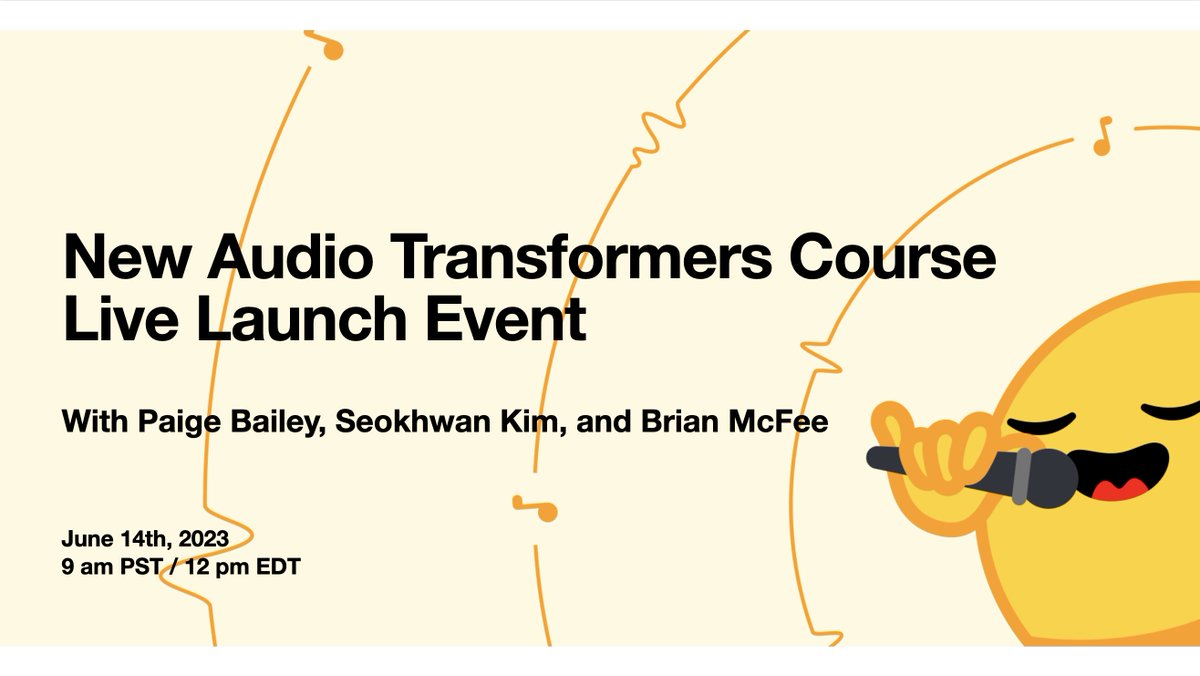
🚨Exciting news! Next week, we’ll be launching a brand-new Audio Course! 🤗
Sign up today (https://t.co/2cLmirTddm) and join us for a LIVE course launch event featuring amazing guests like @DynamicWebPaige, Seokhwan Kim, and @functiontelechy! ⚡️
https://t.co/jy7Y2FIQgf
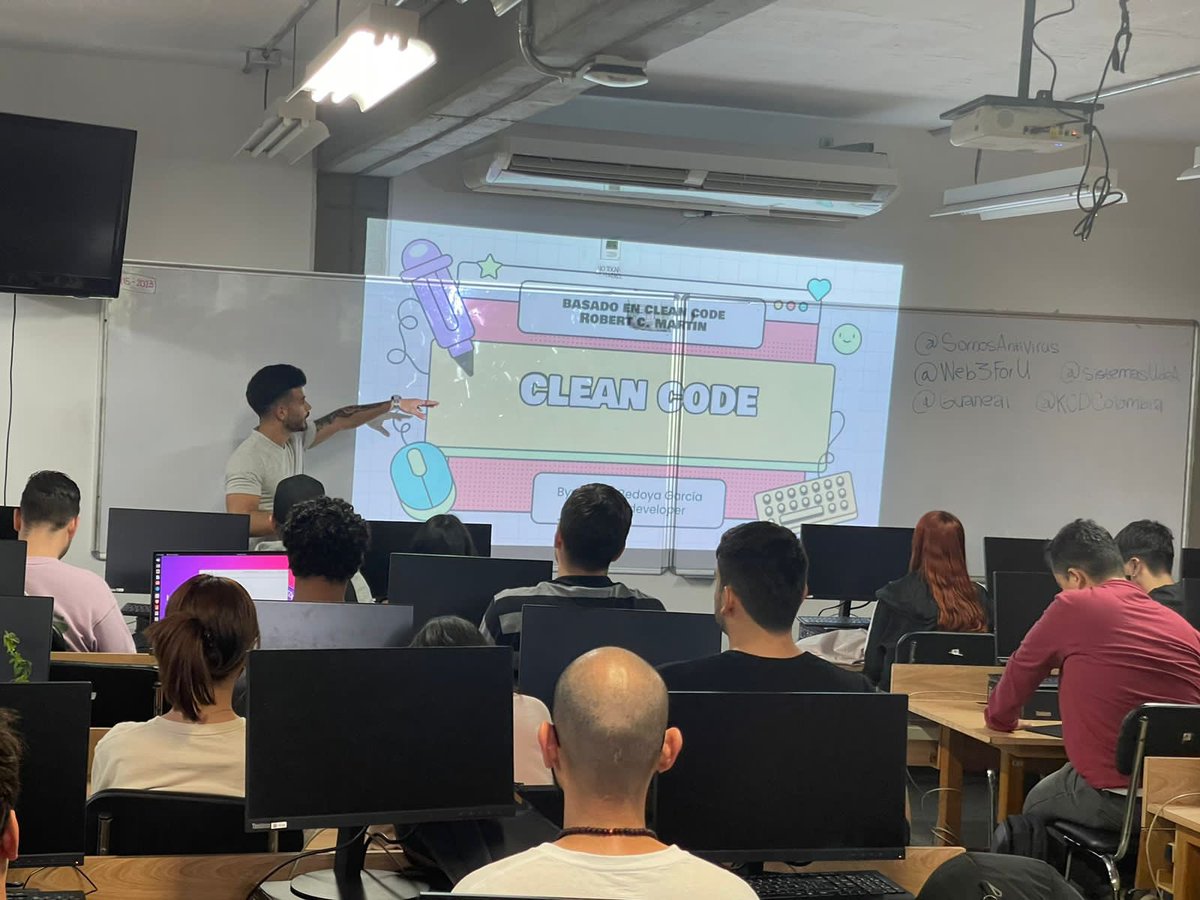
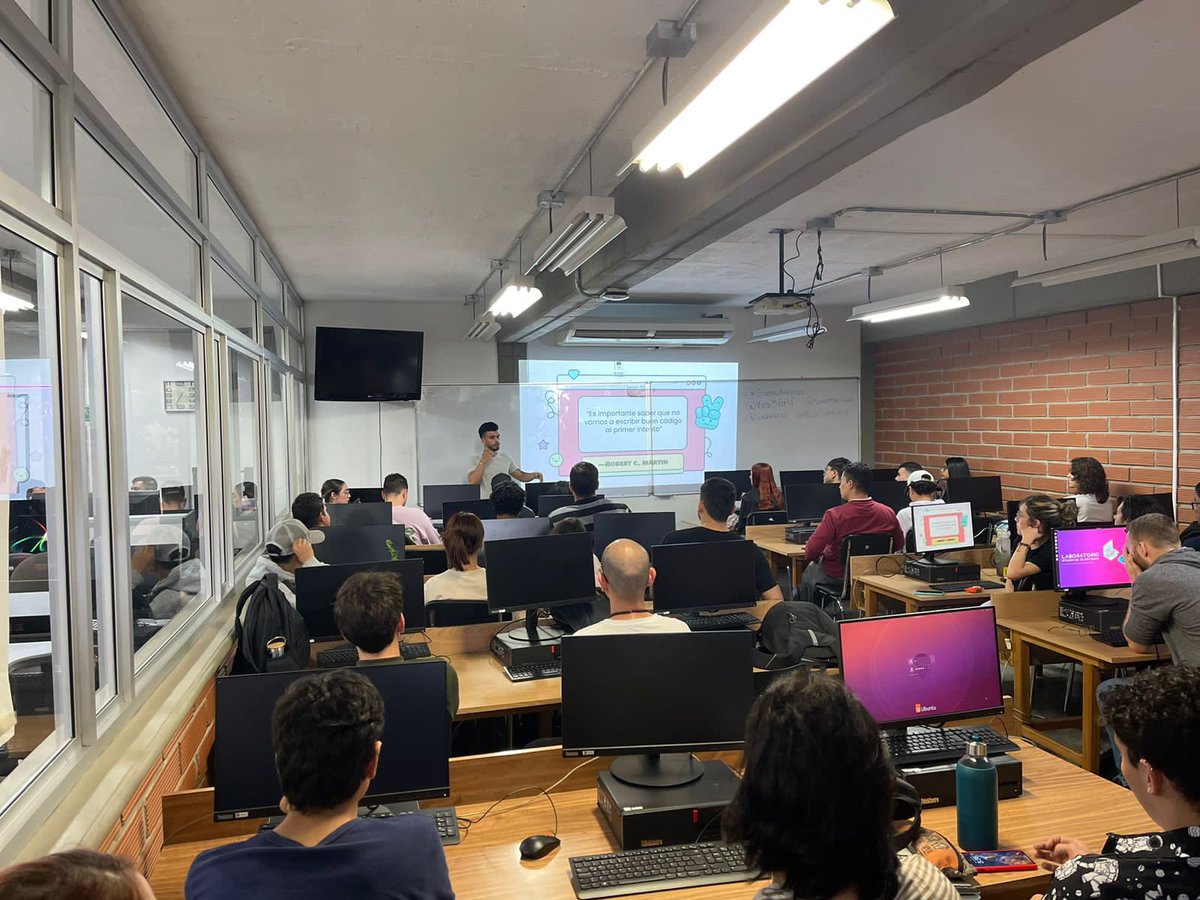
Así estuvo nuestro último encuentro del semestre ! 😎🤩 gracias a @manugo_dev y a @edisonbedoya98 por compartir su experiencia con todos nosotros 💙 ; a @somosantivirus por hacer esto posible y a nuestros patrocinadores 💃🍾🎉
After 70x faster Whisper, we present to you - 5x faster Whisper fine-tuning! ⚡️
Powered by LoRA and 🤗 PEFT - Squeeze in 5x larger batch sizes, fit Whisper-large checkpoint < 8GB VRAM! 🔥
Best part? With almost no degradation in WER! 🤯
Check it out: https://t.co/9DvxF995Yr