The Psychoid, Soul and Psyche: Piercing Space-Time Barriers
by Jungian psychoanalyst Ann Belford Ulanov, Ph.D.
A sentence in #Jung’s paper “Soul and Death” struck into me because it connected with a clinical experience that was profound. Jung was addressing the difference between #consciousness whose “limitation” ... “in space and time is such an overwhelming reality” that when it is “annulled,” as it was in that clinical experience, it is of “the highest theoretical significance” and the “annulling factor would be the psyche, since space-time would attach to it at most as a relative and conditioned quality.” But, Jung goes further, “Under certain conditions it [psyche] could even break through the barriers of space and time precisely because of a quality essential to it ... its relatively trans-spatial and trans-temporal nature.” Jung urges, “The possible transcendence of space-time ... is of such incalculable import that it should spur the spirit of research to the greatest effort” (Jung 1934/1960, para 813; also cited in Bright 20014, 87).
This book is an effort to contribute to such research. Jung was discussing the space-time barriers in relation to #telepathy. I am discussing them in relation to clinical experience of the psychoid quality of unconscious processes. Further, penetrating space-time barriers links to Jung’s looking for his lost soul, as recounted in The Red Book (Jung 2009, 232). Without soul, he lost not only his capacity to annul the space-time barrier, but also lost the aliveness of his everyday life.
Both Jung and #Freud thought our #projections of psyche and soul into religious categories, let alone political, philosophical or cultural institutions, that is, into containers ‘outside’ the psyche, had fallen away. Where had all that projected energy gone? It fell into our human psyche and the new discipline of psychoanalysis was the result. For Freud this meant getting rid of religion, for Jung, this meant investigating what he eventually called the ultra-violet spiritual pole of the #archetype and the God-image and God beyond it.
In his Liber Novus [The Red Book], a pivotal transition happens to Jung, changing his initial project of reanimating religious traditions by discerning the correspondence of the truth of their symbols to images arising in our psyche. He now sees the human psyche is itself the site of transformation: “the spirit of the depths burst forth and led me to the site of the innermost” (Jung 2009, 239; see also 252 n.211, 253, and n227, 228; see also Jung 1953, para 7). Psyche/soul is now a space where transforming of us happens (or fails to) and that relates to what animates the whole world, for “the psychology of the individual, corresponds to the psychology of the nation. What the nation does is done also by each individual, and so long as the individual does it, the nation also does it. Only the change in the attitude of the individual is the beginning of the change in the psychology of the nation” (Jung 2009, 253 n221 and in Jung 1953/1966, para 7, his italics; see also Jaffé 1963, 132).
Psyche is all the processes #conscious and #unconscious which enable or disable us to be a person connected to self, to others and to what transcends psyche. Psyche mediates reality, adding a psychical line of interpretation to traditional hermeneutics (Ulanov and Ulanov, 1975, 81-82). Soul is that willingness to be such a person related to self and others and to the beyond, the something more in us that longs for, desires both something beyond and dwelling in the quotidian. Jung writes, “it [the soul] has the dignity of an entity endowed with, and conscious of, a relationship to deity” (Jung 1953, para 11). I understand soul as that unlockable door residing within our body-self, our psychosomatic being, through which God (or whatever we put in place of God) can put a paw on us at any time.
Jung uses the term #soul to denote a psychological faculty central to religious experience, and central to feeling oneself creatively alive and real. In conversation with Meister Eckhart, for example, Jung sees the soul as a definite #complex, personifying contents of the unconscious (Jung 1921, paras 420-421): soul “is a function of relation between the subject and the inaccessible depths of the unconscious. The determining force (God) operating from these depths is reflected by the soul, that is, it creates #symbols and #images” (Jung 1921, para 425). Soul shows in a willingness to respond, to be real and creatively alive in relation to others, to God, to self, even if in terror and dread (Ulanov A. and B. 1975, 91-92). Jung’s view of the soul as “in an intermediate position” between conscious and unconscious makes me think of it as a two-way mirror, reflecting upwards to (#ego) consciousness images of #archetypal depths, and reflecting downwards to the unconscious what is going on in consciousness, especially the effects on our ego of the images reflected upwards from the unconscious. As Jung puts it, soul is “both receiver and transmitter” (ibid).
In the work of many #mystics, soul dwells in depths of us inaccessible by rational intellect or ordinary words or #dualisms of consciousness (Hollywood 1995, chapter 1). God as center of reality is also soul’s ‘breath of life’ embodied in us, displaying the radical fact that ground of being is ground of us (though the relations of the two are very complicated and explained in diverse and conflicting ways). God is in the soul and the soul informs psyche about this groundedness (Jung 1950/1966, paras 139-140; Caputo 2011, 89-90; Ulanov 1984/2005, 280-283; Ulanov 1998/2004, 206; Ulanov 2008/2014, 181).
To see that psyche has trans-spatial and trans-temporal capacities and relation with soul, has effects in our clinical work. For example, a major consequence of #trauma is loss of soul. Its mirroring function gets frozen or fragmented so that in addition to losing body flexibility and pleasure, we lose capacity to transcend “space-time barriers” in relation to the beyond (however we characterize it) and lose our capacity to live stably in space and time. Meaning goes missing; we cannot find it and fear it is destroyed forever. The ground beneath us cracks open. We cannot represent in word or even image what has happened to us. We have fallen out of being and suffer what Bion calls “nameless dread” as if surrounded by buzzing bees stinging us to death in a bombardment of unprocessed experiences ”(Bion 1962, 96; Bion 1992, 1992, 45-46). We need the clinical relationship (or its equivalent) to perceive that this buzzing is reaching to communicate the unlived meaning of events, memories and panics that besiege us (Godsil 2014, p. 63).
Jung begins his odyssey in The Red Book to find the soul he discovers he had lost. Instead of turning his soul into a “scientific object” which he could study and have “many learned words for her ... the spirit of the depths forced me to speak to my soul, to call upon her as a living and self-existing being. I had to become aware that I had lost my soul” (Jung 2009, 232 and n 39).
▪️(US) Baker & Taylor – https://t.co/OclQz2PGhB
▪️(Worldwide) Daimon Verlag – https://t.co/EkvTjiXaSY
Deeply concerned that CORU’s proposed standards for psychotherapy fall far below the minimum recommended by the European Association for Psychotherapy (EAP) . They ignore core elements like personal therapy and supervision, and duration of training.
https://t.co/L6X7wn1sL9
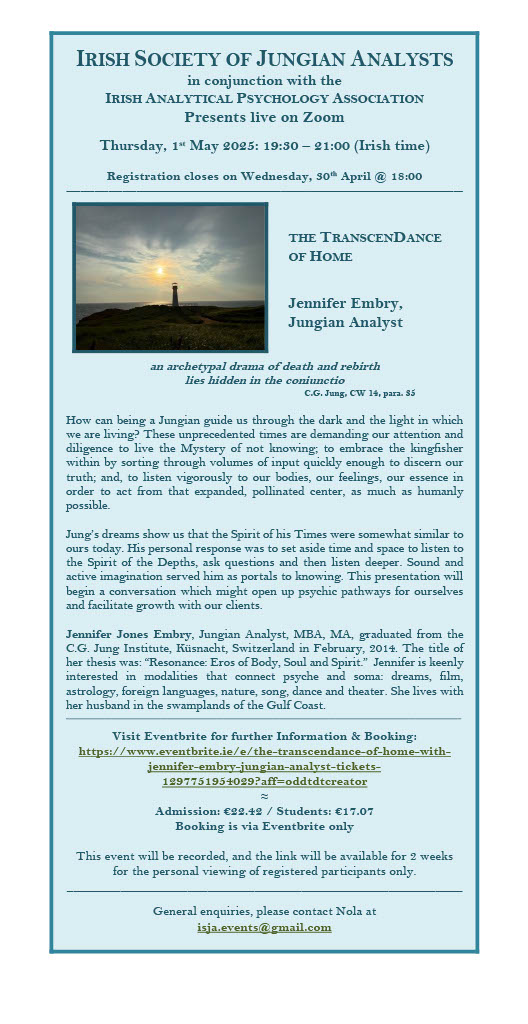
The TranscenDance of Home with Jennifer Embry, Jungian Analyst
Date: 1 May 2025
Time: 7:30pm – 9pm
Location: Online
Cost: €20 / €15 (students)
Registration closes today 30/04/2025 @ 6pm.
Register: [email protected]
Book via @EventbriteIE https://t.co/vARxctW058
Cutting benefits and dismissing mental health struggles won’t solve the mental health crisis - it will deepen it.
The impact climate change is having on our mental health is indisputable. We've outlined the connection in our blog.
🔗: https://t.co/qcUntkf5eX #ClimateChange
We’d like to learn more about our followers so we can create content that’s most relevant to you. If you follow us, are you a UKCP member?
Your feedback helps us shape our posts. Vote below ⬇️
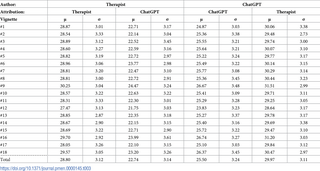
more on AI as therapists https://t.co/YT7t8zpKg1 worth also checking out this interview about Compassion Focused Therapy Stan Steindl did with chat gpt https://t.co/3HZTYdSrJs
The intersection of AI and psychotherapy is a topic that raises important ethical considerations. We must also remain vigilant about the implications for client privacy, informed consent, and the therapeutic relationship. It needs attention from politicians and stakeholders.
@MoyaSarner Sisu and Symington's concept of the lifegiver both come from different angles, but they relate to an inner capacity for tenacity and overcoming challenges. I see the connection in the shared emphasis on tenacity and resilience.