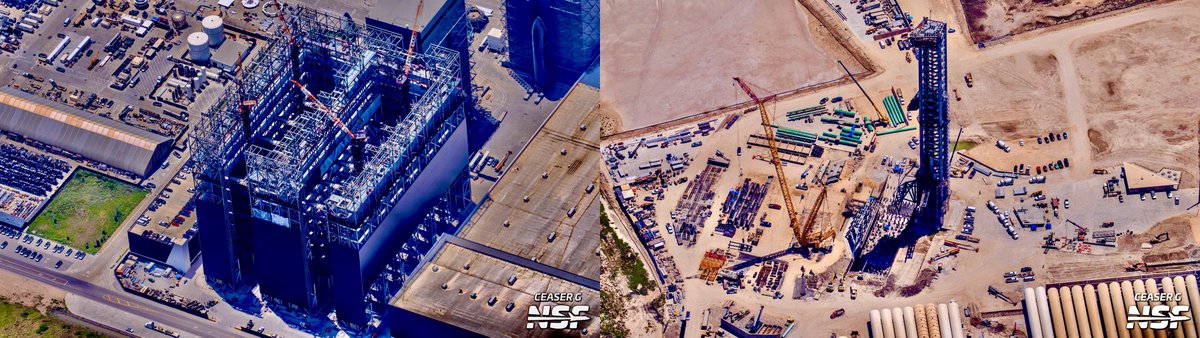
This 160,000-square-foot facility represents Vandenberg Space Force Base’s largest Sentinel military construction project and a major evolution of the Sentinel program. Once complete, it will consolidate Initial Skills Training for missile operators and technical training for missile maintainers into a single, integrated campus.
https://t.co/P7pQQI4HyX
#Sentinel #Missile
#Vandenberg
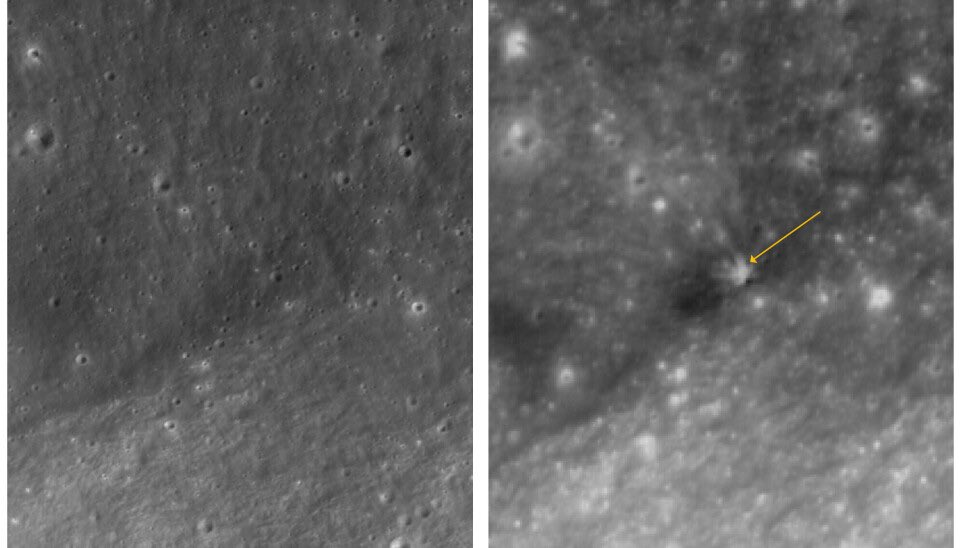
Why there’s no images of the Falcon 9 moon impact yet:
No cameras were positioned to record the impact in real time at close range. Because the event occurred on sunlit terrain, any flash was obscured by daylight from Earth’s perspective.
Ground-based observers and telescopes—particularly in the Americas, where the Moon was high in a dark sky—searched for an ejecta plume above the lunar limb; however, reports indicate it was not readily visible to the naked eye or most amateur instruments.
Specialized observations, including detections of sodium and lithium gas plumes from Lowell Observatory, were documented. NASA’s Lunar Reconnaissance Orbiter (LRO) and South Korea’s Danuri (Korea Pathfinder Lunar Orbiter, equipped with ShadowCam) are conducting pre- and post-impact imaging.
High-resolution crater imagery is anticipated in the coming days, contingent upon orbital geometry, illumination conditions, and data downlink.
#Falcon9 #SpaceX #Moon #Impact
*Tonight/early tomorrow morning!*
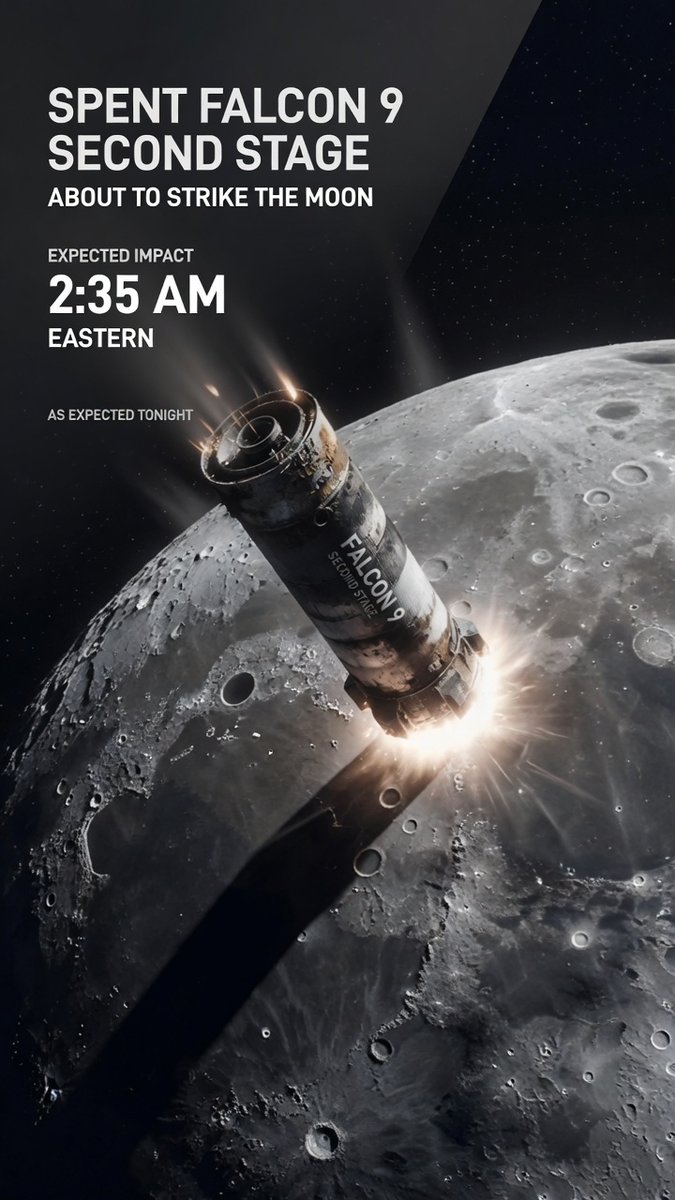
An abandoned segment of a SpaceX Falcon 9 rocket is expected to impact the lunar surface at approximately 2:35 a.m. EDT on August 5. The object, a truck-sized spent upper stage. The projected impact velocity is 5,436 mph. #SpaceX#Falcon9
NASA’s Kennedy Space Center (KSC) Florida: The Florida Gigabay is designed for stacking, integrating, refurbishing, and preparing Starship vehicles—the Super Heavy booster (lower stage) and Starship upper stage—before they roll out to launch pads. It supports high-volume operations with 24 work cells so several vehicles can be processed in parallel.
This is essential for rapid reuse and scaling flight rates.
• Height: about 380 feet
• Workspace: around 815,000 square feet across ground level, elevated platforms, and upper levels (including work/meeting space on a top “penthouse” floor that does not cover the full footprint in all areas).
• Includes about 24 work cells for integration and refurbishment.
• Cranes: capable of lifting up to ~400–420 U.S. tons.
Target completion/operational readiness has been cited as the end of 2026 (with some earlier reports pointing toward August 2026).
#NASA
#SpaceX
#GigaBay
#Starship
July 21st - on this day in 1961, NASA launched the United States' second human spaceflight, Mercury-Redstone 4.
Astronaut Gus Grissom and his Mercury spacecraft named Liberty Bell 7 were carried on a 15 minutes, 37 seconds long suborbital ride to space on top of a Mercury-Redstone Launch Vehicle. An apogee of 190.31 km was reached.
Liberty Bell 7 splashed down Northeast of The Bahamas. After the spacecraft's hatch had blown open prematurely, the capsule began to sink. Grissom left the capsule as quickly as possible and was hoisted to safety by a nearby U.S. Navy helicopter.
Liberty Bell 7 sank to a depth of almost 4,900 meters and was recovered in 1999. Today, it is on display at Cosmosphere in Hutchinson, Kansas.
#NASA
#Mercury
#Redstone
#Rocket
#SpaceExploration
During the Apollo 11 mission, Neil Armstrong made history as the first person to step onto the Moon at 02:56 UTC (10:56 p.m. EDT on July 20, 1969). Buzz Aldrin joined him about 19 minutes later.
#nasa#Apollo#SpaceExploration
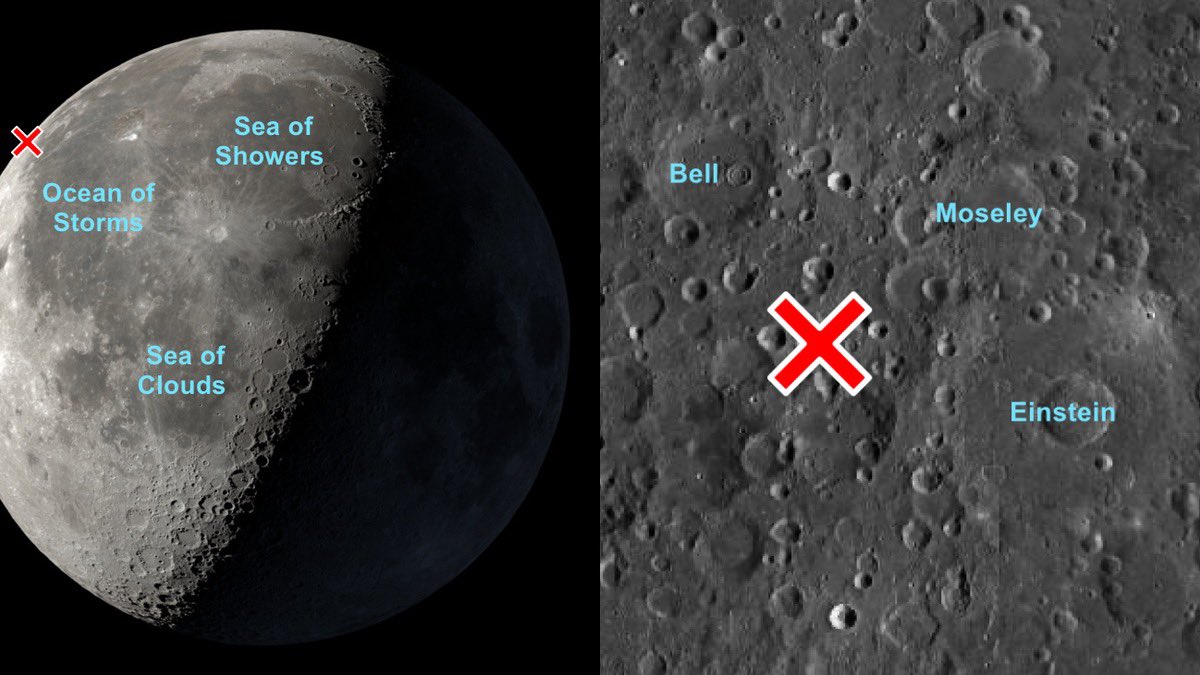
A spent Falcon 9 upper stage (second stage, catalogued as 2025-010D) from a January 15, 2025 SpaceX launch is on a collision course with the Moon.
When?: August 5, 2026, around 2:44 a.m. EDT (06:44 UTC).
Where?: Near Einstein Crater on the Moon’s western limb (near side, close to the edge/far side boundary).
How fast?: ~2.43 km/s (about 5,400 mph or 8,700 km/h) — roughly 7 times the speed of sound on Earth.
#SpaceX
#Falcon9
#Moon
#CLPS
The MQ-28 Ghost Bat took part in a flight with the F-15EX and a proof-of-concept FARP operation as part of the Experimental Operations Unit’s activities during Valiant Shield 2026.
https://t.co/Mjjv1CZnvH
The Convair B-36 Peacemaker, initially known as the XB-36 prototype, made its maiden flight on August 8, 1946. It entered operational service with the United States Air Force’s Strategic Air Command (SAC) in 1948 and continued its frontline duty until February 1959.
The B-36 Peacemaker’s immense size allowed mechanics to traverse tunnels within its wings to access the engines during flight. Notably, the wings possessed a thickness exceeding seven feet at their root, resembling a substantial structure.
Furthermore, the B-36 underwent testing as a flying nuclear-reactor platform under the NB-36H program. It carried an operational nuclear reactor within the aircraft, not for propulsion purposes, but to assess the feasibility of a nuclear-powered bomber.
Consequently, the B-36 Peacemaker transcended its role as a conventional bomber, emerging as a formidable Cold War weapon:
- Six piston engines
- Four jet engines
- Intercontinental range
- Nuclear weapons capability
- Experiments with an onboard reactor
#ColdWar
#B36
#Bomber
What if we all spent less time staring at all the poison that is on display on the so-called “news” feeds and social media sites? Started out by substituting just 30 minutes a day that you would normally spend on X, Facebook, or YouTube, with reading the Holy Scriptures. Or even better yet, spent that 30 minutes in prayer, speaking and listening to God. Maybe things could change…
#Christ
#Orthodox