Public Finance Journal is an open-access biannual journal publishing peer-reviewed research in budgeting and finance. This journal is published by the @GFOA.
Public Finance Journal is committed to the practice of diversity, equity, access, and inclusivity in soliciting, reviewing, and publishing public budgeting and finance scholarship. Read our statement here: https://t.co/3nt0UBaXqx
"Administrative Discretion and Fiscal Slack Accumulation" by Peter Jones & Vincent Reitano finds that Texas school districts use overestimated budget expenditures to build discretionary financial reserves, particularly during economic crises. https://t.co/bB8Okjdqvk
"Does GAAP Compliance Matter to Municipal Bond Investors?" by Justin Marlowe finds that small municipalities that use cash-basis accounting rather than GAAP face higher borrowing costs, reduced investor interest, and declining activity in the bond market. https://t.co/H6OcpueMW9
On behalf of Public Finance Journal, we are excited to announce the release of issue 3(1) of the journal! We will be highlighting the scholarship over the next few days! https://t.co/PHknlFmiPn
"Exploring Connections Between Financial Sophistication and Democratic Function in Local Governments" by Stephanie Leiser & Natalie Fitzpatrick finds a link between stronger democratic functioning and more complex financial practices in local governments. https://t.co/emOZpEE2jy
PFJ has an estimated CiteScore of 5, another exciting sign of the journal’s growing reach and impact in public finance scholarship. A huge thank you to our authors, reviewers, editors, readers, and the broader PFJ community for helping strengthen the journal.
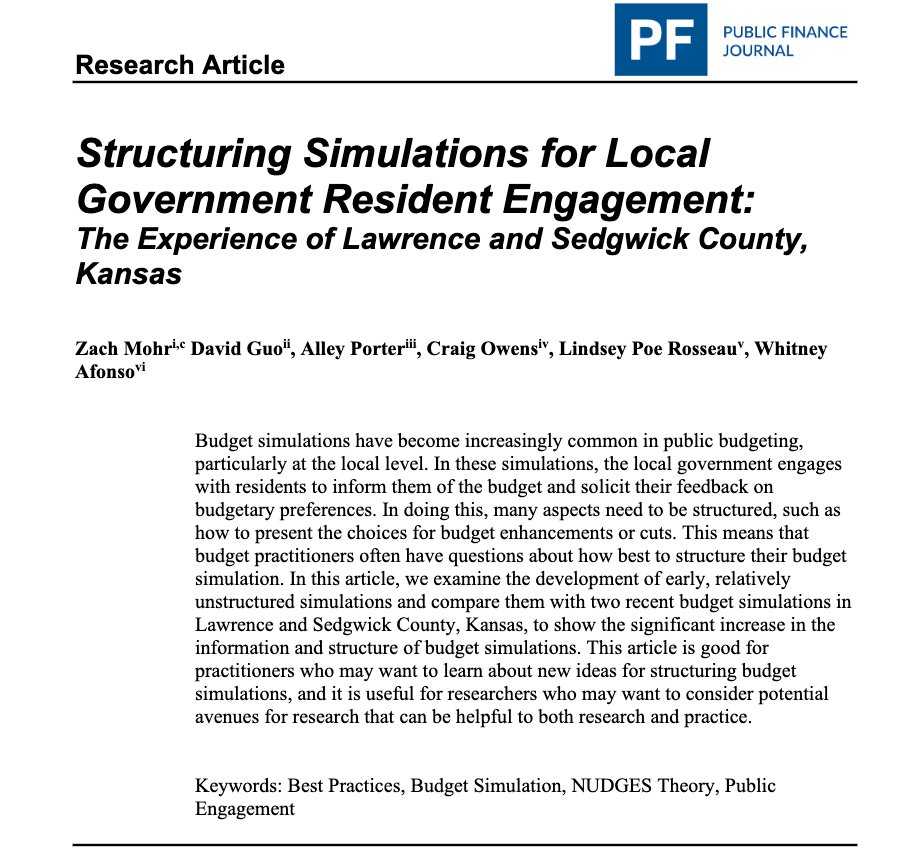
... evolved from relatively unstructured exercises into more sophisticated tools that give residents more information and structured choices, offering lessons for practitioners designing simulations and for researchers studying public engagement in budgeting. (n/n)
"Structuring Simulations for Local Government Resident Engagement: The Experience of Lawrence and Sedgwick County, Kansas by Zach Mohr, David Guo, Alley Porter, Craig Owens, Lindsey Poe Rosseauv, & Whitney Afonso finds that budget simulations have... (1/n) https://t.co/MERrKcKedA
"Improving Local Government Performance Through Benchmarking" by Christopher Acuff reviews David Ammons’ latest book, arguing that local governments should move beyond measuring performance and focus on adopting best practices that improve outcomes. https://t.co/RlDEOy3awW
A book review of "Contemporary Issues and Challenges in Public Financial Management: Responding to Global Crises" by @carlosm_rod highlights how PFM systems continue to evolve as governments face growing fiscal pressures and demands for accountability. https://t.co/ZYG7hXoT3S
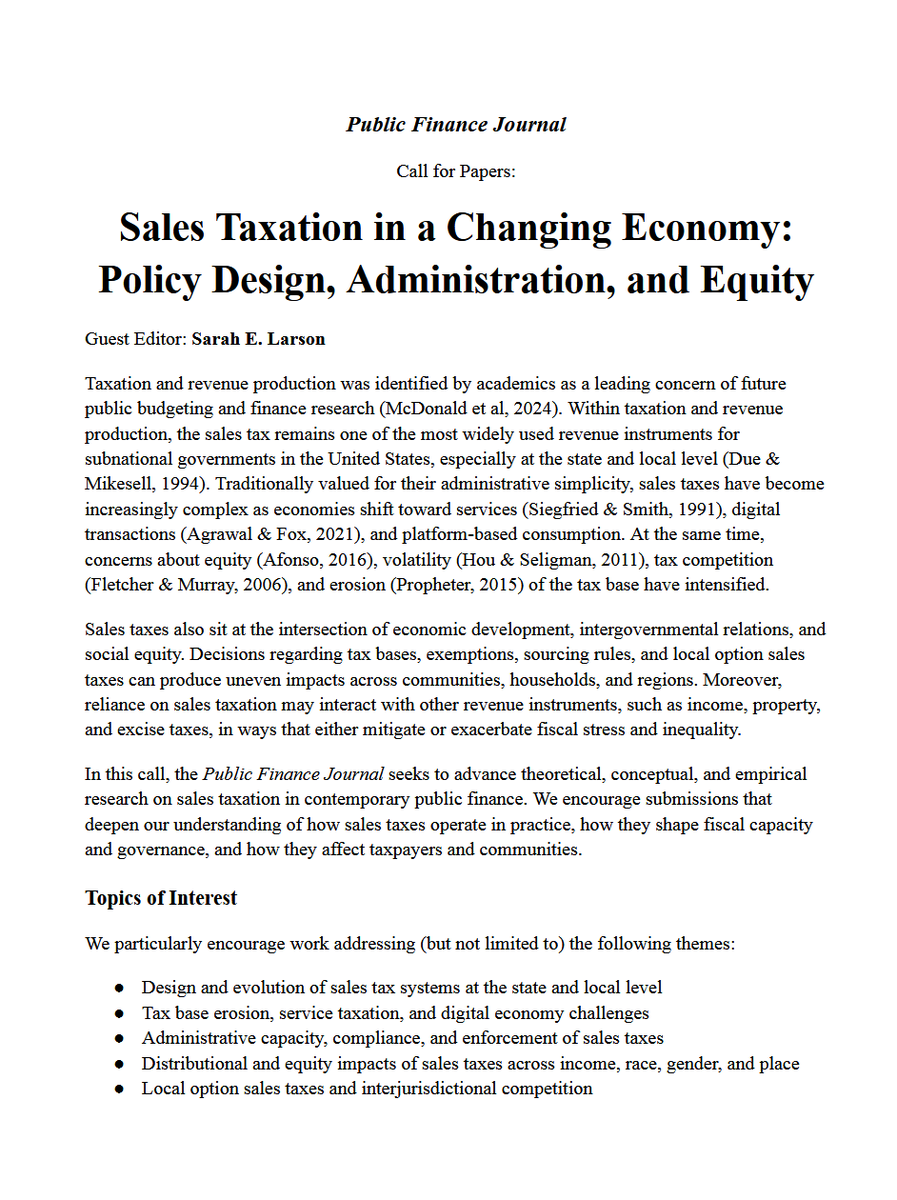
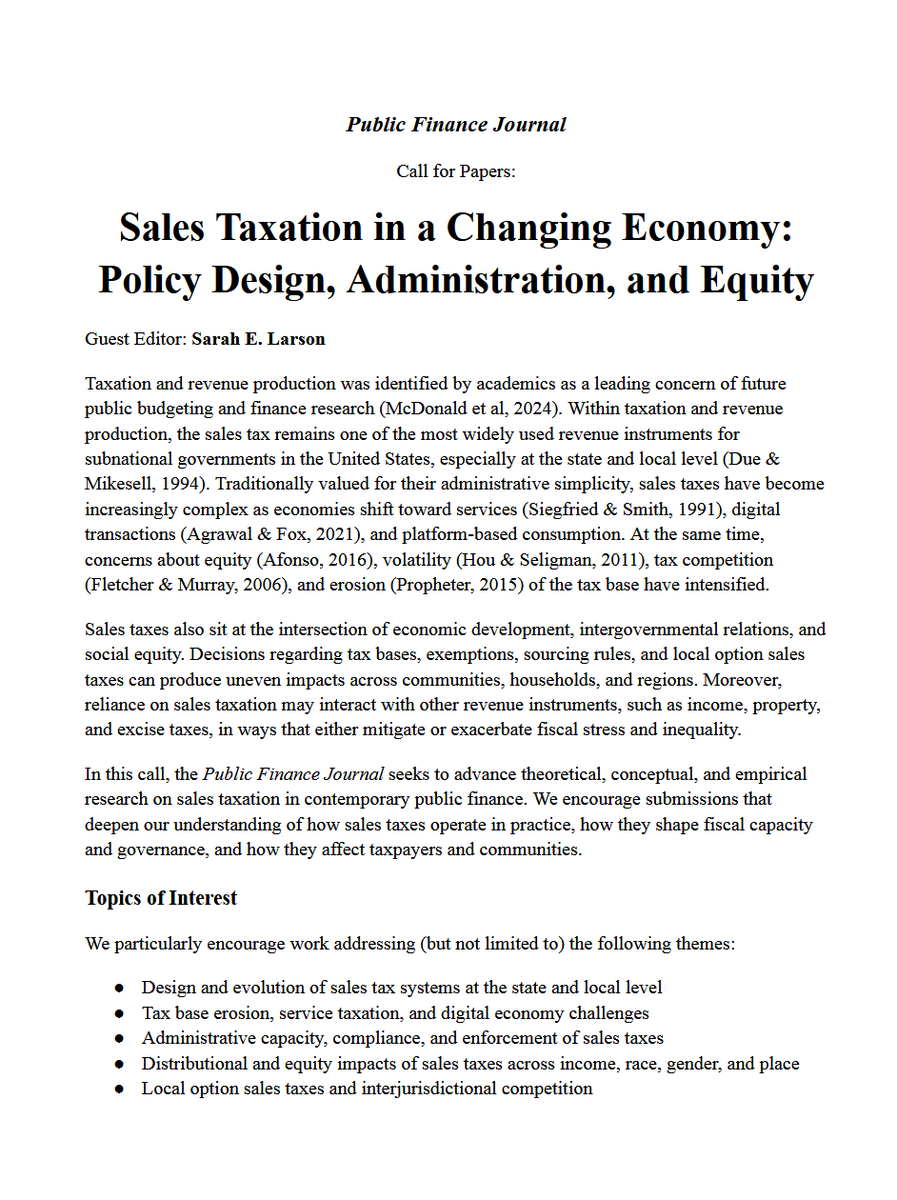
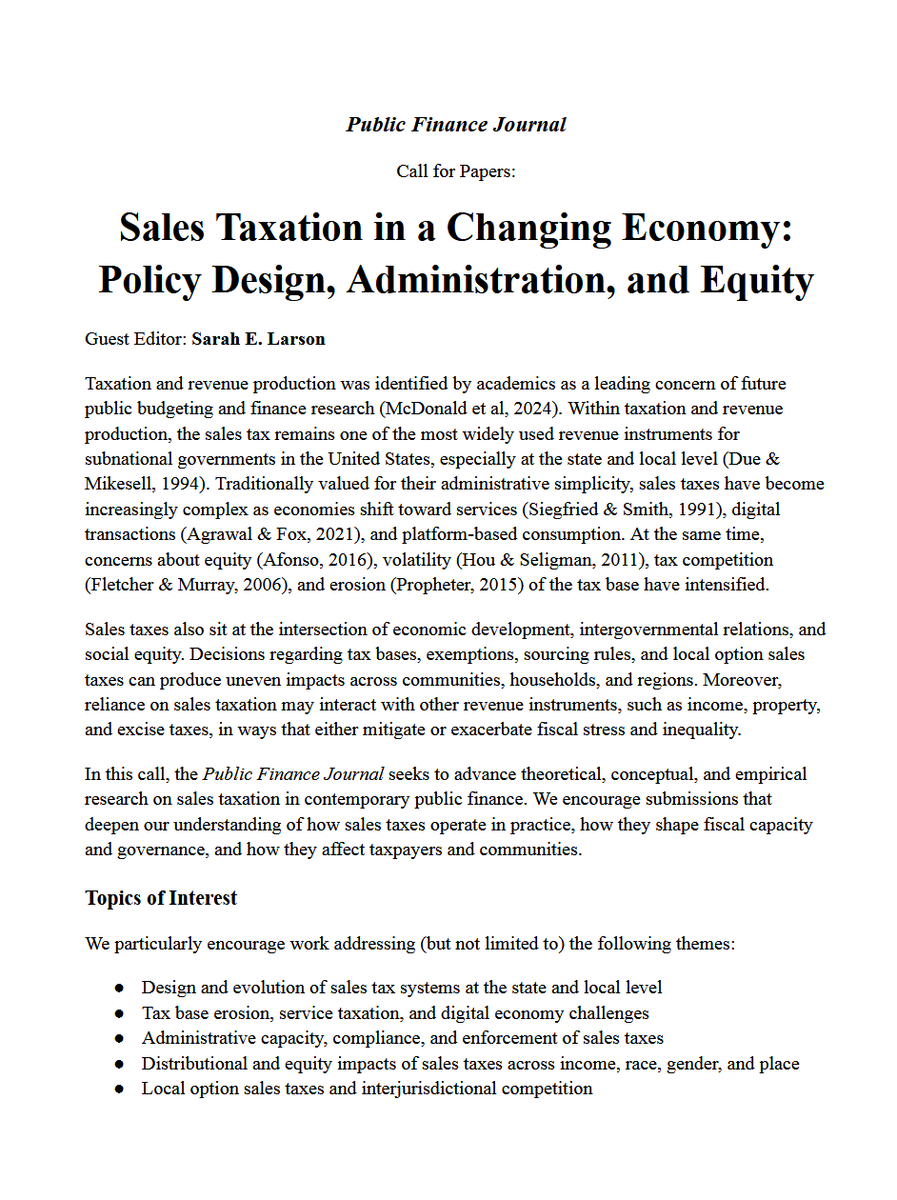
The deadline is coming up quickly (March 31st)! Submit proposals for a symposium on Sales Taxation in a Changing Economy! Research is welcomed that examines how sales taxes operate in modern economies, their governance, and their fiscal impacts. https://t.co/VmDHMASu8T
New year and our first symposium on sales tax policy! Public Finance is accepting proposals through March 31, 2026, for "Sales Taxation in a Changing Economy: Policy Design, Administration, and Equity." Questions? Contact Guest Editor @slizlarson. https://t.co/VmDHMAT1Yr
New year and our first symposium on sales tax policy! Public Finance is accepting proposals through March 31, 2026, for "Sales Taxation in a Changing Economy: Policy Design, Administration, and Equity." Questions? Contact Guest Editor @slizlarson. https://t.co/VmDHMAT1Yr
Why should you send your research to Public Finance Journal for publication? Quick review process! Guaranteed distribution to practitioners! Free open-access publications, so your research is never stuck behind a paywall! Submit today! https://t.co/ZrU5EnjsUJ
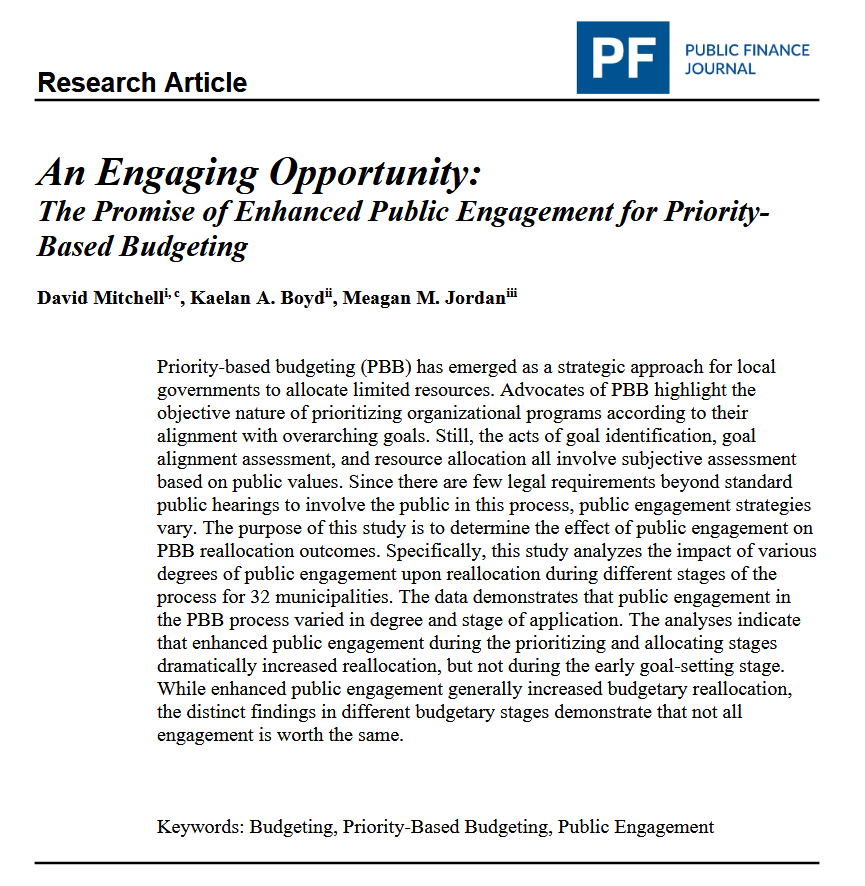
"An Engaging Opportunity: The Promise of Enhanced Public Engagement for Priority-Based Budgeting" found in 2(2) identifies the effects of public engagement on priority based budgeting reallocation outcomes. https://t.co/QPddWvLw85
Fascinating findings in "A Fiscal Comparison of Bond Ratings for Black and White Majority Municipalities" by Hunter Bacot found in 2(2) regarding bond rating discrimination! https://t.co/z6Tu6mtu3N
"A Fiscal Comparison of Bond Ratings for Black and White Majority Municipalities in the United States" by Hunter Bacot shows significant funding inequities, as Black-majority municipalities face bond rating discrimination. https://t.co/z6Tu6mu1Tl
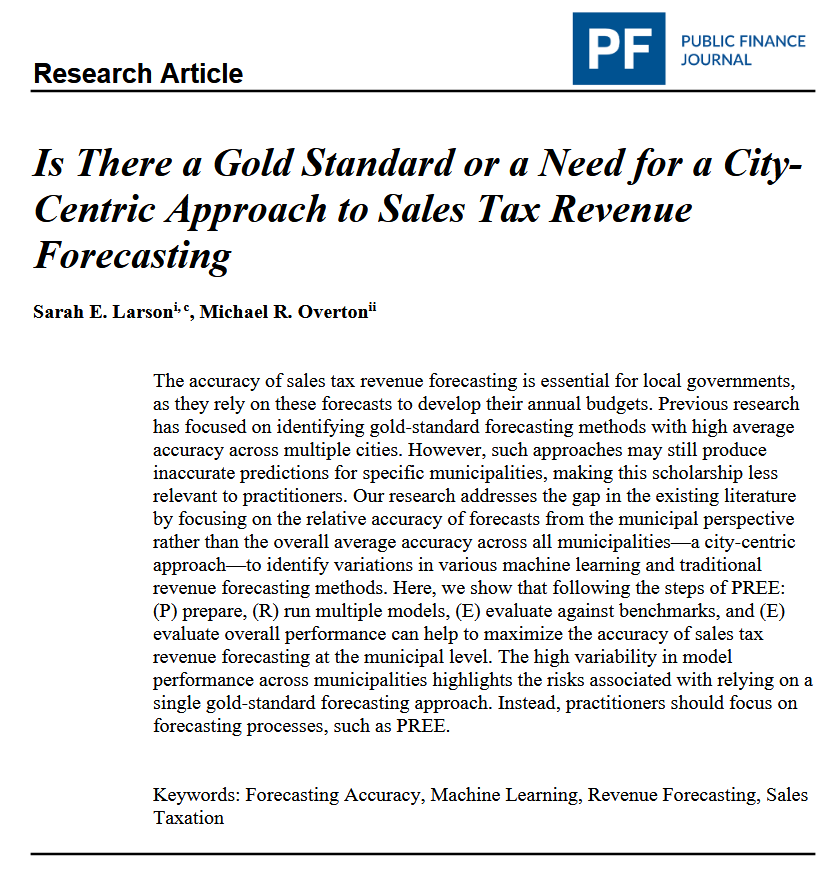
Have you had a chance to read "Is There a Gold Standard or Need for a City-Centric Approach for Sales Tax Revenue Forecasting" by @slizlarson and Michael Overton found in 2(2)? If not, today is a great day to read this open-access research. https://t.co/yHRa4vmqF0
"Is There a Gold Standard or Need for a City-Centric Approach for Sales Tax Revenue Forecasting" by @slizlarson & Michael Overton introduces PREE as a way to maximize the accuracy of sales tax revenue forecasting. https://t.co/yHRa4vlSPs
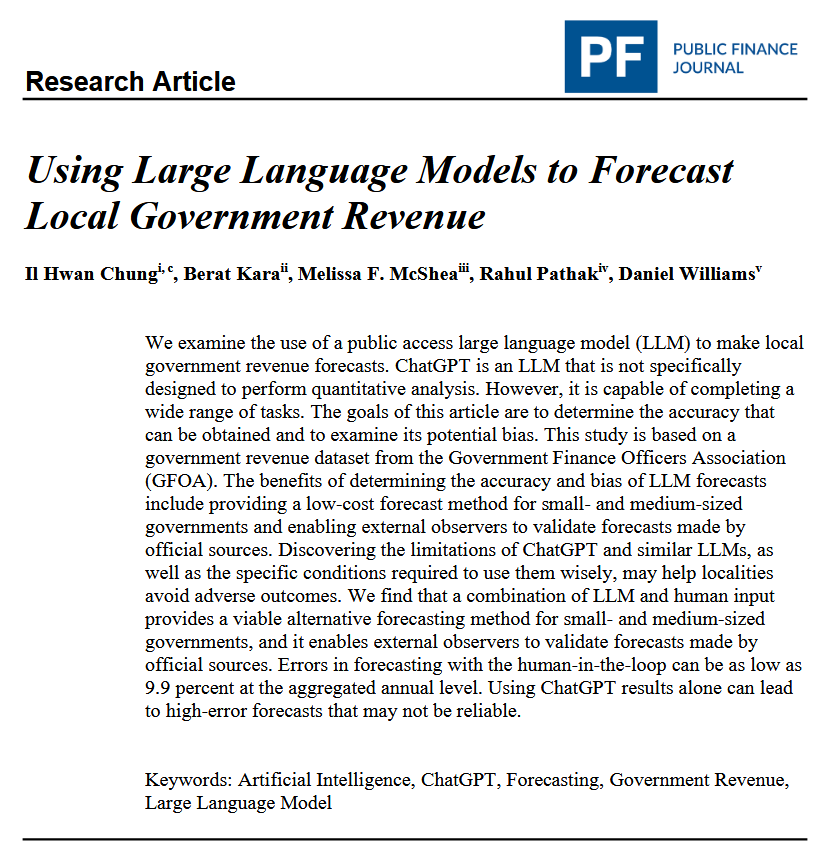
"Using Large Language Models to Forecast Local Government Revenue" by Il Hwan Chung, Berat Kara, Melissa McShea, @pathaksocial, & Daniel Williams explores the use of ChatGPT with human input as a viable alternative forecasting method. https://t.co/1PeJegCs1t
Issue 2(2) of Public Finance Journal is now live on the website! We will highlight the research featured in this issue over the next few days. https://t.co/oOpZ27sUEw