#OA journal for mathematical models, datasets & software solutions in Agriculture, Food, Natural Resources and more.
Published by @Pensoft on @ARPHAplatform.
💙We are moving to *B*l*u*e*s*k*y. To keep up to date with our latest studies, find us there, on Facebook or LinkedIn:
https://t.co/Xoaw6XexjQ
https://t.co/6vXJDWY3cg
https://t.co/PlG5h81UNz
🌾Researchers @AarhusUni have developed a #computermodel of Folsomia candida - a #soil#springtail to better understand how populations respond to real-world conditions across #agricultural landscapes.
👉Research in our #openaccess journal: https://t.co/Ww9JMiDvPo
🎬 Get to know us in a minute & watch the video below.
🌾 Every phase of the modelling process is genuine #scientificwork - so why should only the final paper get a citable record? AEM is a specialist #journal built to change that. ⤵️
#MachineLearning#foodsystems#LLM
🌱Food and Ecological Systems Modelling Journal is now Agricultural and Environmental Modelling (AEM) - a rebranded, expanded #OA journal covering the full lifecycle of #agricultural, #foodsystems, and #environmental modelling. Editorial👇
https://t.co/9rYwhKDlWP
#LLM
🏙🐜 UrbanAnts is a database developed using the Shiny framework aimed at guiding the recording of ant species occurrences in urban environments. Find out more about it here: https://t.co/6zNzULjkmO
@museugoeldi#ecology#biodiversity#conservation
A model aiming to create a realistic representation of Coccinella septempunctata ladybirds moving through landscapes in space and time and to generate emergent population dynamics from the sum of the behaviours of the individual ladybird agents.
https://t.co/CmDp0uKzZN
An important tool for identifying data gaps and research needs, as well for supporting risk assessments of solitary bee species in complex landscapes.
#landscapes#bees#biodiversity@Syngenta
https://t.co/TyGhr3EBbg
We now have more details on the programme of #eLTER2025SC, including the schedules for the sessions, presentations, and interactive workshops.
https://t.co/nKTTDn7Dd4
WP1 of #PollinERA, led by @UNIBO, focuses on #pollinator vulnerability to #pesticides. 🦋
By analysing species traits, it aims to predict exposure and sensitivity, and identify critical risks.
Learn more in the video below 👇
#PollinERAwps
Do you know what #WorkPackages are? 🐝 They’re the backbone of #PollinERA! Join us each week as we dive into their purpose, individual objectives and partners' involvement. 🌍 #PollinERAwps
🆕 In their collection, @pollinERA_eu will share:
☑️Ecotoxicological knowledge gaps datasets
☑️#Pollinator#pesticide risk indicators
☑️ Models for chemicals and pollinator populations
☑️Systems-based approach to pollinator Environmental Risk Assessment.
https://t.co/wRcwPM4xUh
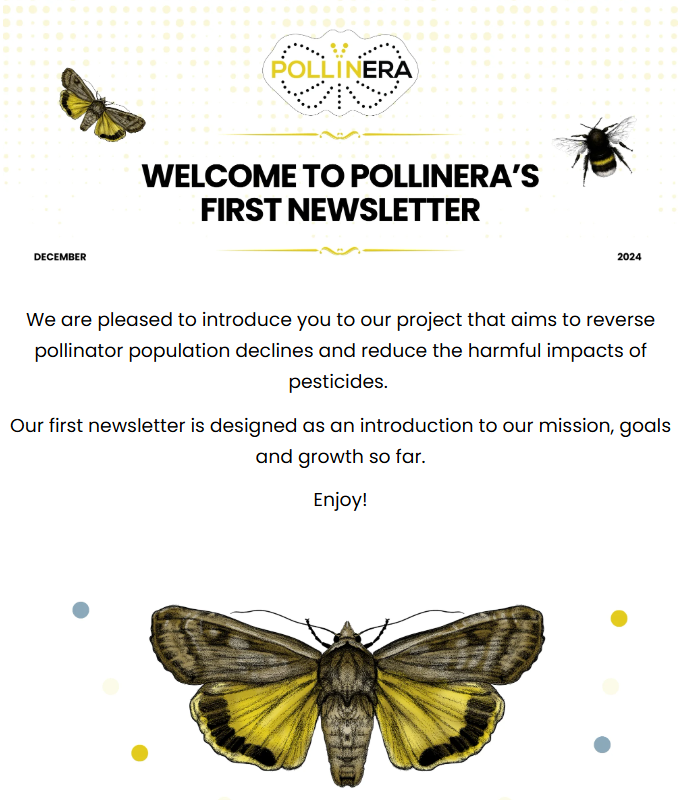
📢The @pollinERA_eu project got a Newsletter!
✏️Subscribe here: https://t.co/Kd0dWzHTqV to stay updated about the consortium's progress to develop new-age #pesticides risk & impact assessment to reverse #pollinator populations declines!
🐝Newsletter #1: https://t.co/gLo5e8rzhH.
A very exciting opportunity to submit your abstracts in modelling - @eLTER_Europe's conference, titled “Towards a whole-system approach for ecosystem science,” is accepting contributions until January 17, 2025.
#CallForAbstracts#modelling#ecosystems
https://t.co/JBrC0lR5mh
🗨️"This foundational #subpopulation#model could be used to model #species with large population sizes within the #ALMaSS framework and can be integrated into other simulation systems."
🔓Find the Methods paper by @xiaodong_duan and @cjtecosaudk:
https://t.co/KMdgDpK7za.