You have to decide what your priorities are and have the courage - pleasantly, smilingly, non-apologetically - to say 'no' to other things. And the way you do that is by having a bigger 'yes' burning inside.
@SemudaraAbayomi Hi @SemudaraAbayomi, my team and I built @JunctaXYZ a DLMM DEX with native integrated lending on @cedranetwork
We are live on testnet and currently building the full lending market. Would love to apply for the grant
Idle capital is a bug.
We fixed it.
Juncta Testnet is live on @cedranetwork. Smarter DLMM. Precision liquidity. Fees that keep ticking.
And soon: out-of-range liquidity that lends instead of waits.
More networks. More yield. More Juncta.
Try it out here → https://t.co/S1P9TgzLFN
🚀 We just shipped a CLI for @JunctaXYZ token prices on @cedranetwork !
Interactive mode: type to search tokens → hit enter for price, contract, decimals & more.
One-shot for scripts/agents: `bun prices.ts jUSDC WEN --json`
Runs on our public dev API.
Project spotlight of the week 👇
This time we’re highlighting @JunctaXYZ, a project building a DLMM and integrated lending protocol on Cedra.
Juncta’s goal is to make DeFi liquidity more capital efficient by putting inactive liquidity to work.
Thread 🧵
Most DeFi liquidity is still sitting idle.
In our latest Cedra Talks, we spoke with @Iam_dsage, CEO & Co-Founder of @JunctaXYZ, about why that happens and how Juncta is trying to solve it.
We covered:
• Idle capital in DeFi
• DLMM + integrated lending
• Building infrastructure on Cedra
• Security and risk management
• Juncta launch, perps, and what’s next
Check out the full recap in the comments below 👇
We’re going live soon with Cedra Talks!
Our founder will be joining @cedranetwork to discuss how Juncta is approaching onchain liquidity, from integrated lending markets to capital-efficient LP strategies.
📅 Today
⏰ 2PM UTC
📍 X Space
Set a reminder and tune in: https://t.co/CzcG0Mzk8U
Do NOT miss this one! 🔥
We’re excited to join Cedra Talks today 🤝
We’ll be diving into how Juncta is rethinking onchain liquidity, from integrated lending markets to capital-efficient LP infrastructure.
See you at 2pm UTC. 🥂
Aptos just committed $50M to become the global trading engine for markets and machines.
We have been building toward this moment.
@Aptos@AptosCollective
Juncta is a unified DLMM + integrated lending market. The two share a single pool of reserves. Idle LP liquidity is automatically made available to borrowers. LPs earn from both swap fees and lending yield simultaneously. One deposit. Two yield sources. No idle capital.
We have been building and testing on Cedra and Aptos alongside Solana from day one. The reason Aptos is a natural home for Juncta comes down to architecture.
Here is what that means technically:
Juncta's unified reserve layer runs DEX liquidity and lending on the same pool of capital. No physical token transfers between a DEX pool and a lending pool. The same reserves serve both functions, with an accounting layer determining which role each unit of capital is playing at any given moment.
This requires formal ownership guarantees. Asset duplication cannot happen. Reserves cannot be double-counted. Capital cannot be lost during state transitions between DEX-active and lending-available designations.
Move's resource model enforces these guarantees at the language level rather than relying purely on runtime checks. For a protocol managing concurrent DEX and lending claims on the same capital pool, that is a meaningful property to have natively.
Aptos is optimizing for institutional-grade execution and autonomous systems transacting at machine speed. Juncta sits exactly at that intersection:
For markets: deeper, more capital-efficient liquidity for every trading pair. LPs who would otherwise pull capital when price moves out of range now earn lending yield on idle bins and stay in the pool. Deeper liquidity. Better pricing. More volume.
For machines: Juncta's keeper network is an agentic workload running continuously, monitoring bin states, submitting rebalancing transactions, and managing liquidation triggers at high frequency. Aptos sub-second finality and low transaction fees make this operationally efficient at scale.
The $50M Aptos commitment spans protocol infrastructure and trading partners. Juncta is both. A protocol primitive and a liquidity venue for every trading application that builds on Aptos.
LiquidSwap and Pancake are the dominant Aptos DEXes. Neither is a DLMM. Aries and Echelon serve lending. Nobody has unified them. That gap is what Juncta fills.
Where liquidity never sleeps. $APT
The next Cedra Talks is coming.
📅 15.05.26
⏰ 2 pm UTC
📍 X Space
We’ll be joined by the founder of @JunctaXYZ to explore how they’re approaching onchain liquidity through integrated lending markets, dynamic fees, and capital-efficient LP infrastructure.
Topics include:
• How Juncta combines lending with liquidity provisioning
• LP strategies and capital efficiency
• What’s coming next for Juncta
Link: https://t.co/LepqI0YhEM
Your liquidity never sleeps.
As a Juncta LP, you're not locked into one yield source. Your position earns trading fees when it's active and lending yield when it's not. The market decides which.
Your capital stays productive either way.
We shipped a Go SDK for @cedranetwork
Full feature parity with the official TS SDK: accounts, BCS serialization, transaction building and signing, faucet, events, ANS, view functions.
GitHub: https://t.co/lJhz49iYrC
Docs: https://t.co/xVg8n9xv4F
Building on Cedra with Go? This is for you.
There's a physicist at Stanford named Safi Bahcall who modeled this exact principle and the math is wild.
He calls it "phase transitions in human networks." When you're stationary, your probability of a lucky event is limited to your existing surface area: the people you already know, the places you already go, the ideas you've already been exposed to. Your opportunity window is fixed.
When you move, your collision rate with new nodes in a network increases nonlinearly. Double your movement (new conversations, new cities, new projects) and your probability of a serendipitous encounter doesn't double. It roughly quadruples. Because each new node connects you to their entire network, not just to them.
Richard Wiseman ran a 10-year study at the University of Hertfordshire tracking self-described "lucky" and "unlucky" people. The single biggest differentiator wasn't IQ, education, or family money. Lucky people scored significantly higher on one trait: openness to experience. They talked to strangers more, varied their routines more, and said yes to invitations at nearly twice the rate.
The "unlucky" group followed the same routes, ate at the same restaurants, and talked to the same 5 people. Their networks were closed loops. No new inputs, no new collisions.
Luck isn't random. Luck is surface area. And surface area is a function of movement.
The lobster emoji is doing more work than most people realize. Lobsters grow by shedding their shell when it gets too tight. The growth requires a period of total vulnerability. No protection, no armor, soft body exposed to the ocean.
That's the cost of movement nobody posts about. You have to be uncomfortable first. The new shell only hardens after you've already moved.
The problem with idle liquidity and why most LP capital sits doing nothing between price ranges.
In DeFi AMMs, 70-90% of LP capital often earns zero fees because it's positioned at prices where no trading happens. This "idle liquidity" kills returns, thins pools, and drives traders to CEXs. Here's the full evolution and how DLMMs solve it.
A Thread!👇
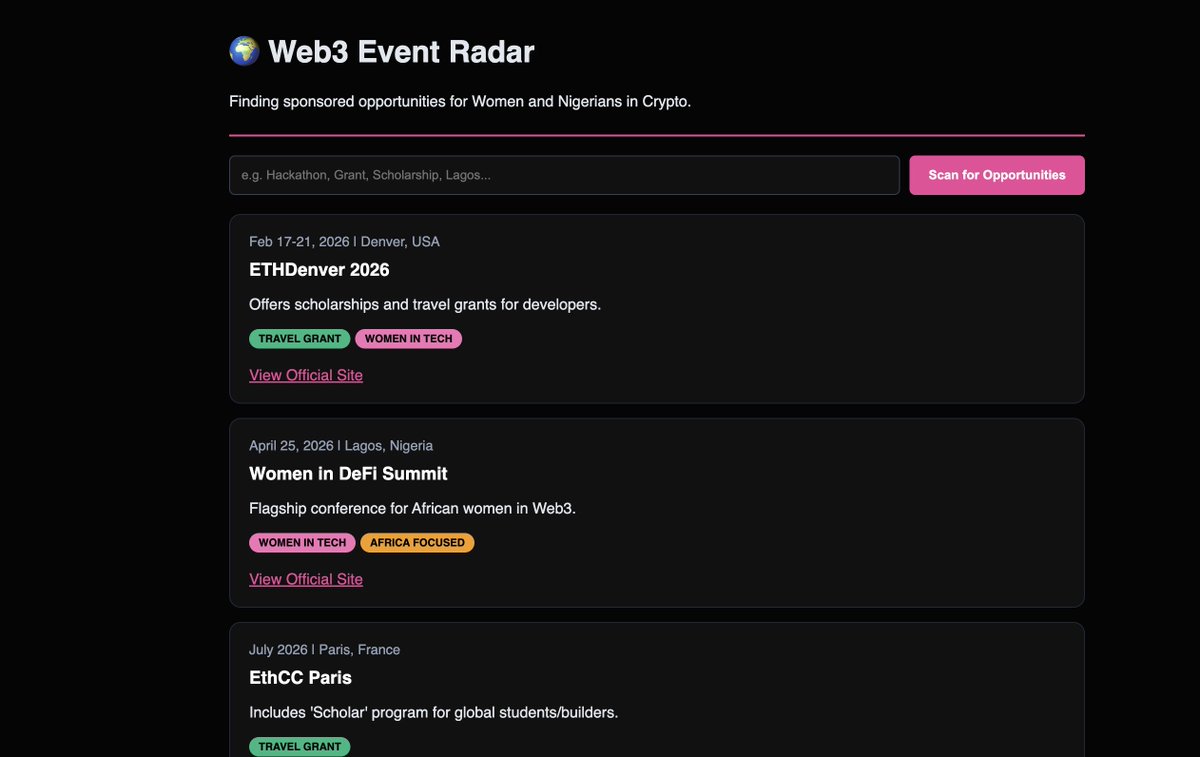
I just built a radar for sponsored events and opportunities in web3
Have been scouting the internet looking for travel grants available to 🇳🇬
They are all scattered across different sites so I decided to build a radar to house them in one place.
once read about Lee Kuan Yew and all it took to trigger him during his visit to Nigeria was three things
> the security surrounding them was like the country was under siege
> he had a one on one conversation with the then minister of finance, he shock 😭😂
> he said he observed we put people into positions based on tribe, alliance or favoritism instead of using a merit based system.
let me break it down ⬇️⬇️⬇️⬇️