I keep being asked. How long can France go on with budget deficits and increasing debt until we get a crisis? The answer: I cannot tell. Not because I am particularly dumb (this is a separate issue). But because there is a potentially large danger zone, where the crisis may or may not happen, depending on the whims of investors. Given our debt and our deficit, we have probably entered the danger zone.
If investors continue to be relatively relaxed, they require only a small risk spread, the interest bill may not be too large, and debt, while high, may be sustainable. But, if for some reason, they worry and require a large spread, the interest bill explodes, debt becomes unsustainable, and this triggers a crisis. To be nerdy about it: both equilibria are rational equilibria. Investors beliefs are confirmed in both cases.
The investors’ whims could literally come out of nowhere: Investors waking up in bad mood. More likely they are triggered by some news, a good poll number for an extremist party, a bad supply shock, the failed passage of a law. The news may be small, but it may lead to a very large adjustment, with a sharp spike in the rate. Or it may not. One cannot tell.
The lesson for budget policy? Avoid bad budget news as much as you can. 😊 Provide good budget news, even small ones, as much as you can. 😊 This is good on its own. And it reduces the risk of a shift to the bad equilibrium, the risk of a costly fiscal and potentially financial crisis.
A great piece in The Economist by Anantha Nageswaran, the chief economic adviser to the Indian government. A must read.
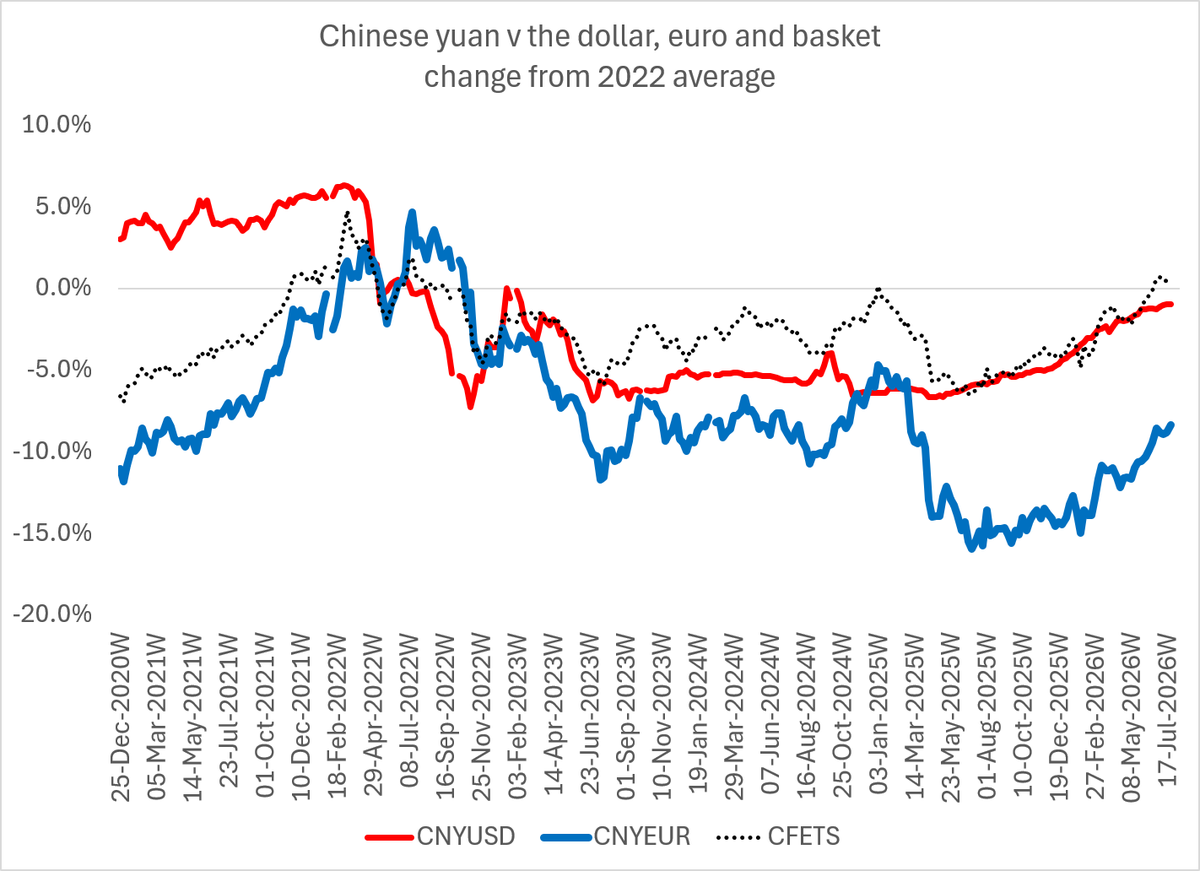
The yuan is more than a symptom of global imbalances
https://t.co/sQVu9Mdgg1
from The Economist
https://t.co/j0jmVYwBLm
If true, extremely significant. No historical precedent, to my knowledge, of a major country selling another country’s currency without prior consultation and coordination. Opens a new and very dangerous era if such action was to be repeated
The analytic case for disregarding the "Don't talk about the yuan" advice of Gopinath, Gourinchas and Rey and instead making currency the focal point of European and ideally G-7 macroeconomic diplomacy is laid out here
3/3
https://t.co/PtaROuAgDD
Yes we should all agree on that. And recognize that China, with all its successes, is not fully a market economy, ( crucially) has a closed capital account, and manages its real exchange rate so as to achieve on the long run industrial and technological superiority.
Can we all agree: China's growth model needs to be fixed & its trade footprint causes large domestic& global distortions; RMB is undervalued, a managed currency & authorities could significantly accelerate pace of appreciation, which would be the correct course & beneficial?
Note that capital controls are, by themselves, a tool of exchange rate management. No need for intervention . Controls directly act on the supply/ demand of foreign vs domestic currency. In 2015,tight capital controls were reinstated to stop the depreciation of the exchange rate
Currency is for China a clear policy choice -- no one seriously thinks the yuan isn't managed (even if the management doesn't appear on the PBOC's balance sheet)
Very important arguments. Amongst them : international dialogue and coordination on exchange rates have a long history and practice. Not so much on domestic policies, especially with the largest economies in the world - for which Brad Setser rightly notes the IMF restraint 1/4
And I at least think the world should lose a bit of patience with Xi and put some real pressure on him ...
and I think Merz, Meloni and Macron now would agree!
27/27
As we show with Sebastien Jean, such controls allow authorities to use the real exchange rate as one instrument of industrial policy- to transfer ressources from the non tradable to the tradable sector and support industrial and technological expansion over the longer run.
4/4